
TL;DR · 30-second read
The Short Version
Chinese telecom equipment maker ZTE is now selling the hidden machinery behind artificial intelligence: the electrical systems and liquid cooling that keep giant computer buildings running.
Its argument is that today’s artificial intelligence computers use so much electricity, and run so hot, that power, cooling and the computers themselves should be designed as one package. One new cooling unit can carry away about as much heat as a thousand household space heaters running flat out.
ZTE says it has built data center projects in more than 20 countries. It has not named buyers for the new equipment.
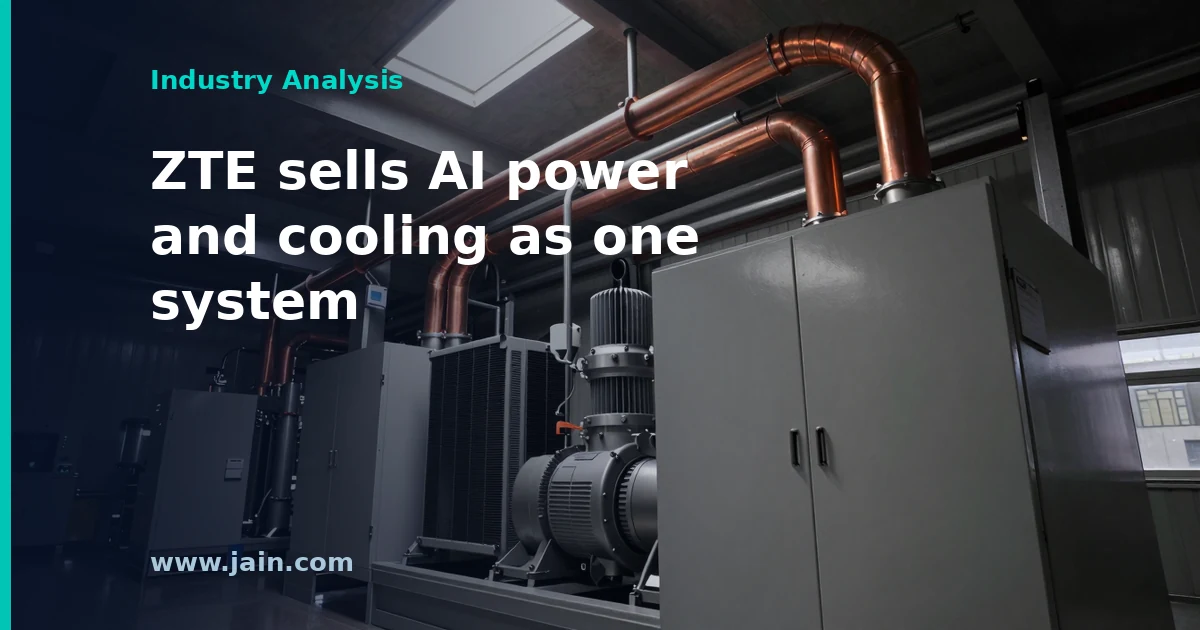
ZTE said in a release distributed by PR Newswire on November 23, 2026 that it is building out an energy-infrastructure line for AI data centers, which it calls AIDC. The two flagship products are an 800-volt high-voltage direct current (HVDC) power system that can also run at the ±400 V standard, and a cold-plate liquid-cooling coolant distribution unit (CDU) rated at 1.5 MW per unit and expandable to 2.4 MW. ZTE says the combination keeps power usage effectiveness (PUE), the ratio of total facility energy to the energy reaching the computers, stably below 1.15.
The company also pointed to two reference sites: the Nanjing Binjiang data center, a retrofit running liquid cooling at up to 60 kW per rack with a PUE of 1.15, and Karakoram-01, which ZTE described as Pakistan’s first and largest purpose-built AI-ready data center campus and which it brought online with partners. ZTE says it has delivered more than 500 data center projects in over 20 countries, totaling more than 400,000 cabinets, over 3,200 MW of installed capacity and 3.5 million square meters of floor space.
Executive Summary
The release reads like a product launch, but its real content is a change in what ZTE is selling. Alongside the 800 V power system and the 1.5 MW cooling unit, ZTE describes battery storage cabinets (125 kW / 261 kWh), a 5 MWh containerized storage product, solar-plus-storage microgrids, energy- and facility-management software, and SuperPod AI servers developed with partners. It says all of this should be planned together from the first day of a project rather than procured piece by piece.
That matters because data center power, cooling and IT equipment have traditionally been specified and bought separately, often from different vendors and contractors. ZTE is arguing that at AI rack densities those boundaries become a liability, and it says plainly that its goal is to turn its strength in energy equipment into a competitive advantage in AI compute.
The specifications are concrete; the commercial evidence is thinner. ZTE names no customers for the 800 V system, gives no efficiency figure for its power conversion, and its best documented reference site runs at 60 kW per rack, well below the 600 kW to 1 MW racks the release uses to frame the problem.
Energy Equipment Moves Into the Compute Sale
The central claim of this release is not any single spec sheet; it is ZTE’s statement that compute planning, power transmission and distribution, and heat removal should be designed as one system from the start of a project. ZTE backs that with a product list that spans almost the full stack: SuperPod servers on the IT side, 800 V HVDC distribution and busbars on the electrical side, 1.5 MW liquid-cooling CDUs on the thermal side, battery and solar storage on the supply side, and three layers of management software (BESS, iDCIM and iEMS) tying them together. The release ends by saying ZTE intends to convert its advantages in energy into a competitive advantage in AI compute. That is the vendor itself describing energy infrastructure as part of what it sells when it sells compute capacity.
The mechanism ZTE offers is density. Its argument is that when racks climbed from 10 to 20 kW toward 100 kW and beyond, a weakness in any one link (a conversion stage that wastes power, a cooling loop that cannot keep up) starts to cap the output of the whole hall. If that holds, the buyer’s question shifts from which server to buy toward how much useful compute a given grid connection can deliver, which ZTE frames as turning each kilowatt-hour into tokens, the units of text an AI model processes.
For operators, a single vendor across power, cooling and IT can shorten design coordination and reduce finger-pointing when something fails. It also concentrates dependency. ZTE addresses this partly by stressing dual-standard voltage support and what it calls open decoupling, but it does not explain how its management software interoperates with third-party servers or cooling equipment, which is the practical test of whether an integrated offer is also an open one.
Why 800 Volts, and What Remains Unquantified
The case for higher-voltage direct current is grounded in basic electrical engineering. For the same power, doubling the voltage halves the current, and resistive losses in cables fall with the square of the current. Fewer conversions between alternating and direct current also mean fewer places to lose energy as heat. ZTE describes conventional multi-stage conversion chains, from transformer to server, as a source of significant annual operating cost, and 800 V DC has become a widely discussed direction for next-generation AI racks.
ZTE’s telecom roots are relevant here. Telecom networks have long run on DC power plants with battery backup, so DC distribution and battery management are familiar territory for a telecom equipment maker. The ability to switch between ±400 V and 800 V suggests ZTE is hedging between two emerging conventions rather than betting on one, which lowers risk for a customer unsure which standard its future racks will need.
What the release does not give is the number that would let a buyer compare systems: end-to-end conversion efficiency, or loss reduction against a conventional AC chain. The PUE figure of below 1.15 is attributed to the power and cooling combination, but PUE blends many factors, including climate, load level and supply-air temperature, and it does not isolate the contribution of the 800 V design.
The Cooling Math: A 1.5 MW Unit Against a 60 kW Reference
A CDU is the heat exchanger and pump station that circulates coolant to cold plates sitting directly on chips, then hands that heat to the building’s water loop. ZTE’s unit is rated at 1.5 MW, expandable to 2.4 MW, configurable as two to five cabinets, with temperature held within ±0.5 °C and pressure within ±0.05 bar, plus N+X redundancy and dual power feeds. As simple arithmetic, a single 1.5 MW unit would serve roughly fifteen racks at 100 kW each, before any redundancy margin.
ZTE puts the practical limit of air cooling at around 20 to 30 kW per rack, which is why it describes liquid cooling as moving from option to mainstream. The Nanjing Binjiang site supports that direction: liquid cooling at up to 60 kW per rack, HVDC distribution, 32 °C supply air and a PUE of 1.15. But 60 kW is the highest density ZTE documents in operation. The 600 kW and 1 MW rack figures that open the release describe where demanding AI workloads may go, not what ZTE says it has deployed.
Where This Offer Is Likely to Land
ZTE’s overseas delivery list (Indonesia, Uzbekistan, Mexico, Italy, Pakistan, Algeria and Chile) points to markets where a buyer may value one accountable supplier for a full AI-ready facility, especially where local engineering depth or grid reliability is limited. Karakoram-01 in Pakistan, built with cold-plate cooling, prefabricated power modules and smart busbars, fits that profile, and the inclusion of storage and solar microgrids speaks to sites where grid supply is constrained or unreliable.
The scale claims, more than 3,200 MW installed across 500-plus projects, establish ZTE as a substantial data center builder. They do not show how much of that is liquid-cooled, high-density AI capacity versus conventional facilities, which is the number that would show whether the integrated AIDC offer is already winning business or still being introduced.
Background
ZTE is a Shenzhen-based telecommunications equipment maker best known for mobile network infrastructure, transmission gear and devices. Like other telecom vendors, it has long supplied the DC power plants and battery systems that keep network sites running, and over the past decade it has expanded into building complete data centers, which it says now total more than 500 projects in over 20 countries.
AI has changed the engineering of those buildings. Conventional racks drew 10 to 20 kW; GPU clusters for training and running AI models routinely exceed 100 kW per rack. That pushes operators toward liquid cooling and toward power architectures with fewer conversion stages, such as high-voltage DC, and it puts electricity supply and efficiency, rather than chips alone, at the center of how much AI capacity a site can deliver. Source: ZTE treibt hocheffiziente KI-Rechenzentren mit robuster Energieinfrastruktur voran — ZTE’s November 23, 2026 release on its 800V HVDC power system, 1.5 MW liquid-cooling CDU and integrated AI data center energy offering.Sources