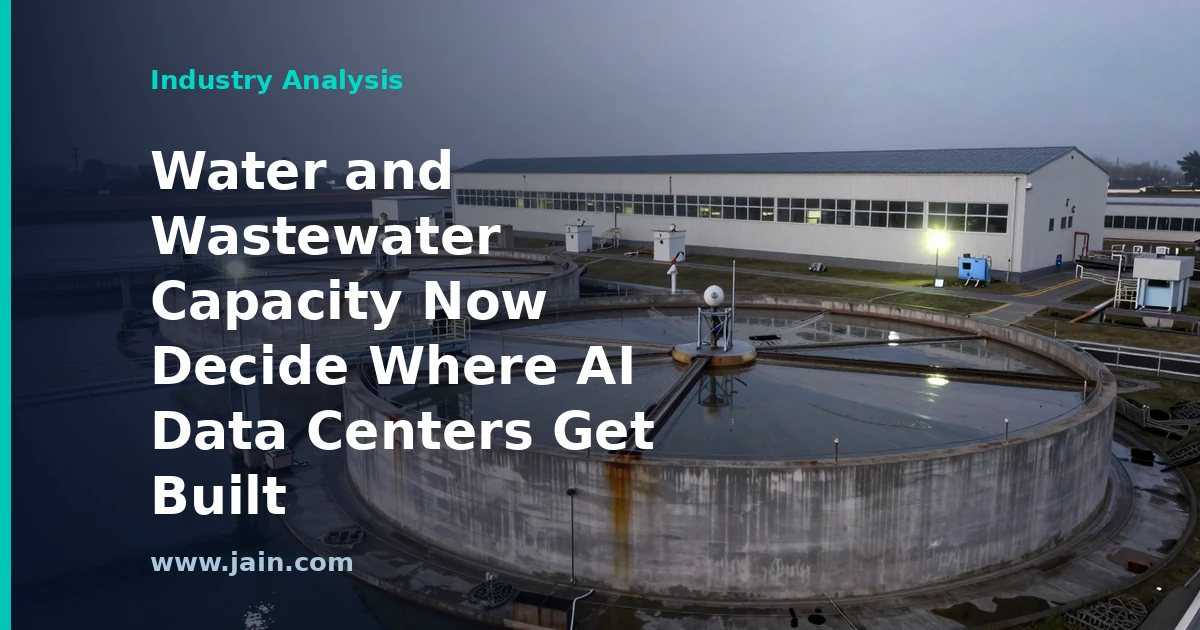
Data Center Knowledge reported on May 30, 2026 that water and wastewater capacity have joined — and in some markets now rival — electrical power as the decisive factors in where AI data centers can be built. The report’s framing marks a shift in an industry that has spent the past several years describing its siting problem almost entirely in megawatts.
Executive Summary
The report argues that the availability of water for cooling, and just as importantly the capacity of municipal systems to accept the water a facility discharges, now determine whether an AI data center project is viable at a given site. That is a meaningful reframing: since the AI buildout accelerated, the industry conversation has centered on grid interconnection queues and power procurement, with water treated as a secondary sustainability metric rather than a gating constraint.
Why it matters: if water and wastewater capacity are genuine go/no-go criteria, the map of viable AI data center locations changes. Sites with abundant power but strained water or sewer systems lose ground, while regions with underused water and treatment infrastructure gain a new selling point. It also pulls a different set of actors — water utilities, sewer authorities, and municipal planners — into negotiations that were previously dominated by electric utilities.
From Megawatts to Gallons: A New Siting Calculus
For most of the AI infrastructure boom, the binding constraint has been electricity: how many megawatts a utility can deliver, and how fast. Water has been discussed mostly in sustainability reports. The shift Data Center Knowledge describes — water as a siting decision, not a disclosure line item — reflects how AI-scale facilities actually work. High-density computing throws off enormous heat, and many cooling designs, particularly evaporative systems, consume large volumes of water to reject that heat to the atmosphere. A campus that can secure power but not water is still an unbuildable campus.
Wastewater is the less obvious half of the equation, and arguably the more interesting one. Water that runs through cooling systems and is not evaporated must go somewhere, often into municipal sewer systems as industrial discharge. Treatment plants are sized for the communities they serve; a single large industrial user can consume capacity a municipality planned to allocate over decades of residential growth. Discharge from cooling systems can also be warmer and more mineral-concentrated than household wastewater, which treatment plants must be equipped to handle. A town can have a river next door and still lack the permits, pipes, and treatment headroom to host an AI campus.
Winners, Losers, and the New Bargaining Table
If this framing holds, the winners are jurisdictions that can offer both power and water headroom — including regions with cooler climates that reduce cooling demand, or with industrial water infrastructure left over from manufacturing that has since departed. Water utilities and engineering firms that design treatment and reuse systems gain leverage and business. The relative losers are water-stressed markets that have competed for data centers on power and tax incentives alone, and developers holding land banks in places where the sewer authority, not the electric utility, turns out to be the limiting party.
For operators, the economics push toward designs that trade water for electricity or capital: closed-loop liquid cooling, dry coolers, and water recycling all reduce consumption but raise power draw or upfront cost. That trade-off means water scarcity does not just move projects — it changes their engineering and their operating cost profile. Expect water-use effectiveness (WUE), the industry’s ratio of water consumed per unit of computing energy, to get the same contractual and public scrutiny that power-use effectiveness (PUE) received a decade ago.
What the Framing Does and Does Not Establish
A note of even-handedness: the source available to us is a report headline and premise, not a dataset. The claim that water now “decides” siting is directionally consistent with well-documented industry trends — public disputes over data center water use in drought-affected regions, and the growth of water-positive pledges from major cloud providers — but the strength of the claim varies by market. In cool, wet regions with modern treatment plants, water may barely register as a constraint; in arid, fast-growing metros it can be decisive. Readers should treat “water decides siting” as an increasingly common condition, not a universal law, and ask for market-specific evidence — permit denials, moratoria, or utility capacity studies — before generalizing.
Background
Since the generative AI boom began in late 2022, data center development has grown at a pace that strained electric grids, making interconnection queues and power procurement the industry’s defining bottleneck. Water surfaced periodically as a flashpoint — community disputes over data center water consumption in drought-affected regions drew attention, and major cloud providers responded with public water-stewardship and replenishment pledges — but it was generally treated as a reputational issue rather than a siting gate.
Data Center Knowledge, the trade publication behind the report, has covered the industry’s infrastructure constraints throughout the buildout. Its framing of water and wastewater as decisive siting factors reflects the arrival of AI-scale campuses whose cooling demands, and whose discharge volumes, exceed what many municipal systems were designed to accommodate.