
TL;DR · 30-second read
The Short Version
The newest AI computers run so hot that many are cooled with liquid piped right to the chips, a bit like a car’s radiator. That liquid has to stay clean, free of air bubbles and chemically balanced. If it doesn’t, the cooling quietly gets worse and parts wear out.
Vertiv, a big maker of power and cooling equipment for data centers, is buying King Environmental Services, an Irish company that specializes in exactly that upkeep. It is Vertiv’s second such purchase in under a year. Looking after the coolant is becoming an ongoing job, not a one-time setup.
Vertiv Holdings (NYSE: VRT), which makes power and cooling equipment for data centers, has agreed to acquire King Environmental Services Ltd. (KES). KES is headquartered near Dublin, Ireland, and provides fluid management, commissioning and load-testing services for high-density, liquid-cooled data centers across Europe, the Middle East and Africa (EMEA). Zawya carried the announcement on October 5, 2026.
Financial terms were not disclosed, and Vertiv said they are not expected to be material to its results. The deal is expected to close in the fourth quarter of 2026. It follows Vertiv’s December 2025 acquisition of PurgeRite, which the company describes as the foundation of its fluid management business in North America.
Executive Summary
Vertiv is buying a specialist field-services firm rather than a product line. KES flushes, filters, treats and validates the liquid that circulates through cooling systems. It also runs thermal load tests on liquid cooling infrastructure and electrical load tests on critical power systems before a facility goes live. Vertiv says the deal extends its “thermal management services capabilities” into EMEA and supports its strategy of serving customers “across the thermal chain.”
The significance is in the pattern and the scope. This is the second fluid-management acquisition Vertiv has named in roughly ten months, after PurgeRite in North America. The scope Vertiv describes runs well past installation day, covering “monitoring, maintenance and lifecycle optimization.” That is a statement about where Vertiv expects work and revenue to sit in liquid-cooled AI data centers: in the ongoing care of the coolant loop, not only in the hardware that carries it.
The Coolant Has Become Equipment That Needs Servicing
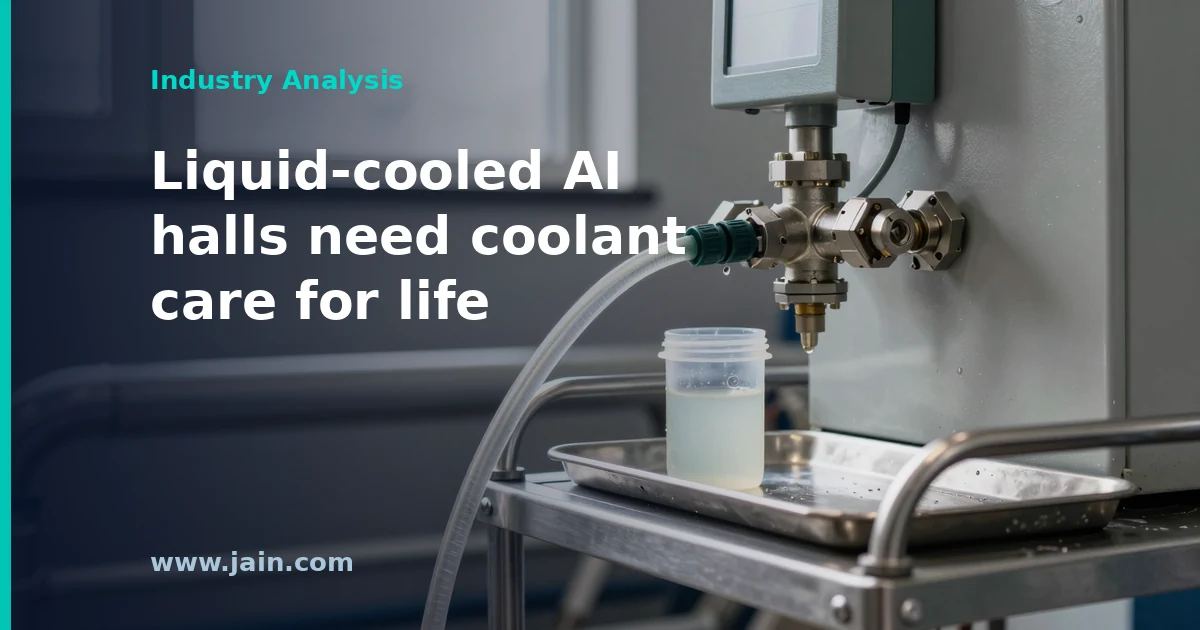
Air-cooled data centers move heat with fans and air handlers. Liquid-cooled AI halls instead pump a water-based coolant through cold plates mounted on the chips, then through coolant distribution units (pumps and heat exchangers) that pass the heat to the building’s water system. Vertiv’s announcement lists what goes wrong in that loop: contamination, trapped air, corrosion, improper chemistry and flow imbalances. Each reduces heat-transfer efficiency, degrades equipment and creates risk both at startup and in operation. The fluid’s condition changes over time, which makes it a component to be maintained, not plumbing to be installed and forgotten.
That mechanism explains why Vertiv describes KES’s scope in lifecycle terms: “system preparation, performance validation, monitoring, maintenance and lifecycle optimization.” It also says outright that “beyond initial commissioning, customers need lifecycle fluid management services.” CEO Gio Albertazzi framed it this way: “the performance of cooling and power infrastructure will depend as much on execution in the field as on engineering and system design.” Every liquid-cooled rack adds piping and fluid volume. That fluid must be flushed and validated before go-live, then sampled, treated and balanced for as long as the facility runs. Work of that kind recurs; it does not end at handover.
The people affected are the operators of AI data centers, whose uptime depends on fluid quality, and the tenants leasing that capacity. Also affected are the mechanical contractors and independent specialists who have historically done flushing and commissioning as project work. One caveat applies: Vertiv has not disclosed how much of this business is recurring maintenance versus one-time commissioning. The recurring-service thesis is clearly stated in the company’s strategy, but not yet shown in numbers.
Two Deals, Two Regions, One Template
PurgeRite gave Vertiv a fluid management base in North America; KES is meant to do the same for EMEA. Two acquisitions by one company do not make an industry trend. They do show a deliberate geographic build-out of the same capability, by a supplier whose equipment already sits inside the cooling loops these teams service. KES’s Dublin-area base puts it in one of Europe’s established data center markets.
KES also brings load testing. Thermal load testing uses heat-generating equipment to simulate a full room of running servers, so operators can confirm the cooling performs before costly AI hardware arrives. Electrical load testing does the equivalent for backup and critical power systems. Finding a flow imbalance or a power fault before the servers are installed is far cheaper than finding it afterward. Vertiv’s pitch is that one “single accountable partner” can handle commissioning, testing, fluid management and ongoing operations, plus compliance with regional rules on fluid handling, treatment and disposal.
A Small Price, a Clear Signal and a Neutrality Question
Vertiv says the terms are not material to its financial results. That suggests KES is small next to Vertiv’s business, and that this is a purchase of capability and footprint rather than revenue. Experienced field teams, local regulatory know-how and a safety record take years to build, and buying them is the faster route into a region. Vertiv’s own risk disclosures name the obvious exposure: keeping KES’s management and key employees, and maintaining its customer and supplier relationships, after the deal closes.
There is a fair question for buyers too. Commissioning is often valued as an independent check on what a vendor delivered. When the company supplying cooling equipment also validates and maintains it, customers may reasonably ask how independence is preserved. Vertiv’s single-partner model offers clear accountability. Whether customers weigh that above independent verification is something the market, not the announcement, will settle.
Background
Vertiv, headquartered in Westerville, Ohio, and listed on the New York Stock Exchange, supplies power, cooling and IT infrastructure, along with software, analytics and services, to data centers, communication networks and commercial and industrial facilities. It does business in more than 130 countries.
The shift behind this deal is the rise of liquid cooling. As AI and high-performance computing workloads push more heat into each rack, air alone struggles to remove it, and operators increasingly pipe coolant directly to the hardware. That makes the condition of the fluid, along with the testing and upkeep of the systems that carry it, a factor in uptime. Field services such as commissioning and fluid maintenance are becoming a larger part of how cooling suppliers compete. Source: Vertiv announces agreement to acquire King Environmental Services Ltd., expanding global fluid management services: Zawya’s publication of Vertiv’s October 5, 2026 announcement of its agreement to acquire Ireland-based KES.Sources