
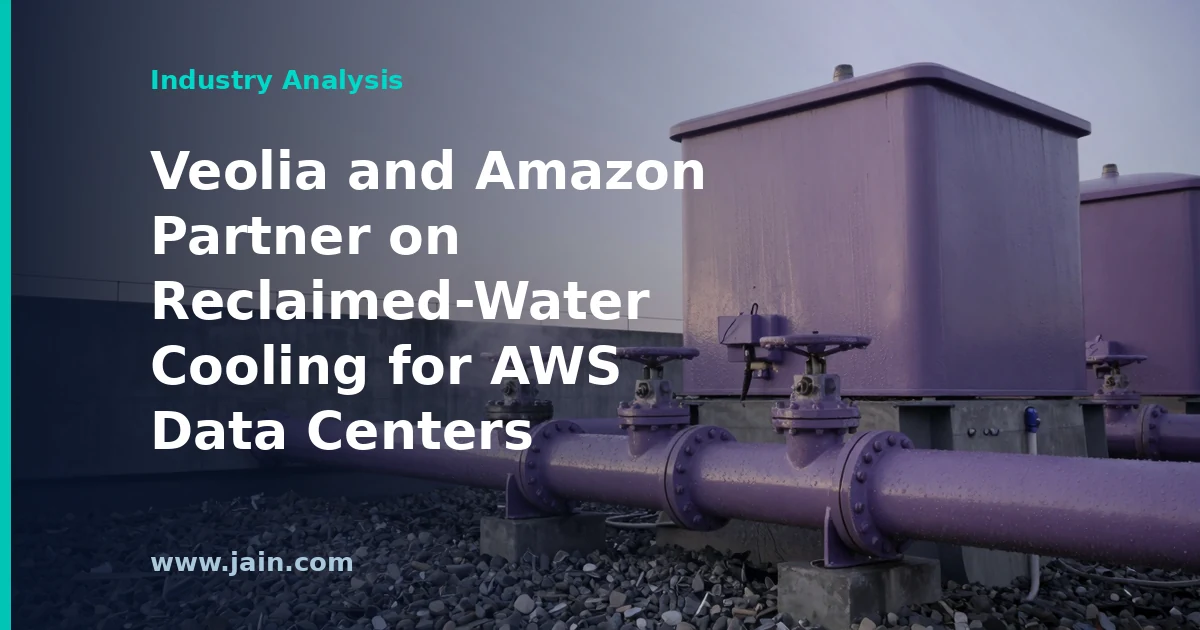
Veolia, one of the world’s largest water and environmental services companies, announced on April 27, 2026 that it is working with Amazon to develop a reclaimed-water cooling system for data centers. The collaboration targets Amazon Web Services (AWS) facilities, aiming to substitute treated, recycled water for the potable water that many data centers currently draw for cooling.
Executive Summary
The announcement pairs the operator of some of the world’s largest water-treatment networks with the world’s largest cloud provider on one of the industry’s most scrutinized problems: how much drinking-quality water data centers consume to stay cool. Reclaimed water — wastewater that has been treated to a standard fit for industrial reuse, though not for drinking — can displace that potable draw, easing pressure on municipal supplies in the communities where hyperscale campuses cluster.
For Amazon, the partnership supports its publicly stated goal of becoming “water positive” by 2030 — returning more water to communities than its operations consume — and, just as practically, it addresses a growing source of friction in siting and permitting new capacity. For Veolia, it signals a move to position water expertise as core infrastructure for the AI-era data center buildout. The release, however, is light on specifics: no named sites, volumes, timelines, or financial terms were disclosed.
Why Water Is the Data Center Industry’s Quiet Constraint
Power gets most of the headlines, but water is increasingly the constraint that shapes where data centers can be built. Many large facilities use evaporative cooling, which chills servers efficiently by evaporating water — often millions of gallons per year per site, much of it drawn from the same municipal systems that supply homes. In drought-prone regions, that draw has become a genuine permitting and community-relations issue, with local opposition to new campuses increasingly citing water alongside electricity and land.
The industry measures this through water usage effectiveness (WUE) — water consumed per unit of computing energy delivered — and operators face growing pressure from regulators, investors, and neighbors to disclose and reduce it. A credible, scalable alternative to potable water is therefore worth real money: it can be the difference between a project that clears local approval and one that stalls.
What Reclaimed Water Solves — and What It Doesn’t
Reclaimed water is municipal or industrial wastewater treated to a quality suitable for non-potable uses such as irrigation and industrial cooling. Using it for data center cooling substitutes a resource that would otherwise be discharged for one that communities drink. That is a genuine improvement, and it is proven ground: power plants and heavy industry have run on recycled water for decades. The engineering challenge is real but tractable — reclaimed water’s chemistry can promote scaling, corrosion, and biological growth in cooling loops, which is precisely the treatment problem a company like Veolia exists to solve, along with the pipeline infrastructure needed to move recycled water from treatment plants to campuses.
What reclaimed water does not do is reduce total water consumption. Evaporative cooling still evaporates the water, whatever its source. It changes which water is used, not how much — a meaningful distinction in water-stressed basins, where hydrologists note that treated wastewater returned to rivers also supports downstream flows. The release, as summarized, does not address consumption volumes or how the system compares with closed-loop and other low-water designs.
The Strategic Logic for Both Sides
For Veolia, hyperscale data centers represent a growth market adjacent to its core business: the company already operates treatment plants and industrial-water services worldwide, and packaging that capability for cloud providers moves it up the value chain from utility contractor to strategic infrastructure partner in the AI buildout. A named relationship with Amazon is also a powerful reference for selling similar systems to other operators.
For Amazon, the calculus spans sustainability accounting and siting pragmatism. Progress toward its water-positive pledge requires exactly this kind of substitution at scale, and demonstrating a reclaimed-water pathway gives AWS a stronger story in front of the councils and water authorities that approve new capacity. If the partnership produces a repeatable template rather than a single showcase, it could modestly widen the map of viable data center locations — and put competitive pressure on other hyperscalers, some of which have taken the different route of designs that eliminate evaporative water use entirely.
Background
Data center water use moved from an engineering footnote to a public issue over the past several years, as hyperscale construction accelerated to serve cloud and AI demand and communities in water-stressed regions began scrutinizing how much potable water evaporative cooling consumes. The major cloud providers have responded with public commitments — Amazon’s is a pledge to be water positive by 2030 — and with a mix of recycled-water sourcing, more efficient cooling designs, and replenishment projects.
Veolia, formed from more than a century of French municipal water operations and now one of the world’s largest environmental-services groups, has built its industrial business on exactly this kind of problem: treating and delivering non-potable water for cooling and process use. The April 2026 announcement extends that franchise into hyperscale computing, an infrastructure market whose growth currently outpaces most of the industrial sectors Veolia has traditionally served.
Source: Veolia Works With Amazon to Develop Reclaimed Water for Cooling System for Data Centers — Veolia press release, April 27, 2026, announcing a collaboration with Amazon on reclaimed-water cooling for AWS data centers.