
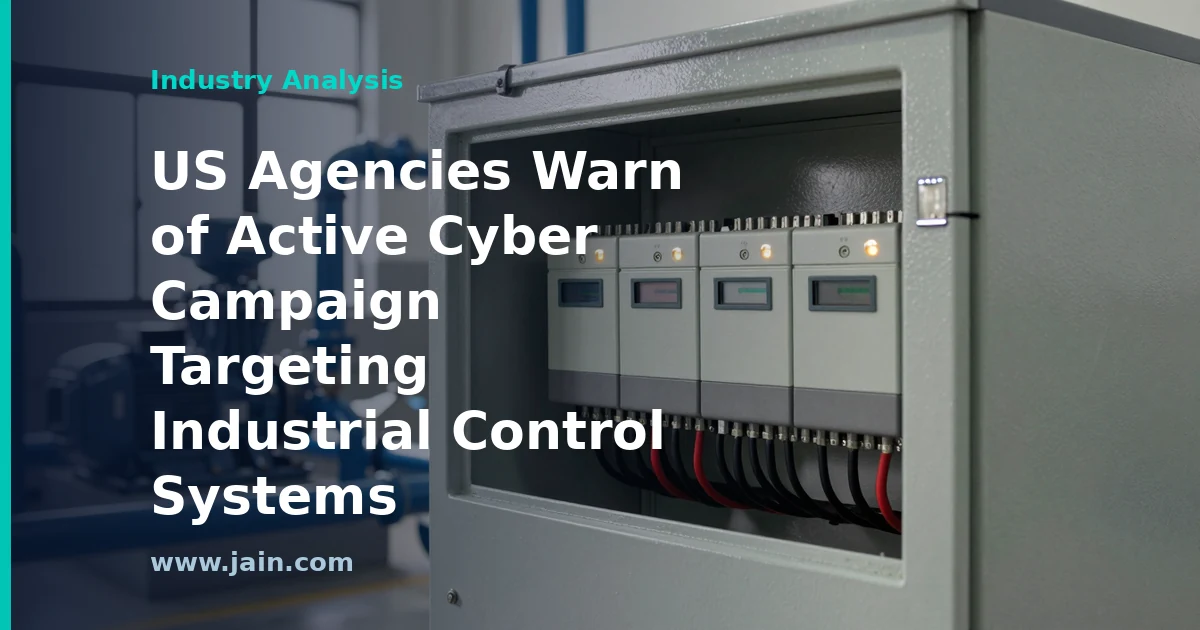
US government agencies have issued a warning about an active cyber threat targeting critical infrastructure, as reported by Fox Business on April 29, 2026. The alert concerns the control-system layer of infrastructure — including programmable logic controllers (PLCs), the small ruggedized computers that directly operate pumps, valves, breakers, and machinery in sectors such as power, water, and manufacturing.
Details in the initial report are limited: the public reporting confirms an active campaign and a federal warning, but the underlying advisory’s specifics — which sectors, which vulnerabilities, and which actor — are not spelled out in the source item.
Executive Summary
The core of the announcement is straightforward: federal cybersecurity authorities believe an active campaign is underway against the systems that physically run American critical infrastructure, and they consider it serious enough to warn operators publicly. Warnings of this kind are typically issued by the Cybersecurity and Infrastructure Security Agency (CISA), often jointly with the FBI and NSA, and are directed at the operational technology (OT) side of the house — the industrial networks that sit behind, and are supposed to be separated from, ordinary corporate IT.
Why it matters: PLCs and related industrial controllers were largely designed decades ago for reliability, not security. Many run without authentication, cannot be easily patched, and were never meant to touch the internet — yet thousands are reachable online. When an attacker moves from stealing data to manipulating a controller, the consequences shift from financial loss to physical disruption: outages, equipment damage, and safety risk.
For infrastructure operators — including data center, network, and cloud providers whose facilities depend on building automation, power management, and cooling control systems — the warning is a prompt to treat OT exposure as a live operational risk, not a compliance checkbox.
Why Attackers Keep Coming Back to PLCs
A programmable logic controller is a purpose-built computer that reads sensors and drives physical equipment on a fixed loop — open this valve, start that pump, trip this breaker. The installed base is enormous, long-lived, and heterogeneous: controllers commissioned 15 or 20 years ago still run production processes today. Many speak industrial protocols (Modbus, for example) that carry no authentication at all — any device that can reach the controller on the network can often command it.
That makes PLCs asymmetrically attractive. An attacker does not need a sophisticated exploit if the device accepts unauthenticated commands by design; they need network access. This is why federal advisories in recent years have repeatedly emphasized unglamorous basics — inventorying internet-exposed devices, changing default passwords, and putting controllers behind firewalls and VPNs — rather than exotic defenses.
The Pattern Behind the Warning
This alert does not arrive in a vacuum. US agencies have spent several years documenting both state-linked pre-positioning in critical infrastructure — most prominently the Volt Typhoon campaign attributed to China, which agencies said sought footholds in US infrastructure networks — and opportunistic attacks by lower-skill actors on exposed water and utility systems. Real-world incidents, from the 2021 Colonial Pipeline ransomware shutdown to intrusions at small water utilities, have shown that the gap between a network compromise and a physical consequence can be uncomfortably short.
The honest caveat: from the initial reporting alone, we cannot tell which category this campaign falls into — a capable state actor, criminal ransomware crews, or opportunists scanning for exposed controllers. Those are very different threats with different defenses, and the distinction matters more than the headline. Until the underlying advisory’s technical details are widely digested, operators should assume the guidance applies to them and act on exposure, not attribution.
The Economics of OT Security Debt
Critical-infrastructure operators face a structural problem that ordinary IT does not: you cannot patch a controller that is running a water plant on Tuesday afternoon, and replacing fleets of working industrial hardware to gain security features is capital-intensive with no revenue upside. Utilities in particular operate under rate regulation that can make discretionary security spending hard to justify quickly. The result is a persistent installed base of insecure-by-design equipment — security debt that accumulates faster than refresh cycles retire it.
The likely beneficiaries of sustained federal pressure are the OT-security specialists — firms focused on industrial asset inventory, network monitoring, and segmentation — and vendors of modern controllers with secure-by-design features. The costs land on asset owners, and disproportionately on small operators such as municipal water systems, which own critical processes but lack dedicated security staff. Any policy response that ignores that resourcing gap will under-deliver.
What This Means for Data Center and Cloud Operators
It is tempting for digital-infrastructure companies to read “PLC warnings” as someone else’s problem. They should not. Modern data centers are industrial facilities: building management systems, power distribution and switchgear controls, generators, and cooling plants all run on the same classes of controllers and protocols named in OT advisories. A compromised cooling or power-management controller is a facility-availability event, and at AI-era power densities the thermal margin between normal operation and equipment shutdown is measured in minutes.
The practical checklist is well established even before this advisory’s specifics emerge: know every OT device you own, ensure none are directly internet-reachable, segment OT networks from corporate IT, eliminate default credentials, monitor industrial protocols for anomalous commands, and rehearse manual-operation fallbacks. None of that requires waiting for attribution.
Background
Critical infrastructure — energy, water, transportation, communications, and the industrial base — runs on operational technology: control systems designed in an era when isolation from outside networks was assumed. That assumption eroded as operators connected plants for remote monitoring and efficiency, leaving insecure-by-design devices reachable from hostile networks. The US government has responded with an escalating series of advisories and initiatives over the past decade, from post-Colonial Pipeline security directives to joint alerts on state-sponsored pre-positioning in infrastructure networks.
CISA, created in 2018, coordinates this defense across sixteen designated critical-infrastructure sectors, most of which are privately owned — meaning federal warnings largely rely on voluntary action by companies and municipalities. The recurring theme of recent years is that the gap between attacker interest and defender readiness in OT remains wide, particularly among small utilities with limited security resources.
Source: US warns of active cyber threat targeting critical infrastructure — Fox Business report, April 29, 2026, on a federal warning about an active campaign against critical-infrastructure control systems.