
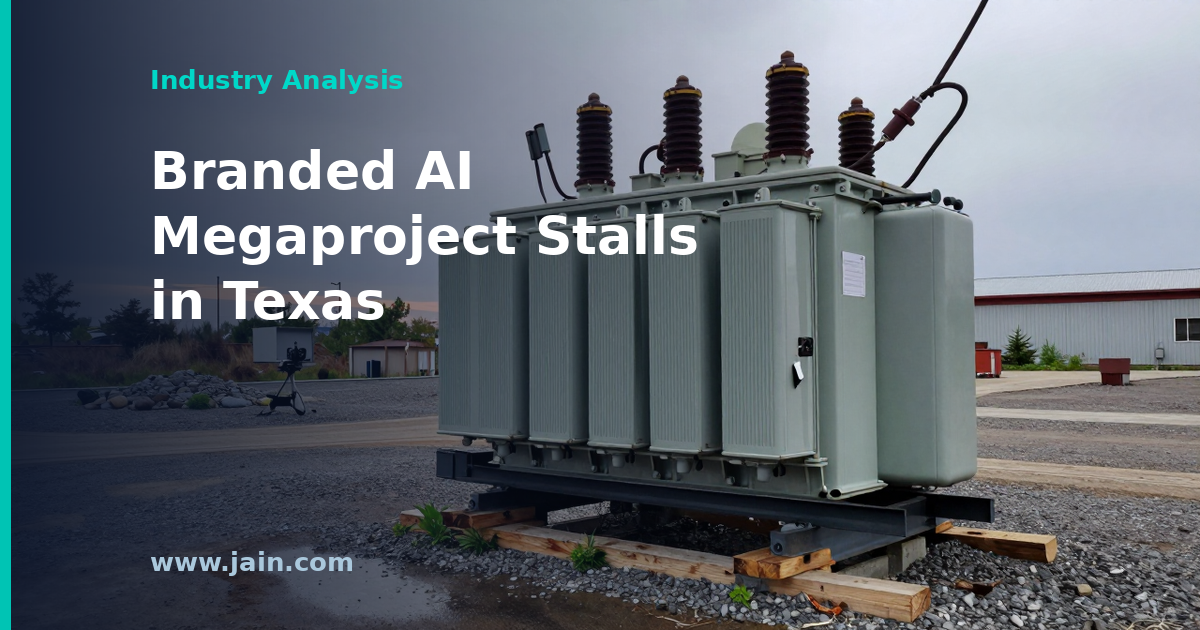
An AI data center megaproject carrying the Trump brand has stalled, and its chief executive has left the company, according to an Axios report published on April 20, 2026. The report is the first public signal that the venture, promoted as a large-scale AI computing campus, is not proceeding on its announced path.
The available source is a headline-level wire item. It establishes two things: the project has stalled, and the CEO has departed. It does not, in the material available to us, set out the project’s contracted capacity, financing status, customer commitments, or the reason for the leadership change.
Executive Summary
The announcement of a large AI campus and the delivery of one are separated by a chain of dependencies that rarely appears in a press release: firm power, an interconnection agreement with the grid operator, long-lead electrical and generation equipment, an anchor customer willing to sign a decade-long lease, and a capital stack willing to fund construction before that customer moves in. A stall at this stage usually means one link in that chain did not close.
Why it matters beyond one project: since 2024, the AI buildout has been announced in gigawatts rather than megawatts, and much of that pipeline is speculative. A gigawatt is roughly the output of a large power plant, enough for a mid-sized city. Projects at that scale are not real estate transactions; they are power transactions with buildings attached. Each publicly stalled project gives lenders, utilities and enterprise buyers a data point on how much of the announced pipeline converts to poured concrete.
The political branding adds a distinct variable. A licensed name raises a project’s visibility and can widen its investor pool, but it does not shorten an interconnection queue, secure a turbine order, or substitute for a creditworthy tenant. This case tests whether that distinction is priced correctly.
Announcements Are Cheap; Interconnection Is Not
The binding constraint on large AI campuses today is electricity, not land or capital appetite. To draw hundreds of megawatts from a grid, a developer must enter the operator’s large-load interconnection process, fund system-impact studies, and often pay for transmission upgrades that take years to build. In Texas, the ERCOT market is attractive precisely because it is fast and deregulated by U.S. standards, but the surge of large-load requests has made a queue position an asset in itself, and grid operators have grown more demanding about which requests are financially backed rather than exploratory.
Behind-the-meter generation, the common workaround, has its own timetable. Large gas turbines and grid-scale transformers are ordered years in advance from a small number of manufacturers, and a developer without a slot in that order book cannot buy one at any price on short notice. A project that announced first and secured equipment later is exposed to exactly this gap.
The practical lesson for readers evaluating any megaproject: treat an announced capacity figure as an aspiration until it is paired with a signed interconnection agreement, an energy supply contract, or a filed transmission study. Those documents are frequently public. Rendering images are not evidence.
Who Signs the Lease Decides Whether the Steel Goes Up
The economics of a hyperscale campus rest on offtake — a long-term commitment from a creditworthy tenant to pay for capacity whether or not it uses it. That contract is what construction lenders underwrite. Without it, a developer is asking capital markets to fund a multi-billion-dollar facility on the assumption that demand will arrive, which is a materially more expensive proposition and, in tighter credit conditions, sometimes an impossible one.
This is where independent developers face a structural disadvantage against the largest cloud and AI operators. A hyperscaler building for itself is its own anchor tenant, funds construction from operating cash flow, and can absorb a delay. A newly formed venture must persuade someone else’s balance sheet first. When a project of this type stalls, the most common explanation is not that AI demand evaporated, but that the demand went to counterparties who could deliver capacity on a credible schedule.
Both readings deserve scrutiny. If the venture’s backers argue this is a temporary financing pause, the fair question is which specific milestone slipped and what the revised date is. If critics argue the project was never viable, the fair question is what evidence beyond the stall itself supports that — announced projects are routinely restructured, resited or resumed under new sponsors, and a stall is not a liquidation.
A Brand Is Not a Balance Sheet
Name licensing is a conventional real estate structure: a developer pays for the right to use a recognizable brand, which can lift marketing reach and investor attention. What it does not transfer is operational capability or credit. In digital infrastructure, buyers procure on uptime history, power availability, network density and financial durability over a fifteen-year lease. Brand recognition ranks low on that list, and a politically salient brand can cut both ways with multinational customers who prefer their infrastructure vendors to be uncontroversial.
The CEO departure compounds this. In early-stage infrastructure ventures, the executive team is often the substance of the enterprise — the relationships with utilities, equipment vendors, and prospective tenants sit with named individuals rather than with institutional processes. Losing a chief executive before financial close therefore carries more weight than the same event at an operating company. Nothing in the available source explains the circumstances of the departure, and it would be unfair to the individual to assume any.
For the wider market, the healthiest outcome of episodes like this is better disclosure discipline. Operators, utilities and municipalities all benefit when announcements distinguish between land under option, capacity under study, and capacity under contract. Those are three very different things that are currently reported in the same units.
Background
Since 2024, the buildout of computing capacity for artificial intelligence has become the largest wave of industrial construction in the technology sector, with announced projects routinely measured in gigawatts of electrical load rather than square feet. The scale changed the nature of the business: developers now compete primarily for grid capacity, generation equipment and construction credit, and only secondarily for land. Texas became a focal point because of its independent power market, generation mix and speed of permitting relative to other U.S. states.
That environment produced a wide gap between announced and delivered capacity, and a corresponding pattern of ventures formed to capture attention and capital ahead of securing the underlying power and customers. Independent developers without a captive tenant face the hardest version of this problem, because they must persuade an external counterparty to commit before lenders will fund construction. Reports of stalled projects and leadership changes in that cohort are a recurring feature of the cycle rather than an anomaly, and each one offers a measurable test of which announcements were backed by contracts.
Source: Trump-branded AI data center megaproject stalls, CEO departs — Axios, reported April 20, 2026, via Google News; a headline-level item establishing the stall and the leadership change without further project detail.