
TL;DR · 30-second read
The Short Version
Texas’s governor asked the state to stop approving new data centers, the huge computer warehouses behind artificial intelligence. A month later, watchdog groups found an automated state website still issuing construction approvals.
Texas has now suspended 17 data center permits and switched the website off, so staff can check applications by hand. All 17 cover the same early job: preparing and leveling the land.
The lesson is simple. The race to build for artificial intelligence can be held up by a form about rainwater and dirt.
Texas has suspended the construction permits of 17 data center projects and disabled STEERS, the Texas Commission on Environmental Quality (TCEQ) portal used for automatic authorizations, Tom’s Hardware reported on October 24, 2026, citing 404 Media. The move came after FracTracker Alliance and Public Citizen published reports detailing more than two dozen permits issued to Texas data center projects after Governor Greg Abbott called for new permits to be halted in September.
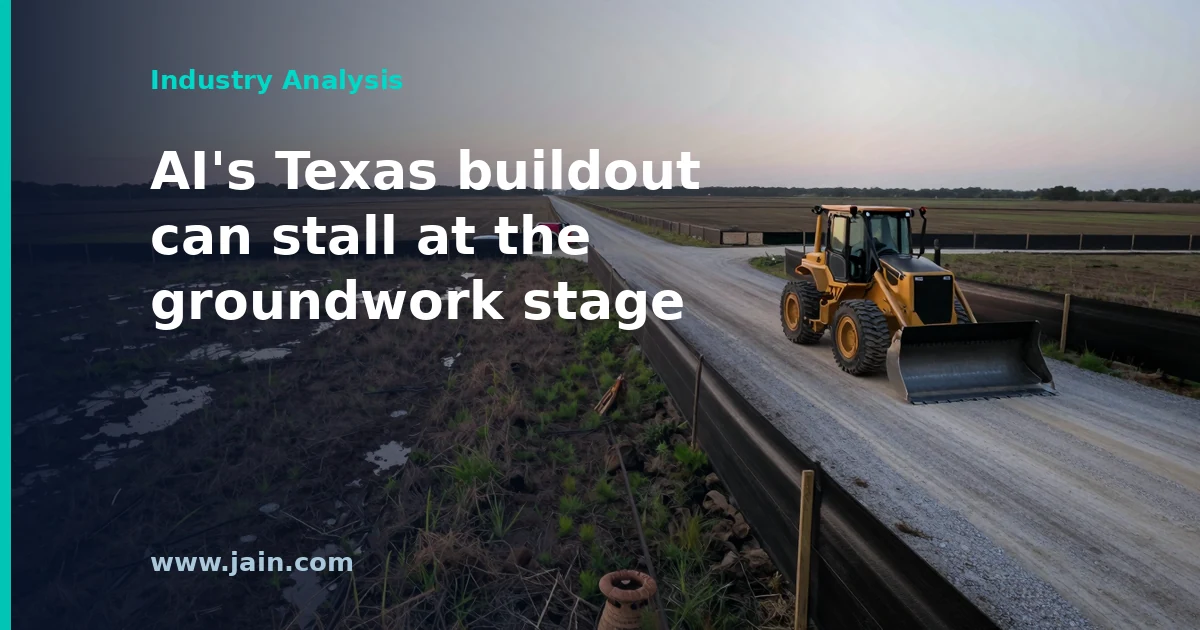
All 17 suspended permits are for stormwater construction, the permitting tied to raising and leveling a site. A notice on the TCEQ site says the filing application has been “temporarily shut down to ensure all applications are reviewed by agency staff to determine if they are related to data centers.”
Executive Summary
Texas has moved from a political call for a data center pause to a concrete administrative step: 17 construction permits suspended and an automated filing route closed. Abbott’s September action put the brakes on 1,800 data center projects while they were audited, but approvals continued through STEERS. Sam Law, a researcher at FracTracker, said projects for OpenAI and Amazon had gone through the system in the week before the shutdown.
The significance lies less in the count than in where the action landed. Abbott’s public statement focused on grid connection and the requirements of the state’s utility regulator and grid operator. The suspensions instead hit a stormwater approval, an early step that all Texas construction projects must clear. For developers, that means schedule risk can appear at the groundwork stage, well before a project’s power arrangements are tested.
Why a Stormwater Permit Became the Gate
A stormwater construction permit sounds peripheral to artificial intelligence. It is not peripheral to the construction sequence. It covers the phase in which contractors raise and level the ground, and it is a vital part of the approval process for all construction projects in Texas. If that step is suspended, the work scheduled to follow it, from foundations to building shells and equipment installation, has a dependency that is no longer secure.
That is the operational conclusion from the 17 suspensions. AI infrastructure planning often centers on chips, power contracts and grid access, and Abbott’s statement pointed in that direction, saying projects that fail to meet the requirements of the Public Utility Commission of Texas (PUCT) and the Electric Reliability Council of Texas (ERCOT) “must be denied connection to the Texas grid.” Yet the enforcement visible in this episode came through an environmental construction authorization at a different agency. Developers, general contractors and the tenants waiting on delivery dates all carry exposure to that earlier gate.
The finding has limits. Seventeen permits is a small count beside the 1,800 projects under audit, and it does not show that Texas construction has broadly stopped. Nor does it establish air-quality permitting, the kind of approval typically associated with on-site generators, as the main constraint on AI power plans. These suspensions concern stormwater. What they do show is that a routine permit can become a point of control once a state decides to use it that way.
Automation Moved the Risk, Not the Requirement
Automatic authorization gives applicants speed and predictability, because a qualifying filing does not wait for individual staff review. The Texas episode exposes the other side of that bargain. An approval that was issued quickly has now been suspended after the fact, so developers and their financiers may reasonably treat automated approvals as less settled than they once appeared, particularly during a politically charged review.
The TCEQ notice also reveals a practical problem. Staff must now review applications to determine whether they relate to data centers, which suggests that sorting by project type has become a manual task. That matters beyond this sector. The notice refers to all applications in that filing channel, and stormwater approval applies across Texas construction, so other builders could feel any resulting backlog even though the policy concern is data centers. How large that effect will be depends on application volume and staffing, neither of which has been stated.
Testing the Claims on Each Side
The watchdog findings carry real weight on one narrow point: permits kept being issued after the governor’s call, and the state’s subsequent action confirms that the process needed to change. They do not, by themselves, show that any suspended project breached an environmental standard. A stormwater authorization also is not approval to connect to the grid, so a fair question for the groups is how much each permit advanced the projects under audit.
The state faces harder questions. A call for a pause and a functioning control are different things, and the portal’s month of continued operation raises the question of how clearly the pause’s scope was defined and communicated to the agencies carrying it out. For applicants, including OpenAI and Amazon, passing through an open government portal is not evidence of wrongdoing. The issue on display is the design of the process.
Texas Joins a Broader Shift, Through a Different Mechanism
Texas is not acting in isolation. New York’s Responsible Data Center Development Act, signed by Governor Kathy Hochul in July, imposed a year-long ban on projects larger than 50 megawatts, a measure of electrical demand. President Trump, who announced an AI Action Plan to accelerate infrastructure in July 2025, announced a mandate in October 2026 requiring AI data centers to pay dividends to communities. In Northern Virginia, Amazon responded to community opposition to four planned data centers by offering its land for housing.
These actions differ in legal form and motive, so they should not be read as a single coordinated policy. New York used a statute, while Texas has acted through an audit and agency permitting. Together, though, they suggest why site selection now requires more than a look at power and land prices. Buyers of capacity and investors in development pipelines have reason to ask which approvals are in hand, how those approvals were obtained, and whether they could be revisited.
Background
Texas has been a central market in the US data center buildout, and its approval landscape involves several bodies. The Texas Commission on Environmental Quality handles environmental authorizations, while the Public Utility Commission of Texas and the Electric Reliability Council of Texas oversee utility rules and the grid. Abbott’s September 2026 action cited concerns about power use and generation, water consumption and community impact.
The national policy climate has also shifted. The July 2025 AI Action Plan aimed to speed adoption of AI tools and infrastructure, but states and communities have since pressed harder on energy costs, water shortages and deforestation. New York’s year-long ban on projects above 50 megawatts and Amazon’s retreat from four planned Northern Virginia data centers are recent examples of that pressure. Source: Texas has suspended 17 data center construction permits and shut down automated portal that rubber-stamped projects — site was left running for a month after Greg Abbott called for a pause on approvals, Tom’s Hardware’s October 24, 2026 report on the Texas permit suspensions and the STEERS shutdown.Sources