
TL;DR · 30-second read
The Short Version
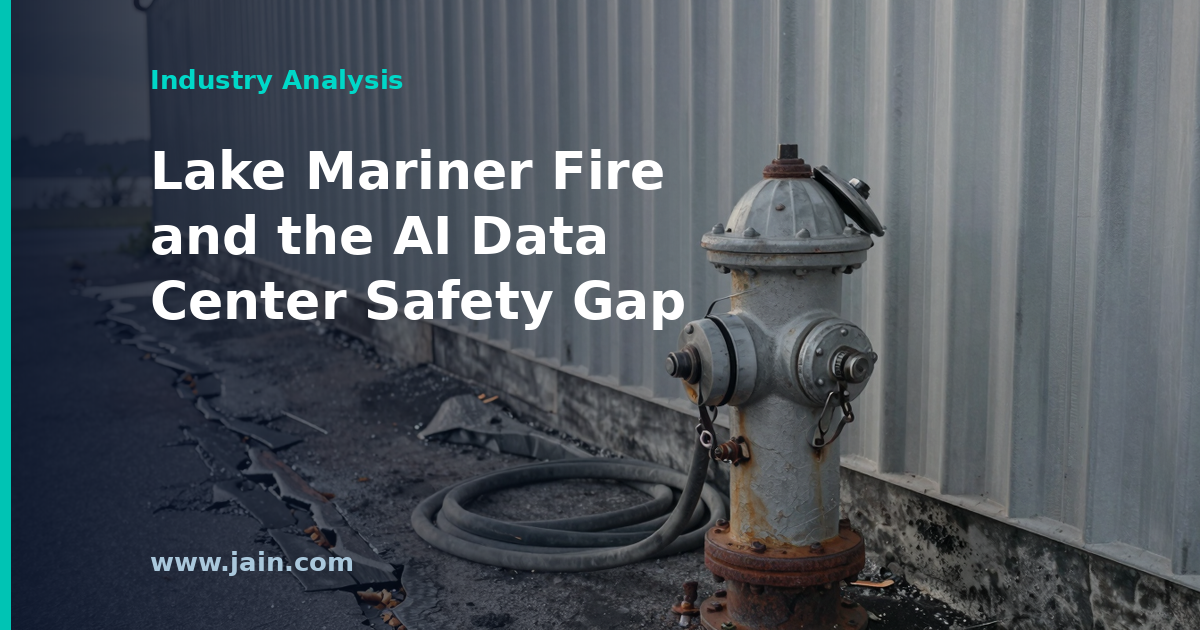
In early June, a building caught fire at a large computer facility in upstate New York, built on the site of a retired coal plant. Firefighters arrived to find no working fire alarm, no built-in system to put out flames, and three fire hydrants that did not work.
The paperwork listing which chemicals were burning had, the owner said, burned in the fire itself. The fire chief said his crew went in blind.
The site is being converted from mining digital currency to running artificial intelligence — the same conversion happening at dozens of sites nationwide.
Crypto Briefing reported that firefighters from the Barker Fire Department responded in early June to a fire in an unfinished building at TeraWulf’s Lake Mariner campus in Somerset, New York, and found no functioning fire alarm, no suppression system and three hydrants that did not work. According to TeraWulf, the safety data sheets that would have identified the chemicals producing the heavy black smoke had burned up in the fire. Fire Chief Steve Matisz said his crew went into the building “kind of blind,” and that he was unsure what to make of the claim that the safety sheets had been destroyed. “It’s been a difficult situation,” Matisz said.
Lake Mariner sits on the site of a retired coal plant that TeraWulf (Nasdaq: WULF) began operating in 2022 for Bitcoin mining and is now converting to artificial intelligence and high-performance computing workloads, targeting a combined 500 to 750 megawatts across several buildings by the end of 2026. Tenants include Core42 and Fluidstack. Post-incident discussions reportedly included plans for additional hydrants and improved storage of safety data sheets. No regulatory follow-up or investigative action has been publicly reported.
Executive Summary
The facts as reported are narrow — one fire, one building still under construction, one rural fire department — but they touch three things that matter across the AI build-out: whether life-safety systems are in service before a building is finished, whether a site’s water supply can actually deliver, and whether anyone outside the company checks. A megawatt is a unit of electrical demand; a campus rated at several hundred megawatts draws power on the scale of a small city, and it concentrates that energy inside a handful of buildings packed with electrical gear, batteries and, increasingly, liquid cooling.
What makes Lake Mariner a useful case is not that TeraWulf is unusual. It is that TeraWulf is typical. A retired coal plant with an existing grid connection is among the most sought-after assets in the industry right now, because the interconnection queue — the waiting line to attach new load to the electrical grid — runs years long almost everywhere else. Buying speed by inheriting a brownfield site also means inheriting its fire mains, its hydrants and its water pressure.
For tenants such as Core42 and Fluidstack, and for the customers behind them, the operational question raised here is not about one fire. It is about what construction-phase safety looks like at a campus racing toward 500 to 750 megawatts by the end of next year, and what an insurer, a lender or a lease counterparty is told when something goes wrong.
Construction Is the Most Dangerous Phase of a Data Center’s Life
A finished data center is one of the better-protected buildings in commercial real estate: detection on every ceiling, suppression plumbed and pressurised, and a fire alarm panel that is tested, certified and monitored before the first server is energised. A data center under construction is a different building entirely. Suppression piping is often installed but not charged. Detection is often wired but not commissioned. Combustible packaging, temporary power, insulation and hot work — welding, cutting, grinding — all sit in the same shell at once. That is why the industry treats the construction window as a distinct risk class with its own controls, rather than assuming a partly built facility is a slightly less protected finished one.
The reported conditions at Lake Mariner map onto exactly that window: an unfinished building, no functioning alarm, no suppression. None of that is inherently a code violation — requirements phase in as construction progresses, and there is a legitimate period in any project when systems exist but are not yet live. What the account does not establish, and what would determine whether this was routine or a lapse, is which protections were required at that stage and which were merely absent. That is a question about the project’s fire-protection plan, and it is answerable only by the company and the authority having jurisdiction.
Brownfield Speed Comes With Borrowed Plumbing
The three dead hydrants are the detail with the longest reach. Converted industrial sites — retired coal, steel, paper, aluminium — are attractive because the heavy electrical infrastructure is already there and the grid connection already exists. But the fire-water infrastructure is inherited too, and it was engineered for the plant that used to be there, under a maintenance regime that ended when that plant did. Private hydrants on a large campus are the owner’s responsibility to flow-test and maintain, not the municipality’s. When three of them do not work, the failure is usually not the fire itself but everything that did not happen in the years before it.
The response profile compounds this. Repurposed heavy-industrial land tends to be rural, which means the responding department may be small, volunteer or both, with tanker shuttles rather than an urban grid of reliable pressurised mains. The specific failure the chief described — going in without knowing what was burning, because the safety data sheets were reportedly inside the building that was on fire — is the one that pre-incident planning exists to prevent. Chemical inventories are meant to be duplicated off-site and shared with the responding department in advance, precisely so that a fire cannot destroy the document that explains itself. That the post-incident discussion reportedly turned to additional hydrants and better storage of those sheets suggests the gap was recognised.
The Risk Is Priced Somewhere, Even If It Is Not Disclosed
Fires during construction are covered by builder’s risk policies, and completed data centers are among the most heavily underwritten assets in the market — insurers inspect them, set conditions and price on the strength of protection systems. A loss during construction is not merely an expense; it becomes part of the underwriting file for the campus, and it can shape terms on renewal and on the buildings not yet built. Where a company is financing a rapid build-out, insurance terms and lender conditions are a real cost line, not a footnote.
There is also a schedule dimension. TeraWulf is targeting 500 to 750 megawatts across several buildings at Lake Mariner by the end of 2026, with tenants already signed. Lease agreements in this market typically carry delivery dates, and a delivery date missed by construction damage is a commercial event as well as a safety one. Nothing in the reported account establishes that this fire affected the schedule, the tenants or the target — but those are the specific channels through which a construction-phase fire reaches investors, and they are the ones worth watching.
Who Checks, and When
The reported absence of publicly known regulatory follow-up is the part that generalises furthest beyond this one campus. Data center fire safety is enforced locally — by building departments, fire marshals and code officials — and the enforcement capacity of a small jurisdiction is not always matched to a multi-hundred-megawatt industrial conversion arriving inside a few years. That is a structural feature of how the AI build-out has distributed itself: toward places with cheap land, existing grid capacity and, often, modest municipal staffing.
It is worth being precise about what can and cannot be concluded. That no follow-up has been publicly reported is not evidence that none occurred; investigations are frequently non-public until they conclude, and some are never announced at all. The fair reading is narrower and still useful: three months after an incident at a campus of this scale, the public record contains a fire chief’s account and little else. For a sector asking communities to host enormous new industrial loads, that asymmetry between the size of the facility and the visibility of its oversight is itself a thing to watch.
Background
TeraWulf (Nasdaq: WULF) started as a Bitcoin miner, a business whose economics turn almost entirely on the price of electricity. That pushed the industry toward the same places utilities and heavy industry once favoured: sites with large, already-permitted grid connections. Lake Mariner, on the grounds of a retired coal plant in Somerset, New York, is a textbook example, and TeraWulf has operated it since 2022.
The rise of artificial intelligence turned those assets into something more valuable. Training and running large models requires dense clusters of specialised chips, and the binding constraint on building them is power — specifically, how quickly a site can attach hundreds of megawatts to the grid. Former mining campuses already have that, which is why so many miners are converting into landlords, leasing capacity to compute providers rather than mining coins themselves. TeraWulf’s Core42 and Fluidstack tenancies at Lake Mariner, alongside a target of 500 to 750 megawatts by the end of 2026, place it squarely in that transition. The conversion also changes the building: denser electrical gear, more batteries and increasingly liquid cooling, all of which raise the stakes on fire protection. Source: TeraWulf’s Lake Mariner data center fire raises safety concerns — an account of the early-June fire at TeraWulf’s Somerset, New York campus, including Barker Fire Chief Steve Matisz’s description of the conditions his crew found on arrival.Sources