
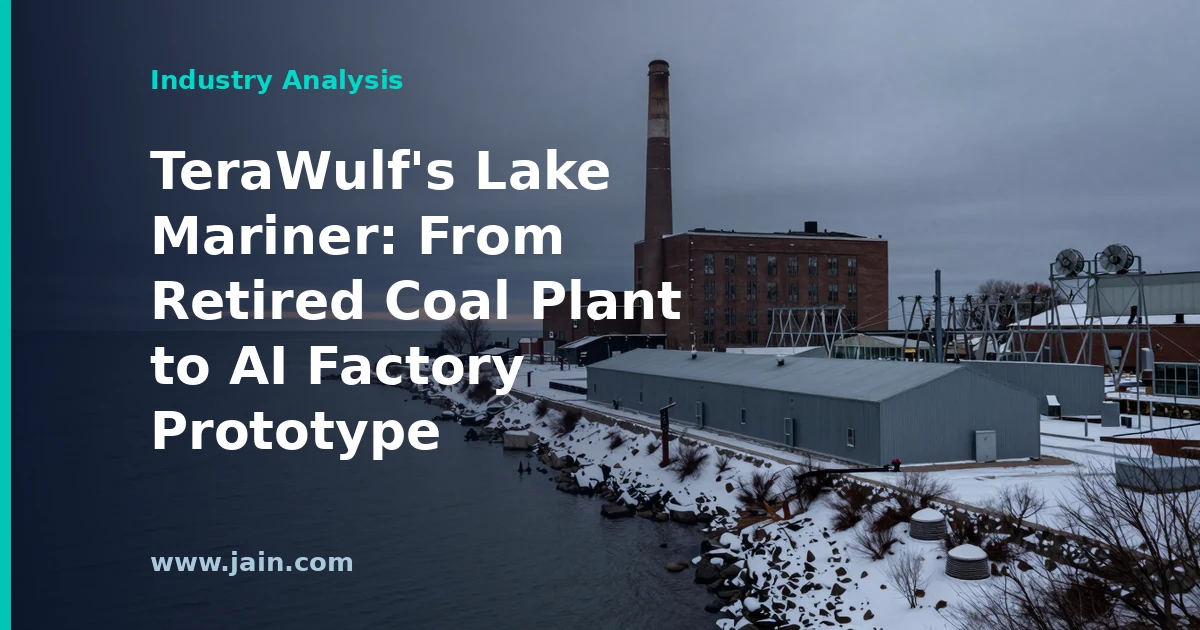
Data Center Frontier profiled TeraWulf’s Lake Mariner campus in Barker, New York, in a May 25, 2026 feature framing the site as a prototype for the “AI factory” — a large-scale data center purpose-built for artificial-intelligence computing. The campus occupies the site of the retired Somerset coal-fired power plant on the shore of Lake Ontario, and the piece traces how TeraWulf, a company that began as a bitcoin miner, has been converting that inherited industrial infrastructure into high-performance computing capacity.
Executive Summary
The core story is one of conversion twice over: a coal plant site converted to digital infrastructure, and a cryptocurrency-mining operator converting itself into an AI-infrastructure landlord. Lake Mariner’s appeal rests on assets that are nearly impossible to recreate quickly — an existing high-capacity grid interconnection built for a power station, access to abundant water for cooling, zoned industrial land, and a regional grid in upstate New York that draws heavily on zero-carbon hydroelectric generation.
Why it matters: the binding constraint on AI data center construction has shifted from chips to power. Utilities in major markets are quoting multi-year waits for large new grid connections, so sites that already have them — like retired thermal power plants — jump the queue. If Lake Mariner works as a template, the industry gains a playbook for turning stranded fossil-fuel assets into AI campuses, with meaningful implications for former coal communities, grid planners, and the competitive map of the data center industry.
The Interconnection Is the Asset
A modern AI campus can require as much electricity as a small city, and the slowest step in delivering it is usually not construction but the grid interconnection — the physical and contractual link that lets a facility draw power from the transmission system. New requests in constrained markets can sit in utility study queues for years. A retired power plant inverts that problem: the wires, switchyard, and transmission rights were built to push hundreds of megawatts out, and much of that capacity can be repurposed to pull power in.
That is the essence of the Lake Mariner thesis. TeraWulf did not have to win a greenfield site fight; it inherited the Somerset plant’s industrial footprint and grid position. The same logic explains a broader industry pattern — operators across the market have been scouting retired or retiring thermal plants precisely because the interconnection, land, and water rights are already in place. In that sense the “prototype” label is apt: the question the site tests is whether coal-to-compute conversion can be repeated at scale, not whether it can be done once.
From Bitcoin Mine to AI Landlord
TeraWulf built Lake Mariner as a bitcoin mining facility, and that history matters more than it might appear. Bitcoin mining taught the company to energize large amounts of power-dense compute quickly and cheaply — but mining revenue is volatile, tied to cryptocurrency prices and periodic “halving” events that cut miner rewards. High-performance computing (HPC) hosting for AI customers offers something mining never could: multi-year contracted revenue from creditworthy counterparties, which is the kind of cash flow lenders and infrastructure investors will finance.
The catch is that the two businesses are less similar than the shared electrical infrastructure suggests. AI training clusters demand far higher reliability, denser cooling — increasingly liquid cooling delivered directly to the chips — and enterprise-grade operations that mining sheds never needed. The conversion is therefore a genuine re-engineering exercise, not a tenant swap, and execution on that transition is the fair test by which TeraWulf and its bitcoin-miner peers should be judged.
The Zero-Carbon Power Angle
Upstate New York’s grid is unusually clean by U.S. standards, anchored by large-scale hydroelectric generation. For AI customers under pressure to report the carbon footprint of their computing, siting workloads on a predominantly zero-carbon grid is a marketable advantage — and there is a certain narrative symmetry in AI compute replacing coal combustion on the same acreage.
The claim deserves precision, though. A clean regional grid is not the same as dedicated clean power, and every large new load consumes headroom that grid planners had earmarked for other purposes. The substantive questions for any site making a sustainability case are how the incremental demand is matched with generation, and what the facility’s water and community impacts look like — questions that apply to Lake Mariner exactly as they apply to every competing campus.
Winners, Losers, and the Watchlist Question
If the coal-to-AI conversion model scales, the winners include former plant communities that regain a tax base and jobs, utilities that get to reuse stranded transmission assets, and early movers holding converted sites when capacity is scarce. The pressure lands on operators pursuing greenfield builds in queue-constrained markets, who must wait for infrastructure that conversion players already own.
For investors treating TeraWulf as a watchlist company, the prototype framing cuts both ways. It signals genuine strategic differentiation — but prototypes, by definition, have not yet proven repeatability. The durable questions are contract quality (who the tenants are and for how long), financing cost for the heavy capital expenditure AI-grade buildings require, and whether the company can operate to the uptime standards hyperscale customers demand. A compelling site thesis is necessary but not sufficient.
Background
TeraWulf was founded to mine bitcoin using predominantly zero-carbon energy and developed Lake Mariner on the grounds of the retired Somerset coal plant in Barker, New York, drawing on the region’s hydro-heavy grid. As demand for AI computing surged and power became the industry’s binding constraint, TeraWulf — like several other large miners — began redeveloping its energized sites for high-performance computing tenants, betting that its grid position would be worth more serving AI than mining cryptocurrency.
The broader market context is a structural shortage of grid-connected capacity: AI’s growth has pushed utilities in major data center markets to years-long interconnection queues, elevating any site with existing power infrastructure — especially former power plants — into strategic real estate.
Source: TeraWulf’s Lake Mariner Campus: How a Retired Coal Plant Became an AI Factory Prototype (Data Center Frontier) — a site profile examining Lake Mariner’s conversion from coal plant grounds to AI data center campus.