Tag: Zoning

  • Everyone Watches NY’s 50 MW Data Center Pause. The Lasting Risk Is Local Zoning.

    Everyone Watches NY’s 50 MW Data Center Pause. The Lasting Risk Is Local Zoning.

    TL;DR · 30-second read

    The Short Version

    A small town on Cayuga Lake in upstate New York is preparing a law that would ban data centers, the warehouse-sized buildings full of computers that run websites, apps and artificial intelligence.

    The trigger is a company called TeraWulf, which wants to build one on the grounds of an old coal power plant. About 200 people packed a town meeting, and most asked for a ban, citing noise, water and electricity bills.

    New York has temporarily paused some state permits for large data centers. A town ban would be different: it would stay in place until a future town board chose to reverse it.

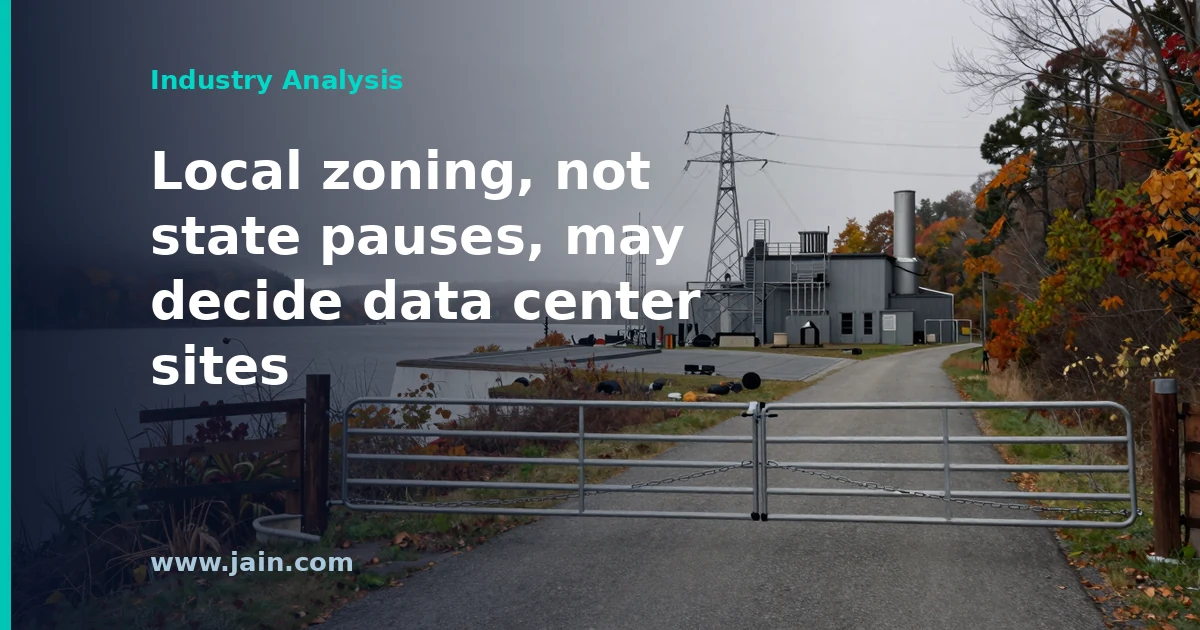
    The Town of Lansing, New York, has moved toward an outright prohibition on data centers, Fingerlakes1.com reported. At a September 29 special meeting attended by roughly 200 people, the Town Board directed town attorney Megan Doherty to draft a local law banning data centers, so board members can review the language before deciding whether to formally introduce it and schedule a public hearing. No ban has been enacted and the town’s zoning has not changed.

    The debate centers on TeraWulf’s Lake Hawkeye proposal to redevelop the former Milliken power plant site, which has been under town review for nearly a year. Town Supervisor Ruth Groff said she favors a total ban, and several other board members said they want to see prohibition language drafted rather than pursue another temporary moratorium. TeraWulf asked the town to keep its existing review process open.

    Executive Summary

    Lansing’s board has not rejected TeraWulf’s project, but it has shifted the question from how to regulate data centers to whether to allow them at all. The catalyst was New York Governor Kathy Hochul’s Executive Order 62, issued July 14, which bars the state Department of Environmental Conservation from issuing discretionary permits for data centers of 50 megawatts or more until the state Department of Public Service completes a broader environmental review. That state pause does not halt local reviews, leaving Lansing to spend money and staff time on a project whose state requirements may later change.

    The significance reaches beyond one proposal. Town officials said nearly 40 New York municipalities have adopted data center moratoriums since the start of 2026. A moratorium buys time; a zoning prohibition closes a town to every developer until it is amended. If Lansing follows through, a former power plant site with concentrated high-voltage transmission lines, the kind of grid access large facilities seek, would be off the table regardless of who proposes to build there.

    For developers, utilities and landowners holding retired generation sites, the episode shows that grid access and a willing seller do not settle siting. Local land-use law, set by a handful of elected board members, can decide the outcome before any state standard is written.

    A Temporary State Pause, a Potentially Lasting Local Ban

    Executive Order 62 is, by design, a holding pattern. It stops one state agency from issuing discretionary permits for data centers of 50 megawatts or more (a megawatt is a unit of electrical capacity; facilities at that scale draw power comparable to a sizable town) until regulators study electricity demand, water use and quality, air quality, noise and effects on disadvantaged communities. In parallel, Empire State Development has been told to build a framework to help municipalities negotiate economic benefits and mitigate harms. Both tracks point toward data centers being permitted under higher standards, not excluded.

    Lansing’s draft points somewhere else. A zoning prohibition does not wait for state standards and does not depend on project size unless the town writes it that way. Doherty told the board a future board could amend the zoning if technology, circumstances or state law change, so the ban would not be permanent in a legal sense. In practice, though, reversing a ban requires a new political decision, while a moratorium expires on its own. That asymmetry is why the local layer now carries more durable risk for developers than the state pause that drew the headlines.

    The figure town officials cited, nearly 40 New York municipalities adopting moratoriums this year, shows how many local governments are already using land-use tools to respond. Lansing does not by itself establish that those towns will move on to bans. It does show the path exists, and that a board can travel it in a single meeting once the cost of continued review looks higher than the cost of saying no.

    Why Regulating Looked More Expensive Than Prohibiting

    The board’s reasoning was largely practical. Members discussed allowing smaller facilities while barring hyperscale ones, the very large campuses typically built for major cloud and computing tenants, with a 10-megawatt threshold raised as one possible dividing line. Groff was skeptical, citing concern that permitting smaller facilities could give developers an opening to seek variances for larger ones. Other members questioned whether an elaborate regulatory structure would invite years of enforcement disputes and legal bills.

    Councilmember Judy Drake, who spent much of the meeting weighing economic development and the town’s tax pressures, framed the cost question directly: if most of the board ultimately supports a ban, paying attorneys to draft a moratorium and regulations first may only spend more town money before arriving at the same result. Councilmember Joseph Wetmore said he had spent about a year looking for regulations that could make a data center compatible with Lansing and found that balance increasingly remote.

    That logic matters for the industry because it does not turn on any single project’s merits. A small town weighing enforcement capacity and litigation exposure may conclude that a bright-line prohibition is cheaper to administer than performance standards for noise, light and water, especially while state rules are still being written.

    The Grid-Ready Brownfield Problem

    The Milliken property illustrates the trade-off. Town planning staff described it as a significant brownfield, meaning previously industrial land with contamination of varying degrees. A large coal ash pile remains a state-regulated landfill regardless of what happens elsewhere on the parcel, and other areas may need remediation before reuse. What the site has in its favor is infrastructure: high-voltage transmission lines are concentrated in northern Lansing around the former plant, which is why energy-related developers find it attractive.

    Planning staff said parts of the site could potentially host solar, with state brownfield programs helping fund cleanup. Tompkins County Legislator Mike Sigler argued that TeraWulf’s project had been anticipated to generate about $10 million in taxes and other community funding, much of it benefiting the Lansing school district, and that the site could stay dormant without an industrial developer willing to take on the brownfield. Town officials did not adopt those estimates, so the economic case on both sides remains unquantified on the public record.

    TeraWulf’s position is a process argument. Pace Rally, its vice president of project development, said the company has done substantial additional technical work and is making meaningful changes to the site plan, and asked that the project be evaluated on the facts. A ban would end that evaluation. The release also notes the prospect of a legal fight over a project already under review for nearly a year, which is the clearest near-term risk for both the town and the company.

    Background

    Lansing is a town in Tompkins County on the east shore of Cayuga Lake in New York’s Finger Lakes region. The former Milliken Station, a coal-fired power plant, has sat dormant since it closed, leaving behind contaminated land, a regulated coal ash landfill and a concentration of high-voltage transmission infrastructure in the town’s north end.

    TeraWulf is a publicly traded digital infrastructure company that operates in New York and has been associated with bitcoin mining and computing facilities that depend on large, low-cost power supplies. Statewide, data centers have come under heavier scrutiny in 2026: dozens of municipalities have adopted moratoriums, and Governor Hochul’s Executive Order 62 paused certain state permits for large facilities while New York develops higher standards for the industry.

    Sources

    Source: Lansing moves toward data center ban as TeraWulf debate reaches turning point (Fingerlakes1.com), reporting on the Lansing Town Board’s September 29 special meeting on TeraWulf’s Lake Hawkeye proposal.

  • Upper Merion’s 4.6M sq ft Denial Shows Why Self-Powered AI Campuses Still Need Town Hall

    Upper Merion’s 4.6M sq ft Denial Shows Why Self-Powered AI Campuses Still Need Town Hall

    TL;DR · 30-second read

    The Short Version

    A suburb outside Philadelphia voted down five giant buildings meant to hold the computers that run artificial intelligence. Together they would have covered roughly 80 football fields of floor space.

    The builder promised $55.4 million a year in local taxes, mostly for schools. Neighbors worried about noise, dirty air and home values, and more than 17,000 people signed a petition against it.

    The twist: to avoid raising local electric bills, the site would have made its own power with gas-burning generators. That fix became part of the fight. The builder says an appeal is coming.

    WHYY reported that Upper Merion Township’s Board of Supervisors on Thursday, August 13, 2026, rejected all five applications from developer Brian O’Neill for a hyperscale data center campus totaling more than 4.6 million square feet near King of Prussia, Pennsylvania. The campus would have been built at Discovery Labs, a health care and life sciences office property run by O’Neill’s company, and was designed to generate its own power using natural gas turbines with diesel backup generators.

    The vote followed a July planning commission recommendation against three of the five projects, a developer lawsuit seeking more review time that a Montgomery County judge cleared on the afternoon of the vote, and a resident petition with more than 17,000 signatures. O’Neill told 6ABC an appeal is planned.

    Executive Summary

    A suburban Philadelphia township has turned down one of the largest data center proposals in the region, despite the developer’s estimate of $55.4 million a year in local tax revenue, nearly $38 million of it for the local school district. The board’s stated grounds were procedural and specific: Chair Tina Garzillo said the township never received landscape, traffic impact, emergency management or sanitary sewer plans, and called the projects “at best speculative and conceptual in nature.”

    The case matters beyond Upper Merion because of how the campus was to be powered. Generating electricity on site is increasingly pitched as the responsible way to build AI-scale facilities without burdening the grid or ratepayers. Here, that design put gas turbines and diesel generators in front of a township board and its residents, and air pollution became a central objection. Self-generation did not remove the local approval gate; it added a power plant to what that gate had to judge.

    For developers, investors and utilities trying to forecast where AI capacity will actually get built, the vote is a reminder that a proposed campus is not capacity until it clears local land-use approval, and that the power strategy is now part of that approval.

    Self-Generation Swapped a Grid Question for a Local One

    The campus was pitched as a good grid neighbor: it would generate its own electricity so it would not strain the regional power system or push up household bills. That is an increasingly common design for AI-scale facilities, often called on-site or behind-the-meter power because the electricity is produced on the property rather than drawn from the utility. But in Upper Merion, the power plant came with the building. The proposal included natural gas turbines and diesel backup generators, and air pollution became one of residents’ leading objections, alongside noise and water use.

    That is the mechanism this vote exposes. A data center that buys power from the grid leaves most generation questions to utilities and grid planners. A data center that makes its own power brings combustion equipment, fuel supply and emissions controls onto a site that a township board must approve, in front of neighbors who will live beside it. O’Neill said scrubbers would control emissions and that discussions had been held with Bloom Energy about using fuel cells on site, but no deal had been finalized, which left the board and residents to evaluate the turbine-and-diesel version of the plan.

    Upper Merion is not the only place where on-site power has drawn local enforcement. In Vineland, New Jersey, where a data center under construction plans to use Bloom fuel cells, the city issued a stop-work order on parts of the 300-megawatt facility (a megawatt is a measure of electrical capacity), alleging that a liquefied natural gas tank and fuel cell units were being installed before city approval. Generating power on site may answer concerns about grid strain and electricity bills, but it adds a power plant to the list of things local officials get to review.

    The Board Ruled on Missing Plans, Not Just Public Anger

    The emotional scenes at the meeting can obscure what the board actually said. Garzillo cited the absence of landscape, traffic impact, emergency management and sanitary sewer plans. Those are ordinary engineering submissions for any large industrial project, and their absence gave the board a procedural basis for denial that stands apart from residents’ objections.

    The process had been heading this way for weeks. In July, the township planning commission voted not to recommend three of the five projects. The developer then sued, seeking an extension and arguing there had not been adequate time to address township concerns; a Montgomery County judge vacated the injunction on the afternoon of the vote, clearing the board to reject the extension. Vice chair William Jenaway said the developer had earlier opportunities to respond to review comments and did not do so in a timely fashion. The two sides’ accounts of the timeline differ, and an appeal would likely test them.

    For the industry, the lesson is about entitlement risk, meaning the risk that a site never receives the land-use approvals it needs. As AI demand pushes developers to repurpose existing properties, here a life sciences office campus, into data center sites, applications that arrive without complete plans risk being denied on the paperwork alone, whatever their scale or revenue promise.

    A $55.4 Million Tax Pitch Met a 17,000-Signature Petition

    The developer’s economic case was large on its face: an estimated $55.4 million a year in local tax revenue, with nearly $38 million going to the Upper Merion Area School District. For a suburban township, that is the kind of figure that usually carries weight. It did not carry the vote. Residents weighed it against quality-of-life costs that do not appear in a revenue projection, and one resident nearing retirement said a loss of home equity “would destroy our savings.”

    Both sides’ claims deserve the same scrutiny. The tax figure is the developer’s own estimate, and its value depends on assumptions about how much gets built and when. Residents’ fears about property values and health are sincere, but their magnitude depends on specifics that were never settled, such as how many turbines would run, how often, and with what controls. The water debate is similar: O’Neill said a closed-loop system would reuse cooling water, while hyperscale facilities in general can consume up to 5 million gallons of drinking water a day. Closed-loop designs reduce consumption substantially, but how much make-up water this campus would need was not specified.

    The backdrop is shifting against developers who lead with revenue. A University of Pennsylvania Annenberg Public Policy Center survey found a 12-point jump in widespread resistance to new data center construction over four months. In that climate, detailed answers on emissions, water and noise are likely to matter more to approval than headline tax estimates.

    What Comes Next for AI Capacity Around Philadelphia

    The denial is not necessarily final. The developer can appeal or submit new or revised plans, and has said an appeal is planned. Residents have said they will oppose any appeal or new application. O’Neill is also seeking approval for a data center in nearby Plymouth Township, which becomes the next test of whether a more complete application, and possibly a different power plan such as the fuel cells under discussion, changes the outcome.

    For operators, investors and utilities counting future AI capacity in the region, the practical point is that local land-use approval is a gate that neither scale, tax revenue nor a plan to stay off the grid can bypass. Capacity forecasts that treat proposed campuses as inevitable will miss decisions like this one, which are made parcel by parcel at township meetings.

    Background

    Upper Merion Township sits in Montgomery County, Pennsylvania, and includes much of the King of Prussia area, a major suburban commercial and office hub northwest of Philadelphia. Data centers, the buildings that house the servers behind internet services, have existed since the mid-20th century, but the rise of power-hungry artificial intelligence has pushed demand toward much larger hyperscale campuses that need substantial electricity and cooling.

    That demand has driven developers to look at existing commercial properties, such as office and life sciences campuses, as potential data center sites, and to consider generating their own power rather than waiting on the grid. It has also produced growing local resistance in the Philadelphia region and beyond, where township boards, not state or federal agencies, hold the zoning and land-use approvals that decide whether a campus can be built.

    Sources

    Source: Upper Merion board denies hyperscale data center campus near King of Prussia, WHYY’s report on the township supervisors’ vote rejecting a five-building data center campus.

  • Amazon’s 2.4M Sq Ft Calvert Cliffs Exit Shows a Nuclear Plant Can’t Shortcut Zoning

    Amazon’s 2.4M Sq Ft Calvert Cliffs Exit Shows a Nuclear Plant Can’t Shortcut Zoning

    TL;DR · 30-second read

    The Short Version

    Amazon has dropped plans to build a large group of data centers on the grounds of a nuclear power plant in southern Maryland. Data centers are warehouse-sized buildings full of computers that run apps, websites and artificial intelligence. This one would have covered roughly 40 football fields of floor space.

    Having a giant power plant next door was not enough. Local voters removed three county leaders who had resisted pausing these projects, and the county is now considering a six-month freeze. Amazon calls it a business decision. Either way, local approval proved as important as electricity.

    Amazon Web Services (AWS), Amazon’s cloud computing arm, has abandoned its proposal to build data centers on the campus of the Calvert Cliffs Nuclear Power Plant near Lusby, Maryland, Maryland Matters reported on August 4, 2026, citing a Calvert County government news release. The proposal, submitted to the county in early May, called for “multiple data center campuses” covering 2.4 million square feet.

    The withdrawal follows the June 23 primary election, in which all three Calvert County commissioners who had voted against a pause on data centers lost their races. The county has scheduled an August 18 public meeting on a temporary six-month moratorium on site plan approvals for data center projects. Amazon described the move as a business decision; plant owner Constellation Energy said the opportunity at the site continues.

    Executive Summary

    AWS has walked away from what was, on paper, one of the most attractive data center sites in the Mid-Atlantic: land beside a nuclear plant that Constellation calls Maryland’s largest source of clean, reliable energy. Co-locating a data center with a power plant is the siting strategy much of the industry has pursued to secure the large, round-the-clock electricity that AI and cloud computing demand.

    The Calvert Cliffs outcome shows the limit of that strategy. Power next door does not remove the need for local land-use approval, and in Calvert County the politics of that approval shifted sharply between Amazon’s May filing and its August exit. Amazon’s own statement names development timelines as a deciding factor — the variable a county moratorium directly controls.

    For developers, utilities and investors, the lesson extends well beyond one county. Much of Maryland’s population now lives under some form of data center moratorium, according to a regional climate advocacy group, and state lawmakers may take up statewide proposals in 2027.

    Power Next Door Did Not Replace the Permit

    Data center developers have spent the past two years chasing power, not land. Large facilities that train and run AI models draw electricity continuously, and securing that supply through a crowded regional grid can take years. Building beside a nuclear plant — often called co-location — is attractive because the plant produces large amounts of steady, carbon-free power on site. Calvert Cliffs, with Units 1 and 2 near Lusby, offered exactly that.

    But a site plan still has to be approved by the county. Amazon filed its 2.4 million-square-foot proposal in early May. On June 23, voters removed commission president Todd Ireland, vice president Mark C. Cox Sr. and commissioner Earl F. “Buddy” Hance, the three commissioners who had voted against a data center pause, in favor of candidates critical of the county’s data center trajectory. On August 4, the county announced both Amazon’s withdrawal and a hearing on a six-month moratorium on data center site plan approvals, intended to allow time for new zoning rules and studies.

    Amazon says the decision was a business one, and nothing public contradicts that. Its statement, however, lists the factors it weighs: “development timelines, operational requirements, and our ability to deliver quickly for customers.” A six-month pause followed by a zoning rewrite is a timeline risk that no amount of nearby generation can offset. The mechanism is straightforward: the power advantage of a nuclear site is realized only after the building exists, while the permitting clock starts first. For hyperscalers — the largest cloud operators — that measure value in speed to capacity, an uncertain local calendar can outweigh a favorable power position.

    Maryland’s Moratorium Map Is Now a Siting Input

    Calvert County is not an isolated case. The Chesapeake Climate Action Network (CCAN), an advocacy group that supports moratoriums, said in July that nearly 77% of Maryland’s population lives under some kind of data center moratorium. That figure comes from an interested party, but the underlying measures are matters of public record: Prince George’s County enacted a two-year hold in July, Harford County has a ban with no time limit, Montgomery County, Baltimore County and Baltimore City have adopted measures, and Queen Anne’s and Washington counties have one-year pauses.

    The political signal is also visible in Frederick County, where voters ousted council chair Brad Young after the council expanded a data center zone in Adamstown. County Executive Jessica Fitzwater then paused data center development through year-end — while county leaders still intend to proceed with a planned 2,500-acre campus. That combination matters: it suggests the backlash is producing delays and new process rather than blanket rejection everywhere, which is a different risk for developers to price.

    CCAN’s Maryland director expects the General Assembly to consider statewide moratorium bills in 2027. That is a forecast, not a filed bill, but for anyone evaluating Maryland sites it turns a county-by-county patchwork into a possible statewide variable.

    What Constellation and the Next Applicant Are Left Holding

    Constellation, which owns Calvert Cliffs, loses a named tenant but not its thesis. It said the opportunity remains to “create jobs, grow the economy and support in-state federal agencies” and that this can be done “responsibly while protecting and expanding” the plant. Those are claims about future projects that have yet to be specified; the county’s proposed review of zoning and heavy industrial use is where they would be tested.

    Opponents have their own case to make. Petition organizer Melissa Emmal, whose Change.org petition has passed 10,000 signatures, and the nonprofit Save Lusby Inc. are asking for studies and zoning changes before any project proceeds. The June results suggest broad local support for that position, though the scope of the studies and the criteria for lifting a pause remain undefined — questions the county will need to answer if a moratorium is meant to lead to rules rather than indefinite delay.

    Meanwhile, the pipeline has not emptied. Natelli Holdings has proposed a separate data center nearby along Route 4, near Calvert Cliffs State Park, an existing landfill, a wastewater treatment facility and a county-owned gun range. Amazon could also resubmit. Whoever moves next will face the same question Amazon did: not whether the power is there, but how long approval will take.

    Background

    Calvert Cliffs Nuclear Power Plant, with Units 1 and 2 near Lusby in Southern Maryland, is owned by Constellation Energy, which describes it as the state’s largest source of clean, reliable energy. Amazon Web Services is one of the hyperscalers — the handful of companies that build and operate the largest cloud and AI data centers — and has been pursuing sites with reliable access to large amounts of electricity.

    Maryland has become a focal point for local resistance to data center development. Through 2026, counties including Prince George’s, Montgomery, Harford, Baltimore County, Queen Anne’s and Washington adopted pauses or bans, and data center policy became a deciding issue in county primaries in Calvert and Frederick counties.

    Sources

    Source: Amazon abandons plans for data center campus at Calvert Cliffs — Maryland Matters on AWS withdrawing its Calvert Cliffs data center proposal after a county primary centered on data centers.

  • Hillsboro’s 120-Day Pause Spares 7 Data Center Sites; AI Builders Face the Rewrite

    Hillsboro’s 120-Day Pause Spares 7 Data Center Sites; AI Builders Face the Rewrite

    TL;DR · 30-second read

    The Short Version

    Hillsboro, Oregon, a Portland suburb, already has 35 data centers. These are giant warehouse-style buildings full of computers that run the internet and artificial intelligence. The city has now voted to stop accepting new proposals for them for 120 days.

    Nothing already running, being built or under review is affected. What changes is the rulebook for whatever comes next.

    The pause also covers big battery sites that store electricity for later. The local power company asked the city to leave those out.

    Oregon Public Broadcasting reported that the Hillsboro City Council unanimously adopted a 120-day moratorium on new land-use applications for data centers and battery energy storage system (BESS) sites at a special meeting on Monday, July 27, 2026. It is the first such moratorium in Oregon. Hillsboro has 35 data centers, according to the website Data Center Maps, which is more than any other city in the state. The city says at least seven more sites are under construction or moving through permitting.

    The pause does not affect existing data centers or projects whose land-use applications were already submitted. The council may extend it once for another 120 days. The city gave one day’s notice of the meeting, which Mayor Beach Pace said was meant to keep companies from rushing applications in before the cutoff.

    Executive Summary

    Hillsboro, the center of the cluster of technology firms around Portland known as Oregon’s Silicon Forest, has temporarily stopped accepting new land-use applications for data centers and grid-scale battery sites. The city says it will use the pause to study the facilities’ impacts and amend its community development code to regulate them.

    The headline word is moratorium, but the practical effect is narrower. Operating campuses and already-filed projects continue, so Hillsboro’s near-term data center pipeline keeps moving. The lasting change will be the zoning rules that emerge from the study. Those rules will govern every new campus proposed in one of the Pacific Northwest’s most established data center markets, at a time when AI computing demand is driving much of the industry’s new capacity.

    The vote also adds to a broader tightening in Oregon. The state has paused new data center tax breaks, approved higher power rates for large users, and set up a governor’s advisory council on data centers.

    What the Pause Actually Freezes

    The moratorium is narrower than the word suggests. It stops Hillsboro from accepting new land-use applications, which are the zoning filings a developer needs before a project can move through local approvals. It does not touch the city’s roughly 35 operating data centers, and it exempts any project whose application was already on file. By the city’s own count, at least seven more sites were under construction or moving through permitting at the time of the vote. Projects at those stages have, in the ordinary course, already passed the point the moratorium blocks.

    Mayor Beach Pace’s reason for calling the meeting on a day’s notice points the same way. The concern was that companies would rush applications in before the cutoff. That suggests the city expected a queue of projects ready to file, and that the pause is aimed at the next round rather than at capacity already committed.

    In the near term, then, Hillsboro’s data center footprint keeps growing. The moratorium does not change the buildings going up now. It changes the terms for whatever comes after them.

    The Code Rewrite Is What AI Builders Should Watch

    The city’s stated goal is to study the impacts of data centers and battery sites and amend its community development code to regulate them. That is the outcome that will last. The moratorium itself expires after 120 days, or 240 if the council uses its single extension. City Attorney Chad Jacobs told the council that state law limits moratoriums to 120 days, and the ordinance allows one renewal. Zoning amendments, by contrast, stay on the books and govern every future application.

    For developers, that moves the main risk from delay to design. A four-to-eight-month pause is an inconvenience on a multi-year data center schedule. New siting standards, depending on what they cover, could change which parcels are viable and what a campus must include to be approved. Across the industry, much of the next wave of capacity is being driven by AI computing demand. That typically means larger, more power-dense campuses, which are the projects most exposed to new local rules on land, power and water.

    The council has not said what the amendments will contain, and the testimony pulled in different directions. That uncertainty, more than the 120 days, is what a company weighing a new Hillsboro site has to factor in.

    Batteries Caught in the Same Net

    The most contested decision was to include battery energy storage systems. These are large banks of batteries that absorb electricity when it is plentiful and release it when demand peaks. Portland General Electric and clean-energy advocates asked the council to exclude them. Adam Capage of Renewable Northwest said the facilities “play a vital role in Oregon’s energy future” and already support resilience and affordable electric service in Hillsboro.

    Councilors Cristian Salgado and Rob Harris acknowledged that battery sites and data centers are different, though they often come together. They argued the city needs to understand both before writing rules. That is a reasonable argument about order of operations, but it has a cost. Storage is one of the tools utilities use to manage demand peaks as large new loads connect. Pausing new battery applications at the same time as the loads leaves an open question for grid planning in the area during the study period.

    A Market Tightening From Several Directions

    Hillsboro’s vote follows several state-level changes. Earlier this year the Oregon Legislature enacted a one-year pause on new data center tax breaks through the Enterprise Zone program. In July the Public Utility Commission approved Portland General Electric’s 29.7% rate increase for large energy users, while residential rates fell 1.3%. Governor Tina Kotek has said the state is a “cheap date” for data centers and suggested more changes are coming.

    Each measure targets a different cost: taxes, power prices and now land use. Together they show that Oregon is renegotiating its terms for large facilities. The Washington County Chamber of Commerce, the Westside Economic Alliance and three building-trades unions argued for letting established planning processes and the governor’s data center advisory council finish first. Most residents who testified supported the pause. Both positions have merit. The chamber’s point about sequencing is reasonable, and so is the city’s view that it cannot write sound rules for facilities whose local impacts it has not studied.

    Background

    Hillsboro, in Washington County west of Portland, is the center of Oregon’s Silicon Forest. The area has long been home to semiconductor manufacturing and has become the state’s densest cluster of data centers. Many large operators have received long-running property tax breaks through Oregon’s Enterprise Zone program. Those breaks became a local flashpoint this spring as residents learned how long they would last.

    State policy has been shifting as well. The Legislature paused new Enterprise Zone tax breaks for data centers for one year. Regulators approved higher electricity rates for large power users such as data centers under a new state law. Governor Tina Kotek has said Oregon is a “cheap date” for the industry and suggested more changes are coming, and her data center advisory council is still working on recommendations.

    Sources

    Source: Hillsboro approves data center moratorium, Oregon Public Broadcasting’s report on the Hillsboro City Council’s July 27, 2026 vote.

  • Project Tango’s 5-1 Denial Shows AI Campuses Can Outgrow Local Zoning Codes

    Project Tango’s 5-1 Denial Shows AI Campuses Can Outgrow Local Zoning Codes

    TL;DR · 30-second read

    The Short Version

    County leaders in Palm Beach County, Florida, voted 5 to 1 to turn down Project Tango. It was a giant complex of computers for artificial intelligence, planned near about 2,400 homes and an elementary school.

    A big worry was a constant low hum, day and night. The builders said cooling would need a one-time fill of about 650,000 gallons of water, roughly one Olympic swimming pool.

    The bigger lesson is that local building rules are struggling to decide what these new facilities even are. The developer can try again.

    Palm Beach County commissioners on Wednesday, July 15, 2026, voted 5-1 to deny without prejudice Project Tango, a proposed AI data center campus in Loxahatchee, WPEC (CBS12) reported. The vote followed hours of debate over low-frequency noise, water use, traffic and compatibility with a rural area that opponents said now includes about 2,400 homes and Saddle View Elementary School. Commissioner Maria G. Marino cast the lone vote in favor. Mayor Sara Baxter recused herself on the County Attorney’s advice because of her prior public statements opposing the project.

    The request before the board covered Phase 2 of the site: 280,000 square feet of data and information processing, 148,000 square feet of cooling-related utility space and about 1.15 million square feet of warehouse. The applicant projected a $34.5 billion asset at build-out over six to seven years and about $561 million in tax revenue at build-out.

    Executive Summary

    Project Tango did not fail on a single number. It failed because commissioners could not agree with the applicant on what the project was. The developer’s attorney argued that data processing was already a permitted use on a site approved years ago for economic development. County staff answered that the application would add roughly 1.5 million square feet to that approval. One commissioner called the proposal “an AI hyperscale whatever” and questioned whether the county’s definitions had kept pace.

    That dispute is the part that matters beyond Palm Beach County. Many AI data center plans rely on land entitlements granted for warehouses, light industry or generic economic development. Project Tango shows a local board declining to treat those older approvals as covering a 24-hour computing campus. The questions it pressed hardest, on low-frequency noise and on water, are ones existing codes were not written to answer.

    Because the denial was without prejudice, the applicant can return with a revised plan. The hearing showed fairly clearly what the next attempt would need to bring: independent expert evidence, a named end user, and firmer answers on noise and water.

    An AI Campus the Zoning Code Wasn’t Written For

    The sharpest exchange of the hearing was about categories rather than engineering. Applicant attorney Brian Seymour described the request as an “allocation of permitted uses, not a new use,” noting that data and information processing is already allowed under the county’s code for the site. County staff rejected that framing directly: “That is incorrect. That is why we are here today. This application is to add square footage.” Staff said the site is approved for 2,020,000 square feet of Economic Development Center uses and that the request would add about 1.5 million square feet to the master plan. Opponents described the result as a 3.6-million-square-foot campus.

    Commissioner Joel Flores put the underlying problem plainly: “This is not exactly a data center. This is something new.” He said he was struggling with whether the county was relying on older definitions “just because they haven’t been updated.” The applicant argued the campus should be treated as light industrial and noted it would replace existing heavy industrial operations, including asphalt and concrete plants. By conventional land-use logic, that is a reasonable argument, since a data hall generates little truck traffic or dust. But a hyperscale AI campus (a very large facility built to run AI workloads at scale) runs around the clock, needs substantial cooling equipment and draws significant electricity. Those traits do not map neatly onto a code category written for offices, warehouses or light manufacturing.

    This matters for developers and investors who treat an existing entitlement as a de-risked asset. Project Tango is a single case and should not be read as a statewide trend. It does show that a board can decline to extend a years-old approval to cover an AI campus, even when the use is technically listed, if it concludes the scale and operating profile are materially different from what was approved. Sites whose value depends on legacy economic-development or industrial zoning carry that risk until local codes define AI facilities explicitly.

    Closed-Loop Cooling Shifted the Water Question Instead of Settling It

    The applicant’s water figures for the computing itself were modest. Its engineer said the campus would use a closed-loop cooling system, which circulates the same water rather than evaporating it daily. The data processing portion would use about 1,696 gallons per day, mostly for restrooms, sinks and kitchens. For comparison, county Water Utilities Director Ali Bayat said the neighboring Arden community uses about 400,000 to 500,000 gallons of drinking water a day. On that basis, daily data center use would be well under 1% of the neighborhood’s use.

    Scrutiny moved to other parts of the plan. The system would need a one-time fill of about 650,000 gallons, roughly a day and a half of Arden’s consumption. The warehouse portion was projected at about 50,000 gallons a day, around a tenth of Arden’s daily use. When Commissioner Maria Sachs asked who would be using it, Seymour said he did not know the headcount because that information came from the contract purchaser. Flores also asked what happens if the loop water must be drained or becomes contaminated. The applicant’s environmental health expert said it would be collected and disposed of off-site under Florida rules.

    The lesson for operators is that closed-loop designs can defuse the familiar evaporative-cooling objection, but that alone does not end the conversation. Boards will ask about every gallon on the site plan. A number without a named user or an explanation reads as a gap, whatever the cooling design.

    Why Meeting the Noise Standard Didn’t End the Noise Debate

    Low-frequency noise drew one of the longest lines of questioning. The applicant’s experts said the project would meet county noise standards and keep levels near Arden and the school within existing ambient levels. Acoustics expert Dr. Norm Bronner acknowledged that low-frequency noise “will exist,” but said it likely would not be particularly noticeable at the predicted levels. Commissioners focused on whether a constant hum would be audible to residents and students. “We’re not talking about music,” Sachs said. “We’re talking about a hum that resonates.”

    The one measurement taken in the chamber illustrates why compliance with the standard did not settle the matter. During a quiet moment, the applicant’s expert recorded 43.9 dBA and 59.8 dBC. A-weighted decibels (dBA), common in noise rules, discount low frequencies roughly as the human ear does at moderate volume. C-weighted readings (dBC) count low frequencies more fully. A gap of about 16 decibels in an ordinary quiet room shows how much low-frequency energy an A-weighted limit can leave out. That is the kind of sound a round-the-clock campus of fans and chillers produces.

    Seymour offered pre- and post-operation noise studies, with shutdown or mitigation if the project failed its conditions. That is a meaningful commitment on paper. However, it asks a board to approve first and verify later. Sachs said she could not accept the project without a scientist able to vouch for a comparable operating facility. That standard points developers toward bringing measured data from existing sites rather than modeled projections alone.

    What the Denial Leaves on the Table

    The economic case was substantial: a projected $34.5 billion asset at build-out over six to seven years, much of it in equipment and computers, and about $561 million in tax revenue at build-out. Commissioner Marino, the lone dissent, said, “I would say we need this.” Other commissioners did not dispute the size of the investment. They said the evidence on compatibility was incomplete, and Vice Mayor Woodward said approval would require “a lot more experts, conditions.”

    Denial without prejudice keeps the project alive in principle. A resubmission would likely need to resolve the square-footage dispute with staff, identify the end user, explain the warehouse water figure and bring independent low-frequency noise evidence. The hearing also carried signs of how heated the local debate had become. Flores disclosed that his office had received threatening calls, and a court had denied an emergency request to block the hearing. Any developer returning to this site, or pursuing a similar one elsewhere in Florida, should expect a long and closely examined process.

    Background

    The Project Tango site in Loxahatchee was approved in 2016 for Economic Development Center uses and currently hosts heavy industrial operations, including asphalt and concrete plants. Residential growth has since surrounded it. The Arden community and Saddle View Elementary School now sit nearby, and opponents put the number of surrounding homes at about 2,400. Residents said they learned of Project Tango about eight months before the vote.

    In Florida, land-use decisions like this one are quasi-judicial. Commissioners act somewhat like judges, weighing evidence presented at a hearing, and they must avoid appearing to have prejudged the case. The Project Tango fight reflects a wider pattern in which AI data centers, designed to run power-hungry computing around the clock, are testing local zoning codes written before such facilities existed at this scale.

    Sources

    Source: Palm Beach County commissioners reject controversial Project Tango AI data center (WPEC): CBS12 coverage of the July 15, 2026 commission vote on the Loxahatchee AI data center proposal.

  • Two Homeowners’ Suit Shows How Nebius’s AI Build Schedule Can Hinge on a Local Court

    Two Homeowners’ Suit Shows How Nebius’s AI Build Schedule Can Hinge on a Local Court

    TL;DR · 30-second read

    The Short Version

    Two homeowners in Birmingham, Alabama, have sued to stop construction of a large computer center being built by Nebius, a company that rents out the computing power behind artificial intelligence tools.

    They say the city never properly approved it, and that the building work has already brought noise, shaking, dust, heavy trucks and damage to one home. They want the work stopped, the permits cancelled and money for the harm.

    Why it matters: two neighbors and one local court could now affect when the project is finished. The first judge stepped aside, so another will be picked at random.

    Two homeowners living near the Nebius AI data center under construction in Birmingham, Alabama, have filed a lawsuit asking a court to halt the work, ABC 33/40 (WBMA) reported on July 2, 2026. The suit claims the project was never properly approved under the city’s zoning rules. It also challenges Birmingham’s new data center ordinance and alleges that construction has already caused noise, vibrations, dust, heavy truck traffic and damage to one home.

    The homeowners are asking the court to stop construction, void the project’s permits and award damages. The judge originally assigned to the case has recused herself, and the case will be randomly reassigned to another Jefferson County judge.

    Executive Summary

    On its face this is a local zoning dispute. The relief it seeks, however, reaches the core of the project: a halt to construction and the voiding of the permits the site is being built under. A data center is a building packed with servers, power and cooling equipment, and it cannot be finished without valid permits. A successful challenge would therefore send the project back through approvals rather than simply attach conditions to it.

    The suit also targets Birmingham’s new data center ordinance, the rulebook the city wrote for exactly this kind of facility. That widens the stakes beyond one site. If the ordinance itself is found wanting, other projects that rely on it inherit the uncertainty. For Nebius, a provider of GPU cloud capacity (rented access to the graphics processors that train and run AI models), the practical question is schedule: when the building can start delivering capacity. That question now partly sits with a Jefferson County court.

    The homeowners’ allegations are claims in a complaint, not findings. The court has not yet ruled on any of them.

    How Two Plaintiffs Can Reach an Entire Build Schedule

    Only two people have sued, but the leverage in a zoning case does not come from headcount. It comes from what is asked for. The homeowners want three things: damages, the voiding of the project’s permits, and a halt to construction. Damages are money and do not by themselves change the schedule. The other two can. An order stopping work idles crews and equipment on a site where power, cooling and hardware installation are sequenced in advance. Voided permits would mean re-establishing approvals before work could resume.

    The legal theory matters as much as the relief. The suit claims the project was never properly approved under the city’s zoning rules. If that argument succeeds, the problem lies in the approval itself rather than in how the site is being run. A developer cannot fix an approval problem by changing site practices. It has to be cured through the municipal process, which runs on the city’s calendar rather than the developer’s.

    The recusal adds a procedural step at the outset. The case now goes to another Jefferson County judge chosen at random. Until that judge takes the case and addresses the request to stop construction, whether work continues is an open question. The exposure runs to Nebius, its contractors, any customers expecting capacity from the site, and the City of Birmingham, whose approval is being challenged.

    An Ordinance Challenge Is a Risk for More Than One Site

    A data-center-specific ordinance normally gives developers certainty. It tells them what the city requires and what an approved project looks like. By challenging Birmingham’s new ordinance directly, the homeowners are contesting that certainty, not just this one application of it.

    That puts the city in the position of defending both its approval of this project and the framework behind it. The outcome will signal to any developer weighing Birmingham whether the ordinance is a stable path to a permit or a contested one. A ruling that upholds the ordinance would strengthen it. A ruling against it would leave projects approved under it asking whether they need to revisit their approvals.

    The same scrutiny applies to both sides. The homeowners’ zoning claim will stand or fall on the text of the ordinance and the approval record, which a court has not yet examined. The city’s and developer’s position that the project was properly approved faces the same test.

    Construction Impacts Are the Part a Developer Controls

    The nuisance allegations are noise, vibrations, dust, heavy truck traffic and damage to one home. They are a different kind of claim from the zoning challenge, because they concern how the site is being built, not whether it should be. That also makes them the category a developer can most directly address. Typical tools include truck routing and working-hours limits, dust suppression, vibration monitoring, and surveys of neighboring structures before and during construction.

    The claim of damage to a home is specific, and whether construction caused it is a factual question that evidence can settle either way. Assurances that a site is being built responsibly are testable in the same way, through measurements and records.

    For a neocloud, schedule is effectively part of the product. Nebius and its peers compete on how quickly they can bring GPU capacity online for AI developers, so a site that delivers late is a commercial problem, not only a construction one. That is why a two-plaintiff local suit deserves attention from people who track Nebius’s buildout: the case controls no chips or power, but it can affect the date the building is ready to use them.

    Background

    Nebius Group is an AI infrastructure company headquartered in Amsterdam and listed on Nasdaq. It emerged in 2024 from the restructuring of Yandex N.V., which sold its Russian businesses and kept its international operations. Nebius builds and operates data centers and sells GPU cloud capacity to AI developers. That makes it one of the so-called neoclouds, specialist providers that compete with the largest cloud platforms for AI computing work.

    Its data center project in Birmingham, Alabama, has been locally controversial. Birmingham has adopted a new ordinance specifically governing data centers. That ordinance is now under legal challenge in Jefferson County alongside the Nebius project’s approvals.

    Sources

    Source: Homeowners file lawsuit against Nebius AI data center, judge recuses herself. ABC 33/40 (WBMA) reports on two homeowners’ suit to halt construction of the Nebius data center in Birmingham and the original judge’s recusal.

  • Pennsylvania’s $517M Tax-Break Vote Moves AI Data Center Leverage to Local Zoning

    Pennsylvania’s $517M Tax-Break Vote Moves AI Data Center Leverage to Local Zoning

    TL;DR · 30-second read

    The Short Version

    Pennsylvania’s state House voted 201 to 1 to let towns stop considering new data centers for six months while they write rules for them. Data centers are the huge warehouses of computers that run artificial intelligence and online services.

    Lawmakers also voted to end a tax break for these buildings that was expected to cost the state $517 million a year by 2030. That break was the reward in the governor’s plan to get builders to promise jobs, clean power and water limits.

    If the break disappears, local town boards become the place these projects are decided. The state Senate still has to act.

    With the June 30 state budget deadline days away, the Pennsylvania House passed three bills on data center development on June 24 and 25, 2026, the Pennsylvania Capital-Star reported. House Bill 2496 lets municipalities pause consideration of data center applications for 180 days and passed 201-1. House Bill 2650 writes Gov. Josh Shapiro’s Governor’s Responsible Infrastructure Development (GRID) Standards into law and passed 134-68. House Bill 2198 repeals the state’s 6% sales and use tax exemption on data center computer equipment and passed 197-5.

    The tax exemption is projected to cost the commonwealth $517 million a year by 2030. On the afternoon of the House vote, the Senate adopted the repeal language as an amendment to a separate tax code bill. The other two bills now sit with the Republican-led Senate, which could send them to Shapiro or leave them unconsidered.

    Executive Summary

    Pennsylvania’s House has moved from courting large data centers to regulating them. In two days it voted for a local construction-review pause, a certification regime that ties tax benefits to disclosure and job commitments, and the repeal of the tax benefit that regime depends on.

    The votes point in different directions. The GRID Standards are voluntary. Developers who meet targets on in-state clean energy, investment, prevailing-wage construction jobs and permanent jobs would get a sales tax exemption and faster permits. The repeal bill, which drew a 197-5 vote and quick Senate action, would eliminate that exemption. That leaves the standards with little to offer beyond permitting speed.

    The measure with the broadest support was the local pause, which passed 201-1. For developers of AI-scale facilities in one of the country’s most active data center markets, the practical gate is moving from state tax terms to municipal land-use calendars. That shift is not yet final, because the Senate has not acted on the pause or the GRID bill.

    The Incentive Is Going Before the Standards Arrive

    Pennsylvania’s 6% sales and use tax exemption on data center computer equipment is about five years old. House Environmental Resources Committee Chairperson Greg Vitali, who sponsored the repeal, said it was passed “during an era when lawmakers were trying to attract them to the commonwealth.” It is now projected to cost $517 million a year by 2030. For a facility filled with servers, networking gear and storage, a sales tax on equipment is a real line item. Across a whole state’s pipeline, it has become a budget question.

    The repeal has the most momentum of the three bills. It passed the House 197-5, and the Senate adopted the same language as an amendment to another tax code bill within hours. That creates a sequencing problem. HB 2650, passed a day earlier, is built on the exemption: it would make the tax break contingent on certification from the Department of Revenue. Rep. Craig Williams (R-Delaware) put it bluntly: “Like Lucy holding the football for Charlie Brown, we’re going to pull that football away.” Repeal supporters such as Rep. Kyle Mullins (D-Lackawanna) described the industry as “no longer an emerging sector looking for a foothold.” In their view the subsidy has simply outlived its purpose.

    Why Leverage Shifts From Harrisburg to the Township Board

    The GRID Standards are designed as a trade. A developer discloses its ownership structure, energy procurement strategy, water usage, community engagement and environmental plans, and meets investment and job floors. In return it gets the sales tax exemption and expedited permitting. Remove the exemption and the state’s offer shrinks to faster permits. That is a thinner inducement for a program that is voluntary. Critics were already skeptical that the largest companies would participate even with the tax benefit.

    The tool that drew near-unanimous support is local. Under HB 2496, a municipality could stop considering data center applications for 180 days and use that time to adopt, amend or repeal the parts of its land use ordinance that cover data centers. Any application received during the pause would be treated as received the day after the pause ends. That detail matters. The pause does not reject projects. It holds them until new rules exist, so a proposal filed mid-pause would be judged against whatever ordinance the township writes. Rep. Paul Friel (D-Chester) noted that many rural municipalities have no zoning ordinance at all, and others lack provisions for facilities of this scale.

    The people most affected are data center developers and their site-selection teams. Their schedule risk would be set by municipal meeting calendars rather than state tax terms. Landowners holding land options are also exposed, as are the utilities and power suppliers whose planning depends on when large new loads actually arrive. One borough in Lackawanna County faces 16 data center applications, according to Mullins, which shows how concentrated these decisions can become. There is an important caveat. If the repeal becomes law and the pause bill stalls in the Senate, Pennsylvania would have neither the state incentive nor the new local pause. Projects would proceed under existing ordinances, which Friel says many townships lack.

    What the GRID Terms Say About Power and Scale

    The certification requirements go beyond jobs. Developers would need to increase their use of clean energy from Pennsylvania sources step by step, reaching 32% by 2035. That makes the standards a power procurement rule, not just an economic development one. The other floors are:

    • at least $250 million in cumulative new investment;
    • at least 200 prevailing-wage construction jobs;
    • 50 permanent jobs paying at least 125% of the statewide average wage within four years;
    • at least $1.5 million a year in compensation to full-time employees after that.

    Energy procurement and water usage both appear on the application. That reflects the pressures lawmakers cited: large AI facilities draw heavily on water resources, energy infrastructure and public services. Pennsylvania sits inside PJM Interconnection, the regional grid operator for much of the mid-Atlantic and Midwest, where large new loads weigh directly on grid planning. The state’s most visible project shows how developers are responding to power constraints. The former Homer City Generating Station in Indiana County, once Pennsylvania’s largest coal-burning power plant, is being turned into a natural gas-powered data center campus, and construction was under way as of mid-May.

    Testing Both Sides’ Claims

    Williams argued that companies such as Google and the parent company of X “don’t care” about the sales tax exemption and would forgo it rather than accept conditions. The $517 million projection suggests the break is worth a lot in total, so it is hardly trivial. But total cost does not show that the exemption decides where any particular facility goes, and the debate did not include a developer saying either way.

    Repeal supporters argue the break is “not needed,” and the volume of applications supports the claim that demand exists without it. Current filings, though, do not show what happens to marginal projects once the benefit is gone. Neither does the phrase “speculative gold rush,” which one legislator used, tell us how many of the dozens of hyperscale applications have tenants, power and financing behind them. A 180-day pause may be the mechanism that sorts firm projects from speculative land positions.

    Background

    Pennsylvania spent much of the past half-decade trying to attract data centers, including through a sales and use tax exemption on their computer equipment. The race to build artificial intelligence capacity has since produced hyperscale proposals across the commonwealth, and local officials are now weighing dozens of applications. Some of the most prominent projects repurpose power-plant sites, such as the former Homer City Generating Station, which is being converted from coal to a gas-powered data center campus.

    Gov. Josh Shapiro outlined his approach to data center development in his February 2026 budget address and released details in May as the GRID Standards. The state is part of PJM Interconnection, the regional grid operator where the arrival of large new electricity loads has become a central planning concern. That places Pennsylvania’s policy choices at the intersection of land use, tax policy and power supply.

    Sources

    Source: Pa. House passes data center ‘pause’ along with Shapiro’s plan for ‘responsible’ development (Pennsylvania Capital-Star), covering House passage of HB 2496, HB 2650 and HB 2198 on data center regulation and tax policy.

  • Montgomery’s 6-Month Pause Shows a Retired Power Plant Won’t Fast-Track a Data Center

    Montgomery’s 6-Month Pause Shows a Retired Power Plant Won’t Fast-Track a Data Center

    TL;DR · 30-second read

    The Short Version

    Montgomery County, Maryland, a large suburb just outside Washington, has stopped accepting building applications for new data centers for six months. Data centers are the huge warehouses of computers that run apps, online storage and artificial intelligence.

    The surprise is that the pause also covers a project already proposed on the site of an old, shut-down power plant. Builders often like those sites because they are already wired into the electric grid.

    Local leaders say they want rules on electricity, water and noise written before anything gets built.

    On June 12, 2026, Montgomery County Executive Marc Elrich signed an executive order directing the county’s Department of Permitting Services to stop accepting, processing and considering permit applications for new data centers. Montgomery County announced that the order takes effect immediately and sets a six-month moratorium, which can end sooner if the County Council adopts permanent zoning rules for data centers.

    The pause applies to projects already proposed, including a potential data center at the site of the decommissioned power plant in Dickerson, in the county’s western reaches along the Potomac River. Council Vice President Marilyn Balcombe and Councilmembers Will Jawando and Kristin Mink backed the order.

    Executive Summary

    Montgomery County has frozen data center permitting for six months so its County Council can write a legal framework for the industry. The county said the order responds to concerns about data centers’ energy consumption, water use for cooling, and noise near homes. It is a pause, not a ban: officials described it as time to set rules before applications move forward.

    What makes the order consequential is its scope. Elrich said his approach differs from an earlier proposal by Council Member Glass that would have exempted the Dickerson site and let it keep moving through permitting. His order does not exempt it. A project on a retired power plant parcel, which is the kind of site developers typically prize for its existing grid ties, now waits in the same line as everything else.

    For developers and investors, the signal is that in Montgomery County, a site’s power-plant legacy is not a substitute for local approval. The rules that emerge on clean energy, water, noise and labor will determine whether the county remains a practical option next to one of the world’s densest data center markets.

    Why a Retired Power Plant Didn’t Earn a Head Start

    For data center developers, a decommissioned power plant is often one of the most attractive parcels available. Such sites are usually already used for heavy industry, and they sit where high-voltage transmission lines once carried the plant’s output to the grid. That matters because the scarce input for today’s AI-driven data center buildout is electricity, not land. Connecting a large new electricity customer can take years, and a site with an existing grid footprint is widely seen as a way to shorten that wait.

    Montgomery County’s order removes that advantage for Dickerson. Elrich explicitly contrasted his order with Council Member Glass’s earlier proposal, which exempted the Dickerson site. Councilmember Mink said a large data center is in the permitting process now and that the order covers it “and all others,” calling that an important distinction. Councilmember Jawando said the moratorium bill he introduced in May was the only one that covered the Dickerson project. The county’s elected leadership treated the site’s history as no reason to let it proceed ahead of the rules.

    The reasoning is visible in the concerns officials named: grid strain, brownouts, water for cooling, noise, and watershed protection. An existing transmission connection addresses whether power can physically reach a site. It does not answer whether the county wants that load on its local system, where cooling water comes from, or how loud cooling equipment will be near homes. The Dickerson developer is the first party affected. The same logic applies to any developer or landowner that has valued retired generating sites on the assumption that local approval follows the grid connection. In Montgomery County, at least, it does not.

    What Six Months Is Meant to Produce

    The moratorium is scheduled to expire in six months, around mid-December 2026. It ends earlier if the County Council adopts Zoning Text Amendments, which are changes to the written zoning code that define where a use is allowed and under what conditions. In practice, the pause gives the Council a deadline. If permanent rules arrive first, the freeze lifts on them.

    Officials have already sketched what they want those rules to cover. Jawando listed “clean energy, no subsidies, union labor, and a safe watershed.” Mink wants the County Noise Ordinance updated and watershed protections established. Climate Change Officer Sarah Kogel-Smucker said the goal is to align data center development with the county’s climate goals through best practices for clean energy and efficient cooling. Each of these would raise a project’s costs or narrow its design choices. Clean-energy requirements affect how a facility buys power. Water limits push operators toward cooling systems that use less water, which can mean more electricity. A no-subsidy stance removes the tax incentives many jurisdictions use to compete for these projects.

    None of these positions has become law yet, and they will not all carry equal weight. How the Council balances them will decide whether Montgomery becomes a place where data centers can be built under strict conditions or one where the conditions make the economics hard to close. Balcombe framed the intent as the former: “The moratorium does not mean we stop; it means we work harder.”

    A Pause on the Doorstep of Data Center Alley

    Montgomery County sits across the Potomac River from Loudoun County, Virginia, whose Ashburn area is known as Data Center Alley and hosts one of the largest concentrations of data centers in the world. Maryland and Northern Virginia are both served by PJM Interconnection, the grid operator for much of the mid-Atlantic. That is why concerns about grid strain and brownouts carry weight on both sides of the river.

    The order should not be read as more than it is. It is one county’s six-month pause, and it does not by itself redirect regional demand. What it does show is that a jurisdiction immediately adjacent to the industry’s busiest cluster has chosen to write rules before approving projects, including one on a site with an energy-industry past. Jawando cast the decision in national terms, saying communities across the country face the same choice. Developers looking for land near Northern Virginia’s network and power infrastructure now have one fewer county where timing is predictable.

    Weighing the Claims on Both Sides

    The order’s stated rationale includes serious claims, notably brownouts. Whether any single facility would contribute to them depends on its size and on the utility’s planning, and officials framed the risks in general terms rather than attaching load or water figures to the Dickerson project. The rules the Council writes will be more durable if they rest on measured impacts rather than on the general reputation of the industry.

    The same scrutiny applies to the other side of the argument. Jawando’s description of “corporate promises of profits that may never come” is a political judgment, not a finding. Kogel-Smucker’s observation that data centers are “critical to our digital economy” is the counterweight. No jobs, tax revenue or investment figures for the Dickerson project were offered at the announcement to test either view. The six months are most useful if both the county and the developer put those numbers on the table.

    Background

    Montgomery County is a large suburban county bordering Washington, D.C., to the northwest, with its western edge on the Potomac River. Across the river lies Loudoun County, Virginia, home to Ashburn’s Data Center Alley, one of the largest concentrations of data centers anywhere. Data center demand across the region has grown with cloud computing and, more recently, artificial intelligence workloads, which require large amounts of electricity and cooling.

    Montgomery County had been working toward data center rules before the order. Its Climate Change Officer co-led a community forum on data centers in February 2026, Council Member Glass had put forward a proposal that exempted the Dickerson site, and Councilmember Jawando introduced a moratorium bill in May that covered Dickerson. Elrich’s June 12 executive order paused permitting while the Council finishes that work.

    Sources

    Source: Montgomery County Executive Marc Elrich Signs Executive Order to Temporarily Pause Data Center Permitting — Montgomery County, Maryland’s announcement of a six-month moratorium on data center permit applications, including the proposed Dickerson project.

  • A Nebraska County’s 1-Year Data Center Pause Shows AI Builds Now Hinge on Zoning

    A Nebraska County’s 1-Year Data Center Pause Shows AI Builds Now Hinge on Zoning

    TL;DR · 30-second read

    The Short Version

    A farm county in southeast Nebraska has put new data centers on hold for up to a year. Data centers are the huge warehouse-like buildings full of computers that run artificial intelligence.

    Residents were alarmed by reports of a Google plan for a Nebraska facility that could use more than three times the electricity of the entire city of Lincoln on a hot summer day. They asked about water, power bills and heat.

    A new state law now gives counties a deadline to rule on some projects. Counties without rules may pause first and write rules later.

    The Otoe County Board of Commissioners in southeast Nebraska voted on Tuesday, May 19, to suspend the permits needed for a new data center for up to a year, Nebraska Public Media reported, carrying reporting by the Flatwater Free Press. Commissioner Chuck Cole said the pause is meant to give county officials time to study the issue and update county regulations.

    The vote followed local concern about a Google proposal for a large Nebraska data center. According to documents shared at a private utility meeting in January, that facility could require more than triple the electricity the city of Lincoln uses during its hottest months. The proposal did not name a site. The Omaha-based energy developer Tenaska, described as a potential partner, has optioned large tracts of land in southeast Nebraska, including in Otoe and Gage counties. Gage County’s planning and zoning commission is scheduled to hold a hearing on its own moratorium in June.

    Executive Summary

    Otoe County has not rejected data centers. It has stopped issuing the permits for one while it writes rules it does not yet have. That distinction matters to anyone planning large AI facilities in rural America. The practical obstacle in Otoe is not a lack of electricity or land. It is the absence of a local rulebook that can answer residents’ questions about water, power costs and heat before a project arrives.

    Two new Nebraska laws raise the stakes. One allows private power plants built to serve a single large industrial customer to connect to the grid. That law is widely seen as aimed at data centers and was backed by Tenaska’s CEO at a legislative hearing. The other law requires counties to rule on some projects within a fixed period. Jon Cannon of the Nebraska Association of County Officials said that deadline may prompt counties to adopt moratoriums first so they are not forced to rule without regulations in place.

    Otoe is one of several signals. Madison County now requires a special permit for data centers, Gage County is weighing a pause, and, according to the report, at least 14 states have considered statewide moratoriums this year.

    A Pause to Write Rules, Not a Permanent No

    A moratorium is a temporary halt on a category of approvals. Otoe’s suspends data center permits for up to a year. The board framed it as time to study the issue and update its regulations, not as a verdict on the industry. Wynee Benedict, one of the residents who pushed for it, described the goal in regulatory terms: “We needed regulations on the books prior to a data center coming to this county. We don’t want to have to play catch up and regulate something that’s already here.”

    Residents did not all agree. Jim Nemec supported time to study the issue but warned about the signal it sends: “Are we sending out the impression that business is closed here?” That is a fair concern. A county that pauses without a clear end date, or that uses the year to write rules nobody can meet, risks becoming a place developers skip. A county that uses the year to publish clear standards on water, noise, setbacks and power costs may become an easier place to build than one with no rules at all. Setbacks are required distances from homes or roads. The ordinance the county drafts will matter more than the vote itself.

    Why AI Siting Now Runs Through the County Board

    This is the core of the story. The scale being discussed in southeast Nebraska is large. The Google proposal could require more than triple Lincoln’s summer electricity use, and the organizers in Gage County said they understood it would include a private natural gas plant. At that size, a project needs the grid connection, the generation, the land and the local land-use permit. The state has now eased the power question by allowing private generation dedicated to a large customer. Tenaska has reportedly secured land options, which are contracts giving it the right to buy or lease land later. The piece still in doubt is the county permit, and in Otoe that piece is now frozen for up to a year.

    The state’s new decision-deadline law pushes counties in the same direction. It was intended to stop counties from stalling projects indefinitely. But a county with no data center rules that faces a firm deadline to decide on an application has two choices: rule without standards, or pause until it has them. Cannon expects many to pause, and not only for data centers. For developers this matters a great deal. A law designed to shorten approvals could lengthen them in counties that are not ready, and in the short term the counties that are not ready are most of the rural counties where land and gas access make these projects attractive.

    This should not be overstated. One county’s vote is not a statewide trend, and Cannon himself said attitudes will vary from county to county, as they have for wind and solar. But Otoe, Madison and Gage have all acted or scheduled action within weeks of each other, and all three are responding to the same prospect. That points to county zoning as the next checkpoint for rural AI campuses, alongside power and fiber.

    Power Was Handled in Lincoln; Water Was Left to the Counties

    Nebraska’s legislature and Gov. Jim Pillen addressed the energy question directly. The private-generation law is meant to keep large new loads from burdening existing ratepayers. Virginia shows what happens when this goes unaddressed. Joe Lerch of the Virginia Association of Counties said the state’s main utility has had to postpone connecting some new data centers for lack of power and transmission capacity.

    Water got no equivalent state-level answer, and in Otoe and Gage it is the concern residents raise first. Gage County organizer Anna Wolken said the top issue would be water, because both a gas plant and a data center can draw on it. Gas plants use water for cooling, and many data centers use water to carry heat away from their servers. How much depends heavily on the cooling design. Air-based and closed-loop systems use far less than evaporative ones. Nobody involved has said publicly which approach the proposed facility would use.

    A separate transparency law will require data centers to report their owners, size, location, annual electricity demand, water use and tax incentives each year. That gives county officials comparable data for future decisions. It does not help a county decide on a first project before any such reports exist, which is exactly Otoe’s situation.

    What Developers Can Take From Otoe

    Cannon’s advice to developers was practical: tell residents early. He described what happens when neighbors learn about a project from each other, through someone who “just signed this big contract for a right of way.” In Otoe and Gage, residents appear to have learned of the potential project through press reporting on a private utility meeting and through land options. It was not an announcement from the companies. A community that pieces a project together from secondhand reports tends to fill the gaps with worst-case assumptions.

    The lesson for anyone siting AI capacity in rural areas is that the time-consuming work may be local rather than technical. That means disclosing water and cooling plans, explaining who pays for power, and engaging before the zoning agenda is set. Developers who bring those answers to a county writing its first ordinance have a chance to help set the terms. Developers who arrive afterward will be working within rules written without their input.

    Background

    Otoe County sits in southeast Nebraska. Its county seat is Nebraska City, south of Omaha and east of Lincoln. Like many rural counties, it has previously dealt with controversial large developments such as wind and solar farms. Its land-use rules were not written with hyperscale data centers in mind. Hyperscale refers to the very large facilities built by major cloud and AI companies.

    Demand for AI computing has driven a nationwide search for sites with available land, power and water. Established hubs such as Northern Virginia have run into grid limits. Nebraska responded in 2026 with a law allowing dedicated private power generation for large customers and a separate law requiring annual public reporting on data center energy and water use.

    Sources

    Source: A Nebraska county just banned new data centers for up to a year. More could follow, Nebraska Public Media (Flatwater Free Press), on Otoe County’s permit suspension and the spread of data center moratoriums across Nebraska.

  • Cleveland Denies Hyperscale Data Center Permit in Slavic Village

    Cleveland Denies Hyperscale Data Center Permit in Slavic Village

    The City of Cleveland has rejected a permit application for a hyperscale data center proposed in Slavic Village, a historically industrial neighborhood on the city’s southeast side, according to a report published by Ideastream Public Media on 14 May 2026.

    The available report is a headline-level item. It does not identify the applicant, the size of the proposed facility in megawatts or square feet, the specific permit or approval that was sought, the body that issued the denial, or the stated grounds for the decision. Those details are treated as open questions throughout this article rather than assumed.

    Executive Summary

    A hyperscale data center is a very large computing facility — typically a windowless industrial building housing tens of thousands of servers, backup generators, and cooling equipment — built to serve cloud platforms or artificial-intelligence workloads. Cleveland’s denial of a permit for such a facility in Slavic Village is, on its face, a routine municipal land-use decision. Its significance lies in where it happened and what it interrupts.

    For the past three years, the public conversation about data center siting has been dominated by electricity: interconnection queues, transformer lead times, generation shortfalls. That framing has quietly become incomplete. In dense, older cities, the first gate a project must clear is not the utility’s — it is the zoning counter. A grid constraint is a schedule problem that money and patience can often solve. A municipal denial is a binary outcome that money cannot buy through, and it arrives earlier in the development timeline.

    The Slavic Village outcome matters most as a signal to site-selection teams who have been treating legacy industrial neighborhoods as underpriced opportunity: cheap land, inherited heavy-industrial zoning, and substation capacity left behind by departed manufacturing. That thesis is sound on the engineering merits and increasingly fragile on the political ones. What is not yet knowable from the available reporting is why Cleveland said no — and that distinction, between a denial grounded in specific code criteria and one grounded in general opposition, determines almost everything about what the decision means for the next applicant.

    Zoning Has Quietly Overtaken the Grid as the Binding Constraint

    Ask an infrastructure investor what stops a data center in 2026 and the answer is usually electrical: no available interconnection, no transformers, no firm capacity until the early 2030s. That answer is accurate for greenfield campuses in transmission-constrained regions. It is misleading for urban infill sites, where the sequence of approvals puts local government first. Before a utility study matters, a developer generally needs the right to build the use at all — through by-right zoning, a conditional-use permit, a variance, or a rezoning. Each of those runs through a planning commission, a board of zoning appeals, or a city council, and each is discretionary in ways an interconnection queue is not.

    The asymmetry is worth stating plainly. Grid limits are negotiable: a developer can pay for network upgrades, accept curtailment terms, bring on-site generation, or wait. Those are cost and schedule variables. A municipal denial is not a variable — it is a stop, appealable only on narrow legal grounds and rarely reversible on the merits within a project’s option period. Capital markets have not fully repriced this. Entitlement risk on urban sites is still frequently modeled as a delay, when it should increasingly be modeled as a probability of total loss on pre-development spend.

    Geography compounds it. Exurban and township sites sit in jurisdictions where a handful of trustees weigh a large new tax base against a small residential population. An urban site sits inside a ward whose council member answers to thousands of nearby households. The same building, with the same load and the same emissions profile, faces materially different political economics depending on which side of a municipal boundary it lands.

    Why Legacy Industrial Neighborhoods Look Better on a Map Than at a Hearing

    The appeal of a place like Slavic Village to a data center developer is genuine and not speculative. Neighborhoods built around heavy manufacturing carry three assets that are scarce elsewhere: parcels already zoned for industrial use, brownfield land available at a fraction of greenfield pricing, and — most valuable — electrical infrastructure sized for loads that no longer exist. When a mill or foundry closes, the substation and the transmission spurs that fed it often remain. Reusing that capacity is faster and cheaper than building it, and it is a legitimately good outcome for the grid as a whole.

    The flaw in the thesis is that the zoning map records history, not the present. An “industrial” designation inherited from the 1950s describes what a parcel once was; it does not describe the residential blocks that grew around it, outlasted the factory, and now sit within earshot of it. The original bargain that justified heavy land uses in residential proximity was employment: thousands of jobs in exchange for noise, trucks, and air quality impacts. A hyperscale data center does not offer that trade. It is capital-intensive and labor-light, with permanent staffing typically counted in dozens rather than thousands relative to its land and power footprint.

    That changes the local calculus in a way developers underweight. The residual impacts a data center does bring — periodic backup generator testing, continuous cooling equipment noise, construction traffic, water use where evaporative cooling is chosen, and a large share of a city’s electrical headroom consumed by a single customer — are real and locally felt, while the offsetting benefits are largely fiscal and diffuse. Where those fiscal benefits are further reduced by tax abatements, the arithmetic a neighborhood performs can end up looking different from the arithmetic in the development pro forma. Whether any of this drove Cleveland’s decision is not established by the available report; it is, however, the structural pattern into which such decisions have been falling.

    Who Absorbs the Cost of a No

    Permit denials are expensive in ways that do not appear in headlines. By the time an application reaches a hearing, a developer has typically spent on land options, geotechnical and environmental diligence, preliminary engineering, utility coordination, legal work, and sometimes a deposit toward electrical capacity. That spend is largely unrecoverable, and the option period consumed cannot be bought back in a market where schedule is the scarcest commodity. For a hyperscale tenant with committed capacity dates, a failed site does not merely cost money — it forces a re-planning cycle across an entire regional portfolio.

    The beneficiaries are predictable. Sites with by-right entitlements — where the use is permitted outright and no discretionary vote is required — command a growing premium over sites that are merely well-located and well-powered. So do jurisdictions that have done the work in advance: pre-zoned data center overlay districts, published standards for noise limits, setbacks, generator testing hours, and water use. Those places convert a political question into an engineering checklist, which is exactly what a developer will pay for. Expect more capital to route toward them, and toward exurban parcels where the zoning conversation is simpler, even at the cost of building new electrical infrastructure that an urban site would have supplied for free.

    Cities face a genuine trade-off here, and it is not obvious which way it cuts. A denial demonstrates that local standards are enforceable, which strengthens a municipality’s hand in negotiating community benefit agreements, noise covenants, water commitments, and payments in lieu of taxes with the next applicant. It also carries a cost to a city’s reputation for predictability, which is one of the few variables in site selection that a municipality fully controls. The durable answer for cities that want the investment on their own terms is not to approve or deny case by case, but to publish the terms in advance.

    What a Thin Record Does and Does Not Support

    The available source for this story is a single headline-level report. That imposes a discipline worth being explicit about: it establishes that a rejection occurred, and essentially nothing else. Readers should be skeptical of any account of this decision — from any direction — that supplies motive, vote counts, or project specifications without citing the underlying record.

    The fair questions run in every direction. Of the applicant: what load, water use, generator testing schedule, noise modeling, and permanent employment figures were placed on the record, and were they disclosed early or late? Of any opposition: what evidence was presented, and was it technical analysis, procedural objection, or general concern — all legitimate inputs to a hearing, but different in weight and in legal consequence? Of the city: was the denial grounded in specific, articulable code criteria, or in a more general reading of neighborhood interest? That last distinction is not academic. In Ohio, as elsewhere, the reviewability of a zoning decision turns heavily on whether the record shows the decision-maker applied the standards in the code.

    It is equally worth resisting the two lazy readings that tend to attach to stories like this one. The first treats organized neighborhood opposition as inherently manufactured; the second treats a municipal denial as evidence of hostility to investment. Neither is supported by anything in the available report, and neither should be asserted without the hearing record, the application file, and the written decision. Those documents exist. Until they are examined, the honest summary is that Cleveland said no in Slavic Village, and the reasons are not yet public.

    Background

    Slavic Village grew in the late nineteenth and early twentieth centuries around Cleveland’s steel and manufacturing corridor, and it retains the physical signature of that era: large industrial parcels, rail access, and electrical infrastructure originally sized for factory loads. Like much of Cleveland’s southeast side, the neighborhood experienced sustained industrial decline and was among the areas most severely affected by the 2000s foreclosure crisis, leaving significant vacant land alongside occupied residential blocks — precisely the mix that makes redevelopment both attractive and politically complicated.

    Against that backdrop, northeast Ohio has drawn growing interest from data center developers during the current artificial-intelligence buildout, aided by state-level incentives for qualifying data center equipment, available water, and a moderate climate favorable to cooling. That interest has arrived alongside an unresolved public debate about how large computing loads should be charged for electricity and what obligations they should carry to the communities that host them. Cleveland’s May 2026 permit denial in Slavic Village sits at the intersection of those two trends: strong developer demand for legacy industrial land, met by municipal land-use authority that operates on entirely separate criteria from the grid or the tax code.

    Source: Cleveland rejects permit for hyperscale data center in Slavic Village — Ideastream Public Media, 14 May 2026, reporting the city’s denial of a permit application for a proposed hyperscale data center on Cleveland’s southeast side.