Tag: xAI

  • Musk’s TSMC Talks Show a 1.4nm Captive AI Fab Still Rents Its Process Edge

    Musk’s TSMC Talks Show a 1.4nm Captive AI Fab Still Rents Its Process Edge

    TL;DR · 30-second read

    The Short Version

    Elon Musk is planning a huge chip factory, called Terafab, that would make chips only for his own companies: the carmaker Tesla, the rocket maker SpaceX and his artificial intelligence company xAI.

    On Saturday he confirmed early talks with Taiwan Semiconductor Manufacturing Company, the world’s biggest maker of chips for other firms. Intel is already lined up to supply its most advanced manufacturing recipe.

    The surprise is that owning the factory is not enough. Money pays for the building, but the know-how to make the most advanced chips still has to come from one of a handful of outside companies.

    Elon Musk confirmed on Saturday, October 3, that Terafab, the chip-manufacturing initiative meant to supply only Tesla, SpaceX and xAI, is in discussions with TSMC, the world’s largest contract chipmaker. Tim Culpan’s Culpium newsletter reported the talks on Friday. Musk wrote on X, “Just discussions, but something may come of it.” TSMC has not commented.

    Intel is the only other named Terafab partner. It is slated to supply its 14A process, a 1.4-nanometer-class manufacturing technology. Culpium described two possible structures. In the first, TSMC would own and operate the fab while SpaceX/Terafab invests, commits to buy a guaranteed volume of chips, or does both. In the second, SpaceX would hold a majority stake while TSMC operates the plant and supplies process technology. Culpium also linked TSMC’s rumored Texas fab complex to an effort to support Terafab.

    Executive Summary

    Terafab is a captive fab, meaning a chip factory that serves its owner rather than taking orders from the open market. Musk’s confirmation that it is talking to TSMC, while Intel is already named as its process supplier, shows how such a fab gets access to leading-edge manufacturing. In every arrangement described so far, the process technology comes from an established foundry. A process is the full recipe of hundreds of manufacturing steps that turns a chip design into working silicon.

    That matters for AI infrastructure because the custom chips behind Tesla’s vehicles, SpaceX’s systems and xAI’s models are only as available as the factories able to make them. Musk’s companies can supply capital and guaranteed demand. The talks suggest they cannot supply the process expertise themselves, at least not yet, and must secure it from Intel, TSMC or both.

    Nothing is agreed. Musk called the talks “just discussions,” TSMC is silent, and the ownership structure, the process choice and Intel’s future role are all open.

    The Process Is the Part Musk Cannot Build Himself

    Look at the arrangements that have been named so far. The constant across all of them is where the manufacturing know-how comes from. Today, Terafab’s named process is Intel’s 14A, a 1.4-nanometer-class technology. Nanometer figures are now generational labels rather than literal feature sizes, and smaller numbers denote newer, denser chips. In Culpium’s “Plan A,” TSMC would own and run the fab and bring its own process. In “Plan B,” SpaceX would hold the majority stake, yet TSMC would still provide “operational expertise” and its process technologies. Ownership changes from one scenario to the next. The source of the process does not.

    The economics explain why. A foundry, a company that manufactures chips designed by others, develops each process and refines its yield over years. Yield is the share of chips on each wafer that work. The foundry recovers that cost and learning across an open order book of many customers. A captive fab serving three affiliated companies brings concentrated demand but not that breadth. What Terafab can offer is the same thing TSMC’s joint-venture partners offer in Japan and Germany: capital and committed volume. That is why the talks look less like a factory purchase and more like an effort to license or borrow a capability.

    Intellectual property adds a second layer. Tom’s Hardware points out that Intel holds a broad cross-patent license with TSMC, meaning each can use the other’s patents, while Terafab has no such license. On that reading, running an Intel-developed process at a non-Intel fab could expose Terafab to TSMC patent claims. That gives even an Intel-based Terafab a reason to keep TSMC close. TSMC is also a leading supplier of advanced packaging, the step that assembles multiple chips into a single high-performance module, and packaging is a common choke point for AI accelerators.

    Plan B Would Ask TSMC to Do Something New

    Plan A follows a known template. TSMC’s JASM venture in Japan and ESMC venture in Germany pair local partners, who supply money and demand, with TSMC, which supplies process technology and operates the fabs. Plan B would be different: TSMC would run a fab that it does not control, for a closed set of customers. For TSMC, the trade-off would be guaranteed volume on one side and, on the other, putting its process know-how and engineers into a facility owned by someone else.

    TSMC’s capacity is not open-ended. It is allocated by its board in large monthly tranches. In a 6-K filed September 24, TSMC reported that its board approved, for August 2026, $16,035 million for machinery for advanced-technology capacity, $4,791 million for advanced packaging, mature and specialty capacity, and $8,616 million for real estate and capitalized leased assets, about $29.4 billion in total. The filing does not break those figures out by site or mention Terafab. Any TSMC role in Terafab would compete with that existing program for tools, engineers and management attention.

    Intel’s 14A Role Is the Variable to Watch

    For Intel Foundry, Terafab is a high-profile external customer for 14A. If TSMC joins and brings its own node, 14A could drop out of the project. Tom’s Hardware also describes a middle path, in which Terafab produces wafers on Intel’s 14A and TSMC packages them in Texas. That split would keep both suppliers involved.

    Intel has said it expects 14A to perform within 5% of TSMC’s A14. If that holds, raw transistor performance is not the strongest argument for bringing TSMC in. The stronger arguments are TSMC’s record of operating fabs at volume, its packaging capacity and its patent position. Those are the parts of a foundry’s value that a new captive fab finds hardest to replicate.

    Financing Looks Like the Easier Constraint

    Capital is the input Musk’s companies are best placed to provide. In an 8-K filed September 29, Tesla disclosed $30 billion of new unsecured credit facilities. They are a $20 billion three-year delayed-draw term loan, which can be drawn in stages over 18 months, an $8 billion five-year revolving facility and a $2 billion 364-day revolver. The revolvers can be expanded by up to $4 billion. Tesla said the proceeds are for general corporate purposes, and nothing had been drawn at signing. The filing does not connect the facilities to Terafab, but it shows the group can raise large sums of money on short notice.

    Demand also exists. Tesla told investors on October 2 that it delivered more than 486,000 vehicles in the third quarter and deployed 13.7 gigawatt-hours of energy storage. As Tom’s Hardware frames it, Musk wants an uninterrupted, surplus supply of custom silicon, not a foundry that competes with Intel, Samsung or TSMC. Capital and demand are what that goal brings to the table. Leading-edge process access is what it still has to obtain from an outside foundry.

    Background

    TSMC is the world’s largest contract chipmaker. It manufactures chips that other companies design, including many of the processors used in AI data centers. It has expanded outside Taiwan through joint ventures in Japan (JASM) and Germany (ESMC) and through large fab investments in Arizona. Intel is building its own foundry business around new processes such as 14A, and Samsung Foundry is the other major leading-edge contract manufacturer.

    Musk’s companies already design custom chips. Tesla’s AI5, a 2-nanometer-class chip, taped out at both TSMC and Samsung Foundry. Terafab is intended to take that a step further: a dedicated manufacturing operation whose entire output serves Tesla, SpaceX and xAI, with the goal of an uninterrupted supply of chips for AI, vehicles and spacecraft.

    Sources

    Source: Elon Musk confirms discussions with TSMC about Terafab chipmaking collaboration — Intel is the only other named partner, Terafab to exclusively supply Tesla, SpaceX, and xAI (Tom’s Hardware). Musk confirms TSMC talks on Terafab, a captive fab for his companies, with Intel’s 14A as the named process.

    Primary sources: TSMC Form 6-K filed September 24, 2026 (August 2026 capital appropriations); Tesla Form 8-K filed October 2, 2026; Tesla Exhibit 99.1: Third Quarter 2026 Production, Deliveries & Deployments; Tesla Form 8-K filed September 29, 2026 ($30 billion credit facilities).

  • EPA’s AI Data Center Exit: 57 Disputed Turbines Show Where Permit Risk Lands

    EPA’s AI Data Center Exit: 57 Disputed Turbines Show Where Permit Risk Lands

    TL;DR · 30-second read

    The Short Version

    The federal government’s main pollution regulator said on June 10 that it will not write national environmental rules for the giant computer warehouses that run artificial intelligence. States and local towns will decide instead.

    That does not mean fewer fights. Some of these sites burn natural gas on their own property to get electricity quickly. In April, civil rights and environmental groups sued the company xAI, saying it ran 57 gas-fired generators near Memphis without the pollution permits the law requires. How that case ends will decide who gets to challenge these projects in court.

    US Environmental Protection Agency (EPA) Administrator Lee Zeldin said at the Politico Energy Summit on June 10, 2026, that the agency will not pursue any nationwide environmental requirements or recommendations aimed at the AI industry, Crowell & Moring reported. Zeldin acknowledged that technologies exist to reduce data centers’ water consumption and air pollution, but said deciding the right practices for each facility is a matter for states and local communities, not EPA.

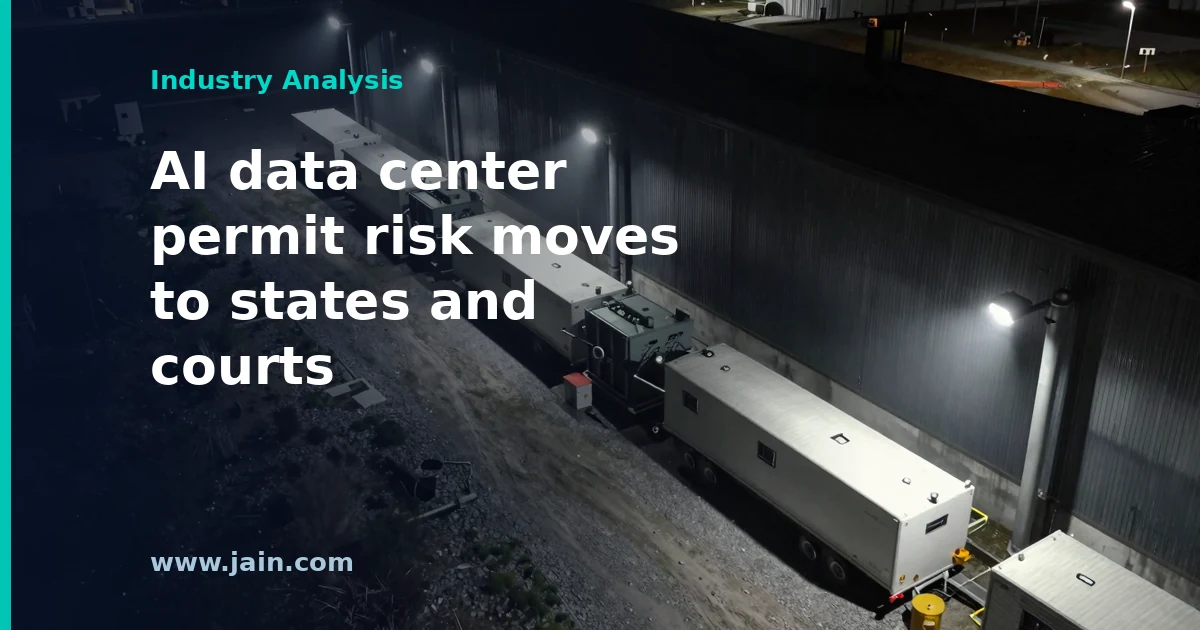
    The announcement follows a year of EPA actions easing permitting for power generation and data centers, and it lands amid active litigation: an April 14 Clean Air Act citizen suit by the NAACP, the Southern Environmental Law Center and Earthjustice alleging that xAI and its subsidiary MZX Tech operated 57 unpermitted portable methane gas turbines to power the Colossus 2 data center in South Memphis, and a June 16 Department of Justice motion to intervene and have that suit dismissed.

    Executive Summary

    EPA has taken itself out of the business of writing AI-specific environmental rules. There will be no national standard for data center water use, air emissions or cooling practices, and no federal list of recommended best practices. That removes a layer of regulation developers had reason to expect, but it does not suspend the Clean Air Act or the Clean Water Act, and it does not change the fact that most day-to-day permitting decisions sit with state and local agencies.

    The practical effect is to relocate risk rather than remove it. The part of an AI campus most exposed is on-site combustion — gas turbines and backup engines that make electricity on the property — because that equipment is what triggers air permits. With no federal template, those permits will be judged against differing state and local standards, and enforcement increasingly runs through private lawsuits, as the xAI case shows.

    Whether that private enforcement route stays open is now itself in question. The Department of Justice has argued that private groups cannot pursue Clean Air Act suits over the federal government’s objection. The outcome of that argument will shape the legal risk attached to fast-tracked on-site power across the industry.

    Stepping Back Is Not the Same as Fewer Permits

    Zeldin’s June 10 statement rules out new federal requirements and recommendations aimed at AI. It does not rewrite existing law. Data centers that burn fuel on site still fall under the Clean Air Act, and those that discharge water still fall under the Clean Water Act. New Source Review (NSR) — the Clean Air Act program requiring a permit before a large new pollution source is built — still applies. Until EPA finalizes the rule it proposed in May 2026, a major NSR permit is still required before any construction begins.

    Read in sequence, EPA’s recent actions share a pattern. In May 2025 it issued guidance allowing certain emergency engines to run up to 50 hours a year in non-emergency conditions to support grid reliability for data centers. In September 2025 it gave developers flexibility to start non-emissions-related building work before obtaining a Clean Air Act permit. In May 2026 it proposed redefining when construction legally ‘begins’ so non-emitting structures can go up earlier. Each step lets the concrete and steel move faster. None of them exempts the equipment that actually emits.

    Why 57 Turbines Mark Where the Risk Now Sits

    The server halls of an AI campus do not need an air permit; the generators feeding them can. That is the mechanism behind the title’s claim. When grid connections lag behind construction schedules, some developers bridge the gap with on-site gas generation, and that generation is precisely where Clean Air Act obligations bite. The citizen suit filed April 14 alleges that xAI and MZX Tech ran 57 portable methane gas turbines without required air permits to power Colossus 2 — a fleet the complaint treats as the data center’s power supply, not an ancillary backup. The allegations have not been proven in court, and the plaintiffs seek substantial penalties and cite health risks for families in South Memphis and North Mississippi.

    With EPA declining to set a national standard, the questions that decide cases like this — whether equipment crosses major source thresholds (the emissions levels above which a facility needs the most demanding permits), what controls are required, how long ‘temporary’ generation may run — are answered by state air agencies and local boards, and tested by private plaintiffs in federal court. A citizen suit is a lawsuit a private party can bring to enforce a federal environmental law after giving 60 days’ notice. The people most affected are developers using on-site generation to beat grid timelines, the lenders and customers relying on those schedules, and the communities living next to the equipment.

    The Justice Department’s Intervention Is the Swing Variable

    On June 16, the Department of Justice moved to intervene in the xAI case and have it dismissed. Its filing argues that the suit threatens national security by seeking to cut power to AI infrastructure that supports the Department of War’s operations, and, more broadly, that the executive branch holds exclusive authority to enforce federal law, so private parties cannot pursue Clean Air Act citizen suits over the government’s objection.

    If a court accepted that theory, it would sharply narrow a private right of action Congress wrote into the statute and raise separation-of-powers questions, since the executive branch would effectively decide which cases reach a judge. Crowell & Moring’s attorneys consider it unlikely the court will accept the argument. Either way, the ruling matters well beyond Memphis: it will tell developers whether federal non-enforcement actually lowers their exposure, or whether private enforcement fills the space EPA has left.

    A Patchwork Rewards Early Paperwork

    Without a national baseline, requirements will diverge by state and locality, and a multi-state developer will face different rules for the same turbine or cooling design. That favors operators who secure permits before breaking ground, audit whether their generation crosses major source thresholds, and treat compliance with federal law as protection against both citizen suits and a future administration that enforces more aggressively.

    Zeldin’s own acknowledgment that pollution- and water-reducing technologies exist points to a hedge: voluntary adoption of measures such as closed-loop cooling, which recirculates water rather than evaporating it, may reduce the odds of state action and local opposition. The competitive edge in this environment belongs less to whoever builds fastest than to whoever can show a regulator, a neighbor or a judge that the power plant behind the data center was permitted from day one.

    Background

    The US Environmental Protection Agency sets national rules under laws such as the Clean Air Act and Clean Water Act, but state and local agencies issue and enforce many of the permits that apply to individual facilities. The rapid growth of AI data centers — and the electricity they need — has drawn activity from Congress, the executive branch, federal agencies and the courts, without yet producing a cohesive regulatory framework.

    Since May 2025, EPA has issued a string of actions aimed at speeding data center and power plant construction, and in January 2026 it held a roundtable with the Data Center Coalition, the industry’s trade association. xAI’s Colossus 2 in South Memphis has become the most visible test of how environmental law applies to AI campuses that generate their own power on site.

    Sources

    Source: EPA Steps Back from AI Data Center Regulation: What Developers Must Know Now – Crowell & Moring LLP — EPA’s June 10, 2026 decision not to set national environmental standards for AI data centers, and the Clean Air Act litigation over xAI’s Colossus 2 turbines.