TL;DR · 30-second read
The Short Version
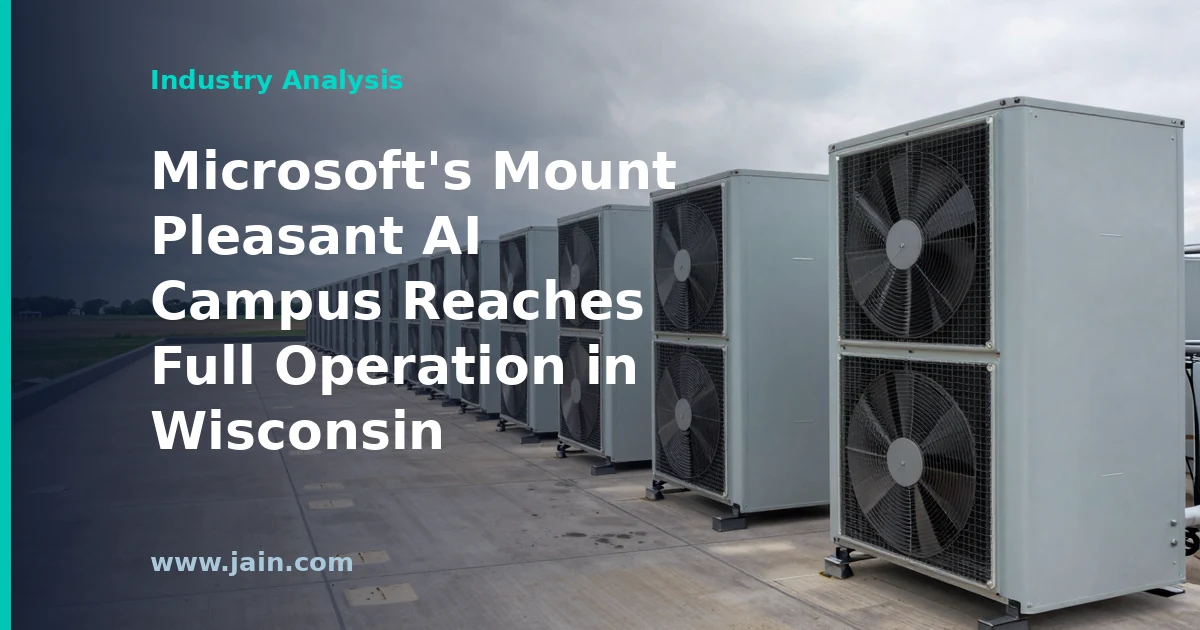
A factory near Milwaukee wants up to 300 new workers. It builds giant cooling systems for data centers, the warehouse-sized buildings full of computers that run websites and artificial intelligence tools.
Pay starts at $23 an hour, about $47,800 a year full-time. No factory experience is needed, and training happens on the job.
The surprising part is that the building opened a year ago. What the company needs now is people to run a second shift. Every one of those computer buildings needs cooling before it can switch on, so this hiring helps decide how fast they arrive.
Modine (NYSE: MOD), the Racine, Wisconsin-based thermal management company, said on September 23, 2026 that it is hiring for up to 300 long-term manufacturing positions at its data center cooling plant in Franklin, Wisconsin. The roles span first and second shifts. Production assembler pay starts at $23 an hour, second shift earns an extra $1 an hour, and benefits begin on day one. A walk-in hiring fair runs September 24 from 4 to 7 p.m., and a billboard campaign across the Milwaukee area will run while hiring continues over the coming months.
The 153,000-square-foot Franklin plant opened in September 2025 and makes Modine’s Airedale data center cooling systems. The announcement comes a week before Modine completes the spin-off of its Performance Technologies business into a combination with Gentherm, which is expected to close October 1.
Executive Summary
Modine’s announcement is a hiring notice, but it also shows where the company is in its data center cooling expansion. In July 2025 Modine announced added U.S. capacity for Airedale cooling products across plants in Franklin, Wisconsin; Grand Prairie, Texas; Grenada, Mississippi; and Jefferson City, Missouri. The Franklin building has now been operating for a year. Modine says the next step is people: “We’re now at a point where we need a larger, committed workforce,” said Karen Sutherland, Vice President of Human Resources for Data Centers, Americas.
That matters to anyone who depends on cooling equipment arriving on schedule. Once a plant exists, its output is set mainly by how many shifts it can staff and how quickly new workers become productive. Modine is recruiting mostly people without manufacturing experience and training them on the job. The speed of that process will shape how quickly the Franklin plant converts demand into shipped units.
The timing adds a corporate dimension. Filings made September 17 show Modine separating its Performance Technologies business on October 1. The company that remains, which Modine has said will be renamed Modexus Solutions, will be smaller and more concentrated on businesses like Airedale.
The Building Is Done. The Shifts Are Not.
A factory’s output comes down to three things: floor space, the hours that space is in use, and the productivity of the people working in it. Modine settled the first in September 2025, when it opened the 153,000-square-foot Franklin plant dedicated to Airedale data center cooling systems. This week’s announcement concerns the other two. Modine says the up-to-300 new hires will “help ramp up production to meet increasing demand,” and it is hiring across both first and second shifts, paying a $1-an-hour premium to fill the later one.
A second shift is usually the fastest and cheapest way to raise output from an existing plant. It needs no new permits, no construction, and no new utility connection. It needs people, and in Modine’s own words that is the requirement it has now reached. For the Franklin plant, the pace of growth now depends mainly on recruiting and training. Construction timelines matter less at this stage. This is the plain meaning of the title. Floor space in Franklin is fixed at 153,000 square feet, and extra output from it has to come from staffing more hours.
This affects data center developers and operators who are waiting on cooling equipment. A cooling supplier’s plant footprint is only a rough proxy for its delivery capacity. Shift coverage and workforce experience are closer measures. For Modine’s investors, the hiring pace becomes a leading indicator of whether Franklin can turn demand into revenue at the rate the company expects. Modine has not published any output targets for the plant.
What $23 an Hour and No Experience Required Signal
At $23 an hour and 40-hour weeks, a starting assembler earns about $47,800 a year before overtime, or about $49,900 on second shift. If all 300 positions were filled at the starting rate on full-time hours, base wages alone would come to roughly $14.4 million a year, before benefits and shift premiums. This is an illustrative calculation from the release’s figures, not a number Modine disclosed. Still, it shows that the ramp represents a meaningful recurring cost commitment.
The recruiting approach says more than the wage does. Modine says most entry-level roles need no prior manufacturing experience and that it provides on-the-job training. That widens the pool of applicants, but it also means new hires start at the bottom of a learning curve. Output per worker is likely to rise over months, not immediately. A walk-in fair with on-the-spot interviews and a Milwaukee-area billboard campaign point to hiring at volume. Modine also describes the roles as long-term. Hiring a permanent workforce rather than temporary labor suggests Modine expects demand to last, although that is the company’s own characterization and it has not tied the roles to a disclosed order book.
A Smaller Modine, More Concentrated on Cooling
The hiring announcement arrives days before a major change in Modine’s structure. According to an 8-K and the joint Gentherm–Modine release filed September 17, Modine will spin off its Performance Technologies business and merge it into Gentherm in a Reverse Morris Trust. In this structure, a unit is distributed to shareholders and immediately merges with another company, generally so the separation can be tax-free. The record date is September 28, and the distribution and merger are both expected October 1, 2026. Former SpinCo holders are expected to own about 43.6% of the combined company.
The filings also revise the cash side of the deal. Because falling overlap between Modine and Gentherm shareholders will increase the exchange ratio, Gentherm expects to issue about 2,902,466 additional shares. To offset that, the cash distribution to Modine before the merger is expected to fall from $210 million to $159 million, and Gentherm will pay its own shareholders a special dividend of about $58.35 million. The companies describe the adjustment as economically neutral, and final figures will be set at closing.
The Airedale data center cooling business stays with Modine. After October 1 it becomes a larger share of a smaller company, which Modine has said will be renamed Modexus Solutions. That raises the importance of execution at plants like Franklin. The analyst and investor day scheduled for November 18, 2026 is the next natural occasion for the company to put numbers on capacity, staffing and demand.
Background
Modine has worked in thermal management for more than 100 years. It is headquartered in Racine, Wisconsin, employs more than 11,000 people, and operates in North America, South America, Europe and Asia. It has reported two segments, Climate Solutions and Performance Technologies. Performance Technologies is being separated and combined with Gentherm on October 1, 2026, and the remaining company is due to be renamed Modexus Solutions. Modine’s data center cooling products are sold under the Airedale brand.
Data center cooling is the equipment that removes heat from server halls: chillers, air handlers and related systems that keep computing hardware within safe operating temperatures. As U.S. data center construction has grown, suppliers have added manufacturing capacity. Modine’s July 2025 expansion across four U.S. plants, including the Franklin facility that opened in September 2025, is its part of that buildout. Source: Continued Growth in Data Center Cooling Business Drives 300 Open Roles — Modine’s September 23, 2026 announcement of up to 300 manufacturing positions at its Franklin, Wisconsin Airedale plant. Primary sources: Modine Form 425 (Form 8-K), filed September 17, 2026; Exhibit 99.1 to Form 425: Gentherm and Modine joint press release, September 17, 2026; Modine Form 8-K, filed September 17, 2026; Exhibit 99.1 to Form 8-K: Gentherm and Modine joint press release, September 17, 2026.Sources