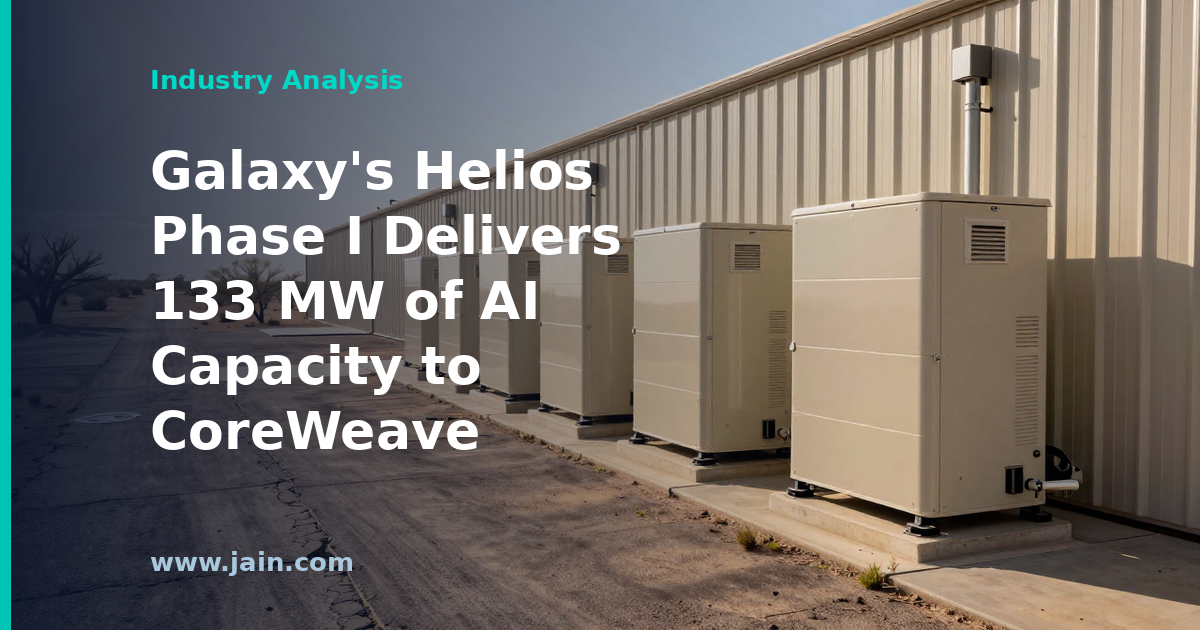
Galaxy announced on July 5, 2026 that it has completed Phase I of its Helios data center campus in West Texas, delivering 133 megawatts (MW) of critical IT load to CoreWeave, the AI-focused cloud provider. Critical IT load refers to the power available to the computing equipment itself — servers and GPUs — as distinct from the total power a facility draws for cooling and other overhead.
The completion converts a site that began life as a Bitcoin mining campus into dedicated AI infrastructure under Galaxy’s long-term lease arrangement with CoreWeave, one of the most prominent examples of the crypto-to-AI conversion trend reshaping the data center market.
Executive Summary
Galaxy, the digital assets and data center infrastructure firm, has finished the first phase of its Helios campus buildout and handed over 133 MW of critical IT load to its anchor tenant CoreWeave. Phase I completion moves the project from promise to delivery: Helios is now an operating revenue-generating AI data center rather than a conversion story on a slide deck.
The milestone matters beyond Galaxy. Helios is the flagship test case for whether former cryptocurrency mining sites — which come with grid interconnections and power contracts already in place — can be economically retrofitted to the far more demanding standards of AI training and inference infrastructure. Delivering a first phase at this scale suggests the model can work, at least for sites with strong power positions.
For CoreWeave, the delivery adds substantial contracted capacity at a time when access to powered land and energized shells — not GPUs — is widely seen as the binding constraint on AI cloud growth.
Why Crypto Sites Became AI Real Estate
The most valuable asset in data center development today is not land or buildings but secured power: a grid interconnection agreement and the megawatts behind it. Bitcoin mining operators spent the late 2010s and early 2020s locking up exactly that, often in low-cost power markets like West Texas. When AI demand exploded, those interconnections became worth far more serving GPUs than mining rigs, because AI tenants sign long-term leases at data center economics rather than riding volatile crypto margins.
Galaxy’s Helios campus, acquired from a Bitcoin mining operator, is the highest-profile execution of that arbitrage. The conversion is not trivial — AI facilities require far denser power delivery, liquid or advanced air cooling, and enterprise-grade redundancy that mining sites never needed — but the timeline still beats greenfield development, where new grid interconnection requests can queue for years.
What 133 MW Actually Buys
133 MW of critical IT load is a substantial block of capacity by any historical standard — a few years ago it would have ranked among the larger single-tenant deployments in the world. In the AI era it is best understood as a first tranche: large frontier training clusters are increasingly specified in the hundreds of megawatts, and operators including Galaxy have discussed multi-phase expansion at Helios well beyond Phase I.
Because the load is contracted to a single tenant, the economics resemble a triple-net real estate deal more than a retail colocation business: predictable lease revenue over a long term, with Galaxy carrying development and delivery risk and CoreWeave carrying utilization risk. That structure has become the dominant template for AI data center finance because lenders can underwrite the lease.
Winners, Losers, and the Competitive Field
The clearest winners are holders of energized or near-energized power positions — converted mining sites, utilities with spare interconnection capacity, and developers who queued early. CoreWeave benefits by adding capacity faster than greenfield timelines would allow, supporting its competition with hyperscale clouds for AI workloads. The pressure lands on developers still waiting in interconnection queues, and on regions whose grids cannot absorb gigawatt-class requests.
The open competitive question is durability. Conversion sites tend to sit in remote, power-rich locations, which suits training workloads that tolerate latency. If the market shifts toward inference — which favors proximity to users — the value of remote megawatts could be repriced. Phase I’s completion answers the execution question; it does not settle the location question.
Background
Helios began as one of the larger Bitcoin mining campuses in the United States before Galaxy acquired the site and redirected it toward AI and high-performance computing. Galaxy subsequently signed long-term lease agreements making CoreWeave the campus’s anchor tenant, with capacity to be delivered in phases — Phase I, now complete, being the first.
The conversion sits inside a broader industry shift: as demand for AI compute outran the pace of new grid connections, sites with existing power infrastructure — many of them crypto mining facilities in Texas and the Mountain West — became prime targets for repurposing. Helios is widely watched as the leading proof point for whether that playbook delivers at scale.
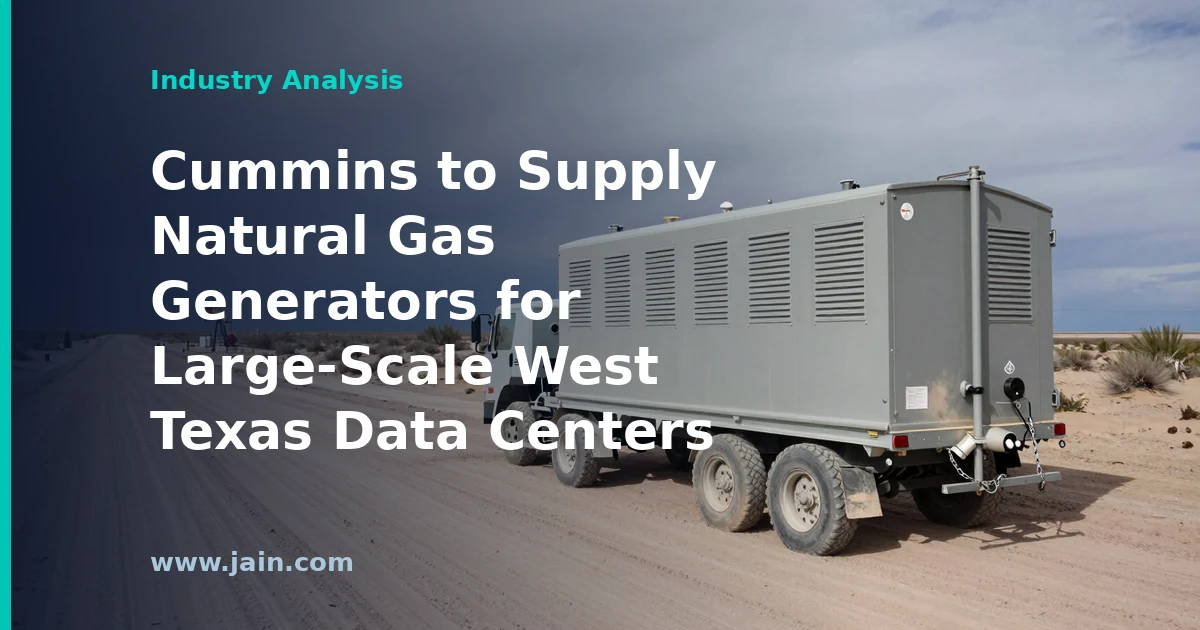
Cummins announced on June 15, 2026 that its natural gas generators will power large-scale data centers in West Texas. The announcement, issued by the engine and power-systems maker itself, confirms a supply arrangement for on-site power generation but does not disclose the customer, the number of units, the total generating capacity, or the delivery schedule.
Executive Summary
Cummins, the Indiana-based manufacturer best known for diesel engines and generator sets, says its natural gas generators have been selected to power large-scale data center development in West Texas. Stripped to its substantiated core, the announcement establishes three facts: the vendor (Cummins), the fuel (natural gas), and the setting (large-scale data centers in West Texas). Everything else — megawatts, dollars, dates, and the developer’s name — is left unstated.
Even so, the deal is worth attention because of what it represents. Data center developers are increasingly buying their own power plants rather than waiting years for utility interconnections, and West Texas — with abundant natural gas, cheap land, and a congested grid — has become the proving ground for that model. A generator manufacturer announcing data-center-scale natural gas orders is a data point in one of the most consequential shifts in how digital infrastructure gets energized.
Why Data Centers Are Buying Their Own Power Plants
The traditional model — build a data center, plug it into the utility grid — is breaking down under AI-era demand. Requests for new grid connections in fast-growing markets can take several years to fulfill, because utilities must study, permit, and build transmission lines and substations before energizing a large new load. For developers racing to deliver capacity to cloud and AI tenants, that queue is often the single longest item on the schedule.
On-site generation — sometimes called behind-the-meter power, because it sits on the customer’s side of the utility meter — collapses that timeline. Reciprocating natural gas generators of the kind Cummins builds can be manufactured, shipped, and commissioned far faster than a transmission project, and they can be added in increments as a campus grows. What was once purely backup equipment, sized to ride through rare outages, is increasingly being specified as primary or bridge power that runs for thousands of hours a year.
West Texas: Abundant Gas, Strained Wires
West Texas is a logical setting for this model. The region sits atop the Permian Basin, one of the most productive oil and gas regions in the world, where natural gas is plentiful and pipeline infrastructure is dense. Land is inexpensive, and the area already hosts substantial wind and solar development. What the region lacks is transmission: moving power across the Texas grid, operated by ERCOT (the Electric Reliability Council of Texas), is constrained by long distances and congested lines.
For a data center developer, that combination — fuel at the wellhead, but a bottlenecked grid — makes on-site gas generation attractive. Rather than exporting the region’s energy as electrons over strained wires, the data center effectively moves the demand to the fuel. The announcement does not say whether these facilities will also seek grid connections later, a common strategy in which on-site generation serves as a bridge until utility service arrives.
What It Means for Cummins and the Genset Market
For Cummins, data-center demand is reshaping a business that historically sold generators as insurance. Backup generators run perhaps a few dozen hours a year; prime-power installations run continuously, which means more units, larger service contracts, and steadier parts revenue. Major engine and turbine makers across the industry have reported stretched lead times for large power equipment as data-center orders stack up, so a manufacturer publicizing a West Texas win is competing for position in a genuinely supply-constrained market.
The competitive backdrop matters too. Data center developers weighing on-site power can choose among reciprocating gas engines, gas turbines, and, eventually, small modular nuclear or fuel-cell options. Reciprocating engines like Cummins’ occupy a middle ground: faster to deploy and more modular than turbines, though generally better suited to incremental capacity than to single gigawatt-scale blocks. Which architecture wins at a given site depends on scale, gas supply, and air-permitting headroom — none of which this announcement details.
The Trade-Offs the Headline Skips
Natural gas generation is cleaner than the diesel that has long dominated data-center backup — it burns with lower particulate and sulfur emissions — but it is still a fossil-fuel source with carbon dioxide and nitrogen oxide emissions, and large installations require air-quality permits from Texas regulators. Hyperscale tenants with public net-zero commitments will want to know whether gas-powered campuses fit their carbon accounting, whether the plants are bridge or permanent solutions, and whether the equipment can later run on lower-carbon fuels.
Reliability cuts the other way: a well-designed fleet of gas generators with firm fuel supply can rival or exceed grid reliability, and it insulates the tenant from ERCOT’s scarcity-priced energy market during extreme weather. The honest framing is that on-site gas is a pragmatic trade — speed and control in exchange for emissions and fuel-price exposure — and this release, as circulated, makes the case for the first half without quantifying the second.
Background
Founded in 1919 in Columbus, Indiana, Cummins built its reputation on diesel engines for trucks and heavy equipment, and its power systems division has long been a leading supplier of standby generator sets for data centers, hospitals, and industry. In recent years the company has expanded its natural gas engine lineup as customers seek lower-emission alternatives to diesel.
The backdrop is a historic surge in electricity demand from AI and cloud computing that has outpaced utilities’ ability to connect new loads. Texas has emerged as a leading destination for this buildout, and West Texas in particular — sitting atop the Permian Basin’s gas supply but far from major transmission corridors — has become a testbed for data centers that generate their own power on-site rather than waiting for the grid.