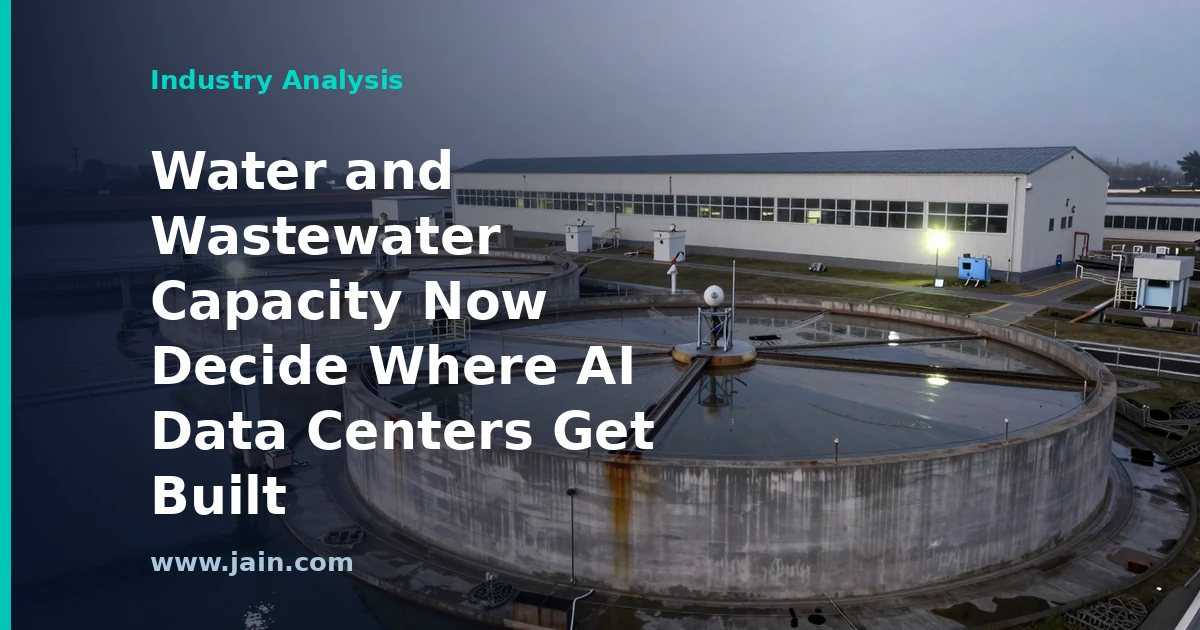
Data Center Knowledge reported on May 30, 2026 that water and wastewater capacity have joined — and in some markets now rival — electrical power as the decisive factors in where AI data centers can be built. The report’s framing marks a shift in an industry that has spent the past several years describing its siting problem almost entirely in megawatts.
Executive Summary
The report argues that the availability of water for cooling, and just as importantly the capacity of municipal systems to accept the water a facility discharges, now determine whether an AI data center project is viable at a given site. That is a meaningful reframing: since the AI buildout accelerated, the industry conversation has centered on grid interconnection queues and power procurement, with water treated as a secondary sustainability metric rather than a gating constraint.
Why it matters: if water and wastewater capacity are genuine go/no-go criteria, the map of viable AI data center locations changes. Sites with abundant power but strained water or sewer systems lose ground, while regions with underused water and treatment infrastructure gain a new selling point. It also pulls a different set of actors — water utilities, sewer authorities, and municipal planners — into negotiations that were previously dominated by electric utilities.
From Megawatts to Gallons: A New Siting Calculus
For most of the AI infrastructure boom, the binding constraint has been electricity: how many megawatts a utility can deliver, and how fast. Water has been discussed mostly in sustainability reports. The shift Data Center Knowledge describes — water as a siting decision, not a disclosure line item — reflects how AI-scale facilities actually work. High-density computing throws off enormous heat, and many cooling designs, particularly evaporative systems, consume large volumes of water to reject that heat to the atmosphere. A campus that can secure power but not water is still an unbuildable campus.
Wastewater is the less obvious half of the equation, and arguably the more interesting one. Water that runs through cooling systems and is not evaporated must go somewhere, often into municipal sewer systems as industrial discharge. Treatment plants are sized for the communities they serve; a single large industrial user can consume capacity a municipality planned to allocate over decades of residential growth. Discharge from cooling systems can also be warmer and more mineral-concentrated than household wastewater, which treatment plants must be equipped to handle. A town can have a river next door and still lack the permits, pipes, and treatment headroom to host an AI campus.
Winners, Losers, and the New Bargaining Table
If this framing holds, the winners are jurisdictions that can offer both power and water headroom — including regions with cooler climates that reduce cooling demand, or with industrial water infrastructure left over from manufacturing that has since departed. Water utilities and engineering firms that design treatment and reuse systems gain leverage and business. The relative losers are water-stressed markets that have competed for data centers on power and tax incentives alone, and developers holding land banks in places where the sewer authority, not the electric utility, turns out to be the limiting party.
For operators, the economics push toward designs that trade water for electricity or capital: closed-loop liquid cooling, dry coolers, and water recycling all reduce consumption but raise power draw or upfront cost. That trade-off means water scarcity does not just move projects — it changes their engineering and their operating cost profile. Expect water-use effectiveness (WUE), the industry’s ratio of water consumed per unit of computing energy, to get the same contractual and public scrutiny that power-use effectiveness (PUE) received a decade ago.
What the Framing Does and Does Not Establish
A note of even-handedness: the source available to us is a report headline and premise, not a dataset. The claim that water now “decides” siting is directionally consistent with well-documented industry trends — public disputes over data center water use in drought-affected regions, and the growth of water-positive pledges from major cloud providers — but the strength of the claim varies by market. In cool, wet regions with modern treatment plants, water may barely register as a constraint; in arid, fast-growing metros it can be decisive. Readers should treat “water decides siting” as an increasingly common condition, not a universal law, and ask for market-specific evidence — permit denials, moratoria, or utility capacity studies — before generalizing.
Background
Since the generative AI boom began in late 2022, data center development has grown at a pace that strained electric grids, making interconnection queues and power procurement the industry’s defining bottleneck. Water surfaced periodically as a flashpoint — community disputes over data center water consumption in drought-affected regions drew attention, and major cloud providers responded with public water-stewardship and replenishment pledges — but it was generally treated as a reputational issue rather than a siting gate.
Data Center Knowledge, the trade publication behind the report, has covered the industry’s infrastructure constraints throughout the buildout. Its framing of water and wastewater as decisive siting factors reflects the arrival of AI-scale campuses whose cooling demands, and whose discharge volumes, exceed what many municipal systems were designed to accommodate.
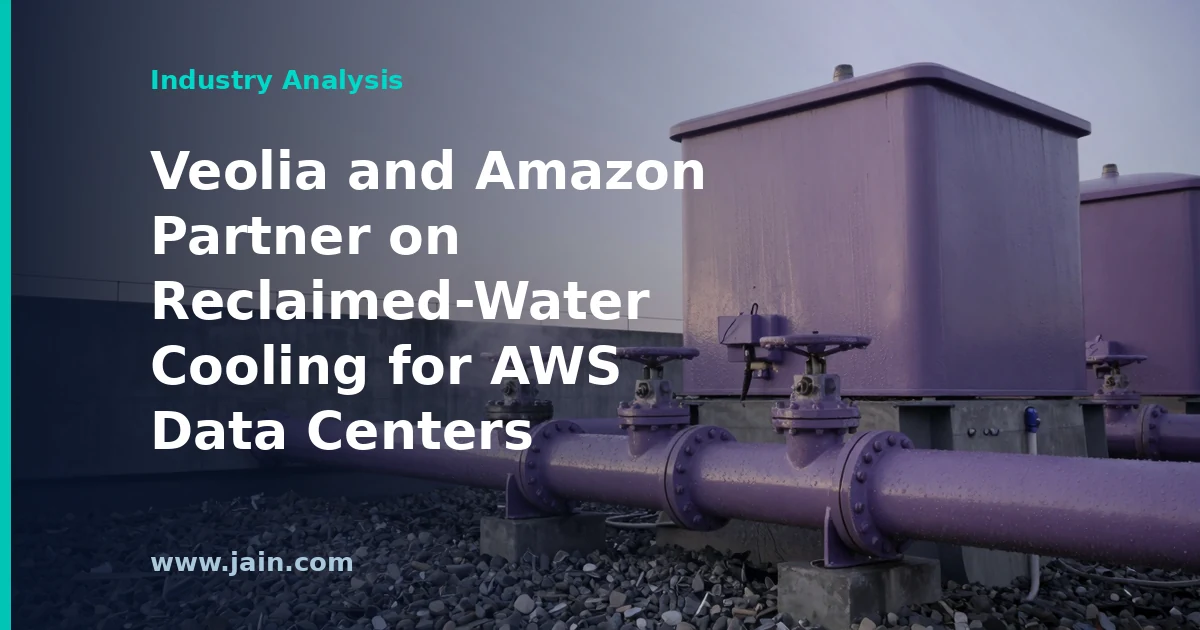
Veolia, one of the world’s largest water and environmental services companies, announced on April 27, 2026 that it is working with Amazon to develop a reclaimed-water cooling system for data centers. The collaboration targets Amazon Web Services (AWS) facilities, aiming to substitute treated, recycled water for the potable water that many data centers currently draw for cooling.
Executive Summary
The announcement pairs the operator of some of the world’s largest water-treatment networks with the world’s largest cloud provider on one of the industry’s most scrutinized problems: how much drinking-quality water data centers consume to stay cool. Reclaimed water — wastewater that has been treated to a standard fit for industrial reuse, though not for drinking — can displace that potable draw, easing pressure on municipal supplies in the communities where hyperscale campuses cluster.
For Amazon, the partnership supports its publicly stated goal of becoming “water positive” by 2030 — returning more water to communities than its operations consume — and, just as practically, it addresses a growing source of friction in siting and permitting new capacity. For Veolia, it signals a move to position water expertise as core infrastructure for the AI-era data center buildout. The release, however, is light on specifics: no named sites, volumes, timelines, or financial terms were disclosed.
Why Water Is the Data Center Industry’s Quiet Constraint
Power gets most of the headlines, but water is increasingly the constraint that shapes where data centers can be built. Many large facilities use evaporative cooling, which chills servers efficiently by evaporating water — often millions of gallons per year per site, much of it drawn from the same municipal systems that supply homes. In drought-prone regions, that draw has become a genuine permitting and community-relations issue, with local opposition to new campuses increasingly citing water alongside electricity and land.
The industry measures this through water usage effectiveness (WUE) — water consumed per unit of computing energy delivered — and operators face growing pressure from regulators, investors, and neighbors to disclose and reduce it. A credible, scalable alternative to potable water is therefore worth real money: it can be the difference between a project that clears local approval and one that stalls.
What Reclaimed Water Solves — and What It Doesn’t
Reclaimed water is municipal or industrial wastewater treated to a quality suitable for non-potable uses such as irrigation and industrial cooling. Using it for data center cooling substitutes a resource that would otherwise be discharged for one that communities drink. That is a genuine improvement, and it is proven ground: power plants and heavy industry have run on recycled water for decades. The engineering challenge is real but tractable — reclaimed water’s chemistry can promote scaling, corrosion, and biological growth in cooling loops, which is precisely the treatment problem a company like Veolia exists to solve, along with the pipeline infrastructure needed to move recycled water from treatment plants to campuses.
What reclaimed water does not do is reduce total water consumption. Evaporative cooling still evaporates the water, whatever its source. It changes which water is used, not how much — a meaningful distinction in water-stressed basins, where hydrologists note that treated wastewater returned to rivers also supports downstream flows. The release, as summarized, does not address consumption volumes or how the system compares with closed-loop and other low-water designs.
The Strategic Logic for Both Sides
For Veolia, hyperscale data centers represent a growth market adjacent to its core business: the company already operates treatment plants and industrial-water services worldwide, and packaging that capability for cloud providers moves it up the value chain from utility contractor to strategic infrastructure partner in the AI buildout. A named relationship with Amazon is also a powerful reference for selling similar systems to other operators.
For Amazon, the calculus spans sustainability accounting and siting pragmatism. Progress toward its water-positive pledge requires exactly this kind of substitution at scale, and demonstrating a reclaimed-water pathway gives AWS a stronger story in front of the councils and water authorities that approve new capacity. If the partnership produces a repeatable template rather than a single showcase, it could modestly widen the map of viable data center locations — and put competitive pressure on other hyperscalers, some of which have taken the different route of designs that eliminate evaporative water use entirely.
Background
Data center water use moved from an engineering footnote to a public issue over the past several years, as hyperscale construction accelerated to serve cloud and AI demand and communities in water-stressed regions began scrutinizing how much potable water evaporative cooling consumes. The major cloud providers have responded with public commitments — Amazon’s is a pledge to be water positive by 2030 — and with a mix of recycled-water sourcing, more efficient cooling designs, and replenishment projects.
Veolia, formed from more than a century of French municipal water operations and now one of the world’s largest environmental-services groups, has built its industrial business on exactly this kind of problem: treating and delivering non-potable water for cooling and process use. The April 2026 announcement extends that franchise into hyperscale computing, an infrastructure market whose growth currently outpaces most of the industrial sectors Veolia has traditionally served.