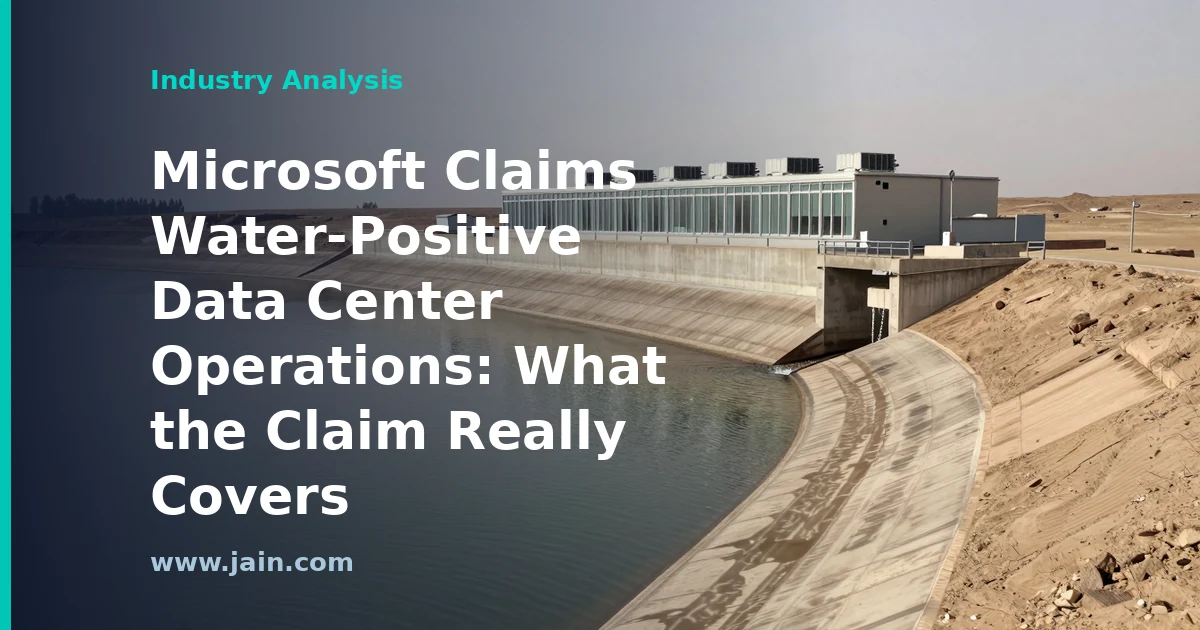
Microsoft is claiming water positivity across its data center operations, according to a June 27, 2026 report from Data Center Dynamics. Water positivity means an operator replenishes more water to stressed watersheds than its facilities consume — a milestone Microsoft first committed to reaching by 2030 when it announced its water-positive pledge in 2020.
The claim spans one of the world’s largest cloud footprints, and it arrives at a moment when AI-driven capacity growth has put data center water consumption under intense public and regulatory scrutiny. The available report is headline-level, so the scope, accounting method, and verification behind the claim remain to be detailed.
Executive Summary
Microsoft has publicly positioned its data center operations as water positive — consuming less water, net of replenishment projects, than it returns to the watersheds where it operates. If the claim holds up under scrutiny, it would represent the first time a hyperscale cloud operator has asserted that its fleet, as a whole, has crossed that line, and it would land years ahead of the company’s stated 2030 target.
Why it matters: water has become the second front, after power, in the fight over data center siting. Communities from Arizona to the Netherlands have pushed back on facilities that draw millions of gallons for evaporative cooling, and regulators increasingly ask for water commitments alongside grid commitments. A credible water-positive benchmark from the market’s second-largest cloud provider would reset expectations for every operator negotiating a site — including colocation and wholesale providers who compete for the same land, power, and permits.
The operative word is credible. Water positivity is an accounting construct, not a physical description of any single site, and its value depends entirely on scope, measurement, and where the replenishment actually happens. The source reporting available at publication does not yet answer those questions, and they are the right ones to ask of any operator making a similar claim.
What “Water Positive” Actually Means — and What It Doesn’t
Water positivity is a ledger claim: over a defined period, the volume of water an operator restores — through wetland restoration, leak-repair programs, irrigation efficiency projects, aquifer recharge, and similar investments — exceeds the volume its operations consume. Consumption here typically means water evaporated or otherwise not returned to the source, which for data centers is dominated by evaporative cooling, the technique of cooling air or water by letting some of it evaporate, trading water for large electricity savings.
What the construct does not mean is that any individual data center stopped drawing water. A facility in a drought-stressed basin can keep consuming while the corporate ledger balances with a restoration project elsewhere. That is not inherently bad-faith accounting — carbon markets work on a similar logic — but water is far more local than carbon. A gallon replenished in one river basin does nothing for the aquifer under a different one. The strongest version of a water-positive claim is basin-matched: replenishment in the same watersheds where consumption happens, weighted toward the most stressed ones. Whether Microsoft’s claim is basin-matched is exactly the kind of detail the headline-level reporting leaves open, and it is the difference between a milestone and a marketing line.
The Cooling Economics Behind the Claim
Data centers face a three-way trade among water, energy, and capital. Evaporative cooling is cheap and energy-efficient but water-hungry. Closed-loop and air-cooled designs eliminate most on-site water consumption but raise electricity use or capital cost, and in hot climates they can strain the power budget that operators are already fighting to secure. Microsoft has spent several years publicizing designs that move toward zero-water cooling for new builds, alongside efficiency metrics like WUE — water usage effectiveness, the liters of water consumed per kilowatt-hour of IT load.
A fleet-level water-positive result, if achieved early, most plausibly reflects three levers working together: newer builds consuming less per megawatt, replenishment portfolios scaling faster than consumption, and — the uncomfortable variable — how fast AI capacity growth adds consumption to the denominator. The AI buildout cuts both ways here. High-density AI halls increasingly use direct liquid cooling, which circulates coolant in a closed loop and can actually reduce on-site water consumption per unit of compute, but the sheer volume of new capacity can swamp per-unit gains. Any operator’s water math in 2026 is a race between those two curves.
A Benchmark With Teeth — If the Methodology Is Public
The industry consequence of this claim depends less on Microsoft than on procurement. Enterprise cloud buyers and public-sector tenders already ask for carbon disclosures; a hyperscaler asserting water positivity gives sustainability teams a new line item to demand from every provider. Google and Amazon have announced their own 2030-era water goals, so competitive pressure to demonstrate progress — not just pledge it — will rise. Colocation operators, who often lack the balance sheet for large replenishment portfolios, may feel the squeeze most: their water story is largely their cooling design, not an offsetting ledger.
For communities and regulators, the useful move is to treat the claim as an invitation to standardize. Today there is no universally accepted audit standard for water positivity comparable to the frameworks maturing around carbon. Claims are only comparable across operators if consumption scope (owned versus leased capacity, construction water, upstream power-generation water), replenishment crediting rules, and basin matching are disclosed. An early, well-documented claim from a market leader could seed that standard. A thinly documented one would invite the same greenwashing skepticism that has dogged renewable energy certificates — and would make life harder for operators doing the work rigorously.
Background
Microsoft is one of the world’s largest data center operators, running cloud infrastructure across dozens of countries to serve its Azure, Microsoft 365, and AI businesses. In 2020 the company pledged to become water positive by 2030 as part of a broader sustainability program that also targets carbon-negative operations, and it has since promoted lower-water cooling designs for new facilities alongside a portfolio of watershed replenishment projects.
The claim lands in an industry racing to build AI capacity while facing growing scrutiny over resource consumption. Water has joined electricity as a gating factor for new data center permits, and no common audit standard yet exists for corporate water-positivity claims — which makes the methodology behind any such announcement as consequential as the announcement itself.
Source: Microsoft claims water positivity across data center operations — Data Center Dynamics report, June 27, 2026, on Microsoft’s claim of water-positive data center operations.