
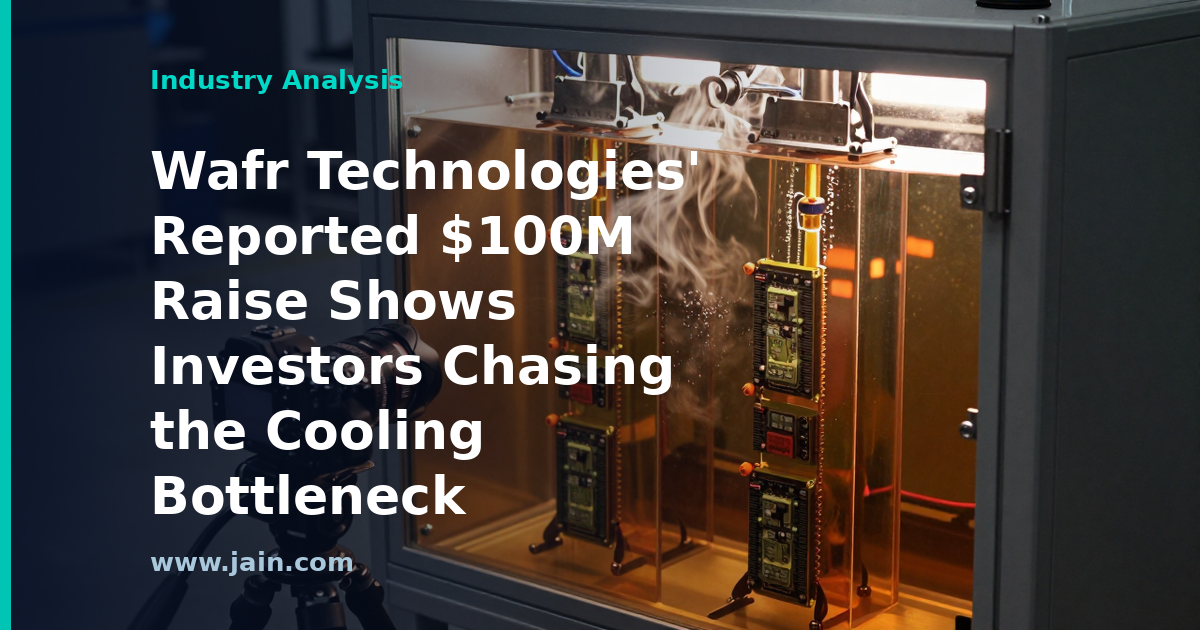
Cooling vendor Wafr Technologies has raised $100 million, according to a report carried by Data Center Dynamics on July 7, 2026. The publication characterized the raise as a report rather than a company announcement, and the item available to us does not name the investors, the round structure, or the intended use of proceeds.
Executive Summary
According to the Data Center Dynamics item, Wafr Technologies — identified simply as a cooling vendor — has reportedly secured $100 million in new funding. That is the extent of what the source substantiates: a company name, a sector, a dollar figure, and the qualifier “report,” which signals the news has not been confirmed in detail by the company itself.
Even in that skeletal form, the story matters because of what it represents. Cooling — the unglamorous business of moving heat away from computer chips — has become one of the tightest constraints on data center construction in the AI era. A nine-figure round for a cooling specialist, if confirmed, would be another data point in a clear pattern: capital that once flowed almost exclusively to chips, land, and power is now chasing thermal management, because without it the rest of the AI buildout stalls.
Why Heat Became the Industry’s Chokepoint
For most of the data center industry’s history, cooling was a solved problem: blow chilled air across servers, exhaust the hot air, repeat. That model works up to roughly the power density of a traditional enterprise rack. AI training hardware broke the equation. Modern accelerated-computing racks draw many times what air can economically remove, which is why the industry is shifting to liquid cooling — circulating fluid directly to cold plates on the chips, or immersing hardware in dielectric fluid — to carry heat away far more efficiently than air ever could.
That transition is not optional for AI-class facilities, and it is happening faster than the supply chain matured. Cold plates, coolant distribution units, rear-door heat exchangers, and the engineering talent to deploy them have all been in tight supply. When a component becomes the binding constraint on a trillion-dollar buildout, capital follows. A reported $100 million round for a cooling vendor fits that logic precisely.
What a Nine-Figure Round Signals About the Market
Cooling has historically been the domain of large industrial incumbents — the Vertivs and Schneider Electrics of the world — for whom thermal management is one product line among many. Venture-scale money flowing to independent cooling specialists suggests investors believe the liquid-cooling transition is big enough, and moving fast enough, to support new entrants rather than simply enlarging incumbents’ order books.
It also says something about where returns are perceived to be. Building data centers is capital-intensive and increasingly commoditized; supplying the critical components that gate construction can carry better margins and faster growth. Investors who missed the GPU wave or the land-and-power wave may see thermal management as the remaining underpriced layer of the AI infrastructure stack. Whether that thesis pays off depends on execution questions this report cannot answer — but the direction of the money is itself informative.
Winners, Losers, and the Scaling Test Ahead
If the raise is confirmed, the most immediate beneficiaries are data center operators and their customers: more capitalized suppliers mean more manufacturing capacity, shorter lead times, and more competitive pricing in a segment where demand has outrun supply. Chipmakers benefit indirectly, since every rack that can be cooled is a rack that can be sold.
The harder question is whether a funded challenger can convert capital into share. Cooling is a trust business — operators are conservative about anything that puts liquid near multi-million-dollar hardware — and incumbents hold deep service networks and long-standing customer relationships. History in this industry suggests that well-funded specialists either scale into meaningful suppliers, get acquired by incumbents seeking their technology, or burn capital competing on price. A $100 million war chest buys time to find out which path applies; it does not guarantee the answer.
Reading a Report, Not a Press Release
It is worth being precise about the evidentiary status here. The source is a trade-press item flagged as a report — not a company announcement, not a regulatory filing. The figure could ultimately prove different in size, structure (equity versus debt), or timing. Trade reporting on private raises is often directionally right and precisely wrong. Until Wafr Technologies or its investors confirm the details, the responsible reading is: a credible industry publication believes a cooling vendor has attracted roughly $100 million, and that belief is consistent with everything else happening in the thermal-management market.
Background
For decades, data center cooling meant air: chillers, raised floors, and hot-aisle containment, handled largely by big industrial suppliers as one product line among many. The AI era upended that. Racks built around modern accelerators draw several times the power of traditional enterprise racks, pushing the industry toward direct-to-chip liquid cooling and immersion systems that can remove heat air cannot. That transition turned a mature, sleepy segment into one of the most supply-constrained corners of the infrastructure market, and capital has followed — into incumbents’ expansion and, increasingly, into independent specialists.
Wafr Technologies enters the public record here with little published history: the report available to us identifies it only as a cooling vendor. That thinness is itself common in this cycle, where private thermal-management companies often surface in trade press via funding reports before making detailed public disclosures.
Source: Cooling vendor Wafr Technologies raises $100m – report, Data Center Dynamics, July 7, 2026 — a trade-press report of the funding round, unconfirmed by the company at publication.