The newest AI computers run so hot that many are cooled with liquid piped right to the chips, a bit like a car’s radiator. That liquid has to stay clean, free of air bubbles and chemically balanced. If it doesn’t, the cooling quietly gets worse and parts wear out.
Vertiv, a big maker of power and cooling equipment for data centers, is buying King Environmental Services, an Irish company that specializes in exactly that upkeep. It is Vertiv’s second such purchase in under a year. Looking after the coolant is becoming an ongoing job, not a one-time setup.
Vertiv Holdings (NYSE: VRT), which makes power and cooling equipment for data centers, has agreed to acquire King Environmental Services Ltd. (KES). KES is headquartered near Dublin, Ireland, and provides fluid management, commissioning and load-testing services for high-density, liquid-cooled data centers across Europe, the Middle East and Africa (EMEA). Zawya carried the announcement on October 5, 2026.
Financial terms were not disclosed, and Vertiv said they are not expected to be material to its results. The deal is expected to close in the fourth quarter of 2026. It follows Vertiv’s December 2025 acquisition of PurgeRite, which the company describes as the foundation of its fluid management business in North America.
Executive Summary
Vertiv is buying a specialist field-services firm rather than a product line. KES flushes, filters, treats and validates the liquid that circulates through cooling systems. It also runs thermal load tests on liquid cooling infrastructure and electrical load tests on critical power systems before a facility goes live. Vertiv says the deal extends its “thermal management services capabilities” into EMEA and supports its strategy of serving customers “across the thermal chain.”
The significance is in the pattern and the scope. This is the second fluid-management acquisition Vertiv has named in roughly ten months, after PurgeRite in North America. The scope Vertiv describes runs well past installation day, covering “monitoring, maintenance and lifecycle optimization.” That is a statement about where Vertiv expects work and revenue to sit in liquid-cooled AI data centers: in the ongoing care of the coolant loop, not only in the hardware that carries it.
The Coolant Has Become Equipment That Needs Servicing
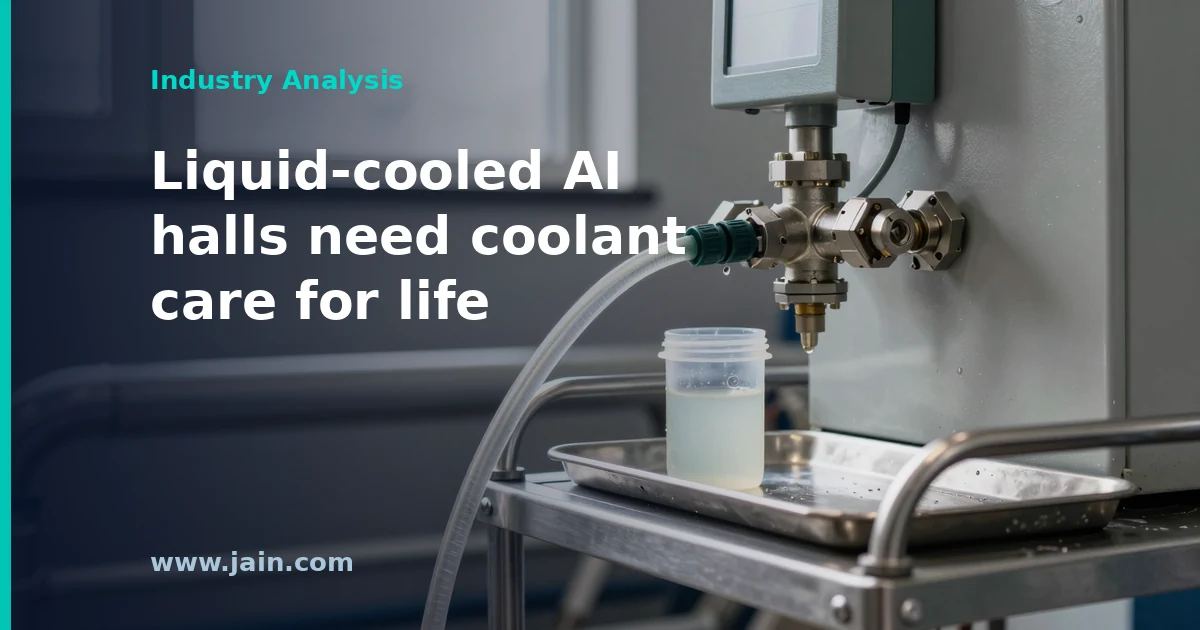
Air-cooled data centers move heat with fans and air handlers. Liquid-cooled AI halls instead pump a water-based coolant through cold plates mounted on the chips, then through coolant distribution units (pumps and heat exchangers) that pass the heat to the building’s water system. Vertiv’s announcement lists what goes wrong in that loop: contamination, trapped air, corrosion, improper chemistry and flow imbalances. Each reduces heat-transfer efficiency, degrades equipment and creates risk both at startup and in operation. The fluid’s condition changes over time, which makes it a component to be maintained, not plumbing to be installed and forgotten.
That mechanism explains why Vertiv describes KES’s scope in lifecycle terms: “system preparation, performance validation, monitoring, maintenance and lifecycle optimization.” It also says outright that “beyond initial commissioning, customers need lifecycle fluid management services.” CEO Gio Albertazzi framed it this way: “the performance of cooling and power infrastructure will depend as much on execution in the field as on engineering and system design.” Every liquid-cooled rack adds piping and fluid volume. That fluid must be flushed and validated before go-live, then sampled, treated and balanced for as long as the facility runs. Work of that kind recurs; it does not end at handover.
The people affected are the operators of AI data centers, whose uptime depends on fluid quality, and the tenants leasing that capacity. Also affected are the mechanical contractors and independent specialists who have historically done flushing and commissioning as project work. One caveat applies: Vertiv has not disclosed how much of this business is recurring maintenance versus one-time commissioning. The recurring-service thesis is clearly stated in the company’s strategy, but not yet shown in numbers.
Two Deals, Two Regions, One Template
PurgeRite gave Vertiv a fluid management base in North America; KES is meant to do the same for EMEA. Two acquisitions by one company do not make an industry trend. They do show a deliberate geographic build-out of the same capability, by a supplier whose equipment already sits inside the cooling loops these teams service. KES’s Dublin-area base puts it in one of Europe’s established data center markets.
KES also brings load testing. Thermal load testing uses heat-generating equipment to simulate a full room of running servers, so operators can confirm the cooling performs before costly AI hardware arrives. Electrical load testing does the equivalent for backup and critical power systems. Finding a flow imbalance or a power fault before the servers are installed is far cheaper than finding it afterward. Vertiv’s pitch is that one “single accountable partner” can handle commissioning, testing, fluid management and ongoing operations, plus compliance with regional rules on fluid handling, treatment and disposal.
A Small Price, a Clear Signal and a Neutrality Question
Vertiv says the terms are not material to its financial results. That suggests KES is small next to Vertiv’s business, and that this is a purchase of capability and footprint rather than revenue. Experienced field teams, local regulatory know-how and a safety record take years to build, and buying them is the faster route into a region. Vertiv’s own risk disclosures name the obvious exposure: keeping KES’s management and key employees, and maintaining its customer and supplier relationships, after the deal closes.
There is a fair question for buyers too. Commissioning is often valued as an independent check on what a vendor delivered. When the company supplying cooling equipment also validates and maintains it, customers may reasonably ask how independence is preserved. Vertiv’s single-partner model offers clear accountability. Whether customers weigh that above independent verification is something the market, not the announcement, will settle.
Background
Vertiv, headquartered in Westerville, Ohio, and listed on the New York Stock Exchange, supplies power, cooling and IT infrastructure, along with software, analytics and services, to data centers, communication networks and commercial and industrial facilities. It does business in more than 130 countries.
The shift behind this deal is the rise of liquid cooling. As AI and high-performance computing workloads push more heat into each rack, air alone struggles to remove it, and operators increasingly pipe coolant directly to the hardware. That makes the condition of the fluid, along with the testing and upkeep of the systems that carry it, a factor in uptime. Field services such as commissioning and fluid maintenance are becoming a larger part of how cooling suppliers compete.
Vertiv, an American company that makes the power and cooling equipment inside data centers, is buying King Environmental Services, a Dublin firm whose crews clean, fill and test the liquid cooling systems used by artificial intelligence computers.
Those chips run so hot that many new buildings pipe liquid right to them, much like a car’s radiator. A little dirt or trapped air in the pipes can overheat very expensive machines.
It is Vertiv’s second purchase of this kind in under a year. The bet: the hard part is getting the plumbing right on day one.
Vertiv Holdings Co (NYSE: VRT) said on September 24, 2026 that one of its wholly owned subsidiaries has signed a definitive agreement to acquire King Environmental Services Ltd. (KES), a fluid management, commissioning and load-testing specialist founded in 2002 and headquartered near Dublin, Ireland, with hubs in North Dublin and Frankfurt. Vertiv disclosed the deal in an 8-K filed the same day, with its press release furnished as Exhibit 99.1.
The transaction is expected to close in the fourth quarter of 2026. Vertiv did not disclose financial terms and said the deal is not expected to be material to its financial results. It follows Vertiv’s December 2025 acquisition of PurgeRite, which the company describes as the foundation of its North American fluid management business.
Executive Summary
Vertiv is extending into Europe, the Middle East and Africa (EMEA) a services line it began building in North America less than a year ago: preparing, cleaning, balancing and testing the liquid loops that carry heat away from high-density AI servers. KES brings pipework flushing, filtration and water treatment, testing, adjusting and balancing (TAB, the process of tuning flow so every branch of a cooling system gets the fluid it was designed for), and large-scale thermal and electrical load testing, in which heaters and load banks stand in for real servers so a facility can be proven before it goes live.
The deal is small by Vertiv’s own account, but the pattern is the story. Two consecutive fluid-management acquisitions, PurgeRite and now KES, put Vertiv’s capital into field crews rather than factories. CEO Gio Albertazzi framed the rationale directly: as computing density rises, cooling and power performance “will depend as much on execution in the field as on engineering and system design.”
For data-center builders and operators in Europe, the practical consequence is that one of the largest thermal equipment vendors now intends to own the commissioning and lifecycle fluid work around its systems, offering what it calls a single accountable partner from construction through operation.
Why Liquid Cooling Risk Concentrates at Handover
Air-cooled data centers are forgiving: if a fan underperforms, the room runs a little warmer. Direct liquid cooling is less forgiving. Heat moves from chips into a closed loop of treated water or coolant, and Vertiv’s own description of what can go wrong is specific: contamination, trapped air, corrosion, improper chemistry and flow imbalances can reduce heat-transfer efficiency, degrade equipment and create commissioning and operational risks. Every one of those failure modes is introduced or caught in the same window, when a newly built system is flushed, filled, balanced and brought under load for the first time.
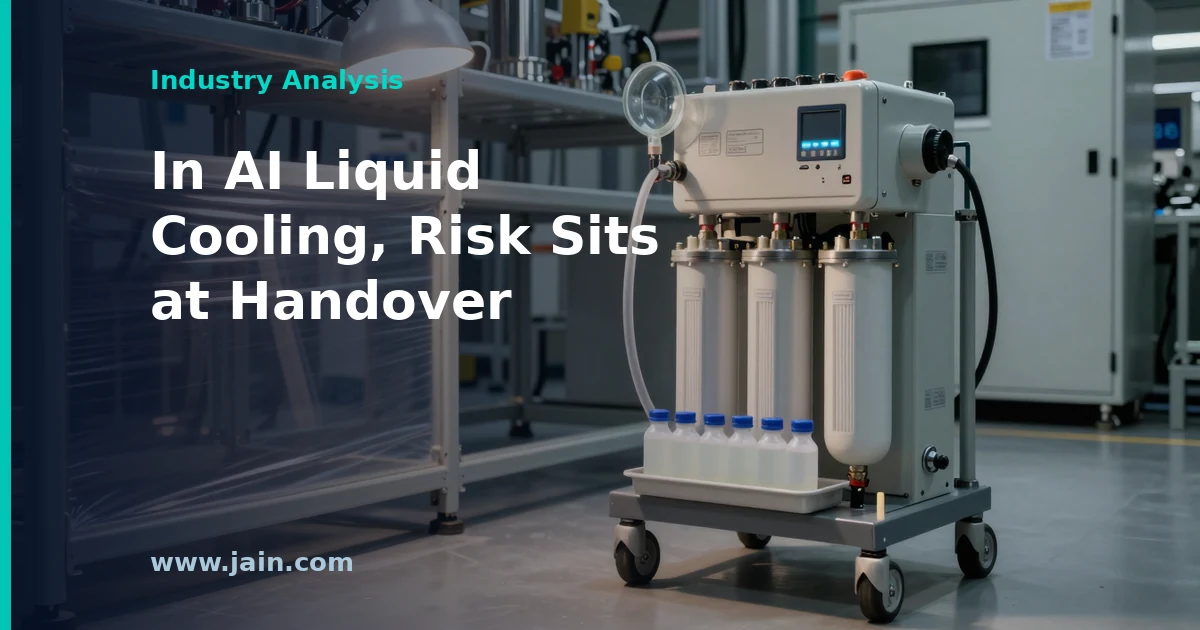
That window is the handover between construction and live operation, and it is exactly where KES sits. The company describes itself as bridging construction and live operation, validating that cooling systems are clean, balanced, design-compliant and ready for AI workloads, including through thermal load testing before a facility enters service. PurgeRite plays the equivalent role for Vertiv in North America. Buying two such firms in under ten months, December 2025 and September 2026, is a clear signal of where Vertiv believes customer risk now sits: not in whether a coolant distribution unit or cold plate works on a test bench, but in whether the loop around it was installed and prepared correctly on site.
This matters to three groups. Operators carry the downtime risk if a contaminated loop fouls hardware. General and mechanical contractors carry schedule risk if commissioning uncovers problems late. And hardware vendors carry reputational risk when a field problem is blamed on their equipment. Vertiv’s pitch of “a single accountable partner for commissioning, testing, fluid management and ongoing operations” is aimed squarely at that last point, collapsing a chain of hand-offs into one party that owns the outcome.
A Small Check With a Strategic Signal
Vertiv says the deal is not expected to be material to its results, and it furnished the announcement under Item 7.01, the Regulation FD disclosure item, in its September 24 8-K. In plain terms, this is a capability purchase, not a revenue purchase. Vertiv is buying people, procedures, regional permits and an operating footprint that would take years to build organically.
The economics also point toward recurring work. The release stresses that beyond initial commissioning, customers need lifecycle fluid management for availability, thermal performance and equipment longevity. Fluid chemistry drifts, filters load up and systems get expanded, so a firm that commissions a loop is well placed to maintain it. For an equipment maker, attaching a service relationship to each installed liquid-cooling system is a way to stay involved long after the hardware sale.
Vertiv’s own risk language underlines what it is really acquiring. Among the transaction risks listed in the release are its ability to maintain relationships with KES’s customers and suppliers and to retain KES management and key employees. In a field-services business, those relationships and people are the asset.
What EMEA Adds, and What Remains to Be Proven
KES operates from North Dublin and Frankfurt, two established European data-center hubs, and serves customers across EMEA. The release also highlights compliance with regional fluid handling, treatment and disposal requirements, a less glamorous but real advantage: treated coolant is a regulated waste stream, and a firm with local disposal routes and regulatory familiarity removes friction that a North American team would face entering the market.
The broader claims deserve a measured reading. Vertiv describes “significant customer benefits” and KES’s “strong reputation” but offers no figures on KES’s headcount, number of projects, load-testing capacity or customer base, so the scale of the European execution capacity being added cannot yet be assessed. Reach is also a fair question: two hubs in Ireland and Germany can serve a lot of Europe, but supporting the Middle East and Africa at the same standard is a different logistical task.
There is also a structural question for buyers. Commissioning has traditionally been valued partly for its independence from the equipment supplier. When the firm validating a cooling system is owned by the company that made parts of it, operators may want clarity on how test results, disputes and non-Vertiv equipment are handled. That is not a criticism of either company; it is the natural question any procurement team will ask as vendors move deeper into services.
Background
Vertiv, headquartered in Westerville, Ohio, and doing business in more than 130 countries, supplies power, thermal management and IT infrastructure equipment and services for data centers, communication networks and commercial and industrial facilities. As AI and high-performance computing push more heat into each server rack, operators are increasingly adopting liquid cooling, in which coolant is piped to or near the chips instead of relying only on moving air through the room.
Liquid cooling shifts a new kind of work onto construction sites and operations teams: the cleaning, filling, balancing and ongoing treatment of cooling loops. Vertiv entered that business in North America with its December 2025 acquisition of PurgeRite. KES, founded in 2002, has specialized in the same class of work in Europe and serves customers across EMEA from North Dublin and Frankfurt.
Vertiv is best known for keeping data centers cool. It is now spending up to $2.6 billion on a six-year-old North Carolina company that helps computing sites generate and manage their own electricity.
The reason: getting connected to the electricity grid has become the slowest part of building a facility for artificial intelligence. Waiting years for a utility hookup can cost more than building power on site.
The deal is expected to be completed by the end of 2026, if regulators clear it.
Vertiv Holdings Co (NYSE: VRT) announced on September 2, 2026 that its subsidiary Vertiv Corporation has agreed to acquire Utility Innovation Holdings, Inc. — which trades as UtilityInnovation Group, or UIG — a designer of microgrid controls, switchgear and behind-the-meter power architecture for data centers. Under the merger agreement dated September 1 and disclosed in an 8-K filed with the Securities and Exchange Commission, UIG equity holders, including holders of vested options and outstanding warrants, will receive approximately $1.45 billion in upfront cash at closing, subject to customary adjustments, plus up to $1.15 billion in additional cash payable in two tranches if EBITDA targets are met.
Vertiv’s announcement states the earnout is measured over 12- and 24-month periods and that the upfront price represents roughly 13 times UIG’s expected 2027 EBITDA. The company expects the transaction to be accretive to adjusted earnings per share in the first year after completion and says in the 8-K that it will fund the deal from existing resources. Closing is subject to customary conditions including expiration or termination of the Hart-Scott-Rodino antitrust waiting period, and is expected in the fourth quarter of 2026.
Executive Summary
Vertiv sells the power and cooling equipment that keeps data centers running — uninterruptible power supplies, switchgear, liquid cooling, and the service network behind them. The UIG acquisition extends that portfolio in a direction Vertiv has not previously owned: upstream of the building, to the point where a site meets the utility grid, and to the on-site generation and battery storage that increasingly sit alongside it.
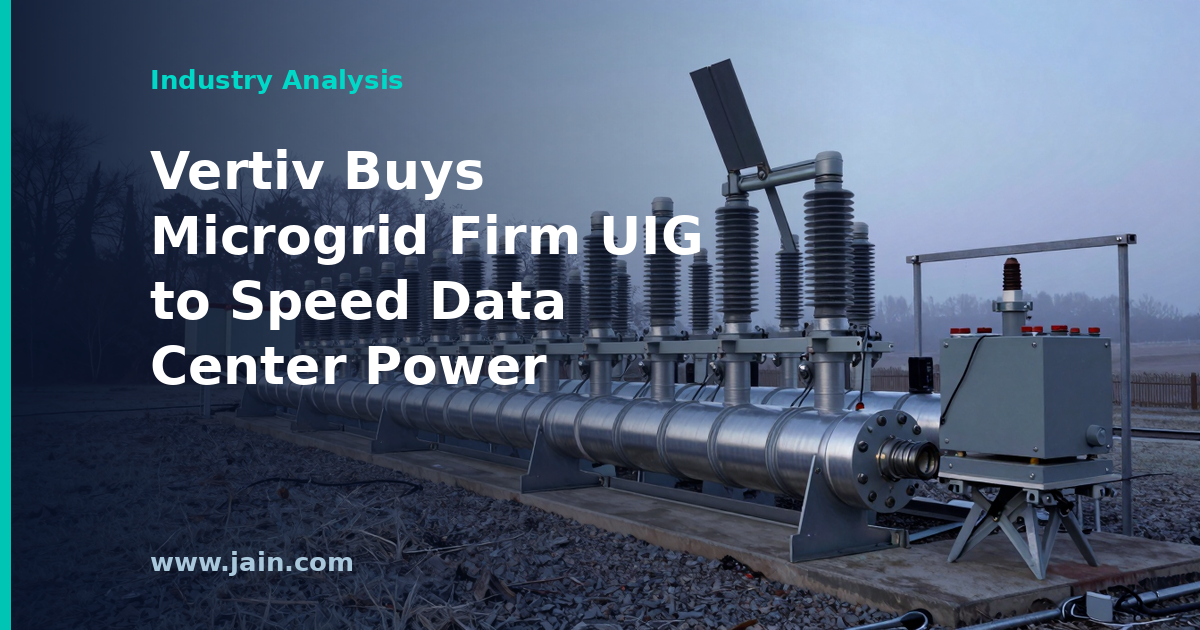
The strategic argument in Vertiv’s announcement is that power availability, not thermal capacity, now sets the pace of AI data center construction. CEO Gio Albertazzi framed it as the time from “site selection to first token” — the moment a facility produces its first unit of AI model output. UIG’s technology is the coordination layer for that problem: proprietary controls software, customized microgrid switchgear and energy storage that can balance load and frequency in real time across on-site sources and utility-connected resources.
For buyers, the deal signals consolidation of a fragmented layer of the stack — power architecture has historically been assembled from separate engineering firms, switchgear vendors and generation suppliers. For investors, the disclosed multiple of roughly 13 times expected 2027 EBITDA on a business founded in 2020 makes this a growth purchase, with more than 40 percent of the potential headline value deferred into an earnout that pays only if that growth arrives.
The Bottleneck Moved From the Rack to the Interconnect
For most of the last decade, the hard engineering problem in a data center was heat. Denser servers meant more watts per rack, and the industry’s capital went into airflow, then into liquid cooling delivered directly to the chip. Vertiv built a large business on that transition. The constraint has now shifted one step further out. A modern AI campus can require more electricity than a mid-sized town, and in many markets the local utility cannot deliver that connection for years — developers join an interconnection queue, the waiting list utilities and grid operators maintain for large new loads, and the queue, not the construction schedule, sets the opening date.
Vertiv’s announcement names three deployment modes UIG’s technology is meant to serve, and they map neatly onto how operators are working around that queue: grid-connected sites, “bridge-to-grid” deployments where on-site generation carries the load until the utility connection arrives, and fully islanded sites running on their own generation. The common requirement across all three is control — software and switchgear that can balance generation, storage and load in real time, and that can disconnect from or support the grid as conditions demand. That is the capability Vertiv is buying, and it is a genuinely different discipline from selling a cooling distribution unit.
The framing also explains why the announcement stresses that decisions are “moving earlier in the planning process.” Whoever is in the room when a developer chooses a power architecture influences a long tail of downstream equipment specifications. Vertiv is paying for a seat at that earlier meeting.
What 13x Buys, and What the Earnout Actually Says
The disclosed valuation is unusually informative. Vertiv states that approximately $1.45 billion represents about 13 times UIG’s expected 2027 EBITDA — earnings before interest, taxes, depreciation and amortization, a rough proxy for operating cash generation. That arithmetic implies expected 2027 EBITDA in the region of $110 million for a company founded in 2020. Vertiv has not published UIG’s revenue, backlog or margin profile, so the implied figure is the only quantitative anchor on the target’s scale that the disclosure provides.
The earnout is the more revealing structure. Up to $1.15 billion in additional cash is payable in two tranches against EBITDA targets over 12- and 24-month periods, and Vertiv says the effective multiple would be “significantly lower” if the full earnout is paid. That statement only holds if the earned EBITDA is materially higher than the base — for a $2.6 billion total to price at a meaningfully lower multiple than 13x, the acquired business would need EBITDA well above $200 million, more than double the level implied by the upfront price. Vertiv has not spelled that out, but it follows from the two figures it did disclose.
Structurally, this is risk allocation working as intended: Vertiv pays a defensible price for the business as it stands and pays a premium only against results that arrive. It also concentrates the seller’s incentives into a 24-month window, which is a familiar tension in founder-led acquisitions — the metric that maximizes a two-year earnout is not always the investment that maximizes value in year five. Vertiv’s statement that it will fund the purchase from existing resources, and its declaration of a $0.0625 quarterly dividend in a separate 8-K the same day, together indicate the company does not view the upfront cash as balance-sheet-straining.
Buying the Conductor, Not the Instrument
The most deliberate choice in this deal is what Vertiv did not buy. It has not acquired a turbine manufacturer, an engine maker or a fuel cell developer. It bought controls software, microgrid switchgear and storage orchestration, and both executives quoted in the announcement went out of their way to stress technology-agnostic architecture — Albertazzi’s phrasing was “without tying customers to a single generation technology or supplier,” and UIG founder and CEO Sidney Hinton described flexible, technology-agnostic architectures as the company’s founding premise.
That positions Vertiv as the integration layer above a generation market whose winning technology is genuinely unsettled, with gas turbines, reciprocating engines, fuel cells and large battery installations all competing for the same on-site role. Selling the conductor rather than the instrument avoids betting on the outcome, and it preserves Vertiv’s ability to sell into projects where the generation vendor has already been chosen by someone else. It also puts Vertiv into more direct contact with electrical-infrastructure incumbents and with the engineering firms that have historically owned power architecture as a services engagement rather than a product.
The competitive question this raises for the wider market is whether power architecture becomes a productized, vendor-integrated layer — the direction Vertiv is clearly betting on — or remains a bespoke engineering exercise per site. If the former, early consolidation of scarce controls expertise is valuable. If the latter, Vertiv has bought a specialist consultancy at a product-company multiple.
Where the Risks Sit
Most of the $1.45 billion is a claim on future performance rather than on assets in place. UIG is six years old, with manufacturing in North Carolina and New Jersey and a European base in Dublin; scaling physical switchgear production to serve global hyperscale demand is a manufacturing problem, not only a software one, and neither company has described current capacity or lead times. The transaction also remains conditional: the merger agreement requires expiration or termination of the Hart-Scott-Rodino antitrust waiting period and other customary approvals before the expected fourth-quarter 2026 close.
The deeper exposure is to the thesis itself. Vertiv is paying a growth multiple for scarcity — specifically, the scarcity of fast grid connections. If interconnection timelines improve through regulatory reform or utility investment, or if AI infrastructure spending decelerates, the premium customers will pay for speed compresses, and with it the earnout Vertiv has agreed to fund. That is a defensible bet on the evidence currently available about grid constraints, but it is a bet on a constraint persisting, which is a different thing from a bet on demand persisting.
Investors should also note what the filing itself cautions: the representations and warranties in the merger agreement were negotiated to allocate risk between the parties, not to establish facts, and Vertiv explicitly says they should not be read as disclosures about either business.
Background
Vertiv Holdings Co (NYSE: VRT), headquartered in Westerville, Ohio and formerly the Emerson Network Power business, supplies the power, cooling and IT infrastructure that keeps data centers, communication networks and industrial facilities running, together with software, analytics and services, and does business in more than 130 countries. Its growth over recent years has been closely tied to data center construction, and particularly to the shift toward denser, higher-power computing that made advanced thermal management a mainstream requirement rather than a specialty.
The market context for this deal is the emergence of electricity supply as the gating factor in that construction. Large new computing loads must be approved and connected by utilities and grid operators, a process that can take years in constrained regions, which has pushed developers toward on-site generation, battery storage and microgrid architectures that let a site operate before — or partly independent of — its utility connection. UIG, founded in 2020, sits squarely in that niche, supplying the controls, switchgear and storage orchestration that make such systems balance load and frequency in real time.
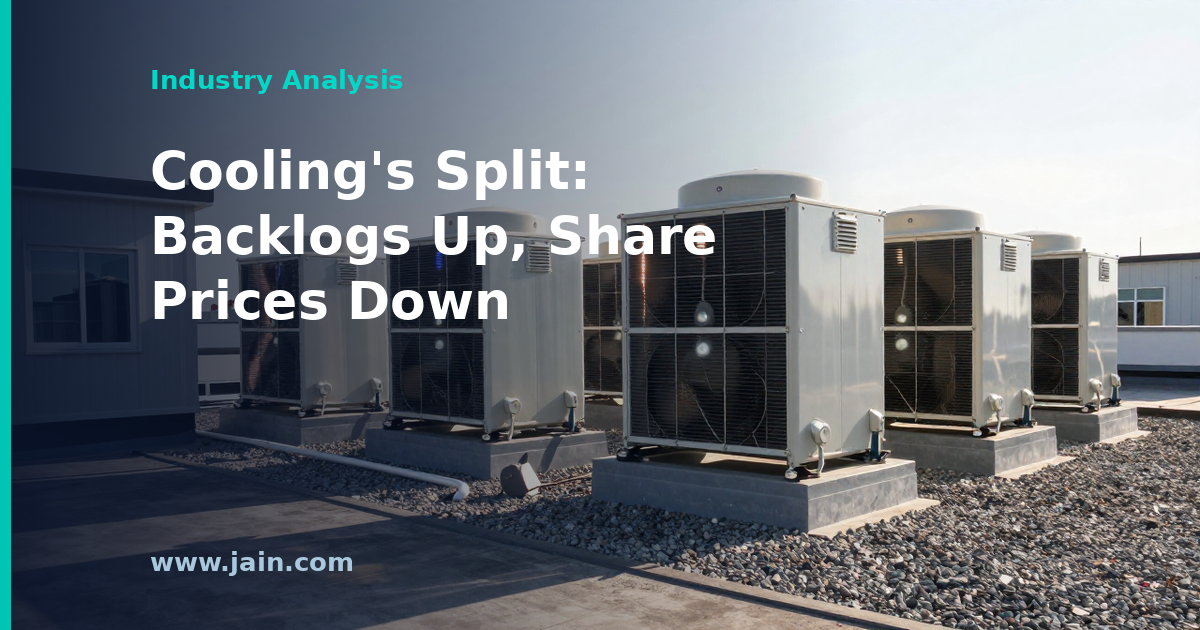
Two thermal-management suppliers moved in opposite directions in the same news cycle. Aggregated coverage carried by Google News reports that shares of Vertiv Holdings (NYSE: VRT), one of the largest vendors of data center power and cooling systems, fell 12%, under a headline asking whether the decline is a buying opportunity. A separate item reports that Modine Manufacturing (NYSE: MOD) gained on a $4 billion data center figure.
The available source material is limited to those two aggregated headlines. The Modine headline is truncated in the feed as “$4B data center c…” and no underlying release text, dated filing, customer name, or delivery window accompanies either item.
Executive Summary
The news itself is small: one stock down 12%, another up on a large dollar figure. What makes it worth an article is the divergence. Vertiv and Modine sell into the same demand driver — the buildout of AI data centers, whose dense computing racks generate far more heat per square foot than conventional servers and increasingly require liquid cooling rather than air. If that demand were the only variable, the two share prices would tend to move together. They did not.
The most defensible reading is that investors are no longer pricing thermal-management companies purely on demand. They are pricing the gap between demand and what is already embedded in each share price. A supplier can book record orders and still see its stock fall if the market had assumed even more; a smaller supplier can rerate sharply on a single large figure because far less was assumed to begin with.
For infrastructure buyers, none of this changes physics or lead times. But supplier share prices influence capital costs, capacity expansion decisions and acquisition activity, so procurement teams have a legitimate reason to watch the tape — without mistaking it for operational news.
Order Books and Share Prices Answer Different Questions
A backlog or contract figure answers a backward-looking question: what has a customer already committed to buy? A share price answers a forward-looking one: is the expected future stream of profits better or worse than what buyers had already paid for? These can diverge for long stretches, and the reported moves are consistent with exactly that. A $4 billion data center figure at Modine is large relative to the company’s historical association with vehicular and building HVAC heat exchangers, so it plausibly resets expectations upward. Vertiv, by contrast, has been among the most visible listed proxies for AI infrastructure spending, which means a good deal of optimism can already sit inside the price before any new information arrives.
This is the ordinary mechanics of expectations, not evidence that AI cooling demand is weakening. Nothing in the source material states why Vertiv shares fell. A 12% single-move decline in a high-expectation industrial name can follow guidance, margin commentary, a customer concentration disclosure, a sector-wide rotation, or an analyst action. Attributing it to any one cause without the underlying report would be speculation.
Liquid Cooling Is Real Revenue, Not Just a Theme
The substantive point beneath both headlines is that thermal management has moved from a line item to a gating factor. When a rack of AI accelerators draws many times the power of a traditional server rack, air alone stops working economically well before it stops working physically. That pushes operators toward direct-to-chip cold plates, rear-door heat exchangers and, at the extreme, immersion — all of which involve pumps, manifolds, coolant distribution units and heat rejection equipment that did not exist in volume in the previous generation of data centers.
That shift widens the addressable market and, importantly, widens the supplier set. Cooling was historically dominated by a small group of specialists selling precision air-conditioning units. Liquid cooling draws in companies with heat-exchanger and fluid-handling engineering heritage from adjacent industries. Modine’s move is the clearest illustration in this news cycle of an adjacent-industry entrant being repriced as a data center supplier. The competitive implication for incumbents is not that demand disappears; it is that the premium for scarcity may compress as more credible suppliers qualify.
What Procurement Teams Should Actually Do With This
Buyers should separate two signals. The first is capacity: a supplier reporting a very large committed order book is telling you its factories and engineering teams are spoken for, which is a lead-time warning as much as a growth story. The second is durability: a supplier whose equity falls sharply is facing a higher cost of capital, which can constrain the very capacity expansion buyers are counting on. Neither headline here is severe enough to warrant requalifying vendors, but both argue for the standard disciplines — dual sourcing on long-lead thermal components, contractual delivery remedies, and design choices that do not lock a hall to a single vendor’s coolant distribution architecture.
For investors, the fair conclusion from two aggregated headlines is narrow: the market is differentiating within a trade it previously bought as a block. Whether Vertiv’s decline is an entry point or a repricing of expectations cannot be determined from the material available, and the source headline poses that as a question rather than answering it.
Background
Data center cooling was for decades a specialist niche dominated by precision air-conditioning vendors serving halls of relatively uniform, air-cooled servers. The economics were stable and the engineering incremental. The arrival of high-density AI computing changed that: rack power densities rose to levels where air cooling becomes impractical, pushing operators toward liquid-based approaches and turning cooling from a supporting utility into a constraint on how much computing a site can host.
That transition has made listed suppliers of power and thermal equipment, Vertiv among the most prominent, into widely traded proxies for AI capital spending, while opening the market to manufacturers such as Modine whose heat-exchanger engineering originated in other industries. Because both the demand and the expectations attached to it have risen quickly, share prices in this group have become sensitive to small revisions in outlook — the backdrop against which these two contrasting headlines should be read.
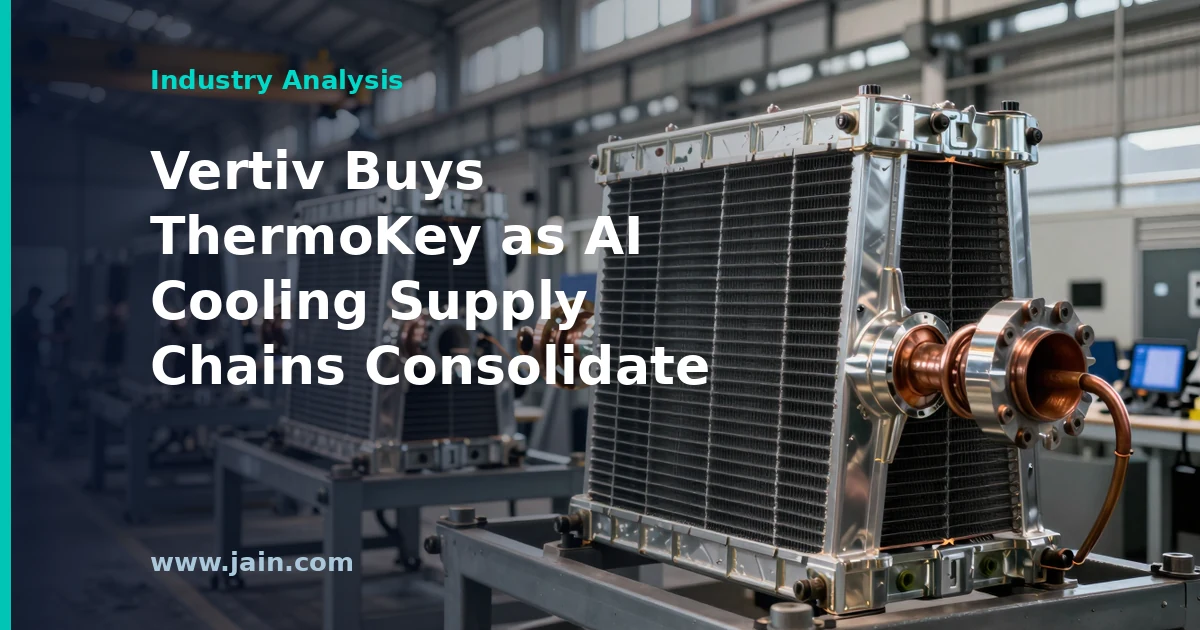
Vertiv, the NYSE-listed data center power and cooling vendor, announced a deal to acquire ThermoKey, an Italy-based heat-exchanger manufacturer, in a move the company frames as expanding its AI data center cooling capabilities. The announcement was reported on June 14, 2026; Vertiv’s shares slipped on the news. Financial terms were not detailed in the source report.
Executive Summary
The acquisition extends a clear pattern: as AI compute densities climb, the large data center infrastructure vendors are buying their way down the thermal supply chain rather than relying on third-party component makers. Heat exchangers — the coils and dry coolers that ultimately move server heat into outside air or water loops — are an unglamorous but capacity-constrained link in every cooling system, whether air-cooled or liquid-cooled.
For Vertiv, owning that link means more control over lead times, cost, and engineering integration at a moment when hyperscalers and colocation operators are ordering thermal equipment years ahead. The market’s muted reaction — shares slipped on the announcement — is a reminder that investors are weighing acquisition spending and integration risk against the strategic logic, particularly with no publicly detailed deal terms to anchor the math.
Why Heat Exchangers Matter in the AI Era
Every watt a GPU consumes becomes heat that must be rejected outdoors. Whatever technology sits at the rack — air handlers, rear-door heat exchangers, or direct-to-chip liquid cooling — the chain ends at heat-rejection hardware: coils, dry coolers, and condensers of the kind ThermoKey manufactures. As rack densities move from tens of kilowatts toward 100 kW and beyond, that heat-rejection stage scales in direct proportion, and it is built from metal, fabrication capacity, and factory floor space that cannot be conjured quickly.
By acquiring a heat-exchanger maker outright, Vertiv converts a supplier relationship into owned capacity. That matters less in a slack market and enormously in a tight one — and the AI buildout has made thermal equipment a long-lead-time item across the industry.
Vertical Integration Follows the GPU Buildout
This deal fits a broader consolidation wave. Vertiv itself has been assembling a fuller thermal stack for years, including its 2023 move on liquid-cooling specialist CoolTera, and competitors across the cooling landscape have pursued similar component-level acquisitions. The strategic logic is consistent: hyperscale customers increasingly want one accountable vendor for an integrated thermal chain, from the cold plate on the chip to the dry cooler on the roof, with matched controls and warranties.
For independent component makers, that creates a squeeze. Remaining suppliers may find their largest customers are now also their competitors’ owners — which historically pushes further consolidation, as remaining independents either scale up, specialize, or sell.
Reading the Share-Price Slip
The headline pairing — an expansion deal and a stock decline on the same day — deserves an even-handed reading. A slip on acquisition news is common and can reflect many things: general market movement, questions about price paid, or wariness about integration workload during a demand boom. Without disclosed terms, none of these can be confirmed from the source material, and a one-day move is a weak signal of a deal’s long-term merit.
What can be said is that investors are applying more scrutiny to AI-infrastructure spending across the board in 2026, and vendors announcing acquisitions now carry the burden of showing how each deal converts into margin or capacity rather than merely into breadth. Vertiv’s task is to demonstrate that owning heat-exchanger manufacturing shortens its lead times or improves its unit economics in ways customers and shareholders can measure.
Background
Vertiv became an independent company in 2016 when private equity firm Platinum Equity carved Emerson Network Power out of Emerson Electric, and it listed on the NYSE in 2020. It has since ridden the data center construction wave as one of the leading suppliers of the power distribution, thermal management, and enclosure systems that sit around the servers themselves, competing with firms such as Schneider Electric and a field of specialist cooling vendors.
The AI boom that accelerated in 2023 transformed cooling from a mature, slow-growth product line into a strategic battleground. Heat-exchanger manufacturing — historically a fragmented, regional business serving HVAC and industrial refrigeration as well as data centers — has become a supply chain chokepoint, setting the stage for component-level acquisitions like this one.
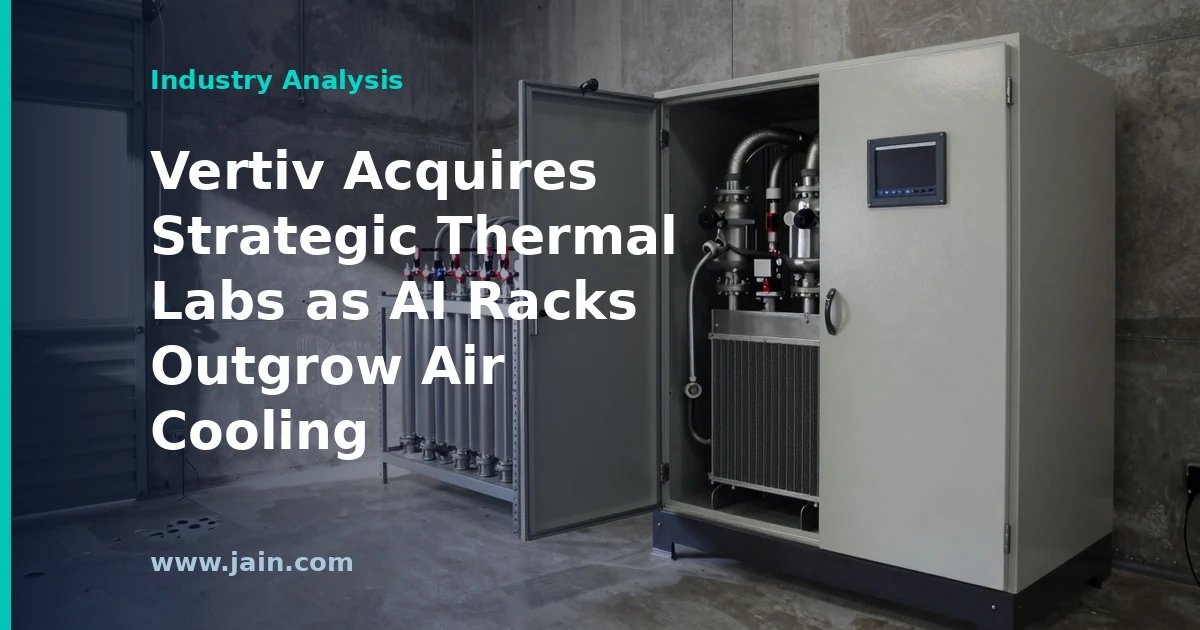
Vertiv, one of the largest suppliers of data center power and cooling infrastructure, has acquired Strategic Thermal Labs, a liquid cooling vendor, according to an April 26, 2026 report from Channel Dive. Financial terms and the scale of the target were not disclosed in the report.
The deal adds another liquid cooling specialist to Vertiv’s thermal management portfolio at a moment when AI computing is pushing rack power densities beyond what conventional air cooling can practically handle.
Executive Summary
The announcement itself is brief: Vertiv has bought a liquid cooling company. But the context is what matters. Liquid cooling — circulating fluid directly to hot components, or immersing hardware in it, rather than blowing chilled air across servers — has moved in just a few years from a niche technique to a central requirement for AI data centers. Racks built for AI accelerators draw many times the power of traditional enterprise racks, and the heat they produce increasingly exceeds what air can remove economically, or at all.
Vertiv has been assembling liquid cooling capability for years, and its largest competitors have been doing the same through their own acquisitions. Strategic Thermal Labs is the latest specialist to be absorbed into a major platform. For data center operators, the pattern points toward a market where liquid cooling is sold as part of an integrated infrastructure stack — power, racks, coolant distribution, and heat rejection from one vendor — rather than as a standalone specialty product.
What the report does not tell us is significant: no purchase price, no revenue or headcount figures for Strategic Thermal Labs, and no detail on which products or technologies motivated the deal. The strategic logic is clear; the economics are not yet visible.
Why Liquid Cooling Became a Must-Own Technology
For decades, data centers were cooled almost entirely by air: chillers and air handlers pushed cold air to server intakes and carried the exhaust heat away. That model works well when each rack draws modest power. AI changes the arithmetic. Racks packed with GPUs and other accelerators concentrate far more power — and therefore far more heat — into the same physical footprint, and at the densities modern AI hardware demands, air cooling becomes inefficient, then impractical.
Liquid is a far better heat conductor than air, which is why the industry has shifted toward direct-to-chip cold plates (metal plates with fluid channels mounted on processors) and, in some designs, full immersion cooling. Chip roadmaps from the major accelerator vendors increasingly assume liquid cooling as the default, meaning every serious data center infrastructure supplier needs credible liquid cooling products to stay relevant in AI buildouts. That makes specialist firms with proven technology natural acquisition targets.
Consolidation Follows the Thermal Money
This acquisition fits an established pattern rather than starting a new one. Vertiv previously bought coolant distribution specialist CoolTera to strengthen its liquid cooling line. Rival Schneider Electric acquired liquid cooling maker Motivair; electronics manufacturer Flex bought cold-plate specialist JetCool. The large infrastructure platforms are racing to own the full thermal chain — from the cold plate on the chip, through coolant distribution units, to the heat rejection equipment outside the building — because hyperscale and colocation customers increasingly want that chain engineered and warrantied as one system.
For the remaining independent liquid cooling vendors, consolidation cuts both ways. Acquisition interest validates their technology and offers a path to scale manufacturing quickly. But competing against integrated giants for large AI projects becomes harder, since those buyers value single-vendor accountability when a cooling failure can idle tens of millions of dollars of computing hardware. The likely trajectory is a market with a handful of full-stack thermal platforms and a shrinking field of independents serving specialized niches.
What Vertiv Gains — and What Remains Unproven
For Vertiv, the strategic appeal of bolt-on liquid cooling acquisitions is straightforward: they can add engineering talent, patents, and product lines faster than internal development, in a market where speed matters because AI capacity is being contracted years ahead. Thermal management is also attractive business territory — it is specified early in a data center’s design and generates ongoing service revenue over the facility’s life.
That said, the report substantiates very little beyond the fact of the deal. Without disclosed terms or information about Strategic Thermal Labs’ size, technology focus, or customer base, it is impossible to judge whether this is a significant capability acquisition or a small technology and talent tuck-in. Acquisitions in fast-moving hardware categories also carry integration risk: specialist engineering teams do not always thrive inside large product organizations, and overlapping product lines can create rationalization decisions that unsettle existing customers. Those are open questions, not criticisms — but they are the questions on which the deal’s value will ultimately turn.
Background
Vertiv traces its roots to Emerson Network Power, the data center infrastructure arm of Emerson Electric, which was spun off and renamed Vertiv in 2016. The company supplies the physical backbone of data centers — uninterruptible power supplies, power distribution, racks, and thermal management — and has ridden the AI infrastructure boom as one of its most direct beneficiaries, since every megawatt of new AI computing requires matching power and cooling equipment.
The liquid cooling market it is buying into has grown rapidly alongside AI deployment. A field once dominated by small specialists serving supercomputing labs is consolidating quickly as hyperscale AI buildouts turn liquid cooling into mainstream, high-volume business — a shift that has made those specialists prime acquisition targets for infrastructure giants like Vertiv, Schneider Electric, and large electronics manufacturers.