The Brookings Institution, a Washington-based public policy think tank, published an analysis on July 7, 2026 arguing that the wave of local opposition to data center construction across the United States is more than scattered NIMBY friction — it is an early signal of a broader political and economic fight over how much electricity artificial intelligence will consume, and who will pay for it.
Executive Summary
According to the piece’s framing, communities near proposed data center campuses are increasingly pushing back on projects through zoning hearings, moratoriums, and local elections. Brookings connects these disputes to the underlying driver: AI workloads require enormous amounts of electricity, and the infrastructure to deliver it — generation, transmission lines, and substations — lands in specific towns and counties whose residents did not sign up for it.
Why it matters: the data center industry has historically won siting battles on the strength of tax revenue and jobs arguments. If Brookings is right that opposition is hardening into an organized, durable political force, the industry’s expansion model — fast site acquisition, utility-negotiated power deals, and light-touch local engagement — may need to change. For an industry racing to build AI capacity, the constraint may prove to be not capital or chips, but community consent and grid access.
The Grid Is Where AI Meets Local Politics
Data centers are unusual among industrial facilities: they consume power on the scale of heavy manufacturing while employing relatively few permanent workers. That asymmetry is at the heart of the backlash Brookings describes. A large AI campus can draw as much electricity as a small city, which means new transmission lines, new substations, and in some regions new generation — all of which are visible, local, and subject to public process. AI is often discussed as an abstract technology; the grid is where it becomes a land-use question that a county board can vote on.
This gives local governments real leverage. Zoning approvals, special-use permits, and utility interconnection queues are choke points where a project can be delayed for years or killed outright. The industry has long treated these as procedural hurdles; the Brookings framing suggests they are becoming political contests.
Ratepayers, Tax Deals, and the Question of Who Pays
The economics beneath the backlash deserve attention. When a utility builds infrastructure to serve a massive new load, the cost recovery question — does the data center operator pay its full share, or do costs get socialized across all ratepayers — is decided in regulatory proceedings most residents never see. Where residents perceive that their electric bills are rising to serve a tech company’s servers, opposition tends to sharpen. Several state utility commissions have begun creating special large-load rate classes to address exactly this concern, an implicit acknowledgment that the old cost-allocation model strains under AI-scale demand.
Tax abatements cut the same way. Data centers are frequently recruited with incentive packages, and critics ask whether the revenue and job numbers justify them. Operators who can demonstrate full cost-of-service payment and transparent community benefit will be better positioned than those relying on confidentiality agreements and after-the-fact announcements.
What Hardening Opposition Means for the Buildout
If backlash becomes systematic, expect three shifts. First, siting migrates toward jurisdictions that actively want the load — regions with surplus generation, declining industrial demand, or explicit pro-data-center policy. Second, timelines lengthen and carry more political risk, which favors operators with existing land banks, secured power, and strong community track records over new entrants assembling projects from scratch. Third, self-supplied power — on-site generation, long-term clean energy contracts, and eventually small modular reactors — becomes more attractive precisely because it reduces the project’s visible draw on the shared grid.
None of this stops the AI buildout; demand is too strong. But it changes who can build, where, and how fast — and it rewards the operators who treat community engagement and grid stewardship as core competencies rather than public relations.
Background
Data centers — the warehouse-scale buildings full of servers that run websites, cloud services, and AI models — have expanded rapidly since generative AI took off in late 2022, with hyperscale operators and specialized developers announcing successive waves of multi-gigawatt campuses across the United States. Electricity availability has replaced land and fiber as the industry’s primary constraint, pulling utilities, state regulators, and local governments into what was once a quiet corner of commercial real estate. Northern Virginia, the world’s largest data center market, became an early flashpoint for community opposition, and similar disputes have since surfaced in markets across the country, making siting politics a national story that policy institutions like Brookings now track.
New Jersey’s legislature has passed a bill establishing a data center tariff and sent it to the governor for signature, Utility Dive reported on July 2, 2026. The measure targets how the electricity costs of large data centers are recovered, with the aim of shielding other utility customers from grid expenses driven by data center growth.
Executive Summary
According to Utility Dive’s July 2, 2026 report, New Jersey lawmakers have approved legislation creating a tariff framework for data centers and forwarded it to the governor. A tariff, in utility parlance, is the regulator-approved schedule of rates and terms under which a customer class buys power — so a data center tariff bill is, at its core, a decision about who pays for the wires, substations, and generation capacity that very large computing facilities require.
The move matters well beyond New Jersey. Electricity demand from data centers — especially AI-oriented facilities — has become the dominant growth story on the U.S. grid, and the costs of serving that growth have increasingly landed in debates over household utility bills. If signed, New Jersey would join a growing list of states acting to assign those costs to the data centers themselves rather than spreading them across all ratepayers. Notably, New Jersey is doing it through legislation rather than leaving the question to case-by-case utility rate proceedings.
Why Data Center Power Costs Reached the Statehouse
New Jersey sits inside PJM, the regional transmission organization that operates the grid across 13 states and procures capacity — commitments from power plants to be available — on behalf of utilities. Capacity prices in PJM have risen sharply in recent auctions, driven in part by projected data center demand, and those costs flow through to retail electric bills. That chain from AI build-out to household bill is what has turned a technical rate-design question into a live political issue in Trenton and other state capitals.
Legislators stepping in is itself significant. Rate design is normally the province of utility regulators — in New Jersey, the Board of Public Utilities — moving deliberately through contested proceedings. A statute compresses that timeline and signals that lawmakers did not want to wait for the regulatory process to allocate these costs on its own.
What a Data Center Tariff Actually Does
The core principle behind large-load tariffs is cost causation: the customer whose demand triggers new infrastructure should bear its cost. Serving a single large data center campus can require new transmission lines, substations, and capacity procurement running into significant sums. Under conventional ratemaking, much of that spending enters the utility’s general rate base and is recovered from all customers. A dedicated data center rate class changes that default.
Tariffs of this kind elsewhere have typically included features such as minimum demand charges (paying for a high share of requested capacity whether or not it is used), long contract terms, collateral requirements, and exit fees — protections against a utility building for a load that never materializes. Whether New Jersey’s bill includes these specific mechanisms is not detailed in the source report, and the final terms will determine how burdensome or benign the framework proves in practice.
Winners, Losers, and the Competitive Map
Residential and small-business ratepayers are the intended beneficiaries: the bill’s premise is that they should stop subsidizing infrastructure built for hyperscale computing. Utilities gain clearer cost-recovery rules and stronger protection against stranded investment, though they lose some flexibility in courting large customers with favorable terms. For data center developers, the calculus is mixed — a transparent tariff provides pricing certainty that ad hoc negotiations do not, but it likely raises the all-in cost of a New Jersey megawatt.
The competitive question is whether developers simply build elsewhere. New Jersey offers real advantages — proximity to New York, dense fiber routes, and a deep enterprise customer base — but neighboring PJM states compete for the same projects. The counterpoint: states including Ohio and Georgia have already adopted large-load protections through their regulators, and development there has continued. Grid cost allocation is one input among many; power availability, land, latency, and tax treatment often weigh more heavily.
The Signal to the Industry
The larger story is a shift in the default social contract around data center growth. Through the first wave of the AI boom, states competed to attract data centers with incentives; the emerging second phase pairs that welcome with conditions, particularly on energy. For hyperscalers and colocation operators, the practical takeaway is that grid-cost responsibility is becoming a standard feature of U.S. market entry, not an outlier risk. That strengthens the case for strategies the industry is already pursuing: securing generation directly, co-locating with power sources, and engaging early with regulators rather than arriving with a load request after the fact.
Background
New Jersey occupies a distinctive position in the data center landscape: adjacent to New York City, laced with dense fiber routes, and home to a long-established financial-services and enterprise colocation market. Like the rest of the PJM region, it has felt the bill impacts of surging capacity prices as data center demand — increasingly driven by AI training and inference workloads — reshapes grid planning.
The question of who pays for that growth has moved rapidly up state agendas since 2024. Utility regulators in several states have approved special rate provisions for very large loads, and legislatures have begun taking up the issue directly. New Jersey’s bill, as reported by Utility Dive, places the state among the earlier movers to address data center cost allocation by statute rather than leaving it wholly to regulatory proceedings.
Utility Dive reported on June 7, 2026 that behind-the-meter gas plants — power generation built on a data center’s own site, outside the utility’s meter — will raise US energy bills. The finding lands as AI data center developers increasingly turn to on-site gas turbines to sidestep multi-year grid interconnection queues, raising the question of who ultimately pays for the workaround.
Executive Summary
The report’s headline claim is direct: the wave of behind-the-meter (BTM) gas generation being planned for US data centers will not insulate ordinary consumers from AI’s power demand — it will add to their bills. “Behind the meter” means the plant serves the facility directly, bypassing the utility grid for most or all of its supply, and often bypassing the retail rates, transmission charges, and regulatory review that grid-served customers face.
Why it matters: BTM gas has been marketed as the pressure-release valve for the AI boom — a way for hyperscalers to get hundreds of megawatts energized in two or three years instead of waiting five or more for grid interconnection, without burdening other customers. If independent analysis concludes the opposite — that these plants raise systemwide costs anyway — it undercuts a central argument utilities, developers, and some policymakers have used to wave the projects through, and it strengthens the hand of regulators pushing for special large-load tariffs and cost-allocation rules.
Why Data Centers Are Building Their Own Power Plants
The context for this report is the collision between AI-driven load growth and a grid that cannot connect large customers quickly. Interconnection queues in major US markets stretch years, and transmission upgrades longer still. For a hyperscaler racing to deploy GPUs, a gas turbine on-site — behind the meter — converts an electricity problem into a procurement problem: buy the turbine, permit the plant, burn the fuel, skip the queue. That speed premium is why BTM gas has moved from a niche arrangement to a defining feature of the current data center buildout.
The pitch to regulators has been that this is self-contained: the data center pays for its own generation, so other ratepayers are held harmless. The Utility Dive report’s conclusion — that these plants will raise US energy bills — challenges that framing at its core.
How a Private Power Plant Can Raise Everyone Else’s Bill
With only the headline finding available, the report’s specific modeling cannot be evaluated here, but the mechanisms by which BTM generation can raise systemwide costs are well understood in utility economics. First, natural gas markets are shared: a fleet of new gas plants competing for fuel, pipeline capacity, and turbines can push up gas prices, and because gas units set the marginal price of electricity in much of the country, higher gas costs flow into wholesale power prices for everyone. Second, BTM facilities typically still rely on the grid for backup and startup power while contributing little to the fixed costs of the wires — costs that get spread across remaining customers. Third, if BTM load later converts to grid service, the system must absorb a large customer it never planned for.
Each of these is a cost-shifting channel, not a conspiracy: individually rational decisions by data center developers can still produce a collectively expensive outcome. That is precisely the kind of externality utility regulation exists to police.
Winners, Losers, and the Regulatory Stakes
The near-term winners of the BTM boom are clear regardless of the report’s conclusion: gas turbine manufacturers with multi-year order books, gas producers and pipeline owners, and developers who can monetize speed-to-power. The contested question is who bears the residual cost. If the report’s finding holds, the losers include residential and small-business ratepayers — and, notably, utilities’ own political capital, since public backlash over rising bills tends to land on the regulated utility whether or not it caused the increase.
For the data center industry, the strategic risk is regulatory: findings like this one give state commissions ammunition to impose standby charges, minimum-take tariffs, exit fees, or cost-allocation rules on large loads. Several states were already moving in that direction before this report. Operators that get ahead of the issue — structuring deals that demonstrably cover their grid costs — will face less friction than those that treat BTM as a permanent regulatory bypass.
Background
The US data center industry entered a period of unprecedented power demand growth in the mid-2020s, driven by AI training and inference workloads. After two decades of roughly flat US electricity consumption, utilities began forecasting sustained load growth, with data centers the largest single driver. Grid interconnection processes designed for a slower era became the bottleneck, and “speed to power” replaced land and fiber as the industry’s scarcest resource.
Behind-the-meter generation — long a niche arrangement for industrial plants with steam needs or reliability concerns — was repurposed as the fast lane: developers began pairing data center campuses with dedicated on-site gas turbines, sometimes at gigawatt scale. Utility Dive, a trade publication covering the US electric power sector, has tracked the resulting policy fight over who pays for AI’s power appetite; this report is part of that running debate.
MultiState, a state and local government relations firm, has published a comparative survey of five state legislative approaches aimed at protecting residential and small-business ratepayers from cost spillover as hyperscale data center load grows on regulated utility systems. The June 5, 2026 brief groups active bills by mechanism rather than by state politics.
The comparison lands as utilities across the country file rate cases citing data center interconnection queues that in some regions now rival or exceed peak residential demand.
Executive Summary
The MultiState overview does not endorse a single template. It catalogues five recurring legislative levers: dedicated large-load tariff classes, minimum demand or take-or-pay commitments, cost-causation rules that push new generation and transmission spend onto the loads that trigger it, transparency and reporting mandates, and outright caps or moratoria pending study.
For infrastructure operators, the practical question is which of these models a given state adopts, because each reshapes the economics of siting a campus, negotiating a power purchase agreement, and forecasting operating cost over a fifteen- to twenty-year asset life. For ratepayers, the question is whether any of the five actually insulates household bills from the capital spending a gigawatt-scale customer induces.
The survey is descriptive rather than prescriptive, and stops short of quantifying bill impact under each regime — a gap worth naming up front.
Why Five Approaches, Not One
The five buckets exist because states are not solving the same problem. A jurisdiction with abundant existing generation and a slow interconnection queue faces a different pressure than one where a single announced campus would consume a double-digit percentage of peak load. That heterogeneity is why a Virginia-style transparency mandate, an Ohio-style minimum-demand contract, and a Georgia-style dedicated tariff class can all be defended on their own terms without any one being obviously correct.
The unifying idea across all five is cost causation — the regulatory principle that the customer who causes a cost should pay it. The disagreement is over how to operationalize that principle when the causing customer is a hyperscale tenant whose load profile, ramp schedule, and even final identity may not be fully disclosed at the time infrastructure is committed.
Where Each Model Bites
Dedicated tariff classes are the cleanest theory: create a rate schedule only large loads qualify for, and design it to recover the marginal cost of serving them. The weakness is that generation and transmission are lumpy — a new combined-cycle plant or a 500 kV line serves everyone who touches the grid, and allocating its cost cleanly to one class invites years of contested proceedings.
Minimum demand and take-or-pay provisions address a different risk: a data center that signs up for a gigawatt, triggers utility capex, and then ramps slowly or cancels. These protect the utility’s balance sheet but do not, on their own, protect residential bills unless paired with allocation rules. Transparency mandates and moratoria pending study are procedural — they buy time and information but defer the underlying allocation fight.
Winners, Losers, and the Middle
Hyperscalers and colocation operators generally prefer the dedicated-tariff and take-or-pay path because it makes their cost predictable and defensible to their own customers, even if headline rates are higher. Vertically integrated utilities are broadly comfortable with any regime that lets them recover prudently incurred capital; their sharper concern is stranded cost if a promised load fails to materialize.
Residential advocates and small-business coalitions are the constituencies most exposed under weak allocation rules, and are the natural drivers of the caps-and-moratoria model. The middle ground — cost-causation statutes with reporting teeth — is where most of the 2026 legislative activity appears to be clustering, though the survey itself does not quantify that trend.
What This Means for Siting Decisions
For anyone planning a campus in the next twenty-four months, the regulatory model matters as much as the interconnection queue. A state moving toward a dedicated large-load tariff offers predictability at a premium; a state relying on transparency alone offers lower nominal rates but exposes the project to future reallocation. The five-model taxonomy is useful precisely because it lets an operator ask the right question of each jurisdiction rather than treating "data center friendly" as a single label.
Background
Retail electricity in most US states is regulated by a public utility commission that approves rates through periodic proceedings. Traditionally, large industrial customers were served under existing commercial and industrial tariffs, and their share of system cost was small enough that allocation debates rarely reached legislatures. Hyperscale data centers changed that: individual campuses now request hundreds of megawatts to more than a gigawatt, comparable to a mid-sized city, and clusters of them can dominate a utility’s forward capital plan.
Beginning around 2024 and accelerating through 2025 and into 2026, state legislators in jurisdictions with heavy data center growth — including but not limited to Virginia, Georgia, Ohio, and several others — introduced bills to address who pays for the resulting infrastructure. MultiState’s June 2026 brief is one attempt to make that patchwork legible to a national audience.
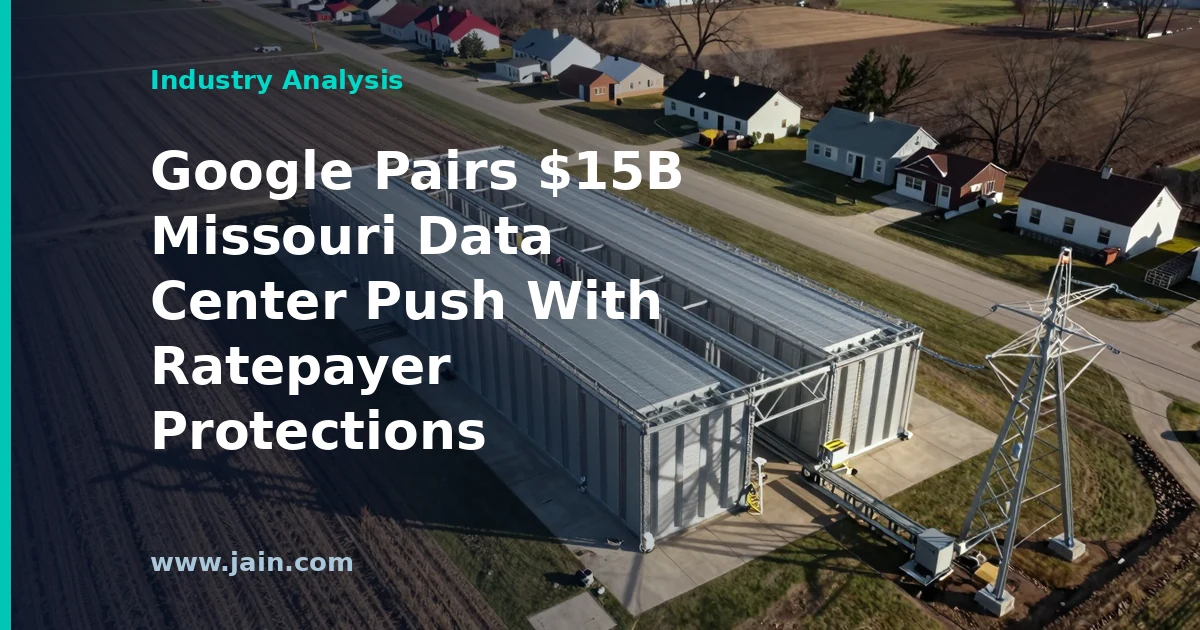
Google has announced a $15 billion data center expansion in Missouri, and — notably — the company is pairing the buildout with explicit power commitments and protections for utility ratepayers, according to a May 22, 2026 report by POWER Magazine. The pledge positions one of the world’s largest cloud and AI operators as a partner in managing the grid impact of its own growth, rather than simply a very large new electricity customer.
Executive Summary
The headline number is striking on its own: $15 billion is a top-tier hyperscale commitment, the kind of figure that historically flowed to established data center markets like Northern Virginia or central Ohio. Directing it to Missouri continues a broader migration of AI-era infrastructure toward interior states with available land, power, and political goodwill.
But the more consequential part of the announcement may be the framing. By foregrounding power commitments and ratepayer protections, Google is acknowledging the central tension of the AI infrastructure boom: data centers are now large enough to move electricity prices and strain grid planning, and communities have noticed. Structuring a megaproject so that existing utility customers are shielded from its costs — at least as pledged — is emerging as the price of admission for hyperscale development, and this deal reads as a template for that era.
Ratepayer Protection Is Becoming the Price of Admission
For most of the data center industry’s history, electricity was a procurement detail. That changed as AI training and inference pushed individual campuses toward the power draw of small cities. Utilities must build generation and transmission to serve that load, and under traditional regulated-utility economics, those costs can be spread across all customers — meaning households could subsidize infrastructure built primarily for a trillion-dollar technology company. Regulators, consumer advocates, and legislatures in several states have pushed back, demanding special tariff classes, minimum-payment contracts, and cost-allocation guarantees for large loads.
Google publicly committing to ratepayer protections up front, rather than having them imposed in a contested rate case, is therefore strategically significant. It shortens the approval path, lowers political risk, and sets a benchmark competitors will likely be measured against. The caveat: a headline pledge is not a tariff. What ‘ratepayer protection’ means in practice depends on binding terms filed with regulators, and the report available to us does not detail those terms.
Why Missouri, and Why Now
Missouri is not a legacy data center hub, and that is increasingly the point. The traditional markets are constrained — grid interconnection queues stretch for years, land prices have soared, and local opposition has hardened. Interior states offer buildable land, room on the transmission system, fiber routes crossing the middle of the country, and governments eager for capital investment and construction activity. A $15 billion commitment would instantly place Missouri among the more significant AI infrastructure destinations in the region.
For the state, the bargain is jobs, tax base, and relevance in the AI economy, weighed against long-lived demands on power and, typically, water for cooling. The durability of that bargain depends heavily on the details this announcement previews but does not fully disclose: how much generation gets built, who owns it, and how firmly the cost shield for existing customers is written.
The Economics of Pledging Power, Not Just Buying It
An explicit ‘power commitment’ from a hyperscaler can take several forms: funding or contracting for new generation, paying for transmission upgrades, guaranteeing minimum offtake so utilities can finance construction without stranding costs on other customers, or bringing dedicated supply behind the meter. Each shifts risk from the public to the developer in a different way, and each has different implications for how fast capacity actually arrives. Hyperscalers have learned that power availability — not chips, not concrete — is now the binding constraint on AI growth, so paying to expand supply is self-interested as much as civic-minded.
For the wider industry, deals like this raise the bar. Smaller operators and colocation providers cannot underwrite generation the way an Alphabet can, which could bifurcate the market: hyperscalers who bring their own power solutions, and everyone else competing for whatever grid headroom remains. Utilities, meanwhile, gain a rare growth story — if regulators can verify that growth genuinely pays its own way.
Background
Google has spent more than two decades building one of the world’s largest data center footprints, and the generative-AI boom that began in late 2022 pushed its infrastructure spending — like that of Microsoft, Amazon, and Meta — to unprecedented levels. As easy grid capacity in traditional hubs ran short, hyperscalers fanned out across interior states, turning electricity availability into the industry’s defining constraint.
That expansion has collided with utility economics. In multiple states, regulators and consumer groups have questioned whether households end up subsidizing grid buildouts made for tech giants, prompting special large-load tariffs and contract protections. Google’s Missouri announcement lands squarely in that debate, presenting itself as the cooperative model: hyperscale growth that pledges to pay its own way.
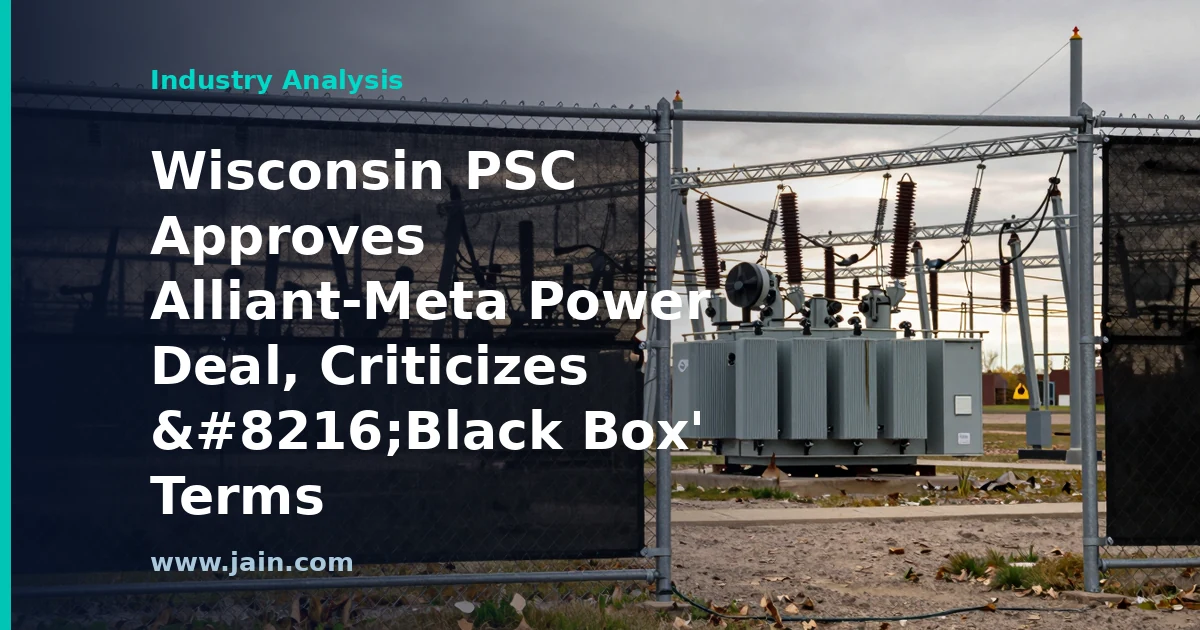
The Public Service Commission of Wisconsin has approved a power-supply arrangement between Alliant Energy and Meta to serve a planned data center in the utility’s Wisconsin territory, according to Wisconsin Watch reporting published May 6, 2026. Commissioners signed off on the deal but publicly criticized its ‘black box’ approach — a reference to confidential contract terms that keep key details, including those bearing on ordinary ratepayers, out of public view.
Executive Summary
State approval of a utility-hyperscaler power contract is normally a routine milestone. What makes this one notable is the regulators’ own commentary: the commission approved the Alliant-Meta arrangement while simultaneously faulting how much of it is shielded from public scrutiny. That dual message — yes to the deal, no to the process — captures the bind facing utility commissions across the country as AI data centers arrive with unprecedented power demands and equally unprecedented confidentiality requirements.
For the data center industry, the approval clears a regulatory hurdle for one of Wisconsin’s marquee technology projects. For utilities and their customers, the ‘black box’ criticism is the more consequential signal: commissioners are telegraphing that future large-load contracts may face demands for greater transparency, standardized tariff structures, or explicit ratepayer-protection findings before they get a vote.
Approve Now, Object Later: What a Split Verdict Signals
Regulators rarely attach public criticism to a deal they are approving. When they do, it usually means they concluded the underlying project serves the state’s interest — jobs, tax base, grid investment — but want to put the utility and its counterparties on notice for the next filing. The ‘black box’ language, as reported by Wisconsin Watch, suggests commissioners felt they were asked to vote on an arrangement whose economics they could describe to the public only in outline. That is an uncomfortable position for a body whose core mandate is protecting captive ratepayers, the households and small businesses who cannot shop for another electric utility.
The practical takeaway for developers and utilities is that approval-with-a-rebuke is a warning shot, not a victory lap. Commissions in several states have begun moving from one-off confidential contracts toward published large-load tariffs — standardized rate schedules for very big customers — precisely because case-by-case secrecy erodes public confidence. Wisconsin’s commissioners appear to be signaling sympathy with that direction, even as they let this deal proceed.
Who Pays for the Grid AI Needs?
The central economic question in any hyperscale power deal is cost allocation: does the data center pay the full cost of the generation, transmission, and distribution built to serve it, or do some costs land in the general rate base that all customers fund? Special contracts typically include minimum-take commitments, exit fees, and contributions toward infrastructure, but when those terms are confidential, outside parties cannot verify that the protections are adequate. That verification gap — not any specific allegation of subsidy — is what a ‘black box’ complaint is really about.
The stakes are larger than one contract. A single hyperscale campus can draw hundreds of megawatts, comparable to a small city, and utilities nationwide are proposing major generation and grid buildouts on the strength of data center demand forecasts. If a big customer later scales back, cancels, or negotiates better terms, stranded costs can migrate to everyone else’s bills. Transparent, verifiable contract structures are the primary tool regulators have to prevent that outcome — which is why their absence draws pointed language even from commissioners voting yes.
Wisconsin’s Bid for the AI Buildout
Wisconsin has emerged as a genuine contender in the Midwest data center race. Microsoft is developing a major campus in Mount Pleasant in We Energies territory, and Meta has publicly committed to a large data center project in Alliant Energy’s service area, announced in late 2025. Competitive electricity, available land, water, fiber routes, and an aggressive economic-development posture have put the state on hyperscaler shortlists that once defaulted to Virginia, Ohio, or Iowa.
That competitive dynamic cuts both ways in regulatory proceedings. States courting these projects have an incentive to accommodate confidentiality, since hyperscalers guard site economics closely and can take their capital elsewhere. But the same growth concentrates demand risk on local utilities and their customers. The commission’s approach here — approve the project, criticize the opacity — is an attempt to hold both goals at once, and other state commissions facing similar filings will likely study how Wisconsin manages that balance.
Background
The approval lands amid a national surge in data center electricity demand driven by AI computing, which has made utility commissions unlikely gatekeepers of the technology buildout. Wisconsin’s share of that surge includes Microsoft’s multi-billion-dollar campus in Mount Pleasant and Meta’s late-2025 announcement of a major data center in Alliant Energy’s service territory — the project behind this power deal. Meta, the parent of Facebook and Instagram, operates one of the world’s largest data center fleets and typically negotiates dedicated energy arrangements, often paired with renewable-power procurement, for each new campus.
Special contracts between utilities and very large customers have existed for decades, but the scale of AI-era loads has intensified scrutiny of them. Regulators in several states have questioned whether confidential, negotiated deals adequately insulate ordinary customers from the cost of new generation and grid capacity built for a single tenant — the same tension the Wisconsin commission voiced in this decision.