E&E News by POLITICO reported on May 4, 2026 that the AI boom has prompted a rare formal warning of “significant risks” to the electric grid. The warning, attributed to grid operators, centers on the reliability challenges created by rapid AI data-center load growth — the surge in electricity demand from facilities built to train and run artificial-intelligence models.
Executive Summary
According to the report, the organizations responsible for keeping the lights on have moved beyond quiet concern to an explicit, on-the-record caution: the pace and scale of AI-driven data-center demand now pose “significant risks” to grid reliability. In the deliberately understated language of the power sector, where public warnings are infrequent and carefully worded, a formal statement of this kind is a notable escalation.
Why it matters: grid operators and reliability bodies are the institutions that decide whether new large loads can connect, how much generation and transmission must be built, and what margins the system must hold in reserve. When they formally flag a risk, that assessment flows into planning studies, interconnection decisions, and regulatory proceedings. For data-center developers, utilities, and the AI companies driving demand, the message is that electricity availability — not land, chips, or capital — may be the binding constraint on the buildout, and that the institutions controlling that constraint are now on notice.
Why a Formal Warning Is a Turning Point
Grid reliability institutions are structurally conservative communicators. Their public assessments are consensus documents, reviewed by member utilities and regulators, and they rarely single out a demand-side trend as a named risk. That is what makes the reported warning newsworthy: the characterization of AI data-center load growth as posing “significant risks” is the kind of language that, once issued, becomes a reference point in rate cases, interconnection disputes, and legislative hearings.
The practical effect of such warnings is less about any single blackout scenario and more about institutional permission. Utilities that want to slow-walk large interconnection requests, regulators that want to impose cost-allocation conditions on data centers, and states weighing incentives for the industry can all now cite an authoritative reliability finding. In power planning, the paper trail matters.
The Mismatch Behind the Alarm
The underlying tension is one of timescales. A large data center can be designed, financed, and built in roughly two to three years, and AI developers are announcing capacity at an unprecedented cadence. The grid assets needed to serve that load — high-voltage transmission lines, large generators, transformers — routinely take far longer to permit and construct. When demand arrives faster than supply infrastructure can, the system’s cushion shrinks, and reliability planners see exactly the kind of risk the reported warning describes.
Compounding the problem is forecasting uncertainty. Utilities plan around load forecasts, and data-center demand is uniquely hard to forecast: projects are speculative, developers often file duplicate interconnection requests in multiple territories while shopping for power, and a single hyperscale campus can rival the demand of a small city. Planners face risk in both directions — underbuilding invites shortfalls, while overbuilding for phantom load can leave other customers paying for stranded infrastructure.
Winners, Losers, and the New Power Calculus
If reliability concerns harden into policy, the advantage shifts to data-center operators who bring solutions rather than just load: projects with secured long-term power contracts, on-site or co-located generation, meaningful backup capacity, or genuinely flexible demand that can reduce consumption during grid stress. Flexibility is emerging as a currency — a data center that can curtail (temporarily reduce) its draw during peak hours is a far easier interconnection decision than one requiring firm power around the clock.
The losers in a constrained environment are late-arriving projects in saturated markets, and potentially ordinary ratepayers if the costs of grid expansion are not allocated cleanly to the loads driving it. For utilities, the moment cuts both ways: data centers represent the largest load-growth opportunity in decades — and therefore revenue — but also a source of operational and political risk if reliability suffers. How regulators referee that tension will shape power planning for the rest of the decade.
Background
For roughly two decades before the AI boom, electricity demand in the United States was essentially flat, and grid planning settled into a routine of modest, predictable adjustments. That era ended when the generative-AI wave set off a race to build data centers at unprecedented scale, pushing utilities to revise load forecasts sharply upward and filling interconnection queues — the waiting lists for connecting new facilities to the grid — across multiple regions.
Grid reliability in North America is overseen by a layered system: regional grid operators run the transmission network day to day, while reliability organizations set standards and publish periodic assessments of whether the system can meet projected demand. Those assessments had grown increasingly pointed about surging data-center load in the years before this reported warning, making the May 2026 statement the continuation — and apparent sharpening — of a trend the power sector has watched closely.
The North American Electric Reliability Corporation (NERC) has issued a Level 3 alert — the highest tier in its alert system, and one it has used only a handful of times in its history — mandating that grid entities take action to address data center load-loss events, as reported by Utility Dive on May 4, 2026. Load-loss events occur when large blocks of data center demand disconnect from the grid suddenly and simultaneously, typically during a voltage disturbance, leaving grid operators to manage an abrupt surplus of generation.
Executive Summary
NERC alerts come in three escalating levels: Level 1 advisories are informational, Level 2 recommendations ask industry to consider actions and report back, and Level 3 “Essential Action” alerts — which require approval by NERC’s board and carry mandatory reporting obligations — direct registered entities to take specific actions. By reaching for its strongest instrument short of a formal reliability standard, NERC is signaling that mass data center disconnections have moved from an academic concern to an operational risk it believes the industry must address now, not after the next major disturbance.
The timing matters. Data centers, driven heavily by AI computing demand, represent the fastest-growing category of large electric load in North America. When a routine transmission fault causes hundreds or thousands of megawatts of that load to transfer to on-site backup power in the same instant, the grid experiences the mirror image of losing a large power plant — and grid protection systems were largely designed around the latter problem, not the former. This alert effectively puts utilities, grid operators, and by extension their data center customers on notice that ride-through behavior is now a reliability obligation, not a private design choice.
Why a Level 3 Alert Is the Grid’s Equivalent of a Fire Alarm
NERC, the FERC-certified reliability organization for the North American bulk power system, issues Level 3 alerts rarely — prior uses have been reserved for systemic threats such as extreme cold weather preparedness after major winter grid failures. Unlike advisories, a Level 3 alert obligates recipients to act and to report what they have done. That distinction matters because the normal path for imposing new grid requirements — drafting and balloting a mandatory reliability standard — can take years. An Essential Action alert is the fastest mechanism NERC has to change industry behavior at scale.
Choosing that mechanism for data center load loss tells us two things. First, NERC’s technical analysis of past disturbance events has evidently convinced it that the risk is material today, at current data center penetration, rather than a projection for the 2030s. Second, it suggests NERC is unwilling to wait for the standards process — or for voluntary industry guidelines — to close the gap. The reasonable inference is that standards work will follow, with the alert serving as the bridge.
The Physics of Losing Load: Why Disconnection Is as Dangerous as a Plant Trip
Grid stability depends on generation and consumption balancing continuously. The industry has spent decades engineering around the sudden loss of a large generator. The inverse problem — sudden loss of a large load — produces the same imbalance in the opposite direction: frequency and voltage rise, and generators must ramp down quickly. Data centers are uniquely prone to causing it because they are designed for near-perfect uptime. When sensors detect a voltage sag from a routine transmission fault, uninterruptible power supply (UPS) systems and transfer switches shift the facility to batteries and generators in milliseconds. Each facility is behaving rationally; the grid experiences hundreds of rational decisions as one massive, uncontrolled event.
This is not hypothetical. NERC’s own disturbance analysis documented a 2024 event in Northern Virginia — the world’s densest data center market — in which dozens of facilities totaling roughly 1,500 MW disconnected simultaneously in response to a fault, an event NERC’s Large Loads Task Force has studied extensively since. As individual campuses grow from tens of megawatts toward gigawatt scale, a single region’s synchronized ride-through failure starts to approach the size of contingencies grids plan for when their largest nuclear units trip offline.
The Compliance Gap: NERC Regulates Utilities, Not Data Centers
There is a structural awkwardness at the heart of this alert: NERC’s authority runs to registered entities — utilities, transmission operators, balancing authorities — not to data center operators, who are simply customers. Generators have long faced mandatory ride-through requirements obliging them to stay connected through routine disturbances; comparable requirements for large loads have not existed. Any action mandated by this alert therefore has to flow through intermediaries, most likely via interconnection agreements, tariff provisions, and operating studies that utilities impose on their large-load customers.
That transmission chain creates both friction and leverage. Friction, because retrofitting ride-through behavior into existing facilities touches UPS configurations, protection settings, and uptime guarantees that operators consider core to their business and, in some cases, to their contractual service-level commitments. Leverage, because data center developers are currently queuing for grid capacity in nearly every major market — utilities negotiating multi-hundred-megawatt interconnections have more bargaining power today than at any point in memory. Expect ride-through specifications to become a standard term of large-load interconnection, and expect equipment vendors who can certify grid-friendly UPS behavior to find a receptive market.
Winners, Losers, and the Cost Question
For hyperscalers and colocation operators, the near-term cost is engineering effort and potentially revised protection settings; the longer-term risk is that ride-through obligations complicate the uptime architectures customers pay premium prices for. Facilities that can demonstrate they stay connected through disturbances may find interconnection approvals faster — a meaningful competitive edge when grid access, not land or capital, is the binding constraint on data center growth. Utilities gain a mandate they can point to when asking sophisticated customers to accept new technical requirements. The clearest beneficiaries may be power-equipment and controls vendors, since grid-aware UPS systems, smarter transfer logic, and monitoring that documents ride-through performance all become salable compliance infrastructure.
The unresolved tension is economic: someone must pay for retrofits, studies, and any incremental risk to uptime. If the costs land on data center operators, expect pushback framed around reliability commitments to their own customers. If they land on utilities, they ultimately reach ratepayers. The alert forces that negotiation to begin; it does not settle it.
Background
Data centers have become the defining load-growth story of the 2020s power sector, with AI training and inference driving interconnection requests measured in gigawatts across markets like Northern Virginia, Texas, and the Midwest. As that load concentrated, grid engineers identified an emergent failure mode: facilities built for maximum uptime disconnect en masse during routine disturbances, creating sudden supply-demand imbalances. NERC — the FERC-certified reliability regulator for the North American bulk power system — began studying the issue through disturbance reports and its Large Loads Task Force after documented multi-facility disconnection events, most prominently a roughly 1,500 MW simultaneous loss in Northern Virginia in 2024.
NERC’s alert system escalates from Level 1 advisories through Level 2 recommendations to Level 3 Essential Actions, which require board approval and mandatory response. Level 3 alerts have historically been reserved for systemic threats — notably extreme cold weather preparedness following major winter grid emergencies — making this application to data center load behavior a notable elevation of the issue.
The North American Electric Reliability Corporation (NERC) — the regulatory body responsible for the reliability of the bulk power system in the United States and Canada — has issued a warning that the rapid growth of data-center electricity demand risks overtaxing the grid, according to reporting by Latitude Media published May 3, 2026. The alert places the AI-driven data-center build-out squarely among the leading reliability risks facing the North American power system.
Executive Summary
NERC is not a trade group or an advocacy organization: it is the FERC-certified Electric Reliability Organization whose standards are mandatory and enforceable for grid operators across North America. When NERC elevates a risk, utilities, regional transmission organizations, and regulators are expected to respond. The reported warning frames unchecked data-center load growth — the wave of large, concentrated electricity demand from AI and cloud facilities — as a material threat to grid reliability, not merely a planning challenge.
The significance lies less in the observation itself, which grid planners have discussed for several years, than in the messenger and the framing. Reliability warnings from NERC historically precede changes in interconnection rules, resource-adequacy requirements, and planning standards. For data-center developers and their customers, that means the era of assuming the grid will simply absorb new campus-scale loads is closing, and the terms of grid access are likely to tighten.
Why the Messenger Matters More Than the Message
Grid strain from data centers is not a new story — utilities in Virginia, Texas, Georgia, and elsewhere have reported unprecedented interconnection queues for years, and NERC’s own long-term reliability assessments have repeatedly flagged accelerating demand growth after two decades of roughly flat US electricity consumption. What changes when NERC issues a pointed warning is the institutional weight behind it. NERC’s assessments feed directly into how utilities justify infrastructure spending before state regulators and how regional grid operators set reserve requirements — the buffer of spare generating capacity kept available for peak conditions.
A reliability warning of this kind typically functions as a forcing mechanism. It gives utilities cover to demand stricter commitments from large-load customers, gives regulators grounds to scrutinize speculative interconnection requests, and gives grid operators justification to slow or condition approvals. The practical effect is that a NERC alarm tends to translate, over the following quarters, into new rules rather than remaining rhetoric.
The Core Problem: Speed, Scale, and Concentration
Data-center load is difficult for grid planners for three compounding reasons. First is speed: a large data-center campus can be built in two to three years, while new high-voltage transmission lines and large power plants routinely take seven to ten years to permit and construct. Second is scale: modern AI campuses request power in the hundreds of megawatts — a single facility can draw as much electricity as a mid-sized city. Third is concentration: developers cluster where fiber, land, and power intersect, so the demand lands on a handful of regional grids rather than spreading evenly across the country.
There is also a planning-data problem that reliability bodies have wrestled with publicly: developers frequently submit interconnection requests to multiple utilities for the same project, a practice sometimes called phantom load. Grid planners cannot easily distinguish which requests represent real, committed demand, which makes forecasting — the foundation of reliability planning — genuinely harder. A warning about “unchecked” growth is, in part, a warning about growth that planners cannot see clearly.
Winners, Losers, and the Coming Rule Changes
If NERC’s warning hardens into policy, the likely instruments are familiar: stricter financial commitments and deposits for interconnection requests, minimum-take or ramp-schedule contracts for large loads, requirements for on-site or contracted generation, and curtailment provisions that let grid operators reduce a data center’s draw during system emergencies. Each of these shifts risk from ratepayers and the grid back onto the load itself.
The relative winners in that world are developers who already control their power story — those with signed long-term supply agreements, on-site generation, flexible-load capability, or sites in regions with surplus capacity. Speculative developers banking on cheap, unconditional grid access face longer timelines and higher costs. Utilities gain leverage but also face a genuine dilemma: overbuild for demand that may not materialize and ratepayers foot the bill, or underbuild and reliability suffers. That asymmetry is precisely why an independent reliability body raising the flag matters — it pushes the debate from utility earnings calls into the formal reliability-standards process.
What a Reliability Warning Does Not Say
It is worth being precise about what a warning like this does and does not establish. It does not mean blackouts are imminent, and it does not assign blame to any individual company or project. Reliability risk is probabilistic: it means the margin between available supply and projected peak demand is narrowing faster than infrastructure is being added, raising the odds of emergency measures during extreme conditions. Nor does the warning settle the policy question of who should pay for grid upgrades — that fight is playing out state by state in rate cases and large-load tariff proceedings, and NERC’s role is to describe the risk, not to allocate its costs.
Background
NERC was formed in 1968 after the 1965 Northeast blackout and became the enforceable Electric Reliability Organization for the United States under the Energy Policy Act of 2005, with the Federal Energy Regulatory Commission (FERC) as its overseer. It publishes seasonal and long-term reliability assessments that grid operators and utilities treat as authoritative, and in recent years those assessments have tracked a historic shift: after two decades of essentially flat US electricity demand, consumption is rising again, driven by AI and cloud data centers, manufacturing reshoring, and electrification.
Data centers sit at the center of that shift because their demand is large, fast-arriving, and geographically concentrated, while the transmission and generation needed to serve them move on much slower permitting and construction timelines. The May 2026 warning reported by Latitude Media extends a line of increasingly direct statements from reliability authorities that the gap between load growth and infrastructure build-out is itself becoming a systemic risk.
Southern Company, the Atlanta-based utility holding company whose subsidiaries include Georgia Power, Alabama Power, and Mississippi Power, reported soaring electricity sales driven by 42% growth in its data center segment, according to a May 1, 2026 report from Utility Dive. The figure stands out because it converts years of talked-about AI demand projections into a number showing up in an actual utility’s actual sales.
Executive Summary
For two years, the electricity industry has debated whether the enormous data center load forecasts attached to the AI build-out would materialize or evaporate. Southern Company’s reported 42% growth in data center electricity sales is one of the clearest signals yet that, at least in the Southeast, the demand is real, metered, and being billed. Electricity sales — as opposed to interconnection requests or load forecasts — represent power actually delivered to operating facilities.
The announcement matters beyond Southern’s own territory. Utilities have quietly become one of the most durable beneficiaries of the AI infrastructure cycle: unlike chipmakers or cloud providers, they sell a regulated, contracted product to customers who cannot easily relocate once a facility is energized. A 42% jump in one demand segment, if sustained, reshapes how regulators, investors, and data center developers should read utility growth plans across the Sun Belt.
From Forecast to Booked Revenue
The data center power story has been dogged by a credibility gap: interconnection queues across the United States are stuffed with speculative and duplicate requests, as developers file with multiple utilities for the same project. Skeptics have reasonably asked how much of the forecast load is real. Sales figures cut through that noise. When a utility reports 42% growth in data center electricity sales, it is describing megawatt-hours delivered to energized buildings and invoiced to customers — not letters of intent.
That distinction matters for how the market prices the AI build-out. Forecasts can be revised down quietly; delivered sales cannot. Southern’s number suggests that in its Southeast footprint, the pipeline of announced hyperscale and colocation projects is converting into operating load at pace. It also implies that the facilities energized in recent quarters are ramping utilization, since sales growth reflects consumption, not just connection.
Why Utilities Are the AI Build-Out’s Quiet Winners
The AI investment narrative has centered on GPU vendors and hyperscalers, but the utility position in the value chain is structurally attractive in a different way. Data centers are among the most creditworthy, longest-duration customers a utility can sign, and once built they are effectively immobile — a facility with hundreds of millions of dollars in the ground does not switch power providers. For a vertically integrated, rate-regulated utility like Southern’s subsidiaries, growing load also supports the case for new generation and transmission investment, on which regulated utilities earn an authorized return.
Southern is also unusually well positioned on supply. Its Georgia Power subsidiary completed Vogtle Units 3 and 4 — the first newly constructed nuclear reactors in the U.S. in decades — giving it firm, carbon-free baseload capacity precisely as large-load customers began demanding both reliability and clean-energy attributes. The Southeast’s combination of available land, water, fiber routes, and historically constructive regulation has made Georgia in particular one of the fastest-growing data center markets in the country.
The Ratepayer and Capacity Question
Rapid large-load growth is not an unalloyed good, and regulators know it. The central policy question is cost allocation: who pays for the new generation and grid capacity that data centers require? If a hyperscaler’s load justifies a new gas plant or transmission line and that customer later scales back, ordinary households and small businesses could be left carrying the cost. Several states, including Georgia, have been developing special rate structures and minimum-take contract terms for very large customers to insulate other ratepayers from exactly this risk.
There is also a physical question. A 42% growth rate in any demand segment tests reserve margins — the cushion of spare generating capacity utilities maintain for peak conditions. Sustained growth at anything like this pace forces choices among new gas capacity, renewables paired with storage, nuclear uprates, and demand flexibility, each with different cost, carbon, and timeline profiles. How Southern and its regulators sequence that build will determine whether today’s sales growth becomes tomorrow’s reliability headline.
What It Signals for the Data Center Market
For data center developers and tenants, the signal is double-edged. Confirmation that Southeast load is materializing validates the region’s status as a top-tier market — but it also means the easy capacity is being absorbed. As delivered load climbs, utilities gain leverage: expect longer interconnection timelines for new requests, stricter contract terms, larger upfront commitments, and less tolerance for speculative reservations. Power availability, not land or fiber, remains the binding constraint on where the next wave of AI capacity gets built.
For investors, the takeaway is that utility exposure to AI is no longer hypothetical. The sector’s traditional appeal was stability rather than growth; a demand segment compounding at double-digit rates changes that math for the handful of utilities sitting under major data center clusters — while raising the stakes on execution, since regulated returns depend on building capacity on time and on budget.
Background
Southern Company traces its roots to the early twentieth-century electrification of the American Southeast and today ranks among the largest U.S. utility holding companies, operating primarily through state-regulated subsidiaries Georgia Power, Alabama Power, and Mississippi Power. Its highest-profile recent undertaking was the expansion of Plant Vogtle in Georgia, where Units 3 and 4 — the first newly constructed nuclear reactors completed in the United States in a generation — entered service after years of delays and cost overruns, ultimately giving the company scarce firm, carbon-free capacity.
That capacity arrived just as the generative-AI boom transformed electricity demand. After roughly two decades of flat U.S. load growth, utilities began reporting surging interconnection requests from hyperscale data center developers around 2023, with Georgia emerging as a leading destination. The open question has been how much of that forecast demand would become real consumption — which is what makes delivered-sales figures like this one significant.
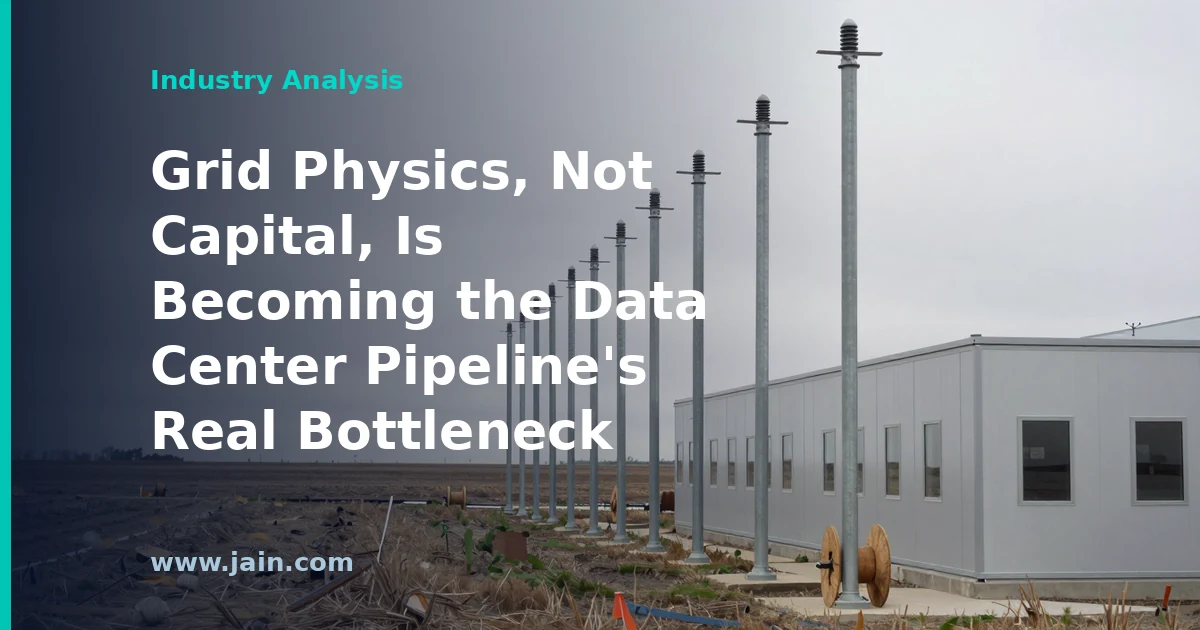
Latitude Media reports that the physical realities of the electric grid are “setting in” for the data center development pipeline. The April 26, 2026 piece frames a shift the industry has been circling for two years: the constraint on new AI-driven data center capacity is increasingly not capital, land, or chips, but whether the grid can physically deliver the power — and how long interconnection and transmission upgrades take.
Executive Summary
The report’s core observation is that the announced data center pipeline — the sum of projects developers have declared — is colliding with what the transmission system can actually serve. Interconnection (the formal process of connecting a large new load or generator to the grid) and transmission capacity (the physical ability of high-voltage lines to move power to a given location) operate on utility timescales measured in years, while hyperscale demand has been announced on timescales measured in quarters.
Why it matters: if grid physics is the binding constraint, then the familiar metrics of the buildout — megawatts announced, acres acquired, capital committed — stop predicting what actually gets energized and when. Siting strategy shifts from “where is land and fiber” to “where is deliverable power,” and the advantage moves to players who secured interconnection positions early or who can bring their own generation.
Announced Megawatts Are Not Energized Megawatts
A recurring pattern in this cycle is the gap between the announced pipeline and deliverable capacity. A developer can buy land, order equipment, and issue a press release in months; a utility must study the new load’s effect on the surrounding network, plan any needed substation and transmission upgrades, and build them — a sequence that routinely runs on multi-year timelines. The Latitude Media framing, that physical realities are “setting in,” suggests the market is starting to discount announcements accordingly. For readers of industry news, the practical takeaway is to treat energization dates, not announcement dates, as the real milestone.
Why Transmission Is the Hard Constraint
Transmission is unforgiving because it is physics plus process. Physically, a high-voltage line can carry only so much power before thermal and stability limits bind, and a concentrated gigawatt-scale load changes flows across an entire region, not just one feeder. Procedurally, upgrades require engineering studies, regulatory approvals, cost-allocation fights over who pays, and often new rights-of-way. None of these steps compresses easily with money. That is what distinguishes this bottleneck from earlier ones like GPU supply or land: you cannot pay a premium to make load-flow studies and line construction happen in a quarter.
Winners: Whoever Holds Deliverable Power
If interconnection position is the scarce asset, several groups benefit. Incumbent data center operators with existing utility relationships and already-energized capacity hold something new entrants cannot quickly replicate. Sites with surplus deliverable power — including brownfield industrial locations with legacy grid infrastructure — gain value relative to greenfield land. And “bring your own power” strategies, from on-site generation to co-location with existing plants, move from novelty to mainstream consideration, though they introduce their own permitting, fuel, and regulatory questions. Conversely, late-arriving developers whose projects sit deep in interconnection queues face the risk that their capacity arrives after the demand it was meant to serve has been placed elsewhere.
The Siting Map Is Being Redrawn
For two decades, data center geography followed fiber routes, tax incentives, and cheap land. A grid-constrained era redraws that map around electrical headroom: regions with spare transmission capacity, faster-moving utilities, or generation-rich locations become competitive even without a legacy data center cluster. This also raises a policy dimension — utilities and regulators must decide how much speculative load to plan for, and how to protect other ratepayers from paying for infrastructure serving projects that may not materialize. How that risk gets allocated will shape which regions court this demand and which slow-walk it.
Background
Data center development historically treated electricity as a routine input: sites were chosen for fiber connectivity, land cost, and tax treatment, and utilities absorbed the load growth without drama. The AI buildout that accelerated from 2023 onward broke that assumption, with individual campuses proposed at power levels comparable to heavy industry and developers announcing capacity far faster than grid infrastructure has historically been built.
By 2026 the conversation across the industry had shifted from chip supply and capital availability to power delivery — interconnection queues, transformer and equipment lead times, and transmission planning. The Latitude Media piece discussed here sits in that context: an energy-sector publication documenting the moment when the announced pipeline meets the grid’s physical and procedural limits.
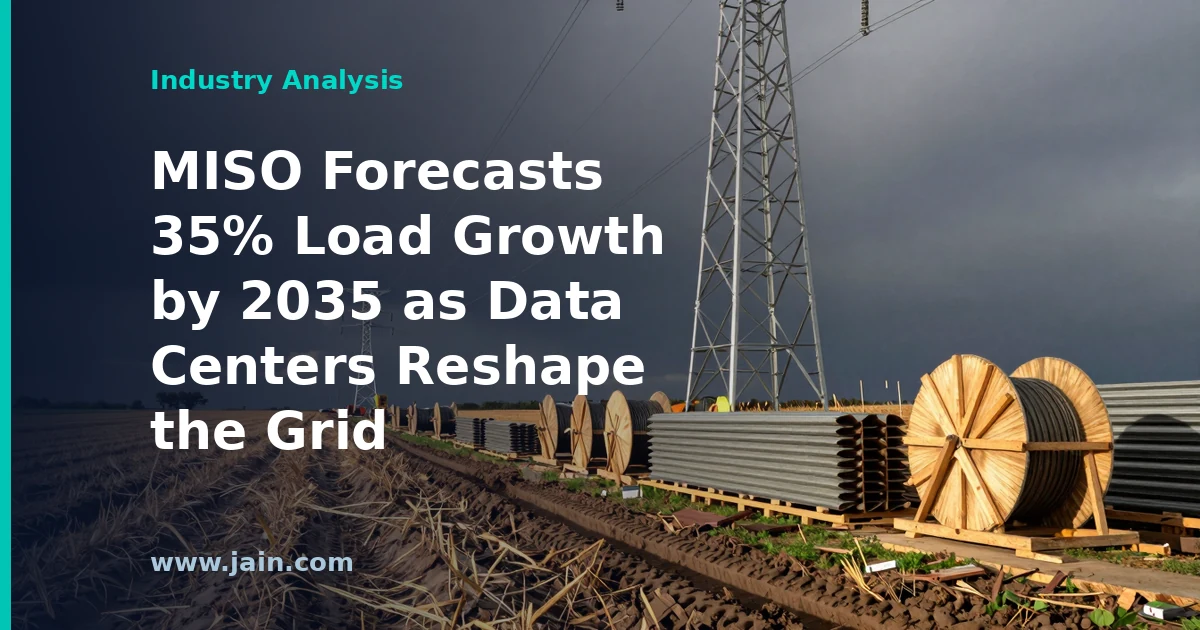
The Midcontinent Independent System Operator (MISO) — the grid operator coordinating electricity across a footprint spanning 15 U.S. states and the Canadian province of Manitoba — expects electric load to jump roughly 35% by 2035, according to an April 2026 report from Utility Dive. The primary driver named in the forecast is data center growth.
A 35% increase over roughly a decade represents a dramatic break from the era of essentially flat U.S. electricity demand that prevailed from the late 2000s through the early 2020s, and it puts one of the largest grid operators in North America on record quantifying the scale of the AI-and-cloud buildout.
Executive Summary
MISO’s forecast is a planning document, not a press release from a company selling something — which makes it one of the more consequential data points in the ongoing debate over how much electricity the data center boom will actually consume. Regional transmission organizations (RTOs) like MISO exist to keep supply and demand balanced in real time and to plan the wires and generation needed years ahead. When an RTO raises its ten-year demand outlook by more than a third, that number flows directly into transmission planning, capacity auctions, and the resource plans of dozens of utilities.
The significance is twofold. First, it validates what individual utilities across the Midwest and Gulf South have been reporting piecemeal: hyperscale data center projects are arriving in interconnection queues at a pace with no modern precedent. Second, it sets up a decade of hard trade-offs. Meeting 35% growth requires new generation, new transmission, and new large-load interconnection rules — all on timelines that historically run slower than the two-to-three-year construction schedule of a data center campus.
For the infrastructure industry, the headline number is both an opportunity signal and a warning: the grid is now the binding constraint on digital infrastructure growth, and the regions that solve power delivery fastest will win the next wave of siting decisions.
The End of Flat Demand Is Now Official Planning Doctrine
For roughly fifteen years, U.S. grid planners could assume that efficiency gains — LED lighting, better HVAC, industrial offshoring — would offset economic growth, keeping total electricity demand nearly flat. That assumption underpinned everything from utility rate cases to power plant retirement schedules. A 35% load-growth forecast from MISO formally retires it for one of the largest grid footprints in North America.
What makes an RTO forecast different from a consultant’s projection is accountability: MISO must plan transmission and resource adequacy against this number. If the forecast is right and the buildout lags, the result is capacity shortfalls and price spikes. If the forecast is wrong and infrastructure is overbuilt, ratepayers carry stranded costs. Either error is expensive, which is why the assumptions behind the number — how much announced data center load actually materializes — deserve as much scrutiny as the number itself.
Data Centers as the Marginal Buyer of Power
A data center is, from the grid’s perspective, an unusual customer: it demands large blocks of power (often hundreds of megawatts per campus), runs at high utilization around the clock, and wants to connect years faster than traditional industrial load. When such customers become the dominant source of demand growth, they effectively set the terms of grid expansion — and grid operators, utilities, and regulators are still working out who pays for the upgrades those connections require.
The economics cut in several directions. Utilities in MISO territory gain a growth story they have not had in a generation, which supports investment in wires and generation. Existing ratepayers face the risk of subsidizing infrastructure built for loads that may not fully arrive — a concern regulators in several states are already addressing through special large-load tariffs and financial-commitment requirements. Data center developers, meanwhile, face the reality that power availability, not land or fiber, now determines where and when they can build.
Winners, Losers, and the Speed Mismatch
The core tension in a 35%-by-2035 scenario is timing. Gas turbines face multi-year order backlogs, new nuclear operates on decade-plus horizons, and large transmission projects routinely take seven to ten years from planning to energization. Data center campuses go from groundbreaking to load in two or three. That mismatch favors whoever can bridge it: developers with early interconnection positions, utilities with spare capacity or fast-track large-load processes, suppliers of grid equipment, and operators pursuing on-site or co-located generation.
It also raises competitive stakes between regions. MISO’s footprint — stretching from the upper Midwest to the Gulf Coast — competes with PJM, ERCOT, and the Southeast for hyperscale siting. A credible, well-executed plan to serve 35% more load is itself an economic-development asset; a forecast without matching buildout is a queue of frustrated customers who will site elsewhere.
Forecast Versus Reality: The Phantom Load Question
Every load forecast in the current environment must grapple with duplicate and speculative requests. Developers commonly file interconnection requests in multiple jurisdictions for the same project, and some announced campuses will never be built. Grid operators know this and apply screening assumptions, but the industry has little historical data on what fraction of AI-era announced load converts to actual consumption. The honest read of any 35% figure is that it is a planning scenario with meaningful uncertainty in both directions — actual growth could undershoot if projects evaporate, or overshoot if AI demand keeps compounding.
That uncertainty is not a reason to dismiss the forecast; it is a reason to watch how MISO and its member utilities structure commitments. Mechanisms that require large customers to put capital at risk — minimum-take contracts, collateral requirements, contribution to network upgrades — are the market’s way of separating real load from phantom load, and their adoption across the footprint will be a better indicator of true demand than any single projection.
Background
MISO was founded in 1998 and became the first FERC-approved regional transmission organization in the United States in 2001. It coordinates generation and high-voltage transmission across a footprint stretching from the upper Midwest down through the Gulf South, serving tens of millions of people through its member utilities. Like other RTOs, it does not own power plants or lines; it operates markets and plans the system that its members build.
The forecast arrives amid a broader U.S. re-acceleration of electricity demand after more than a decade of stagnation, driven by AI and cloud data center construction, manufacturing reshoring, and electrification. Grid operators across the country have been revising load outlooks upward repeatedly since the early 2020s, and interconnection queues for both large loads and new generation have swelled to historic levels — making forecasts like this one central to the industry debate over how much of the announced boom is real.