Tag: utilities

  • White House Seeks AI Power Cost Pledge From Utilities and Data Centers

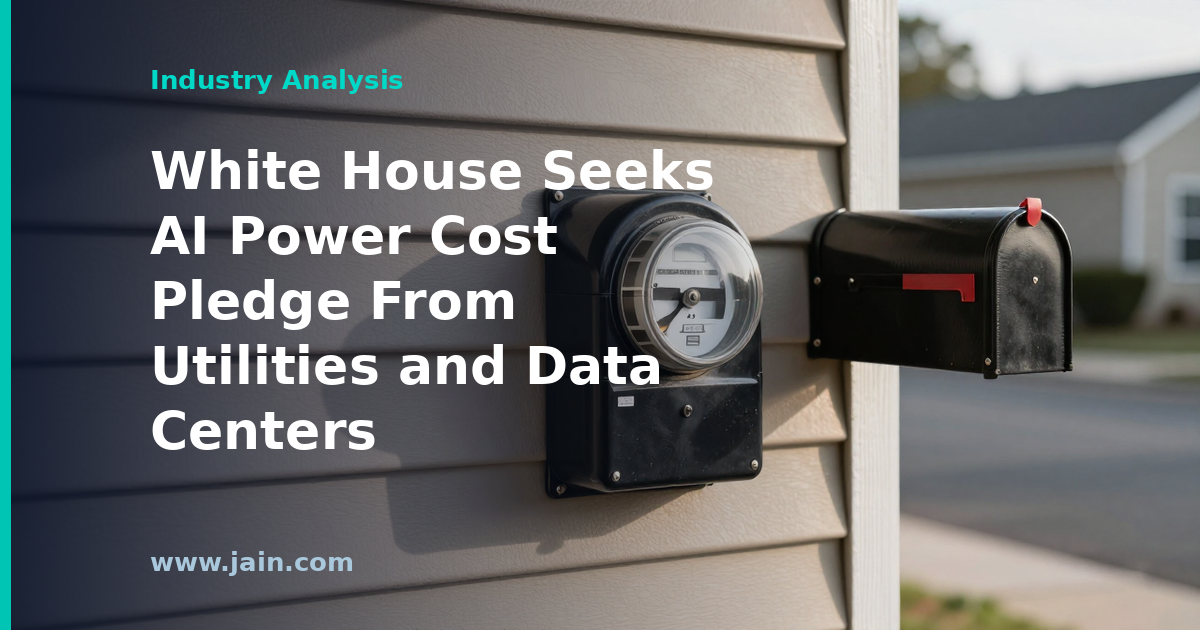
    White House Seeks AI Power Cost Pledge From Utilities and Data Centers

    Reuters reported on July 12, 2026, citing sources, that the White House intends to rally electric utilities and data center operators behind a pledge addressing the power costs associated with artificial intelligence. The report frames the effort as a response to growing concern that the AI build-out is putting upward pressure on electricity bills.

    No official announcement accompanied the report, and the text, participants, and timing of any pledge had not been made public at the time of writing.

    Executive Summary

    According to the Reuters report, the administration is convening two industries whose interests increasingly collide on the electric grid: the utilities that must build generation and transmission to serve surging demand, and the hyperscale data center operators whose AI workloads are driving much of that demand. A “power cost pledge” — the report’s shorthand — suggests a voluntary commitment aimed at reassuring the public that households will not shoulder the cost of AI’s electricity appetite.

    The move matters because it signals that data center power demand has fully crossed from an industry planning question into a national political one. When the White House feels compelled to broker a public commitment on electricity costs, it reflects pressure from ratepayers, state regulators, and elected officials who are hearing about rising bills from constituents.

    It also matters for what it is not: a report based on unnamed sources, describing a voluntary pledge whose contents are unknown. Whether this becomes a substantive cost-allocation framework or a reputational exercise depends entirely on details that had not yet been disclosed.

    Why Electricity Bills Became an AI Problem

    The AI boom has made data centers one of the fastest-growing sources of new electricity demand in the United States, reversing roughly two decades in which overall power consumption was largely flat. Serving that growth requires new power plants, new transmission lines, and grid upgrades — and under traditional utility regulation, those costs are spread across all customers through rates approved by state commissions. That is the mechanism at the heart of the ratepayer backlash: households can end up helping pay for infrastructure built primarily to serve a handful of very large industrial customers.

    Utilities and data center operators counter that large customers typically sign long-term contracts, often pay for dedicated interconnection upgrades, and can anchor investments that benefit the whole grid. Both framings contain truth, and which one dominates in a given state depends on tariff design — the specific rate structures regulators approve. A federal pledge would be entering a debate that is normally fought state by state, utility by utility.

    What a Voluntary Pledge Can — and Cannot — Do

    Voluntary pledges are a familiar Washington instrument: they move quickly, require no legislation, and give all parties a public commitment to point to. If the pledge commits data center operators to pay the full incremental cost of serving their load — through special tariff classes, minimum-take contracts, or funding their own generation — it could genuinely shift cost risk away from households. Several utilities and states have already been moving in this direction through large-load tariffs, so a pledge could standardize and accelerate an existing trend.

    The limits are equally clear. A pledge cannot override state ratemaking authority; electricity rates are set by state public utility commissions, not the White House. It carries no enforcement mechanism unless one is built in. And “power cost” commitments are only as strong as their accounting: transmission, capacity, and reliability costs are notoriously difficult to attribute to a single customer class, which gives every party room to claim compliance. Analysts and consumer advocates will reasonably ask who verifies the math.

    Winners, Losers, and the Politics of Grid Cost Allocation

    For hyperscalers, a pledge is likely a price worth paying. Their binding constraint is speed of interconnection — how fast new facilities can get grid connections and power. A public commitment on costs could defuse local opposition and regulatory friction that currently slow projects. For utilities, the calculus is similar: demand growth is the best earnings story the sector has had in decades, and anything that keeps the political environment permissive protects that story.

    The open question is what ratepayer advocates get. If the pledge produces binding tariff structures and transparent cost attribution, consumers benefit. If it produces language without accounting, the underlying dispute simply resurfaces in the next rate case. Smaller data center operators and AI startups also warrant attention: cost-allocation rules designed around hyperscalers can inadvertently raise barriers for firms without the balance sheet to fund their own substations or sign decade-long power contracts.

    Background

    Since the generative AI boom began in late 2022, hyperscale cloud providers and AI companies have raced to build data center capacity across the United States, turning electricity availability into the industry’s defining constraint. After decades of roughly flat national power demand, utilities now face sustained load growth, and the question of who pays for the required generation and transmission has become a flashpoint in state rate cases and local permitting fights.

    Both federal and state policymakers have increasingly engaged with the issue — from grid interconnection reform to utility proposals for special large-load tariffs — as electricity affordability has risen on the political agenda. The reported White House pledge effort sits squarely in that context: an attempt to get ahead of ratepayer backlash without new legislation.

    Source: White House to rally utilities, data centers for AI power cost pledge, sources say — Reuters report, July 12, 2026, on a planned White House effort to secure a voluntary commitment on AI-related electricity costs.

  • Utilities Scramble for Transformers as Data Center Demand Strains the Grid Supply Chain

    Utilities Scramble for Transformers as Data Center Demand Strains the Grid Supply Chain

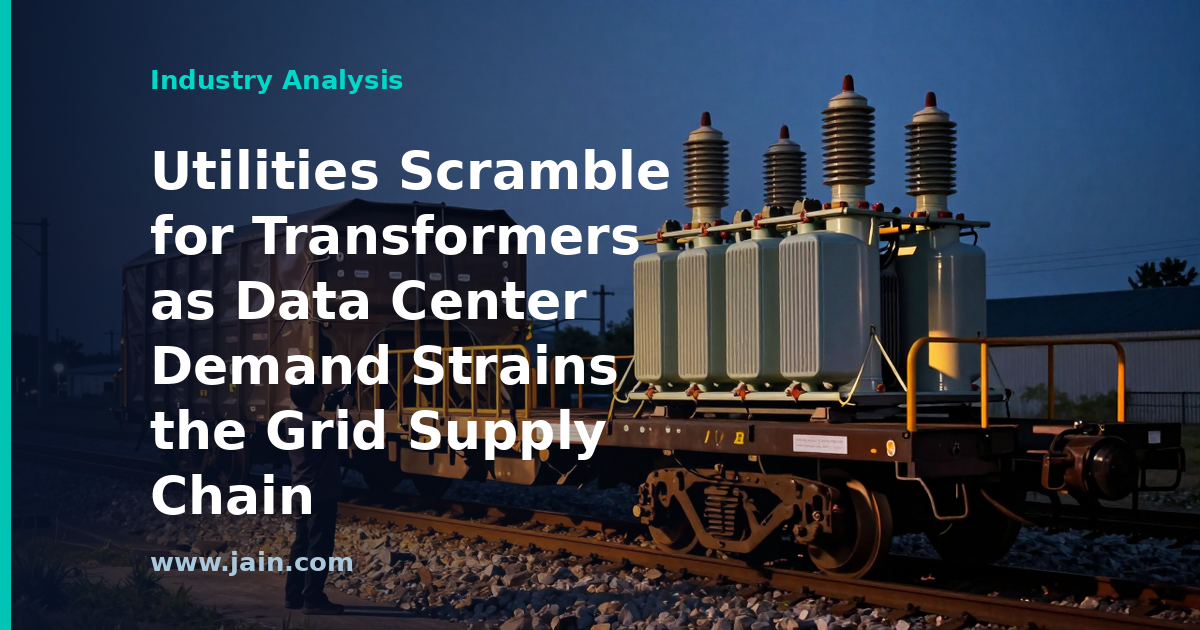
    Reuters reported on July 8, 2026 that US power companies are scrambling to secure electrical equipment — the transformers, switchgear, and related grid hardware that move electricity from generators to customers — as surging demand from data centers strains available supplies. The report frames a nationwide procurement crunch: utilities that once ordered this equipment on routine replacement cycles are now competing for constrained manufacturing capacity against a wave of new large-load projects.

    Executive Summary

    The headline is not about a single deal or data center campus; it is about the industrial base underneath all of them. Transformers step electrical voltage up for long-distance transmission and back down for delivery, and switchgear is the apparatus that switches, protects, and isolates circuits. Neither is optional: every new data center interconnection, substation upgrade, and grid expansion needs both. Reuters’ reporting indicates that US utilities can no longer take timely delivery of this equipment for granted.

    Why it matters: for the first time in decades, US electricity demand is growing meaningfully, and data centers — particularly AI-driven facilities — are a leading cause. When the equipment supply chain becomes the pacing item, it stops being a utility procurement problem and becomes a constraint on data center delivery schedules, grid reliability investment, and ultimately on how fast the AI buildout can proceed. Power availability has already emerged as the industry’s defining bottleneck; this report locates part of that bottleneck one layer deeper, in the factories that make grid components.

    Why Transformers Became the Grid’s Chokepoint

    Large power transformers are among the least glamorous and most consequential machines in the economy. They are heavy, highly engineered, often custom-built to a specific substation’s requirements, and produced by a relatively small number of manufacturers worldwide. Capacity to build them cannot be added quickly: it requires specialized factories, scarce materials such as grain-oriented electrical steel, and skilled workers who take years to train.

    The US grid spent roughly two decades with flat electricity demand, and the supply chain sized itself accordingly — tuned for steady replacement of aging units, not for a demand shock. When data center load growth, electrification, and grid-hardening programs all began pulling on that thin manufacturing base at once, order backlogs stretched and utilities found themselves queuing for hardware. The scramble Reuters describes is the predictable result of a just-in-time supply chain meeting a step change in demand.

    When Equipment Lead Times Set the Data Center Schedule

    For data center developers, this crunch changes what “time to power” means. A site can have land, fiber, permits, and even a utility willing to serve it, and still wait on a transformer delivery slot. Interconnection — the process of physically and contractually tying a new load into the grid — increasingly depends less on paperwork and more on whether the required substation equipment physically exists.

    That reality is reshaping behavior on both sides of the meter. Utilities are reported to be securing equipment earlier and more aggressively, which effectively shifts them from reactive procurement to strategic stockpiling. Large data center operators, for their part, have strong incentives to lock in capacity years ahead, pre-order long-lead equipment themselves, or favor sites where grid infrastructure already exists — one reason established carrier hotels and campuses with existing substation capacity have gained strategic value relative to greenfield sites.

    The Economics of Scarcity: Who Absorbs the Cost

    Scarcity moves pricing power toward manufacturers. Electrical-equipment makers with transformer and switchgear capacity are in an unusually strong position, and the open question is how much they will invest in expansion — factories are decade-scale bets, and executives remember the last long stretch of flat demand. Utilities, meanwhile, typically recover equipment costs through regulated rates, which means sustained price inflation in grid hardware eventually reaches ratepayers and invites regulatory scrutiny over how much of the buildout data center customers should fund directly.

    Among data center players, scarcity favors scale and incumbency. Hyperscale operators can pre-purchase equipment, sign long-term supply agreements, and absorb schedule risk in ways smaller developers cannot. If the crunch persists, expect it to act as a filter: well-capitalized projects with early equipment commitments proceed, while speculative projects — announced capacity without secured power and hardware — quietly slip or die. That could rationalize an overheated development pipeline, but it also raises barriers to entry across the industry.

    What Could Break the Bottleneck

    Several paths out exist, none fast. Manufacturers can and do add capacity, but new production lines take years to reach output. Standardizing transformer designs — reducing the custom engineering in each order — could raise effective throughput. Utilities can extend the life of existing units, share spares, and prioritize deployments. On the demand side, data centers that bring their own generation or agree to flexible operation reduce the immediate grid equipment burden.

    The honest assessment is that this is a multi-year imbalance. Equipment supply is a lagging system responding to a leading demand signal, and the gap between them is where project delays, price escalation, and strategic maneuvering will play out. For infrastructure operators, the practical takeaway is that secured power and in-hand electrical equipment are now assets in their own right, worth nearly as much as the buildings around them.

    Background

    For most of the 2000s and 2010s, US electricity demand barely grew, thanks to efficiency gains offsetting economic expansion. That era ended as data centers — driven most recently by AI training and inference workloads — joined manufacturing reshoring and electrification as major new sources of load. Utilities, regulators, and grid operators have spent the past several years revising demand forecasts upward and confronting the fact that generation, transmission, and the equipment supply chain were all sized for a slower world.

    Concerns about transformer supply predate the AI boom — the aging of the US transformer fleet and the concentration of manufacturing capacity have been discussed in grid-security circles for years — but data center growth has converted a slow-burning replacement problem into an acute procurement race. The July 2026 Reuters report captures that shift from the utilities’ side of the table.

    Source: US power companies scramble to secure equipment as surging data center demand strains supplies — Reuters reporting, July 8, 2026, on utilities competing for transformers and switchgear amid data-center-driven load growth.

  • National Grid’s $1.75B Joulent Deal: When Interconnect Delays Force Utilities to Buy

    National Grid’s $1.75B Joulent Deal: When Interconnect Delays Force Utilities to Buy

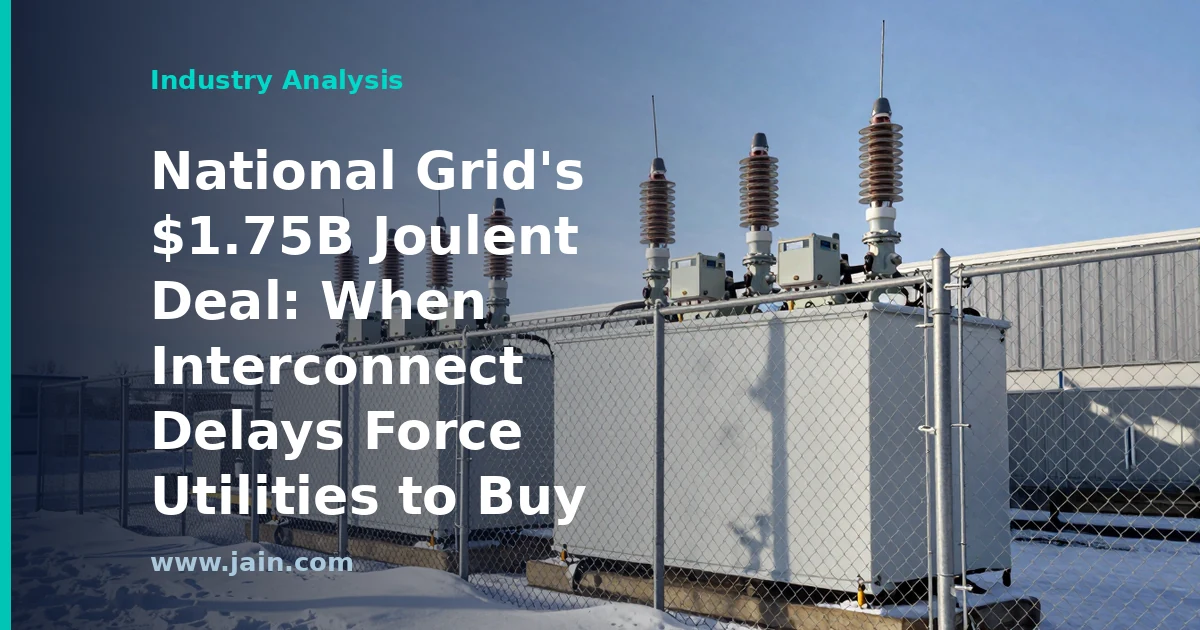
    National Grid has struck a $1.75 billion deal with Joulent, according to a Data Center Knowledge report published July 1, 2026. The report frames the transaction as a response to mounting interconnection delays driven by AI data center demand — utilities, unable to connect new load fast enough through conventional build-out, are increasingly spending to acquire capacity and capability rather than queue for it.

    Executive Summary

    The reported transaction pairs one of the world’s largest electricity transmission and distribution operators with Joulent in a deal valued at $1.75 billion. The headline framing is the important part: the deal is attributed not to routine portfolio strategy but to AI interconnect delays — the growing backlog of requests to connect large new loads and generation to the grid, a process that in many regions now takes years.

    Why it matters: if the reporting’s framing holds, this is a data point in a broader shift. Utilities have historically grown connection capacity by building — new substations, transformers, transmission lines — on regulated timelines. When AI-driven demand outruns those timelines, acquisition becomes the faster path. A $1.75 billion commitment suggests National Grid sees the capacity crunch as durable, not a passing spike. That said, the available source is a single news headline; the deal’s structure, scope, and closing conditions are not detailed in the material we can verify, and readers should treat specifics beyond the reported figure and parties with appropriate caution.

    Why Buying Beats Building When the Queue Is the Bottleneck

    Interconnection — the engineering and regulatory process of physically wiring a new data center, factory, or power plant into the grid — has become one of the defining constraints of the AI build-out. Studies, permitting, equipment procurement, and construction stack into multi-year waits in many markets, and lead times for critical hardware such as large power transformers and high-voltage switchgear have stretched dramatically since the early 2020s. In that environment, anything that already exists — installed equipment, an established delivery capability, a workforce, a manufacturing slot — carries a scarcity premium.

    A utility that spends $1.75 billion to acquire capacity or capability it would otherwise wait years to build is making a straightforward time-for-money trade. The economics can work because the cost of delay is now enormous on both sides of the meter: hyperscale customers measure the cost of a stranded, unpowered data center shell in the millions per month, and utilities that cannot connect large customers forgo years of revenue from their fastest-growing load class.

    National Grid’s Position in the AI Load Story

    National Grid sits at the center of this dynamic in two major markets. It operates the high-voltage transmission network in England and Wales — where grid connection queues became a widely acknowledged national bottleneck and the subject of regulatory reform efforts — and it owns large regulated electricity and gas utilities in New York and Massachusetts, in the demand path of the US Northeast’s data center and electrification growth. Few companies feel interconnection pressure from as many directions at once.

    That context makes the reported deal legible even without full details: a transmission-heavy utility facing connection backlogs on two continents has clear motives to secure capacity, equipment supply, or delivery capability by acquisition. It also carries risk. Large deals struck during a scarcity cycle can look expensive if the cycle turns — if AI load forecasts moderate or supply chains normalize, capacity bought at peak-crunch prices may earn a thinner return than capacity built patiently through the regulated process.

    What $1.75 Billion Signals — and What It Doesn’t

    The figure itself is the strongest signal in the reporting. Utilities are conservative, regulated businesses; a commitment of this size typically requires board conviction that the underlying driver — here, sustained AI-driven demand outpacing conventional grid expansion — will persist long enough to pay back the investment. In that sense the deal is a vote of confidence in continued data center growth, made by a party with unusually good visibility into actual connection requests rather than press-release pipelines.

    What the number does not tell us is the mechanism. “Buying your way to capacity” can mean acquiring a company outright, purchasing assets, locking up equipment manufacturing capacity, or securing services under a long-term contract — and each has very different implications for competitors, regulators, and customers. The single-source material available does not specify which of these the National Grid–Joulent transaction is, what Joulent brings to the arrangement, or how the spend will be recovered. Those distinctions matter: an acquisition that removes a supplier or contractor from the open market can tighten conditions for every other utility shopping in it, while a capacity contract merely reallocates near-term supply.

    Background

    National Grid built its position over decades as the operator of Great Britain’s electricity transmission backbone before expanding into the US Northeast, where it serves millions of electricity and gas customers in New York and Massachusetts. In both markets it entered the mid-2020s facing an unprecedented problem: connection requests from data centers, electrified transport, and new generation arriving faster than networks could be studied, permitted, and built, prompting queue-reform efforts by regulators on both sides of the Atlantic.

    The AI boom sharpened that squeeze into a defining industry constraint. Transformer and switchgear lead times stretched, hyperscale campuses began requesting connections measured in hundreds of megawatts, and ‘time to power’ displaced real estate as the data center industry’s scarcest resource — the backdrop against which a utility paying $1.75 billion to shortcut the queue becomes a rational, if notable, move.

    Source: AI Interconnect Delays Spur $1.75B National Grid-Joulent Deal — Data Center Knowledge report, July 1, 2026, on National Grid’s $1.75 billion deal with Joulent amid AI-driven grid interconnection backlogs.

  • Virginia Approves First Data Center Power Tax: A Precedent for AI-Era Grid Costs

    Virginia Approves First Data Center Power Tax: A Precedent for AI-Era Grid Costs

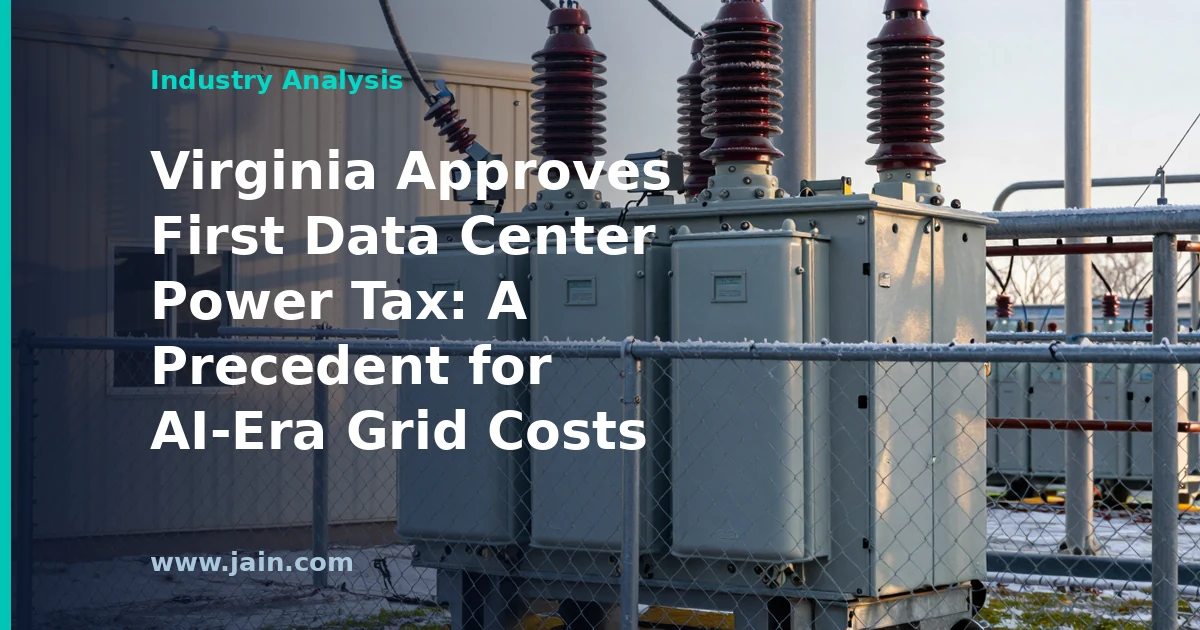
    Virginia has approved what is being described as the first-ever data center power tax, according to a June 23, 2026 report from Data Center Knowledge. The measure makes Virginia — home to the largest concentration of data centers in the world — the first U.S. state to attach a dedicated levy to data center power consumption.

    Details of the tax’s rate, structure, and effective date were not included in the initial report, but the “first-ever” framing marks a significant policy departure: rather than courting data centers exclusively with incentives, the state that hosts more of them than any other is now taxing the electricity they use.

    Executive Summary

    The significance of this measure lies less in its mechanics — which the initial reporting does not detail — than in its symbolism and its likely ripple effects. Virginia built its data center dominance in part on a generous sales-and-use tax exemption for data center equipment, a policy other states copied for two decades. A power tax moving in the opposite direction signals that the political economy of hosting data centers has shifted: the question in Richmond is no longer only how to attract capacity, but how to make that capacity pay for the grid strain it creates.

    For operators, hyperscalers, and their customers, the precedent matters more than the immediate cost. Utilities and regulators across the country have been wrestling with how to allocate the enormous transmission and generation investments driven by AI-era load growth — and whether ordinary ratepayers are subsidizing them. A dedicated tax on data center power is one answer to that question, and now the largest data center market on earth has adopted a version of it. Other states weighing similar debates will be watching closely.

    Because the available source is a headline-level report, the analysis below focuses on the policy context and the questions the measure raises, rather than on provisions that have not yet been publicly detailed.

    Why Virginia Was Always Going to Move First

    Northern Virginia — particularly Loudoun County’s “Data Center Alley” — hosts the densest cluster of data centers anywhere in the world, a position built on early internet-exchange infrastructure, proximity to federal customers, and a long-standing tax exemption on data center equipment. That concentration has made Virginia the place where the costs of the AI buildout show up first and loudest: transmission congestion, multi-year interconnection queues, land-use fights, and public concern that residential electricity bills are absorbing grid investments made largely to serve large industrial loads.

    Virginia’s own legislative auditors flagged these tensions in a December 2024 study of the industry’s fiscal and energy impacts, and the General Assembly has debated data center energy policy in every session since. Seen against that backdrop, a power tax is not a bolt from the blue — it is the next step in a multi-year negotiation between a state and an industry that has become its signature economic engine and its biggest new source of electricity demand.

    The Real Question: Who Pays for AI-Era Grid Growth?

    Electric grids recover their costs from customers through rates, and when one customer class grows explosively — as data centers have — regulators must decide whether the new transmission lines, substations, and generation get billed to that class or spread across everyone. Consumer advocates argue that spreading the cost amounts to households subsidizing some of the world’s wealthiest companies; utilities and operators counter that large, steady loads can actually lower average system costs by spreading fixed expenses over more kilowatt-hours. Both arguments have evidentiary support in different circumstances, which is precisely why the allocation fight has been so contentious.

    A tax is a blunter instrument than a rate class. Utility ratemaking assigns costs based on engineering studies of who causes them; a tax is a legislative judgment that a category of consumption should contribute more to public coffers, whatever the cost-causation math says. Whether Virginia’s measure funds grid infrastructure specifically, flows to the general fund, or offsets residential bills will determine whether it functions as genuine cost allocation or as a revenue measure wearing cost-allocation clothing. The initial reporting does not say — and that distinction is the single most important thing to watch as details emerge.

    What It Means for Operators, Tenants, and Competing States

    For data center operators, a per-unit levy on power lands directly on the largest line item in their operating budgets. Colocation providers will face the classic question of how much they can pass through to tenants under existing contracts; hyperscalers running their own facilities will absorb it as a marginal cost increase on Virginia capacity relative to other markets. The competitive effect depends entirely on magnitude: a modest levy on power in the market with the best fiber connectivity in the country changes few siting decisions, while a heavy one accelerates the diversification toward Ohio, Texas, Georgia, and the Carolinas that grid constraints were already driving.

    Competing states now face a strategic choice of their own. Some will advertise the absence of such a tax as a recruitment tool. Others — facing identical ratepayer politics as AI load arrives on their grids — may treat Virginia’s measure as proof of concept. It is worth remembering that Virginia’s data center equipment tax exemption was copied by more than thirty states. Policy that starts in the world’s data center capital has a history of traveling.

    A Precedent That Cuts Both Ways

    The industry has long argued, with some justification, that data centers are exceptional taxpayers — Loudoun County’s budget depends heavily on data center property tax revenue — and that layering new levies on top risks punishing a sector for succeeding. That argument deserves a fair hearing, and it will get one in the rate cases and legislative fights ahead. But the industry has also benefited from a bargain in which states competed to reduce its tax burden while the public bore growing grid costs, and Virginia’s move suggests that bargain is being renegotiated rather than abandoned.

    The measured takeaway: this is neither the end of Virginia’s data center industry nor a trivial development. It is the first formal acknowledgment, in statute, by the market that matters most, that data center power consumption is a distinct fiscal category. How the tax is structured — and whether it stabilizes the industry’s social license to operate or simply raises its costs — will determine whether operators come to see it as the price of durable acceptance or the start of an unwelcome trend.

    Background

    Virginia’s data center industry dates to the early internet era, when network interchange points in Northern Virginia made the region a natural home for hosting infrastructure. Over two decades, aided by a state sales-and-use tax exemption on data center equipment, Loudoun and neighboring counties grew into the world’s largest data center cluster, and data center property taxes became a pillar of local budgets. The AI boom then supercharged demand: utilities serving the region have projected sustained, historic load growth, and interconnection wait times stretched to years.

    That growth turned data centers into a live political issue in Richmond. A December 2024 state legislative audit examined the industry’s fiscal benefits and energy costs, and subsequent General Assembly sessions produced a stream of bills on data center siting, ratepayer protection, and tax treatment. The power tax reported in June 2026 is the most consequential product of that debate to date — the first time the industry’s electricity consumption itself has been made a taxable category.

    Source: Virginia Approves First-Ever Data Center Power Tax — Data Center Knowledge, June 23, 2026, reporting Virginia’s approval of the first U.S. tax targeting data center power consumption.

  • Bloom Report: AI Power Crunch Meets Community Pushback

    Bloom Report: AI Power Crunch Meets Community Pushback

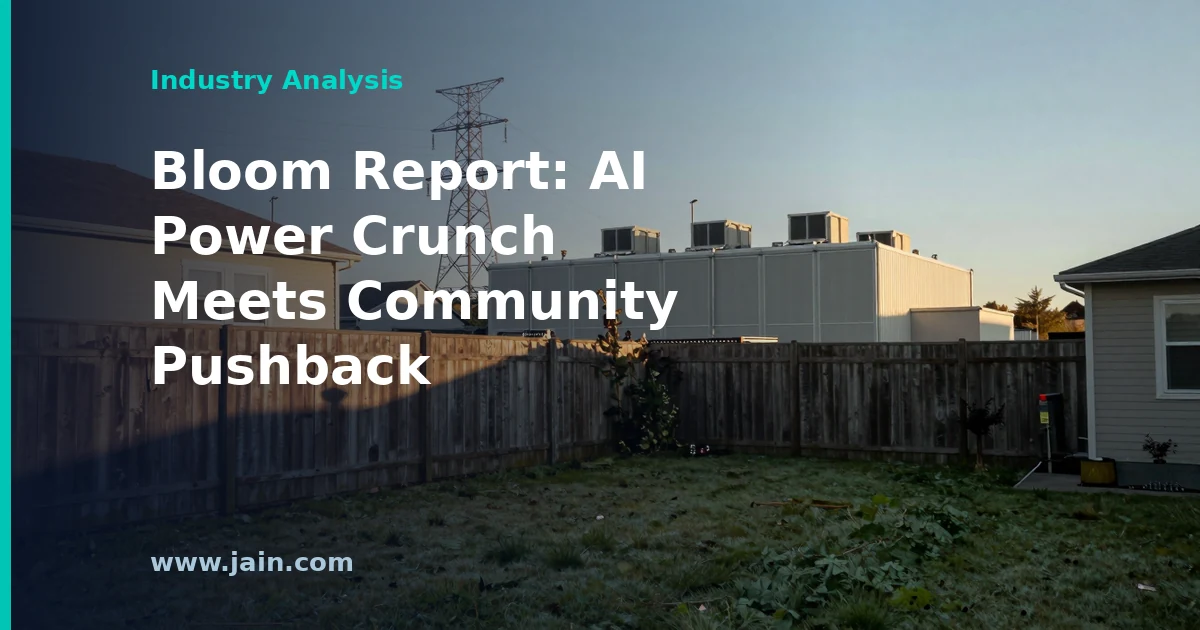
    Bloom Energy has published a report arguing that continued expansion of AI data centers depends on operators addressing two intertwined constraints in parallel: electricity supply and local community acceptance. The report, released in June 2026, frames the two issues as inseparable rather than sequential.

    Executive Summary

    The fuel-cell maker’s central thesis is that the AI buildout cannot be solved by megawatts alone. Even where generation, transmission, or on-site power can be procured, projects increasingly stall on zoning, noise, water, and land-use objections from neighbors and municipalities. Conversely, community outreach without a credible power plan is equally insufficient.

    For an industry accustomed to treating power and permitting as separate workstreams, the framing is a nudge toward integrated planning. It also, unsurprisingly, positions Bloom’s distributed on-site generation product as a natural fit for that integrated approach — a commercial interest readers should weigh alongside the analysis.

    Why ‘Power And Community’ Is The Real Bottleneck

    For most of the cloud era, data center siting followed a familiar recipe: cheap land, fiber, tax incentives, and a utility willing to sign an interconnect. AI workloads have broken that recipe. A single hyperscale AI campus can now request hundreds of megawatts — comparable to a small city — on timelines that outpace utility planning cycles measured in years. Bloom’s report reframes this as a two-variable problem: neither raw generation nor social license alone is sufficient, and progress on one without the other tends to collapse the project.

    That framing matters because the industry has historically optimized for the technical variable and treated community relations as public affairs. When a substation upgrade takes five years and a rezoning fight can add two more, the bottleneck is whichever constraint binds first — and increasingly, both bind simultaneously.

    Winners, Losers, And The Distributed-Generation Pitch

    The report’s logic favors technologies that can be sited close to load, deployed quickly, and configured to reduce visible community impact — a description that fits Bloom’s solid-oxide fuel cells, but also natural-gas peakers, on-site solar-plus-storage, and eventually small modular reactors. Utilities that can offer flexible, phased interconnection may win share from those that cannot. Operators willing to co-locate generation with compute gain optionality against constrained grids.

    The losers, if the thesis holds, are projects that assume grid capacity will materialize on hyperscaler timelines, and jurisdictions that treat every large load as a windfall without offering a permitting path. It is worth noting that the report comes from a vendor whose products directly address the problem it describes; that does not make the diagnosis wrong, but readers should treat the prescription as one option among several.

    Community Concerns Are Not A Communications Problem

    The more substantive point in the report — to the extent the summary conveys it — is that community opposition is being driven by material impacts: water use for cooling, diesel backup emissions, noise from chillers and generators, truck traffic during construction, and property-value anxieties. These are engineering and siting questions, not messaging questions. Treating them as PR problems has, in several high-profile cases, hardened opposition rather than defused it.

    For buyers and investors, the implication is that due diligence on new capacity should include the permitting posture and neighbor relations of a site, not just its power and fiber. A campus with signed interconnects but an organized opposition can be as delayed as one with willing neighbors and no transformer.

    Background

    Bloom Energy, founded in 2001 and headquartered in San Jose, makes solid-oxide fuel cells that generate electricity on-site from natural gas, biogas, or hydrogen. Its customers include large enterprises and, increasingly, data center operators seeking alternatives to constrained grid interconnection.

    The wider context is a global surge in AI training and inference demand that has pushed data center power requests to levels utilities did not plan for. In the United States in particular, several regions have seen multi-year queues for large interconnects, prompting operators to explore on-site and behind-the-meter generation, direct utility partnerships, and, in some cases, relocation to more permissive jurisdictions.

    Source: AI Data Center Growth Hinges on Solving Both Power Constraints and Community Concerns, Bloom Energy Report Finds — Bloom Energy report frames power supply and community acceptance as inseparable constraints on AI data center expansion.

  • Gartner: Data Center Electricity Use to Grow 26% in 2026

    Gartner: Data Center Electricity Use to Grow 26% in 2026

    Research and advisory firm Gartner has published a forecast projecting that data-center electricity consumption will grow 26% in 2026. The figure, released in June 2026, puts a number on what utilities, grid operators, and data-center builders have been experiencing on the ground: power — not land, capital, or chips — has become the binding constraint on digital-infrastructure growth.

    Executive Summary

    Gartner’s headline claim is simple: the electricity consumed by data centers will rise 26% in 2026. For context, most mature electricity systems in developed economies have spent two decades planning around annual demand growth in the low single digits. A single customer class growing 26% in one year is the kind of step-change that utility resource plans — documents typically written on five-to-fifteen-year horizons — were not designed to absorb.

    The forecast matters less as a precise number than as a planning signal. If even a substantial fraction of that growth materializes, it shapes generation procurement, transmission buildout, interconnection queues, and electricity rates for every other customer sharing the grid. For data-center operators and their customers, it also signals that access to secured, deliverable power will continue to separate projects that get built from projects that wait.

    A 26% Jump Is a Planning Problem, Not Just a Number

    Electric utilities plan in decades. Building a new gas plant, a transmission line, or a large substation typically takes years of permitting, procurement, and construction. Demand that grows 26% in a single year — even within one customer segment — compresses those timelines past what traditional integrated resource planning can handle. The practical consequence is already visible across the industry: multi-year interconnection queues (the waiting list to connect large new loads or generators to the grid), utilities demanding long-term take-or-pay commitments from data-center customers, and regulators debating who bears the cost if forecast demand fails to show up.

    The forecast, in other words, is best read as a statement about mismatch: digital infrastructure now moves at software-industry speed, while the electricity system that feeds it still moves at heavy-civil-engineering speed. Closing that gap — through faster permitting, on-site generation, or demand flexibility — is the defining infrastructure challenge the number points to.

    AI Is Rewriting the Load Curve

    Growth of this magnitude is not organic expansion of traditional enterprise computing. Conventional data-center workloads — web serving, databases, storage — grew steadily for years while efficiency gains (better chips, better cooling, higher utilization) kept electricity demand roughly flat. What changed is accelerated computing: AI training and inference run on dense GPU racks that can draw several times the power of traditional server racks and tend to run at sustained high utilization rather than in daily peaks and troughs.

    That load profile is a mixed blessing for utilities. Flat, predictable, around-the-clock demand is easier to serve than spiky demand and can improve grid economics by spreading fixed costs over more kilowatt-hours. But it also removes slack: a grid serving large always-on loads has less headroom for extreme weather events and less tolerance for generation shortfalls. How much of Gartner’s projected growth is firm, flexible, or interruptible will matter as much as the total.

    Winners, Losers, and the Power Value Chain

    If the forecast is directionally right, the beneficiaries extend well beyond data-center operators. Makers of transformers, switchgear, generators, and cooling equipment — many already quoting extended lead times — see demand visibility measured in years. Generation developers, from gas turbines to nuclear restarts to utility-scale renewables paired with storage, gain a creditworthy customer class willing to sign long-dated contracts. Utilities in data-center-heavy regions gain load growth after decades of stagnation, though with real execution and rate-design risk.

    The squeezed parties are those competing for the same electrons and equipment: other large industrial loads, smaller colocation players without utility relationships, and — if cost allocation is handled poorly — residential ratepayers. For data-center operators themselves, the forecast reinforces an emerging hierarchy: companies holding contracted, deliverable power capacity own an appreciating asset, while those still in interconnection queues hold an option of uncertain value.

    Treat the Number as a Signal, Not a Certainty

    A forecast is a model, and this one — as syndicated — arrives without its assumptions attached. Projections of AI-driven power demand have varied widely across analysts, and history urges caution: early-2000s forecasts of runaway internet power consumption overshot badly because they underestimated efficiency gains. Chip-level performance-per-watt improvements, smarter model architectures, and rising inference efficiency could all bend the curve; conversely, faster-than-expected enterprise AI adoption could steepen it.

    The even-handed reading is that Gartner’s 26% figure is a credible-sounding midpoint from an established research house, but its value depends on methodology the public headline does not disclose — baseline year, geographic scope, and workload assumptions among them. Planners should treat it as one scenario input, not a settled fact.

    Background

    Data-center electricity demand was, for roughly a decade before the AI era, a story of successful restraint: workloads migrated into ever-more-efficient hyperscale facilities, and total consumption grew far more slowly than computing output. That equilibrium broke with the generative-AI buildout that began in earnest in 2023, as operators raced to deploy GPU clusters whose power density and utilization patterns overwhelmed the old efficiency offsets. Since then, power availability has displaced real estate as the industry’s primary constraint, and forecasts from analysts, utilities, and government agencies have been repeatedly revised upward.

    Gartner, a research and advisory firm whose projections are widely used in enterprise technology planning, publishes recurring forecasts on data-center spending and infrastructure. Its June 2026 electricity-consumption forecast lands amid active debate among utilities, regulators, and operators over how much of the projected AI load will actually materialize — and who should pay to serve it.

    Source: Gartner Says Data Center Electricity Consumption to Grow 26% in 2026 — Gartner’s June 2026 forecast announcement, as syndicated via Google News.

  • Phoenix Becomes the Test Case for Who Pays for AI’s Power Demand

    Phoenix Becomes the Test Case for Who Pays for AI’s Power Demand

    On June 4, 2026, the Wall Street Journal published a feature describing metropolitan Phoenix as a data-center mecca — and, more pointedly, as a test case for how the enormous electricity demands of artificial intelligence will be paid for. The framing places one of America’s fastest-growing data-center markets at the center of a national debate over grid-buildout economics.

    Only the article’s headline and framing are accessible through the syndicated feed; the underlying reporting sits behind the Journal’s paywall. This analysis therefore examines the question the piece raises rather than details it may contain.

    Executive Summary

    The Journal’s framing captures a real shift in the data-center industry’s center of gravity. For two decades, the binding constraints on data-center development were land, fiber, and tax treatment. In the AI era, the binding constraint is electricity — and with it comes a question that land and fiber never posed: when a utility spends billions on new generation, transmission lines, and substations to serve a handful of very large customers, who ultimately pays?

    Phoenix is a natural place to ask. The metro area has courted data centers aggressively and now hosts one of the largest concentrations of them in the United States, served principally by Arizona Public Service and the Salt River Project. How Arizona’s utilities and regulators allocate the cost of serving AI-scale loads — to the data centers themselves through special tariffs and long-term contracts, or across all customers through general rates — will be watched closely by every other market facing the same surge.

    For readers, the honest caveat is that the source material available here is a headline, not a data set. The analysis below addresses the question the headline poses; the specific figures, projects, and proceedings the Journal reported on remain behind its paywall and are flagged as open items in the gaps section.

    Why Phoenix Became a Data-Center Magnet

    Phoenix’s rise as a data-center hub was not accidental. The region offers large tracts of developable land, very low exposure to earthquakes, hurricanes, and flooding, and network proximity to Southern California — letting operators serve West Coast users while avoiding California’s costs and permitting friction. Arizona layered on tax incentives for data-center equipment, and its utilities historically welcomed large industrial loads as a way to spread fixed grid costs over more sales.

    That welcome is what the AI era is now stress-testing. A market built on the premise that big customers make the grid cheaper for everyone works when load grows incrementally. AI training and inference campuses invert the premise: they arrive in blocks so large that the grid must be expanded specifically to serve them, which means new costs rather than better utilization of existing assets. The economic-development logic that attracted the industry does not automatically survive that inversion — it has to be re-underwritten, tariff by tariff.

    The ‘Who Pays’ Question, Unpacked

    Serving AI-scale load requires three layers of spending: new generation capacity (or contracts for it), high-voltage transmission to move the power, and local substations and distribution upgrades to deliver it. In the regulated-utility model that covers most of Arizona, those costs are recovered through rates approved by state regulators. The allocation question is whether they land on the customers who caused them or are socialized across households and small businesses.

    Utilities and regulators across the country have been converging on a middle path: dedicated large-load rate classes that require long-term commitments, minimum-demand charges, or upfront contributions to construction, so that a data center pays for the infrastructure built on its behalf even if its plans change. The unresolved tension is forecasting risk. If a utility builds for announced demand that never materializes — projects are cancelled, chips get more efficient, workloads consolidate elsewhere — someone is left holding stranded assets. Contract structure, more than load-growth headlines, determines whether that someone is the developer, the utility’s shareholders, or the ratepaying public.

    Winners, Losers, and What to Watch

    If Phoenix gets the allocation right, the winners are numerous: operators gain a market where power, not litigation, sets the pace; utilities gain creditworthy anchor customers; and residents gain the tax base and jobs without underwriting the buildout. If it gets the allocation wrong in either direction, the losers are equally clear. Shift too much cost onto general rates and household bills rise to subsidize some of the world’s best-capitalized companies — a politically combustible outcome. Shift too much onto new entrants and the market’s growth advantage erodes in favor of Texas, Georgia, or other hubs competing for the same projects.

    The practical signals to watch are unglamorous but decisive: rate-case filings and large-load tariff proposals before Arizona regulators, utility capital-expenditure plans and their financing, and the terms — especially minimum-take and exit provisions — attached to new interconnection agreements. It is also fair to note what the Journal’s framing implicitly concedes: calling Phoenix a test case means the answers are not yet in. Anyone claiming today to know who will pay for AI’s power, in Arizona or anywhere else, is ahead of the evidence.

    Background

    Metropolitan Phoenix grew into one of the largest data-center markets in the United States over the past decade, first on the strength of cloud computing and enterprise colocation, and more recently on AI infrastructure. Cheap land, low disaster risk, latency-friendly proximity to California, and Arizona’s tax incentives drew hyperscalers and colocation developers alike, while the region’s broader tech expansion — including major semiconductor investment — reinforced its industrial base.

    Electric service in the metro comes mainly from Arizona Public Service, an investor-owned utility regulated by the state, and the Salt River Project, a public power provider. As in other data-center hubs, the AI boom has transformed these utilities’ planning outlook from slow, steady load growth to step-change demand — pushing questions of generation buildout, transmission, and cost allocation to the top of Arizona’s regulatory agenda.

    Source: Phoenix Is a Data-Center Mecca—and Test Case for How to Pay for AI’s Power Needs — Wall Street Journal feature (June 4, 2026) on grid-buildout economics in the Phoenix data-center market.

  • Water and Wastewater Capacity Now Decide Where AI Data Centers Get Built

    Water and Wastewater Capacity Now Decide Where AI Data Centers Get Built

    Data Center Knowledge reported on May 30, 2026 that water and wastewater capacity have joined — and in some markets now rival — electrical power as the decisive factors in where AI data centers can be built. The report’s framing marks a shift in an industry that has spent the past several years describing its siting problem almost entirely in megawatts.

    Executive Summary

    The report argues that the availability of water for cooling, and just as importantly the capacity of municipal systems to accept the water a facility discharges, now determine whether an AI data center project is viable at a given site. That is a meaningful reframing: since the AI buildout accelerated, the industry conversation has centered on grid interconnection queues and power procurement, with water treated as a secondary sustainability metric rather than a gating constraint.

    Why it matters: if water and wastewater capacity are genuine go/no-go criteria, the map of viable AI data center locations changes. Sites with abundant power but strained water or sewer systems lose ground, while regions with underused water and treatment infrastructure gain a new selling point. It also pulls a different set of actors — water utilities, sewer authorities, and municipal planners — into negotiations that were previously dominated by electric utilities.

    From Megawatts to Gallons: A New Siting Calculus

    For most of the AI infrastructure boom, the binding constraint has been electricity: how many megawatts a utility can deliver, and how fast. Water has been discussed mostly in sustainability reports. The shift Data Center Knowledge describes — water as a siting decision, not a disclosure line item — reflects how AI-scale facilities actually work. High-density computing throws off enormous heat, and many cooling designs, particularly evaporative systems, consume large volumes of water to reject that heat to the atmosphere. A campus that can secure power but not water is still an unbuildable campus.

    Wastewater is the less obvious half of the equation, and arguably the more interesting one. Water that runs through cooling systems and is not evaporated must go somewhere, often into municipal sewer systems as industrial discharge. Treatment plants are sized for the communities they serve; a single large industrial user can consume capacity a municipality planned to allocate over decades of residential growth. Discharge from cooling systems can also be warmer and more mineral-concentrated than household wastewater, which treatment plants must be equipped to handle. A town can have a river next door and still lack the permits, pipes, and treatment headroom to host an AI campus.

    Winners, Losers, and the New Bargaining Table

    If this framing holds, the winners are jurisdictions that can offer both power and water headroom — including regions with cooler climates that reduce cooling demand, or with industrial water infrastructure left over from manufacturing that has since departed. Water utilities and engineering firms that design treatment and reuse systems gain leverage and business. The relative losers are water-stressed markets that have competed for data centers on power and tax incentives alone, and developers holding land banks in places where the sewer authority, not the electric utility, turns out to be the limiting party.

    For operators, the economics push toward designs that trade water for electricity or capital: closed-loop liquid cooling, dry coolers, and water recycling all reduce consumption but raise power draw or upfront cost. That trade-off means water scarcity does not just move projects — it changes their engineering and their operating cost profile. Expect water-use effectiveness (WUE), the industry’s ratio of water consumed per unit of computing energy, to get the same contractual and public scrutiny that power-use effectiveness (PUE) received a decade ago.

    What the Framing Does and Does Not Establish

    A note of even-handedness: the source available to us is a report headline and premise, not a dataset. The claim that water now “decides” siting is directionally consistent with well-documented industry trends — public disputes over data center water use in drought-affected regions, and the growth of water-positive pledges from major cloud providers — but the strength of the claim varies by market. In cool, wet regions with modern treatment plants, water may barely register as a constraint; in arid, fast-growing metros it can be decisive. Readers should treat “water decides siting” as an increasingly common condition, not a universal law, and ask for market-specific evidence — permit denials, moratoria, or utility capacity studies — before generalizing.

    Background

    Since the generative AI boom began in late 2022, data center development has grown at a pace that strained electric grids, making interconnection queues and power procurement the industry’s defining bottleneck. Water surfaced periodically as a flashpoint — community disputes over data center water consumption in drought-affected regions drew attention, and major cloud providers responded with public water-stewardship and replenishment pledges — but it was generally treated as a reputational issue rather than a siting gate.

    Data Center Knowledge, the trade publication behind the report, has covered the industry’s infrastructure constraints throughout the buildout. Its framing of water and wastewater as decisive siting factors reflects the arrival of AI-scale campuses whose cooling demands, and whose discharge volumes, exceed what many municipal systems were designed to accommodate.

    Source: How Water and Wastewater Capacity Now Decide AI Data Center Sites — Data Center Knowledge’s May 30, 2026 report on water infrastructure becoming a primary constraint in AI data center site selection.

  • Lake Tahoe’s 49,000-Resident Power Scare Signals AI’s Grid Reliability Problem

    Lake Tahoe’s 49,000-Resident Power Scare Signals AI’s Grid Reliability Problem

    A report surfaced via Yahoo Finance on May 23, 2026 says roughly 49,000 residents in the Lake Tahoe area fear losing electric power as data center growth strains regional grids, with experts quoted as seeing a broader electricity crisis ahead. The story frames household reliability — not just wholesale prices or emissions — as the newest casualty of surging computing demand.

    Executive Summary

    The claim at the center of the report is simple and unsettling: ordinary households near Lake Tahoe worry that the lights may go out because large computing facilities are absorbing the region’s available electric capacity. The figure of 49,000 residents puts a concrete community behind what has mostly been an abstract national debate about artificial intelligence and energy.

    Why it matters: for years the data center power conversation played out in interconnection queues, utility rate cases, and investor decks. When it shows up as outage fear in a specific residential community, the politics change. Reliability concerns mobilize regulators, county commissions, and voters far faster than megawatt statistics do — and the industry’s social license to build depends on answering them credibly. The available source is brief, however, and the underlying evidence for both the fear and the reassurances deserves scrutiny, which we take up below.

    When Grid Strain Becomes a Neighborhood Story

    Grid “strain” is shorthand for a resource-adequacy problem: at moments of peak demand, the generation and transmission serving an area may not comfortably cover the load, forcing utilities to curtail service or lean on emergency imports. Data centers change this math because they add large, around-the-clock demand — a single big AI campus can draw on the order of a mid-size city — and because they arrive faster than power plants and transmission lines can be permitted and built.

    What is new in this report is the framing. The affected parties are not industrial ratepayers or grid operators but 49,000 residents of a well-known mountain community. That framing tends to travel: local reliability fears have already reshaped data center siting debates in Northern Virginia, Georgia, and Ireland, producing moratoriums, connection pauses, and stricter tariffs. If Tahoe-area residents formally raise outage concerns with their utility or state regulators, developers in the region should expect the same escalation path.

    The Evidence Question — For Every Side

    Fear of an outage is not the same as a documented outage risk, and a headline is not a reliability study. The fair questions run in every direction. To those raising the alarm: is there a utility resource-adequacy filing, a grid operator assessment, or an outage record that quantifies the risk to these households, or is the fear inferred from regional growth trends? Which specific facilities, and what load, are actually driving it? To utilities and data center developers: what firm capacity backs the new load, what do interconnection studies show for the local system, and can they demonstrate — not merely assert — that residential service will not be degraded?

    The report as available to us is thin, so we cannot verify which claims rest on filings and which on sentiment. That cuts both ways: the concern should not be dismissed as anti-development noise, and the industry’s standard reassurances should not be accepted without the studies to back them. The productive next step for any of the parties is publishing the load numbers and adequacy analyses that would settle the question.

    Who Pays, and Who Adapts

    Beneath the reliability fear sits an economics fight. Serving large new loads requires substations, transmission, and generation, and someone funds them: the developer through special tariffs, or all ratepayers through general rates. Several states have moved toward large-load tariff classes that require data centers to underwrite their own grid impact precisely to prevent the cost-shifting and reliability spillover this story describes. Where such tariffs do not exist, residential customers have a legitimate complaint — and utilities have a regulatory exposure.

    The likely winners in this environment are operators who bring their own answer: on-site generation, long-term power purchase agreements that add new supply rather than absorbing existing capacity, batteries, and demand-response commitments that let a facility shed load during regional peaks. Developers who show up asking a constrained grid to simply stretch further will find approvals slower, tariffs stiffer, and communities — like the one in this report — organized against them.

    Background

    After roughly two decades of flat U.S. electricity demand, load growth has returned sharply, driven by data centers — especially AI training and inference facilities — alongside electrification of transport and industry. Utilities and grid operators across the country have raised resource-adequacy warnings as interconnection requests from large computing loads outpace the construction of new generation and transmission.

    The Lake Tahoe area sits near one of the West’s fast-growing data center corridors in northern Nevada, where large campuses have clustered east of Reno over the past decade. That regional context makes the residents’ concern plausible on its face, but the report available to us does not tie the fear to specific facilities, load figures, or utility studies — which is precisely the evidence this debate now needs.

    Source: 49,000 Lake Tahoe residents fear they’ll lose power as data centers strain grids. Experts see electricity crisis ahead — report published via Yahoo Finance, May 23, 2026, on data center load growth and household grid reliability in the Lake Tahoe region.

  • Goldman Sachs: US Data-Center Power Demand to Double by 2027

    Goldman Sachs: US Data-Center Power Demand to Double by 2027

    Goldman Sachs, the US investment bank, has published a projection that electricity demand from US data centers will double by 2027, according to a report circulated on May 19, 2026. The forecast frames the artificial-intelligence computing buildout not as a niche technology story but as one of the largest near-term drivers of US electricity consumption.

    Executive Summary

    The headline claim is simple and stark: the amount of power consumed by US data centers — the facilities that house the servers behind cloud services and AI models — is projected by Goldman Sachs to double by 2027. A doubling over such a short horizon is extraordinary for electricity demand, a category that in the US grew slowly or stayed flat for most of the two decades before the AI boom.

    Why it matters: power, not land or chips, has become the binding constraint on data-center expansion. If a major financial institution’s base case is a doubling within roughly a year and a half of the report’s publication, then utilities, grid operators, regulators, and data-center developers are all planning against a demand curve steeper than anything the sector has seen. Forecasts like this one shape capital allocation — transmission projects, generation buildouts, and multi-year power purchase agreements are being underwritten on the strength of exactly this kind of projection.

    Power Is Now the Product

    For most of the industry’s history, data-center capacity was measured in square feet; today it is measured in megawatts. The Goldman Sachs projection captures that shift: the constraint on AI infrastructure growth is no longer how fast servers can be manufactured, but how fast electricity can be generated and delivered. AI training and inference clusters draw far more power per rack than traditional enterprise computing, which is why demand can double even if the number of buildings grows much more slowly.

    A doubling forecast, if it holds, effectively converts every data-center siting decision into an energy-procurement decision. Markets with available grid interconnection — the formal process of connecting a large load to the transmission system — gain a decisive advantage over markets with cheaper land or better fiber routes. That reorders the competitive map for developers and colocation providers alike.

    Who Absorbs the Demand — and Who Profits

    Utilities and independent power producers are the most direct beneficiaries of a demand doubling: large, creditworthy, around-the-clock loads are the customers grid operators dream of. Transmission builders, transformer and switchgear manufacturers, and backup-power suppliers sit next in line, since delivering twice the load requires physical equipment that is already supply-constrained industry-wide.

    The cost side is less comfortable. Rapid demand growth tends to push up wholesale power prices and interconnection wait times, which raises operating costs for every data-center operator — including those serving ordinary cloud and enterprise workloads rather than AI. Residential and industrial ratepayers in data-center-heavy regions may also bear part of the grid-upgrade cost, a tension that is already a live regulatory debate in several US states.

    Reading a Bank Forecast Critically

    It is worth being precise about what this is: a projection by an investment bank, not a measurement. Demand forecasts for AI infrastructure have varied widely across analysts, and they are sensitive to assumptions about chip efficiency, model sizes, and how much announced capacity actually gets energized on schedule. Goldman Sachs has a research franchise in this area, but banks also have commercial exposure to the energy and technology sectors they cover, so the appropriate posture is neither dismissal nor uncritical adoption.

    The strongest reason to take the direction of the forecast seriously — even if the exact multiple proves off — is that it aligns with observable behavior: hyperscale operators signing long-dated power agreements, utilities revising load forecasts upward, and interconnection queues lengthening. Forecasts can be wrong on timing and still be right about the trend that planners must build for.

    Background

    US data centers spent two decades as a quiet, efficient corner of the electricity system: demand grew, but efficiency gains in servers and facility design largely kept national consumption in check. The generative-AI boom that began in late 2022 broke that equilibrium. AI clusters concentrate enormous electrical loads in single campuses, and cloud providers and specialized developers have been racing to build capacity, turning power availability into the industry’s defining constraint.

    Goldman Sachs is one of several major financial institutions now publishing recurring research on data-center energy demand, reflecting how central the topic has become to utility planning, energy markets, and technology investment. Its projections are widely cited by developers, utilities, and policymakers — which is precisely why the assumptions behind them merit as much attention as the headlines.

    Source: US Data Center Power Demand Projected to Double by 2027 – Goldman Sachs, a report published May 19, 2026, projecting a doubling of US data-center electricity demand by 2027.