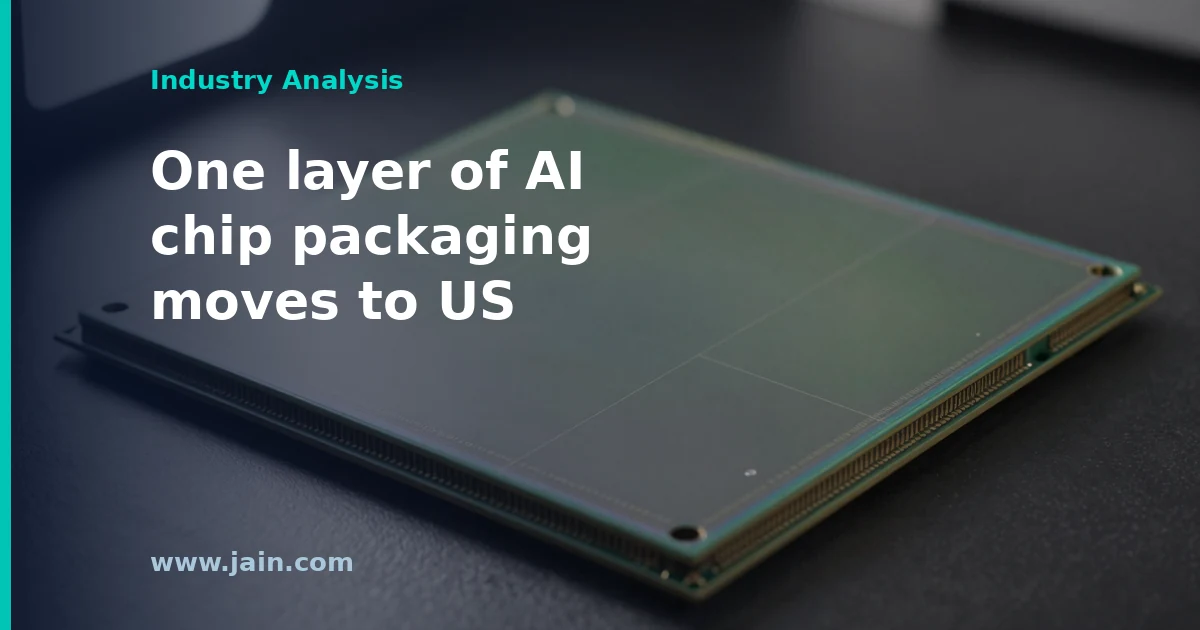
Two major chipmakers, GlobalFoundries and Taiwan Semiconductor Manufacturing Company, the world’s largest contract chipmaker, have struck a $2 billion deal to make a key chip part in the United States.
The part is a silicon “interposer”: a thin slab of silicon that sits under an artificial intelligence processor and wires it to its memory, like a shared floor both chips are mounted on. The packaging step built around it has been one of the main limits on how many artificial intelligence chips get shipped.
Making it in America could add supply outside Taiwan. But it covers one step, not the whole chip.
Yahoo Finance reported that GlobalFoundries and TSMC have reached a $2 billion deal for silicon interposers produced in the United States. Silicon interposers are the base layer in the advanced packages that join high-end AI processors to stacked high-bandwidth memory, which places the agreement inside the part of the GPU supply chain that has repeatedly constrained output.
The deal follows TSMC’s October 8 Form 6-K, its September 2026 revenue report, which showed consolidated revenue of roughly NT$511.86 billion for the month, up 54.6 percent from September 2025, and NT$3,898.73 billion for January through September, up 41.1 percent year over year.
Executive Summary
The headline facts are simple: a $2 billion agreement between the world’s largest contract chipmaker and a US-headquartered specialty foundry, covering a component that is made in the United States. The interposer is not a commodity part. It is a large piece of silicon, patterned in a wafer fab with fine wiring and vertical connections called through-silicon vias. AI accelerators mount their compute die and memory stacks on it side by side.
That matters because AI chip supply has been gated less by the ability to make processors than by the ability to package them with memory. Making interposers in the US adds a domestic source for one input to that packaging flow. However, an interposer is an intermediate part. Until the companies say where the rest of the package is assembled, the deal shows where part of the bottleneck can be relieved, not that it has been.
For GlobalFoundries, a $2 billion commitment tied to AI packaging is a significant new line for a foundry that stepped back from the leading-edge process race in 2018. For TSMC, whose September revenue alone was more than NT$500 billion, the deal is small in financial terms. Its importance is geographic and logistical.
Why the Interposer Sits on AI’s Critical Path
The most capable AI accelerators are not a single chip. They are assemblies. A large processor die sits next to several stacks of high-bandwidth memory (HBM), DRAM chips stacked vertically to deliver very fast data access. These parts have to talk to each other across thousands of extremely fine connections, far denser than an ordinary circuit board can carry. The silicon interposer solves this. It is a slab of silicon wired with lithography, the same patterning process used to make chips, so the processor and memory can be packed millimetres apart and connected at chip-level density.
TSMC’s version of this approach is CoWoS, short for chip-on-wafer-on-substrate. Dies are bonded onto an interposer wafer, which is then mounted on a conventional package substrate. In recent years, CoWoS capacity has been widely identified as a binding constraint on AI accelerator shipments. The processors could be fabricated, but there was not enough capacity to package them with their memory. Interposers are one input to that flow. Because they are made in a fab rather than an assembly house, adding interposer supply requires wafer capacity with the right tooling, not just more packaging lines.
What Onshoring One Layer Does, and What It Doesn’t
This is the substance behind the headline. A US-based interposer source moves one fab-made step of AI packaging onto American soil. That has real value. It adds a source outside Taiwan for a component tied to a known chokepoint. It suits a mature, non-leading-edge process, which plays to GlobalFoundries’ strengths in its New York and Vermont fabs. It also gives chip designers and their hyperscale customers, the largest cloud and AI operators, a domestic option to cite when they are asked about supply resilience.
But an interposer alone does not make a finished accelerator. After the interposer is made, the processor dies and memory stacks must be bonded onto it. The assembly must then be mounted on a substrate, tested, and shipped. If those steps remain in Taiwan, US-made interposers simply cross the Pacific in the opposite direction from the processors. Much of the processor output from TSMC’s Arizona fabs has itself needed to return to Taiwan for advanced packaging. The deal becomes a genuinely domestic AI supply chain only when it pairs with US assembly capacity. TSMC said in March 2025 that its expanded Arizona plans include advanced packaging facilities, and its October 6-K shows continued financial support for US subsidiaries, recording lending to TSMC Washington and guarantees for TSMC Arizona. Connecting the interposer supply to that assembly capacity is the step that would turn a single onshored layer into an onshored package.
The packaging variant also matters. TSMC’s family includes the original CoWoS-S, which uses a full silicon interposer, and newer variants such as CoWoS-L, which replace the full interposer with smaller embedded silicon bridges. If flagship accelerators continue shifting toward bridge-based designs, the market for full-size interposers looks different. Which products these US interposers serve will determine how much of the bottleneck they actually touch.
Reading $2 Billion Against Each Company’s Scale
For TSMC, the figure is modest. Its September revenue was about NT$511.86 billion, and its year-to-date revenue was NT$3,898.73 billion, up 41.1 percent. A $2 billion agreement is not a material financial event at that scale. It is a capacity and location decision. Choosing a domestic partner for a mature-process component frees TSMC to focus its own capital elsewhere while adding a US element to its packaging chain.
For GlobalFoundries, the calculus runs the other way. A foundry that chose in 2018 to stop pursuing the most advanced process nodes now has a direct line into the most supply-constrained segment of the AI hardware market, using processes it already runs. That makes it a significant win, though its annual revenue impact cannot be assessed until the contract’s duration and ramp are known. The two companies were once adversaries in a patent dispute that they settled in 2019 with a broad cross-license. A supply relationship on AI packaging is a notable evolution from that history.
Background
TSMC, founded in Taiwan in 1987, is the world’s largest contract chipmaker. It manufactures processors for most leading AI chip designers, and its CoWoS packaging has become central to AI accelerator supply. It is building fabs in Arizona and has said its US plans include advanced packaging. GlobalFoundries, spun out of AMD in 2009, runs fabs in Malta, New York; Essex Junction, Vermont; Dresden; and Singapore. It stopped pursuing the most advanced process nodes in 2018 to focus on specialty technologies.
The two companies settled a patent dispute in 2019 with a broad cross-license. Their new interposer agreement places GlobalFoundries’ US mature-process capacity inside the AI packaging flow that TSMC dominates.
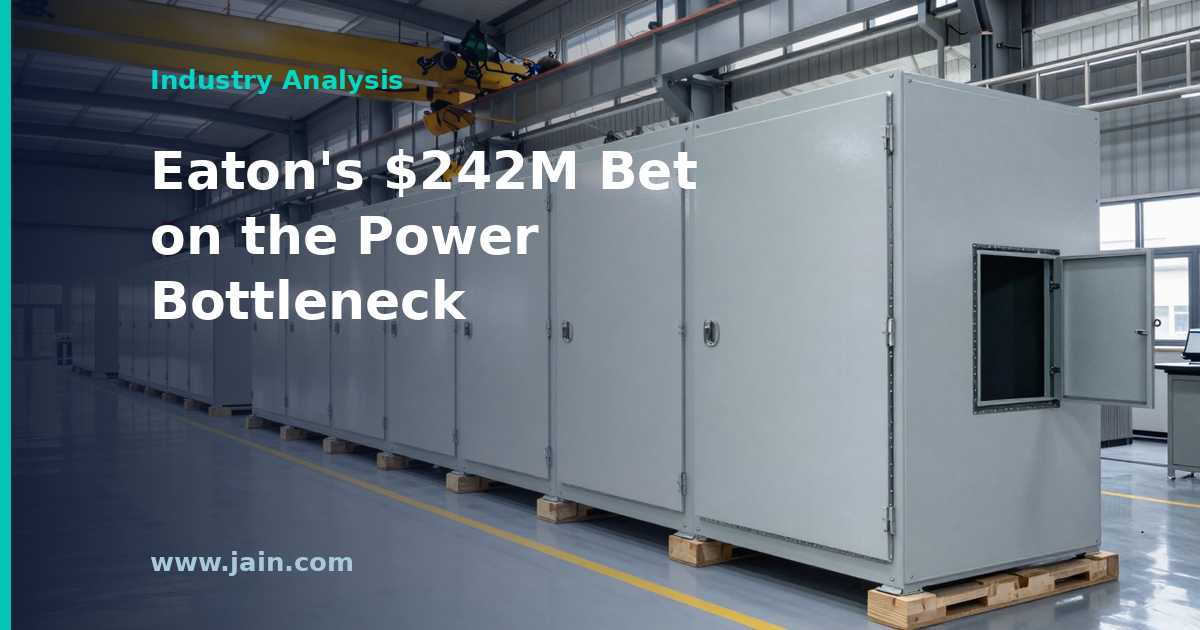
Eaton, a maker of electrical equipment, is spending more than $242 million on a new factory in North Little Rock, Arkansas. It will build the electrical rooms that feed power into data centers — assembled indoors on a production line and trucked to the site, the way a prefabricated house is.
The plant covers a million square feet, roughly seventeen football fields, and Eaton expects it to employ more than 1,200 people.
Why it matters: the thing slowing artificial intelligence down right now is not computer chips. It is getting electricity into the building.
Eaton (NYSE: ETN) announced on September 2, 2026 that it will invest more than $242 million in a new one-million-square-foot manufacturing facility in North Little Rock, Arkansas, which the company expects will double its U.S. capacity to build customized modular electrical enclosures and create more than 1,200 manufacturing, electrical and operations jobs. The plant will produce for Eaton’s Fibrebond business, which the company acquired in April 2025 and which has operated in Minden, Louisiana for more than 40 years.
Eaton says the added capacity is aimed at demand across data center, utility, industrial and digital communications markets. Arkansas Governor Sarah Huckabee Sanders, the Arkansas Economic Development Commission, the City of North Little Rock and the Metro Little Rock Alliance are named as partners on workforce development and technical-skills training tied to the site. Eaton did not announce a construction start date, a production timeline, or the value of any state or local incentives.
Executive Summary
An enclosure is the box the power gear lives in. A modular electrical enclosure is that box built in a factory — walls, switchgear, transformers, wiring, terminations — tested as a unit and shipped to site on a truck, so that work which would otherwise be done by electricians in a muddy field is instead done indoors on a production line. Eaton is committing $242 million to build more of them, and says the Arkansas plant will double what it can produce in the United States.
The scale of the check is worth keeping in proportion. Eaton reported $27.4 billion of revenue and $4.1 billion of net income in 2025; $242 million is under one percent of a single year’s sales. This is not a bet-the-company move. It is a capacity decision, and capacity decisions from component vendors are among the more honest signals available about where a supply chain is actually jammed — a factory takes years to pay back and cannot be quietly cancelled the way a press-release partnership can.
The signal here is specific: Eaton is not adding generation, or chips, or land. It is adding the ability to prefabricate the electrical middle of a data center. That points at a constraint that has migrated downstream, away from megawatts on paper and toward the physical equipment and skilled labor needed to move power the last few hundred feet into a building.
The Bottleneck Moved Downstream
For most of the current AI buildout, the public conversation about power has been about supply: whether utilities can generate enough electricity, whether gas turbines and grid interconnections can be secured, whether a region has spare capacity at all. Those constraints are real. But they are upstream constraints, and a project that clears them still has to solve a second problem — getting that power from the substation fence line into thousands of racks, through switchgear, transformers, breakers, busway and distribution equipment, all of it engineered to the specific site.
That downstream layer has become its own queue. The equipment is heavy, custom, subject to long lead times, and installed by a trade — industrial electricians — that is in short supply across the country and cannot be scaled on the schedule a hyperscale campus wants. Eaton’s own commentary points in this direction: the company said in July that it delivered record second-quarter 2026 results with accelerating orders and a growing backlog, and raised its organic growth guidance. A backlog is unshipped demand. Adding a factory is the response to a backlog you expect to persist.
Eaton’s framing supports a broad read rather than a purely AI one. The release names data center, utility, industrial and digital communications markets, and the company did not break out how much of the new capacity is earmarked for any of them. Utilities are replacing aging distribution equipment and telecom operators are densifying networks; both compete for the same factory hours. The honest statement is that Eaton sees enough aggregate demand across electrification end markets to double a product line’s U.S. footprint — with data centers as the loudest, but not the only, driver.
Why a Factory Beats a Field
The economic case for modular enclosures is a labor-arbitrage and schedule-certainty case, not a materials one. The same switchgear costs roughly the same whether it is installed on site or in a plant. What changes is who installs it, under what conditions, and when the schedule risk lands. In a factory, work is repeatable, weather-independent, inspected under controlled conditions, and performed by a trained workforce that stays put between jobs. On site, the same work is sequential, exposed to trade stacking and rain delays, and dependent on scarce electricians who must be hired into whatever county the campus was built in.
That is why Eaton’s chosen phrasing — customers wanting to deploy power infrastructure “faster, with greater certainty and less complexity” — maps onto something buyers can actually price. Certainty is the product. For an operator whose revenue starts the day the racks energize, compressing field electrical work and de-risking the commissioning date is worth paying a premium for, and it is measurable in a way that generic capacity claims are not.
The Fibrebond history explains why Eaton is doubling down rather than experimenting. Eaton bought the business in April 2025, and it had already been building enclosures in Minden, Louisiana for over 40 years; Eaton says Minden’s capacity has itself doubled over the past three years and continues to receive investment. Arkansas is therefore a second node, not a replacement — geographic diversification of a proven line, plus a labor pool in a metro area that a single small-town plant could not reach. It also fits a broader Eaton pattern of pushing toward integrated, pre-engineered data center solutions, including a reference design announced with Trane Technologies in August aimed at AI data center efficiency and installation cost.
What $242 Million Buys — and What It Doesn’t
Two arithmetic points deserve stating plainly. First, $242 million across one million square feet works out to roughly $242 per square foot of building — consistent with heavy industrial construction plus tooling, and a reminder that a meaningful share of this money is concrete and cranes, not incremental production equipment. Second, “doubles U.S. capacity” is a ratio without a denominator. Eaton has not published Minden’s current output in units, megawatts served, or dollars, so the doubling cannot be converted into how many data center halls per year the industry actually gains. Directionally credible; quantitatively opaque.
There is also a limit to what an enclosure plant can unclog. The enclosure is the wrapper; the constrained contents — large power transformers, medium-voltage switchgear, breakers, and the copper and steel behind them — have their own lead times and their own factories. Doubling enclosure assembly capacity relieves the integration and field-labor step. It does not by itself shorten the wait for a transformer. Buyers evaluating this announcement should ask which specific lead time in their own schedule it compresses.
On winners and losers: the clearest beneficiaries are large data center developers with repeatable designs, who can put standardized modular power blocks into a queue and take delivery on a predictable cadence. Regional electrical contractors lose some scope as work migrates from the field into the plant, though the field commissioning and interconnection work remains. Central Arkansas gains an anchor industrial employer and, per the release, a structured technical-training pipeline — genuinely valuable, and also the part of any plant announcement most exposed to slippage, since job counts are expectations rather than commitments and typically ramp over years. Competing enclosure and integrated-power vendors now face a rival with roughly twice the domestic assembly capacity, which is a durable competitive fact in a market where the scarce good is a delivery slot.
Background
Eaton, founded in 1911 and headquartered for operational purposes in Cleveland with legal domicile in Dublin, sells electrical and industrial power equipment into data center, utility, commercial, residential, aerospace and mobility markets. Its electrical business has been the primary beneficiary of two long-running trends the company calls electrification and digitalization — more of the economy running on electricity, and more of that electricity flowing into compute. It reported $27.4 billion of revenue in 2025 and serves customers in 180 countries.
The modular power segment it is expanding here sits at a specific choke point in data center construction. As campuses grew from tens to hundreds of megawatts, the electrical scope outgrew what could be reliably built in the field on the schedules operators demanded, and prefabrication moved from a niche option to a default for large repeatable designs. Eaton’s April 2025 purchase of Fibrebond bought it a four-decade-old position in that segment; the Arkansas plant is the first major capacity expansion announced under Eaton’s ownership, and it follows other moves toward pre-engineered data center offerings, including a reference design developed with Trane Technologies announced in August 2026.
Two companies behind the cables inside the giant computer buildings that run artificial intelligence have signed a ten-year deal. Molex, a maker of connectors, will supply its customers with glass-fiber cable made by Prysmian, one of the world’s biggest cable makers.
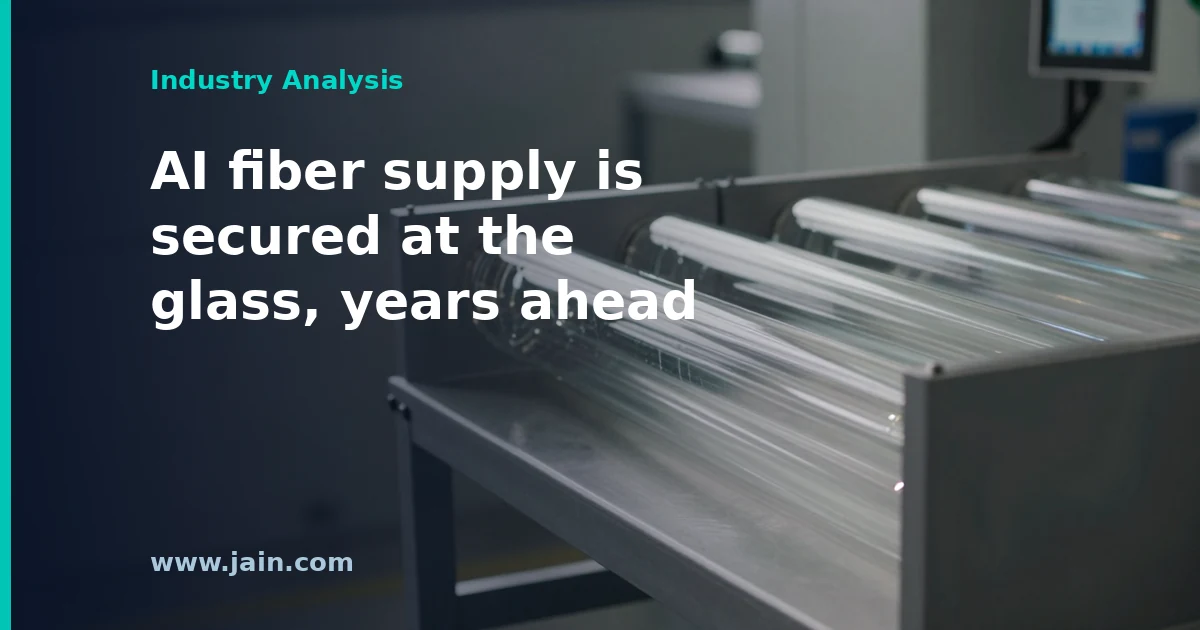
Prysmian says it will spend $1.43 billion to more than double how much fiber it makes in the United States, adding about 600 American jobs. The money reaches all the way back to the first step: making the glass rods that fiber strands are pulled from.
Artificial intelligence runs on light moving through these hair-thin threads, and big buyers now want supply promised a decade ahead.
Molex and Prysmian have entered a 10-year supply agreement to expand fiber connectivity for AI data centers, Lightwave reported on July 21, 2026. Under the arrangement, hyperscalers (the largest cloud and internet operators) and data center builders can secure Prysmian fiber cable supply through Molex.
Alongside the agreement, Prysmian will invest $1.43 billion to extend fiber cable production at U.S. plants, including the glass preform stage, which it says will more than double its domestic fiber capacity. The company expects to create 1,000 jobs worldwide, 600 of them at U.S. manufacturing sites.
Executive Summary
The deal pairs a connectivity specialist with one of the world’s largest cable manufacturers for a decade. Molex CEO Joe Nelligan called it “a strategic expansion in the U.S., bringing increased capacity to support the growing demand for data center solutions.” Prysmian CEO Massimo Battaini said the agreement and capacity investments “strengthen our leadership in data centers.”
What makes the announcement more than a distribution tie-up is where the money goes. Prysmian’s investment reaches upstream to preform, the glass that every strand of fiber is drawn from. That is the step that determines whether new cable capacity is real or merely a reshuffling of existing output, and it is why a ten-year term makes sense for both sides.
For data center buyers, the agreement adds another source of fiber connectivity in a market where Corning has already signed a string of large partnerships. For Prysmian, it marks a push from grid, long-haul and submarine cable into the fiber that runs inside data centers, a segment it forecasts will add $11 billion of value through 2035.
Why AI Fiber Capacity Starts at the Glass Preform
Optical fiber begins as a preform: a thick rod of ultra-pure glass that is heated and drawn into strands thinner than a human hair, which are then bundled and jacketed into cable. The sequence matters. A manufacturer can add cabling lines, but unless it buys glass from someone else, the amount of fiber it can ship is capped by how much preform it can make. So the most telling detail in this announcement is not the $1.43 billion figure itself but where it is spent: extending U.S. production “including the glass preform stage,” with the stated result of more than doubling Prysmian’s domestic fiber capacity.
Doubling fiber output without more preform would simply move the constraint one step upstream. Glass-making capacity is a long-lived asset, and a commitment of this size is easier to underwrite against a long contract than against spot orders. The ten-year term lines up with that logic, and with Prysmian’s own planning horizon, which runs to 2035.
The people affected are those who buy connectivity for AI clusters, where large numbers of processors and switches are linked by fiber. Customers who source through Molex gain access to supply backed by new glass capacity rather than a reallocation of existing cable. The broader lesson for buyers is practical: a fiber or connectivity supply promise is only as firm as the preform behind it, and where a supplier’s glass comes from is now a fair question in any procurement discussion.
Molex Turns Itself Into a Route to Fiber Supply
Molex is best known for connectors, not glass. The agreement repositions it as a channel through which hyperscalers can lock in fiber cable, with both companies stressing “supply chain optionality and resilience through diversified sourcing” and improved lead-time reliability. The company describes the deal as one pillar of a broader global strategy to scale fiber cable supply, which suggests Molex intends to add further sources rather than rely on one.
The more interesting fit is with Molex’s work on co-packaged optics (CPO), which places optical connections directly beside a processor or switch chip instead of in pluggable modules at the edge of the equipment. That shortens the electrical path, which matters as AI systems push more data between chips. Molex recently completed its acquisition of Teramount, a fiber-to-chip connectivity provider, and has expanded its CPO interconnect toolkit. A vendor that controls both the connection at the chip and a long-term supply of the cable leading to it can offer customers a more complete package than either piece alone.
Corning Has Already Drawn the Map
Molex and Prysmian are following a pattern rather than inventing one. Corning has secured multi-billion-dollar partnerships across nearly every layer of the AI connectivity chain: a service provider (Lumen), cloud and data center operators (Amazon and Meta), GPU maker NVIDIA, chip designer Broadcom and connector maker US Conec. The common thread is fiber producers tying their manufacturing to the companies that design, buy and install AI infrastructure, years in advance.
For buyers, a second vertically linked supply chain is useful in its own right: it provides an alternative, and with it some negotiating leverage, when demand is outrunning manufacturing. For Prysmian, the agreement extends a business built on power grid cable, long-haul digital links and submarine telecom into the “inside” data center market, which it expects to grow with modernization cycles for performance and energy efficiency, AI-driven architecture changes and higher fiber density.
What the Numbers Do and Do Not Establish
Several figures in the announcement are firm commitments: a ten-year agreement, a $1.43 billion investment, a doubling-plus of U.S. fiber capacity, and 1,000 expected jobs, 600 of them in the U.S. Others are forecasts. Prysmian values the data center segment at $11 billion on an incremental basis through 2035 compared with 2025, including $1 billion of yearly revenue from 2031. That is a projection of market opportunity, not contracted business.
The capacity claim is also relative. “More than double” is measured against a current baseline that has not been quantified publicly, so the absolute amount of new fiber, and how much of it is earmarked for Molex customers, cannot yet be calculated. That does not weaken the direction of the deal; it limits how precisely anyone can size it.
Background
Prysmian is one of the world’s largest cable makers, operating 112 manufacturing facilities in 50 countries, including more than 20 plants in North America. Its U.S. footprint includes optical fiber plants in Claremont and Lexington and a submarine cable facility under development in Somerset, Massachusetts. Historically its data center business has centered on energy and long-distance digital connections, such as grid cables and long-haul fiber, rather than cabling inside the building.
Molex is a connectivity manufacturer led by CEO Joe Nelligan. It has been building out co-packaged optics interconnect products and recently completed its acquisition of fiber-to-chip specialist Teramount. Demand for fiber inside data centers is being driven by modernization cycles aimed at performance and energy efficiency, AI-driven changes in system architecture and rising fiber density, the same forces behind Corning’s recent partnerships with cloud providers, chipmakers and connector firms.
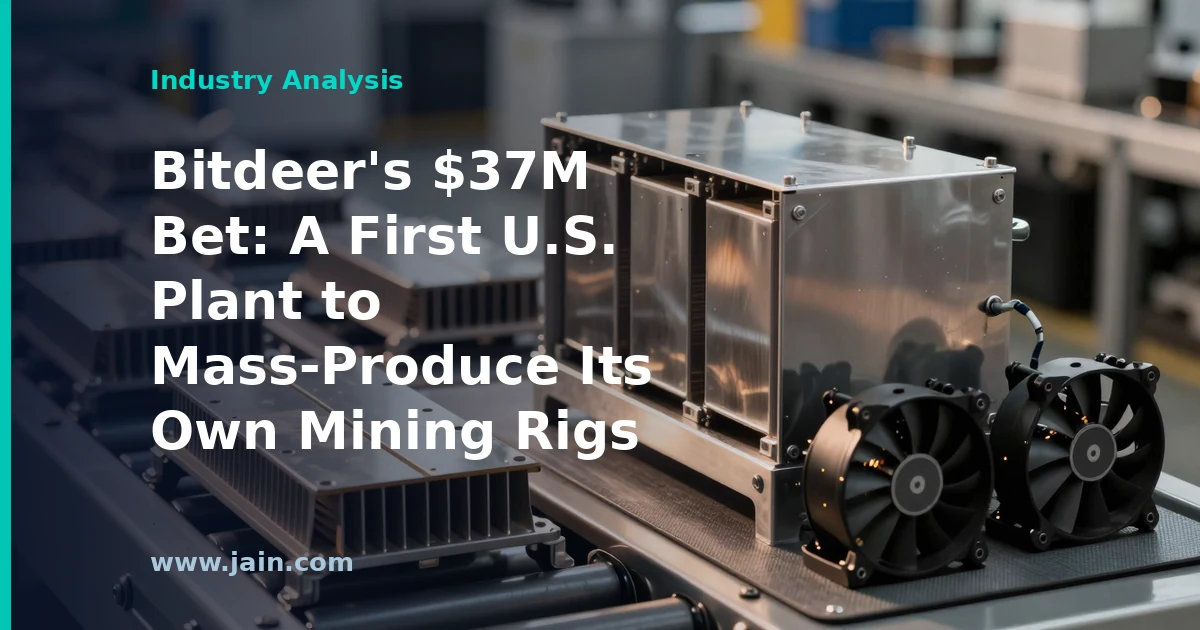
Bitdeer Technologies Group, the Nasdaq-listed bitcoin miner and mining-hardware developer, announced on May 26, 2026 that it will invest approximately $37 million to establish its first manufacturing facility in the United States, dedicated to mass-producing its own proprietary mining machines. The company’s shares rose about 14% on the news.
Executive Summary
The announcement marks a notable step in a trend the mining industry has discussed for years but rarely executed: moving hardware production onto U.S. soil. Bitcoin mining machines — specialized computers built around custom ASIC chips (application-specific integrated circuits designed to do one task, in this case bitcoin’s hashing algorithm, extremely efficiently) — have historically been designed and assembled in China and Southeast Asia. A U.S. plant puts final production of Bitdeer’s rigs inside the same borders as the large American mining fleets that deploy them.
For Bitdeer, which both operates its own mining data centers and develops its SEALMINER line of rigs, the move deepens a vertical-integration strategy: controlling the machine, not just the megawatts. The 14% share-price jump suggests investors read it as strategically meaningful, though at roughly $37 million the commitment is modest by manufacturing standards — a scale worth keeping in perspective when weighing the announcement.
Onshoring the Rig Supply Chain
The economics of bitcoin mining are dominated by two inputs: electricity and machines. U.S. miners have long controlled the first — cheap domestic power — while depending almost entirely on overseas suppliers for the second. That dependence became expensive and unpredictable as U.S. tariff policy toward Chinese-linked electronics hardened, and as shipping, customs, and export-control friction added cost and lead time to every container of rigs. A domestic production line is a direct hedge: machines assembled in the U.S. can reach U.S. deployment sites without crossing the tariff and logistics gauntlet.
It also carries an industrial-policy resonance. Reshoring advanced electronics assembly aligns with the broader U.S. push to localize technology supply chains, which can translate into goodwill with regulators and utilities — intangible but real assets for a company whose core business depends on grid access and permitting.
What $37 Million Buys — and What It Doesn’t
It is worth being precise about scale. Roughly $37 million funds a serious assembly, integration, and testing operation; it does not fund semiconductor fabrication, which requires capital measured in billions. The ASIC chips at the heart of any mining rig will still come from offshore foundries, as they do for the entire industry. What moves onshore is the downstream work: board assembly, enclosures, hashboard integration, quality testing, and logistics. That is genuinely valuable — it shortens delivery times, reduces tariff exposure on finished goods, and improves repair turnaround — but the deepest layer of the supply chain remains abroad.
The headline framing of “mass-producing proprietary machines” is therefore best read as a supply-chain restructuring, not full technological self-sufficiency. Investors and buyers should watch for disclosed production capacity figures to judge how much of Bitdeer’s fleet demand the plant can actually serve.
Vertical Integration as Competitive Strategy
Most large mining operators buy rigs from third-party giants — a market long led by China-linked manufacturers Bitmain and MicroBT. Bitdeer, whose founder previously co-founded Bitmain, is one of the few operators attempting the harder path: designing its own chips and machines while also running the data centers that consume them. If it works, the payoff is structural — capturing the manufacturer’s margin, tuning hardware to its own facilities, and insulating itself from the allocation queues and pricing power of dominant suppliers.
The risk is equally structural. Hardware development is capital-hungry and unforgiving; a rig generation that lags competitors on efficiency (measured in joules per terahash — how much energy it takes to produce a unit of computing work) can strand the investment. A U.S. factory raises the fixed-cost base, which cuts both ways: leverage if demand holds, drag if the bitcoin cycle turns.
Why the Market Cheered
A 14% single-day move on a $37 million investment says the market is pricing the signal, not the sum. The plausible reading: investors see the plant as evidence that Bitdeer’s hardware business is graduating from R&D project to commercial product line, and that the company is positioning for a world where U.S.-made mining and compute hardware commands a premium. It may also reflect optimism that manufacturing capability is transferable — companies with rig-assembly lines and power-rich data centers have optionality toward adjacent high-performance-computing and AI-infrastructure work. That optionality, however, is inference, not commitment; the announcement itself concerns mining machines.
Background
Bitdeer was spun off from Bitmain — the world’s dominant maker of bitcoin mining hardware — and listed on Nasdaq in 2023. Unlike most mining operators, which are pure consumers of third-party machines, Bitdeer runs mining data centers across multiple countries while also developing its own SEALMINER line of rigs, a vertical-integration strategy few in the industry have attempted.
The move lands amid a broader realignment of technology supply chains: U.S. tariff policy and export-control friction have made imported electronics costlier and less predictable, pushing companies across the compute-hardware spectrum to localize final assembly. Mining hardware, long an almost entirely Asia-manufactured category, has been among the most exposed.
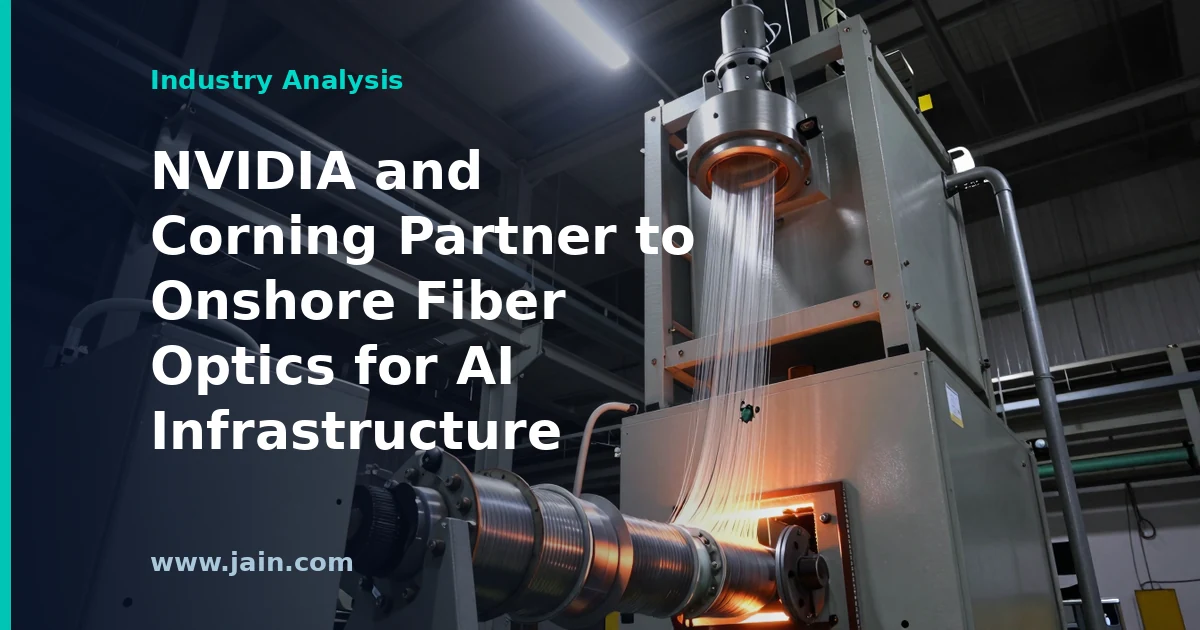
NVIDIA and Corning announced a long-term partnership on May 5, 2026, aimed at strengthening US manufacturing for AI infrastructure, according to a release published through the NVIDIA Newsroom. The tie-up pairs the dominant supplier of AI accelerator chips with the company that invented low-loss optical fiber and remains America’s leading producer of it.
The announcement, as distributed, is headline-level: it frames the partnership around domestic manufacturing capacity for the optical components AI data centers consume, but the source text does not disclose financial terms, volumes, or specific facilities.
Executive Summary
The partnership signals something the AI build-out has made increasingly clear: the constraint on giant GPU clusters is no longer just chips. Modern AI data centers are, in a real sense, optical networks with computers attached — tens of thousands of processors stitched together by fiber links, each rack consuming far more optical connectivity than a traditional cloud facility. A chipmaker locking arms with a glass and fiber manufacturer is a recognition that the network fabric is now part of the product.
For Corning, a long-term relationship with the largest buyer-influencer in AI infrastructure offers the kind of demand visibility that justifies factory investment. For NVIDIA, it extends a broader pattern of shoring up US-based supply for the components its platforms depend on. For everyone else — data center operators, competing optics suppliers, and policymakers pushing domestic manufacturing — the deal is a marker of where the AI supply chain is consolidating.
What it is not, at least based on what the release makes public, is a quantified commitment. Without disclosed dollars, volumes, or timelines, the announcement is directionally significant but not yet measurable.
Why AI Data Centers Are Suddenly a Fiber Story
Training and running large AI models requires connecting thousands of GPUs so tightly that they behave like one machine. Every one of those connections — between chips, between servers, between rows of racks — increasingly runs over optical links, because light through glass fiber carries far more data over distance than copper wire can. The result is that an AI facility consumes multiples of the fiber, optical transceivers, and cable assemblies of a conventional data center of the same size.
That is why an announcement between a semiconductor company and a materials manufacturer makes strategic sense. NVIDIA sells not just chips but entire cluster architectures, and those architectures are only as deliverable as their weakest supply line. Optical connectivity has repeatedly been a pinch point during the AI build-out, and securing it upstream is cheaper than discovering a shortage downstream.
Onshoring the Optical Supply Chain
The release’s framing — “strengthen US manufacturing” — places the deal squarely in the broader push to bring strategic component production back to American soil. Optical fiber and cable production is a global industry, and US policymakers have treated domestic capacity for critical infrastructure inputs as a national priority. A long-term partnership with an anchor customer is the classic mechanism for making onshoring economics work: manufacturers hesitate to build domestic capacity without demand certainty, and buyers hesitate to depend on capacity that does not yet exist. Pairing off resolves both hesitations at once.
The trade-offs are real, though. Domestic manufacturing can carry higher costs than established overseas supply chains, and new capacity takes time to ramp. Whether this partnership changes the market depends on execution details the announcement does not provide — how much capacity, where, and by when.
What It Means for Corning and the Competitive Field
Corning brings unusual credibility to this role: it invented low-loss optical fiber in 1970 and has manufactured it in the United States for decades. A durable relationship with the central player in AI infrastructure gives it a privileged position in the fastest-growing segment of the optical market, and demand visibility that can underwrite capital spending shareholders might otherwise question.
For competing fiber and optical component makers, the signal is more mixed. When anchor customers and suppliers pair off, remaining demand becomes more contestable but also more volatile. And for data center operators and enterprises buying connectivity, the second-order effect is worth watching: supply assurance for NVIDIA-aligned deployments could tighten availability elsewhere if overall capacity does not grow as fast as the partnership implies.
Reading the Announcement Critically
Corporate partnership announcements span a wide spectrum — from binding, take-or-pay purchase agreements to memoranda of understanding with no enforceable commitments. The source material here, distributed as a headline through a news aggregator, does not establish where on that spectrum this deal sits. No dollar figures, product mix, facility plans, or hiring numbers are cited in what was published.
That does not make the announcement empty; both companies have reputations and existing US manufacturing footprints that lend it weight. But readers should treat the strategic direction as substantiated and the scale as unproven until either company attaches numbers — in capital expenditure disclosures, earnings commentary, or facility announcements — that can be verified against it.
Background
Corning, founded in 1851, is one of America’s oldest materials-science companies; its researchers invented low-loss optical fiber in 1970, the breakthrough that made modern telecommunications and the internet physically possible. It remains the leading US manufacturer of optical fiber, cable, and connectivity solutions for telecom carriers and data centers. NVIDIA, whose graphics processors became the workhorses of the AI boom, has grown into the central supplier of AI computing platforms and has increasingly emphasized building out US-based manufacturing for the infrastructure surrounding its chips.
The partnership lands amid a historic wave of AI data center construction, in which optical networking — once a background utility — has become a recognized bottleneck, and amid a sustained US policy push to onshore manufacturing of strategically critical technology components.