
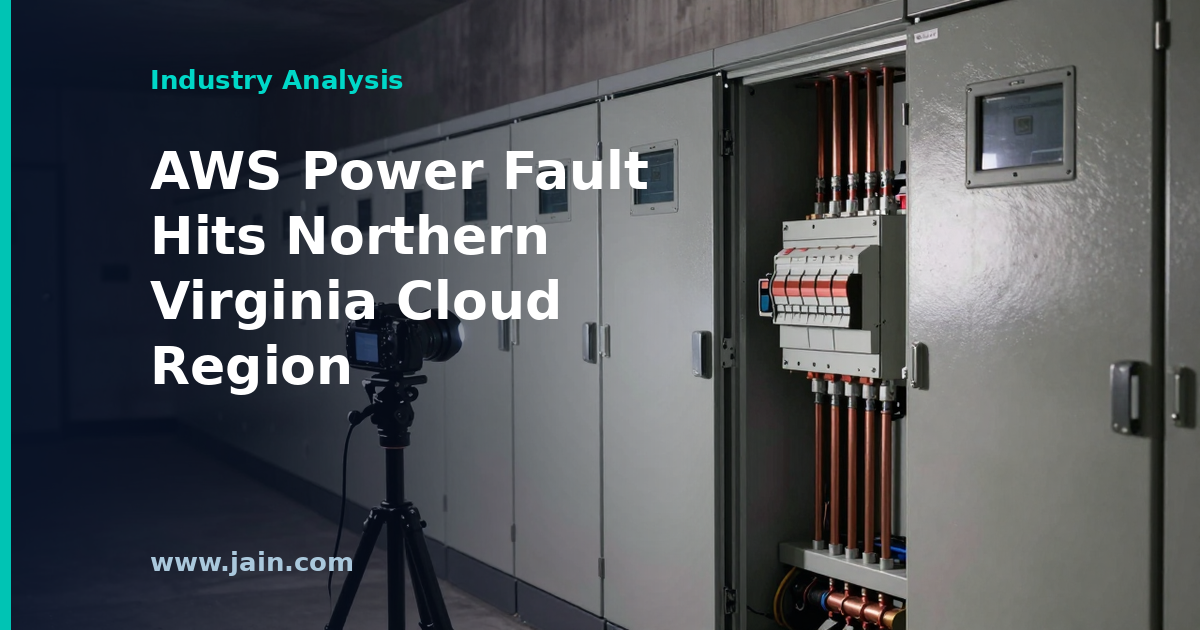
Amazon Web Services experienced power issues at its us-east-1 cloud region in Northern Virginia, causing what was described as a limited outage, according to a report published by Data Center Dynamics on 9 May 2026. us-east-1 is AWS’s oldest and largest region and sits inside the world’s most concentrated cluster of data centers.
The report characterises the disruption as contained rather than region-wide. Beyond the fact of a power-related fault and a limited service impact, the available source material does not establish the root cause, the number of facilities or availability zones affected, the duration, or the list of services and customers involved.
Executive Summary
The headline event is small. A power problem at one of the many buildings that make up AWS’s us-east-1 region in Northern Virginia produced an outage that was reported as limited in scope — the kind of incident that, on most days, resolves before it reaches a board-level conversation.
The significance is structural rather than dramatic. Cloud regions are engineered so that a single building’s failure is absorbed by neighbouring availability zones, which are physically separate facilities with independent power and cooling. That design works, and the word “limited” is evidence that it worked here. But it works by assuming that failures stay inside one electrical failure domain, and the economics of the current build cycle are pushing more compute, at higher power density, into a smaller geographic footprint than the design assumption ever contemplated.
This incident is also distinct from the earlier thermal event reported at the same region — a different physical subsystem, a different failure mode. Two unrelated infrastructure faults at the same campus in a short window do not prove a pattern, but they do make the question worth asking plainly: as Northern Virginia absorbs an unprecedented volume of AI-era load, is the reliability of the electrical distribution layer keeping pace with the density it now has to serve?
“Limited” Is the Most Important Word in the Report
Public cloud regions are not single buildings. A region such as us-east-1 is a collection of availability zones — clusters of data centers deliberately separated by distance and served by independent power feeds, generators and cooling plant — so that one physical failure cannot take down the whole. Customers who spread an application across two or three zones are, in principle, buying insurance against exactly the event reported here.
So when a report says a power issue caused a limited outage, the most defensible reading is that the containment architecture did its job. That is a genuinely favourable data point for AWS, and it deserves to be stated as clearly as any criticism. The customers who felt real pain were most likely those running single-zone workloads, or workloads with a hidden single-zone dependency they did not know about — a database primary, a licence server, a queue — pinned to the affected facility.
The caveat is that “limited” is a description of outcome, not of margin. It does not tell you whether the fault was two layers away from cascading or one. Without a root-cause account, outside observers cannot distinguish a well-contained failure from a lucky one, and that distinction is the whole substance of a reliability assessment.
Electrical Distribution Is the Failure Domain That Ignores the Blueprint
Data center resilience is usually discussed in terms of redundancy — spare generators, spare chillers, spare network paths. In practice, the layer that most often defeats redundancy is the electrical distribution path between the utility feed and the server: the switchgear that transfers load between sources, the uninterruptible power supplies that bridge the seconds before generators start, the breakers and busways that carry power down the row. These components are shared by design. Redundancy at the source does not help if the shared element downstream is the thing that fails.
That layer is under more stress than it was five years ago, for straightforward physical reasons. AI training and inference racks draw substantially more power per square metre than the general-purpose servers most of Northern Virginia’s older halls were designed for. Higher density means higher fault currents, more transfer events, more thermal load on switchgear, and less electrical headroom for the operator to hide a marginal component behind. Nothing in the available reporting says that density caused this particular fault — but density is the reason the industry should treat power distribution incidents as leading indicators rather than routine noise.
The commercial consequence is that reliability spend is shifting. The marginal dollar of resilience capex is moving away from the generator yard and toward monitoring, thermal imaging, arc-flash mitigation and predictive maintenance on medium-voltage gear — unglamorous work that shows up in operating costs rather than in an announcement.
Northern Virginia’s Concentration Premium Has a Concentration Bill
Loudoun County and its neighbours host the densest concentration of data center capacity anywhere in the world, and that concentration exists for good reasons. Decades of fibre investment mean the region has unmatched network interconnection; the sheer mass of tenants creates a peering ecosystem that makes traffic cheaper and faster to exchange there than almost anywhere else; and land, historically, was available at scale. Customers keep choosing us-east-1 because it is the cheapest, best-connected and most feature-complete region AWS operates.
The same gravity produces correlated risk. When a single geography hosts an outsized share of a hyperscaler’s oldest and busiest region, local events — a substation fault, a transmission constraint, a weather event, a distribution failure inside one campus — acquire national consequence. This is not a criticism unique to AWS; every operator that has clustered in the corridor faces the same arithmetic, and the utility serving the region faces it too.
The likely winners from a steady drip of Northern Virginia incidents are the alternative markets that have been marketing themselves on power availability and land: Ohio, Georgia, Texas, the Upper Midwest, and secondary metros with spare grid interconnection. The likely losers are workloads that are contractually or technically stranded in one region — often for data-gravity or egress-cost reasons rather than architectural ones. Every such incident makes the internal business case for regional diversification slightly easier to write.
What This Should and Should Not Change for Buyers
A single contained outage is not a reason to re-architect an estate. It is a reasonable prompt to test whether the resilience you are paying for is the resilience you actually have. The common gap is not the absence of multi-zone deployment but the presence of an unnoticed single-zone dependency inside an otherwise distributed system — and that gap is only ever found by deliberate failure testing, not by reading an architecture diagram.
For procurement teams, the useful questions are contractual as well as technical. Service level agreements for cloud compute generally pay out in service credits, which compensate for the cost of the service rather than the cost of the disruption; that asymmetry is standard across the industry and is worth understanding before an incident rather than after. Buyers with genuinely low tolerance for regional failure should be pricing a second region as an operating cost, not treating it as an optional upgrade.
For investors, the read-through is measured. Incidents of this size do not move demand for cloud capacity, and there is no evidence in the source material of financial or customer impact. The signal to watch is not any single event but whether the operating cost of running very dense capacity in a constrained corridor rises faster than the pricing that corridor can support.
Background
Amazon Web Services launched its first commercial cloud services in 2006, and Northern Virginia — designated us-east-1 — was its founding region. It remains the largest and most feature-rich AWS region: new services typically appear there first, pricing is often lowest, and it is the default in much AWS tooling, which concentrates workloads there by inertia as much as by choice.
The surrounding corridor, centred on Loudoun County and often called Data Center Alley, is the densest concentration of data center capacity in the world. It grew from 1990s fibre investment that made the area a primary internet interconnection point, and every subsequent wave — colocation, public cloud, and now AI training and inference — has reinforced the cluster. That density delivers real performance and cost advantages to tenants, while making local power supply and distribution a matter of national infrastructure significance.
Source: AWS experiences power issues at Northern Virginia cloud region, causing limited outage — Data Center Dynamics reports a power-related fault at AWS’s us-east-1 region resulting in a limited service outage.