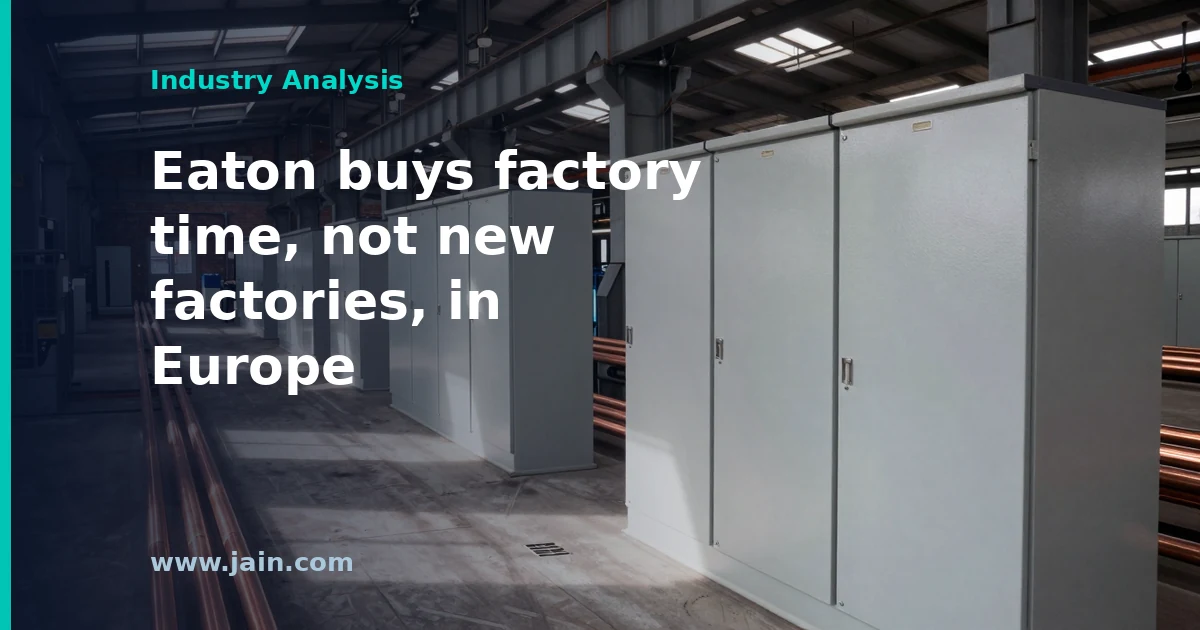
Eaton, a large electrical-equipment company, is buying COL Group, an Italian company that builds equipment for the power grid, for about 923 million dollars.
That equipment includes the heavy machinery that turns high-voltage electricity into power a building can use. It is often one of the slowest things to get when building the giant computer warehouses behind artificial intelligence.
Instead of spending years building new factories in Europe, Eaton is buying factories that already run. That could speed up supply there, but it also leaves buyers with one fewer independent supplier.
Eaton Corporation has agreed to acquire COL Group, an Italian manufacturer of electrical grid equipment, for €810 million, Reuters reported. Yahoo Finance put the price at about $923 million. Eaton describes the deal as a way to expand its footprint in Europe.
Executive Summary
Eaton, one of the largest suppliers of power-distribution equipment to data centers, utilities and commercial buildings, is paying €810 million (about $923 million) for COL Group, an Italian maker of grid equipment. The stated purpose is European expansion. Eaton has not disclosed financing, an expected closing date or COL’s revenue.
The transaction matters beyond Eaton’s own geography because of what it acquires: working production. Grid equipment such as transformers and switchgear is heavy, largely built to order and slow to scale, and the rising power demands of AI data centers, electrification and renewable connections all compete for it. Buying an operating manufacturer gives Eaton plants, trained workers and qualified products at once. Building from scratch would mean waiting years for all three.
For developers, utilities and operators in Europe, the practical question is whether this adds effective supply or mainly moves existing supply under a new owner. Eaton’s answer will show up in what it does with COL’s plants after closing.
Buying a Factory Is Buying Time
The core logic of this deal is sequencing. A new plant for electrical grid equipment has to move through site selection, permitting, construction, tooling, hiring and training. Its products then have to be tested and qualified before utilities and large customers will accept them. Each step mostly waits on the one before it. An acquired manufacturer arrives with every one of those steps already done: the buildings stand, the workforce knows the processes, and the products already carry the approvals customers require.
Seen that way, the €810 million is partly a payment for time. Eaton gets European production capacity immediately, not at the end of a multi-year greenfield program (‘greenfield’ meaning built new on an empty site). The deal does not say how much capacity that is, and Eaton has not published COL’s output or revenue. The direction of the trade-off is still clear. When customers are waiting on equipment, a supplier that already has capacity in hand can capture orders that a supplier still pouring concrete cannot.
The people most affected are European data-center developers and utilities. Their project schedules depend on when electrical equipment arrives. Eaton’s competitors in the region are affected too, because they now face a rival with more local production and a broader portfolio.
Why Grid Gear Sits Upstream of Every AI Data Hall
Before a single AI server can switch on, power has to travel from the high-voltage grid into the building. Transformers step that voltage down to usable levels. Switchgear (the assemblies of breakers and switches that route and protect electrical circuits) directs it safely to each part of the facility. AI data centers need far more power per site than conventional ones, so they need more of this equipment, and they often need larger units.
Eaton already sells much of the power-distribution chain inside data centers. Adding a grid-equipment maker extends its reach toward the utility side of the connection, where equipment is heavier, more customized and typically slower to deliver. That upstream position is attractive when the binding constraint on a project is the electrical connection, not the building or the chips.
A caution applies to that thesis. The companies have framed this as European expansion, not as an AI or data-center move. Eaton has not said what share of COL’s business serves data centers versus utilities, industry or renewable projects. The AI demand case explains why grid-equipment capacity is valuable right now. It does not by itself establish that COL’s output will go to data centers.
What European Equipment Buyers Should Watch
Consolidation cuts two ways for buyers. An integrated supplier that can deliver equipment from the grid connection through to the server rack may simplify procurement and coordination on large projects. The same deal also leaves one fewer independent supplier in the market. That can weaken buyers’ negotiating position and concentrate supply risk with a single vendor.
Allocation is the other open issue. If COL’s existing customers are mainly utilities and industrial firms, they will want to know whether their orders keep their place in the queue once the plants belong to a company with heavy data-center exposure. A clear statement from Eaton on capacity expansion at COL’s sites, as opposed to reprioritizing existing output, would settle much of that uncertainty.
The Price and the Proof
The €810 million figure is the only hard number in the announcement. Without COL’s revenue, earnings or production volumes, outside observers cannot judge whether Eaton paid a premium for scarcity or a conventional industrial multiple (the price expressed as a multiple of the target’s earnings). The European-expansion claim is supported by the act of buying a European manufacturer. The larger claim, that this adds meaningful grid-equipment supply where AI and electrification projects need it, remains to be shown.
The evidence will come in stages. First is regulatory clearance. Then comes any announced investment in expanding COL’s plants. Last is whether Eaton begins quoting shorter European delivery times for the product lines COL makes. Until then, the deal is best read as a bet that owning production capacity now is worth more than building it later.
Background
Eaton is a diversified power-management manufacturer whose electrical segment supplies utilities, buildings, industrial sites and data centers. Its data-center products include power-distribution units, uninterruptible power supplies (backup systems that keep servers running through outages) and switchgear. The company has long used acquisitions to add product lines and regional manufacturing.
Europe’s grid is under pressure from several directions at once. Renewable generation needs new connections. Electrification of heating and transport raises demand. AI data centers compete for scarce connection capacity and for the equipment that makes those connections possible. That combined demand has made established grid-equipment makers valuable acquisition targets for suppliers that want production capacity quickly.
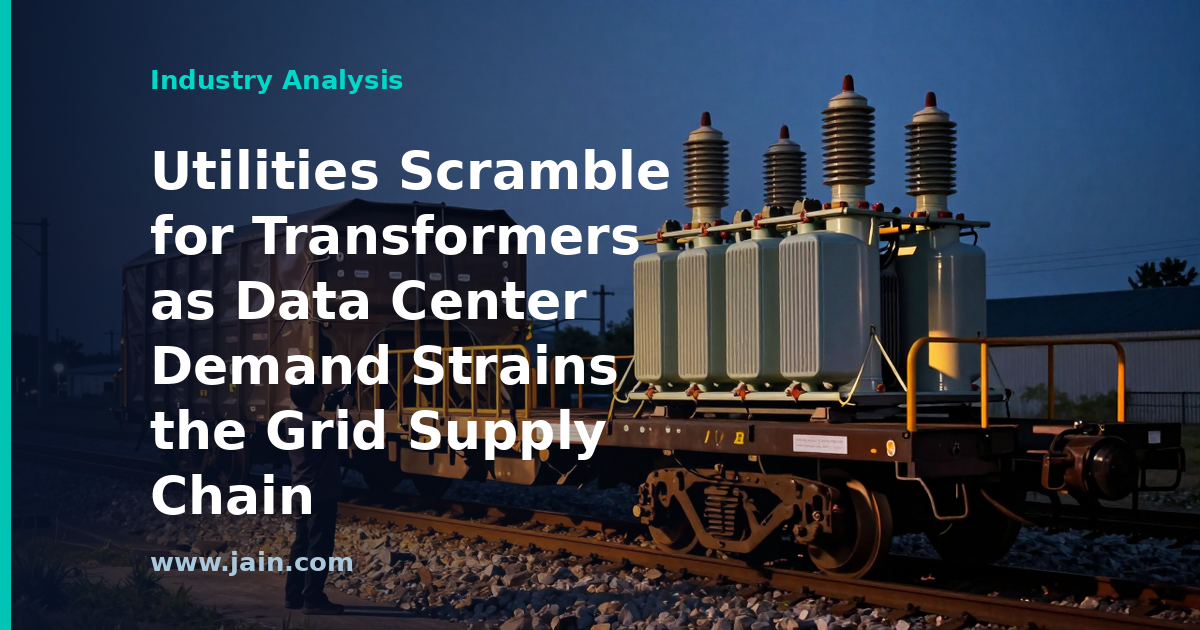
Reuters reported on July 8, 2026 that US power companies are scrambling to secure electrical equipment — the transformers, switchgear, and related grid hardware that move electricity from generators to customers — as surging demand from data centers strains available supplies. The report frames a nationwide procurement crunch: utilities that once ordered this equipment on routine replacement cycles are now competing for constrained manufacturing capacity against a wave of new large-load projects.
Executive Summary
The headline is not about a single deal or data center campus; it is about the industrial base underneath all of them. Transformers step electrical voltage up for long-distance transmission and back down for delivery, and switchgear is the apparatus that switches, protects, and isolates circuits. Neither is optional: every new data center interconnection, substation upgrade, and grid expansion needs both. Reuters’ reporting indicates that US utilities can no longer take timely delivery of this equipment for granted.
Why it matters: for the first time in decades, US electricity demand is growing meaningfully, and data centers — particularly AI-driven facilities — are a leading cause. When the equipment supply chain becomes the pacing item, it stops being a utility procurement problem and becomes a constraint on data center delivery schedules, grid reliability investment, and ultimately on how fast the AI buildout can proceed. Power availability has already emerged as the industry’s defining bottleneck; this report locates part of that bottleneck one layer deeper, in the factories that make grid components.
Why Transformers Became the Grid’s Chokepoint
Large power transformers are among the least glamorous and most consequential machines in the economy. They are heavy, highly engineered, often custom-built to a specific substation’s requirements, and produced by a relatively small number of manufacturers worldwide. Capacity to build them cannot be added quickly: it requires specialized factories, scarce materials such as grain-oriented electrical steel, and skilled workers who take years to train.
The US grid spent roughly two decades with flat electricity demand, and the supply chain sized itself accordingly — tuned for steady replacement of aging units, not for a demand shock. When data center load growth, electrification, and grid-hardening programs all began pulling on that thin manufacturing base at once, order backlogs stretched and utilities found themselves queuing for hardware. The scramble Reuters describes is the predictable result of a just-in-time supply chain meeting a step change in demand.
When Equipment Lead Times Set the Data Center Schedule
For data center developers, this crunch changes what “time to power” means. A site can have land, fiber, permits, and even a utility willing to serve it, and still wait on a transformer delivery slot. Interconnection — the process of physically and contractually tying a new load into the grid — increasingly depends less on paperwork and more on whether the required substation equipment physically exists.
That reality is reshaping behavior on both sides of the meter. Utilities are reported to be securing equipment earlier and more aggressively, which effectively shifts them from reactive procurement to strategic stockpiling. Large data center operators, for their part, have strong incentives to lock in capacity years ahead, pre-order long-lead equipment themselves, or favor sites where grid infrastructure already exists — one reason established carrier hotels and campuses with existing substation capacity have gained strategic value relative to greenfield sites.
The Economics of Scarcity: Who Absorbs the Cost
Scarcity moves pricing power toward manufacturers. Electrical-equipment makers with transformer and switchgear capacity are in an unusually strong position, and the open question is how much they will invest in expansion — factories are decade-scale bets, and executives remember the last long stretch of flat demand. Utilities, meanwhile, typically recover equipment costs through regulated rates, which means sustained price inflation in grid hardware eventually reaches ratepayers and invites regulatory scrutiny over how much of the buildout data center customers should fund directly.
Among data center players, scarcity favors scale and incumbency. Hyperscale operators can pre-purchase equipment, sign long-term supply agreements, and absorb schedule risk in ways smaller developers cannot. If the crunch persists, expect it to act as a filter: well-capitalized projects with early equipment commitments proceed, while speculative projects — announced capacity without secured power and hardware — quietly slip or die. That could rationalize an overheated development pipeline, but it also raises barriers to entry across the industry.
What Could Break the Bottleneck
Several paths out exist, none fast. Manufacturers can and do add capacity, but new production lines take years to reach output. Standardizing transformer designs — reducing the custom engineering in each order — could raise effective throughput. Utilities can extend the life of existing units, share spares, and prioritize deployments. On the demand side, data centers that bring their own generation or agree to flexible operation reduce the immediate grid equipment burden.
The honest assessment is that this is a multi-year imbalance. Equipment supply is a lagging system responding to a leading demand signal, and the gap between them is where project delays, price escalation, and strategic maneuvering will play out. For infrastructure operators, the practical takeaway is that secured power and in-hand electrical equipment are now assets in their own right, worth nearly as much as the buildings around them.
Background
For most of the 2000s and 2010s, US electricity demand barely grew, thanks to efficiency gains offsetting economic expansion. That era ended as data centers — driven most recently by AI training and inference workloads — joined manufacturing reshoring and electrification as major new sources of load. Utilities, regulators, and grid operators have spent the past several years revising demand forecasts upward and confronting the fact that generation, transmission, and the equipment supply chain were all sized for a slower world.
Concerns about transformer supply predate the AI boom — the aging of the US transformer fleet and the concentration of manufacturing capacity have been discussed in grid-security circles for years — but data center growth has converted a slow-burning replacement problem into an acute procurement race. The July 2026 Reuters report captures that shift from the utilities’ side of the table.
Hitachi Energy has published a perspective on data center site selection under grid constraints, arguing that power availability — not real estate, fiber, or tax incentives — is now the deciding factor for where hyperscale and colocation campuses can be developed. The piece, dated 28 May 2026, frames the electrical grid as the pacing item for the industry’s AI-driven buildout.
Executive Summary
The message from Hitachi Energy, a major supplier of high-voltage transformers, switchgear, and grid automation, is that the data center industry’s traditional site-selection playbook is breaking down. Where developers once optimized for cheap land, fiber routes, and state tax abatements, they are now confronting multi-year interconnection queues and utilities that simply cannot deliver hundreds of megawatts on the timelines AI workloads demand.
The perspective matters because Hitachi Energy sits on the supply side of that bottleneck. Transformers and high-voltage equipment now carry lead times measured in years, and the company’s public framing signals both a diagnosis of the problem and a positioning statement: that early utility engagement, grid-aware siting, and integrated power design are becoming prerequisites, not enhancements, for getting a campus energized this decade.
Power Has Replaced Land as the Binding Constraint
For most of the cloud era, data center site selection followed a familiar checklist: proximity to fiber routes, favorable tax treatment, low natural-disaster risk, and access to water for cooling. Power was assumed. That assumption has quietly collapsed. A single AI training campus can now request 500 megawatts or more — comparable to the load of a mid-sized city — and utilities across North America and Europe are responding with interconnection studies that stretch four to seven years. Hitachi Energy’s framing acknowledges what developers already know privately: the binding constraint is no longer where you can build, but where the grid can actually deliver electrons.
Why a Transformer Vendor Is Talking About Siting
Hitachi Energy is not a neutral commentator. As one of a small handful of global suppliers of large power transformers, high-voltage switchgear, and HVDC (high-voltage direct current) systems, the company is directly exposed to the buildout it is describing. That is not necessarily a problem — the firms that make the equipment often see the pipeline earliest — but readers should weigh the perspective accordingly. The commercial subtext is that operators who engage grid-equipment suppliers early in siting, rather than after a lease is signed, can lock in delivery slots for gear that is genuinely scarce.
Winners, Losers, and the New Geography of Compute
If power is the constraint, the geography of the industry shifts. Traditional hubs like Northern Virginia and Dublin, where transmission is already saturated, become harder to expand. Secondary markets with underutilized generation — parts of the U.S. Midwest, the Nordics, and regions near stranded renewable output — become more attractive, provided the transmission math works. Operators willing to co-locate near generation, sign long-term power purchase agreements, or fund grid upgrades directly gain an edge over those still shopping for shovel-ready sites. Utilities, meanwhile, gain unusual leverage: they are effectively rationing a scarce good, and the terms they set will shape which hyperscalers and colocation providers can scale in a given region.
The Risk of Treating the Grid as a Marketing Story
The piece is a corporate perspective, not an engineering white paper, and it is fair to note what that format cannot do. It does not quantify how much of the current interconnection backlog is caused by equipment lead times versus utility planning cycles versus permitting, and those causes require different fixes. Framing site selection as primarily a siting-strategy problem risks understating the structural issues — transmission planning, permitting reform, and generation adequacy — that no single developer or vendor can solve on their own. The useful takeaway is directional: power constraints are now a first-order design input. The unresolved question is who bears the cost of fixing them.
Background
Hitachi Energy was formed in 2020 when Hitachi acquired a majority stake in ABB’s power grids business, creating one of the largest global suppliers of high-voltage equipment, grid automation, and HVDC transmission systems. The company sells primarily to utilities, transmission operators, and large industrial customers, and has increasingly turned its attention to data centers as their electrical demand has begun to rival that of heavy industry.
The wider context is a global grid under simultaneous pressure from AI-driven data center growth, the electrification of transport and heating, the retirement of legacy generation, and renewable integration. Transformer lead times, interconnection queues, and transmission planning have moved from back-office concerns to boardroom issues for hyperscalers, colocation providers, and their investors.
Axios reported on May 21, 2026 that Chinese-made components and materials are quietly flowing into the United States data-center construction boom, even as Washington tightens export controls on advanced chips headed the other direction. The piece frames the dependency as a geopolitical risk for the AI infrastructure now being stood up at record pace.
Executive Summary
The Axios story argues that America’s data-center surge — the physical backbone of the current AI wave — leans on a supply chain in which Chinese firms still play a meaningful, if under-discussed, role. That includes hardware, electrical gear, and construction inputs sourced directly or through intermediaries.
The reason it matters is straightforward: policymakers have spent two years hardening the outbound side of the US–China technology relationship, restricting what advanced silicon and tools American companies can sell to Chinese buyers. The inbound side of the same relationship — what the US buys to build the facilities that host AI — has drawn far less scrutiny, and the article suggests that gap is now visible in the numbers.
The Buildout Nobody Fully Sourced
Hyperscale data-center construction is a bill of materials problem as much as a real-estate problem. A single campus consumes transformers, switchgear, busways, generators, cabling, cooling coils, racks, and structural steel in volumes that already exceed what Western manufacturers can supply on the timelines operators want. When Tier-1 vendors are booked out, buyers turn to whoever can ship — and Chinese factories remain the marginal supplier for a long list of electrical and mechanical components. The Axios framing is that this quiet substitution is bigger than the industry publicly acknowledges.
None of that is inherently a scandal; global sourcing is how infrastructure gets built. It becomes a policy question when the same components sit inside facilities that host frontier AI training runs, defense workloads, or critical services, and when the exporting country is also the strategic competitor the export-control regime is designed around.
Asymmetric Controls, Symmetric Exposure
US policy since 2022 has focused almost entirely on the outbound flow: chips, chip-making equipment, and increasingly the model weights and cloud capacity that could be used to train frontier AI abroad. The inbound flow — grid-scale transformers, power distribution units, network gear, cooling hardware — has been governed by a patchwork of tariffs, Section 232 reviews, and Buy American rules that were not designed with AI infrastructure in mind.
If the Axios reporting holds, the practical implication is that America’s ability to build AI capacity is partly gated by a country it is simultaneously trying to slow down in AI. That is a fragile equilibrium: a future round of tariffs or export restrictions from either side could stretch already long lead times for the exact components operators need most.
Who Gains, Who Gets Squeezed
Western manufacturers of transformers, switchgear, and cooling equipment stand to benefit if buyers and regulators push harder on country-of-origin — but only if they can add capacity, which takes years and skilled labor that is itself in short supply. Hyperscalers with the balance sheets to pre-buy multi-year allocations from domestic and allied suppliers are best positioned; smaller colocation operators and enterprise builders, who buy in smaller lots and later in the cycle, would feel any supply squeeze first.
For AI customers, the second-order effect is schedule risk. A data-center delivery pushed from Q2 to Q4 because a Chinese-sourced transformer was reclassified or a substitute part is on allocation translates directly into delayed GPU deployments and delayed model training. In an environment where compute is the binding constraint on product roadmaps, that is a real cost.
Reading the Claim Carefully
The Axios piece is a framing article, not a forensic supply-chain audit, and the responsible read is to hold both possibilities open. It is plausible that Chinese content in US data-center construction is material and under-reported, given how opaque multi-tier supply chains are. It is also fair to ask how much of the reported exposure is finished Chinese-branded equipment versus subcomponents inside Western-branded gear, and how much is displaceable at reasonable cost versus genuinely single-sourced. Those distinctions determine whether this is a policy problem, a procurement problem, or a headline.
Background
The US data-center industry is in the middle of the largest capacity expansion in its history, driven by generative AI training and inference demand from hyperscalers and a new tier of AI-native operators. That expansion has already collided with constraints on grid interconnection, transformer supply, water, and permitting.
In parallel, the US and China have spent the past several years decoupling on advanced semiconductors, with successive rounds of US export controls on chips and chip-making tools and Chinese retaliation on critical minerals. The Axios story sits at the intersection of those two trends, arguing that the physical layer of the AI economy is still more entangled with China than the policy conversation has acknowledged.
Reuters reported on May 17, 2026 that the ongoing rush to build data centers — driven above all by AI computing demand — is worsening shortages of power equipment and of the skilled workers needed to build and connect electrical infrastructure. The report frames the industry’s constraint as no longer just the availability of electricity itself, but the transformers, switchgear, and trained grid workforce required to deliver it.
Executive Summary
The headline finding is a shift in where the AI infrastructure bottleneck sits. For the past several years, the dominant question in data center development has been access to megawatts — whether utilities can supply enough electricity to power ever-larger campuses. Reuters’ reporting points to a second-order problem: even where power generation exists on paper, the physical equipment that moves electricity (transformers, switchgear, high-voltage cable) and the people qualified to install and energize it (electricians, linemen, substation engineers) are in increasingly short supply, and data center demand is making both shortages worse.
This matters because equipment and labor constraints behave differently from generation constraints. A power plant shortfall is a capacity planning problem that utilities and regulators can see coming years ahead. Equipment lead times and workforce gaps are supply chain and demographic problems — they compound quietly, hit every project in the queue at once, and cannot be solved quickly by spending more money, because factories and apprenticeship pipelines take years to expand. For anyone planning, financing, or buying data center capacity, the practical effect is the same: schedules stretch, and the projects that secured equipment and crews early hold a widening advantage.
The Bottleneck Has Moved Down the Stack
Data center development has always been a race through sequential constraints: land, then fiber, then power, and now the electrical hardware and hands that turn a power allocation into an energized facility. A utility commitment to deliver megawatts is only the first step — that electricity still has to pass through high-voltage transformers, substations, and switchgear before a single server boots. Reuters’ framing suggests the industry has cleared enough of the megawatt question, at least in some markets, to expose the layer beneath it.
This is a meaningful change in how projects fail or slip. A site with signed power agreements can still sit idle waiting for a transformer delivery or a qualified crew to commission a substation. Because these inputs are procured late in a project’s life but have long lead times, the mismatch tends to surface after significant capital is already committed — the most expensive place in a project to discover a delay.
Why Equipment Shortages Are Hard to Fix Quickly
Large power transformers and switchgear are not commodity products. They are engineered-to-order equipment built in a limited number of factories worldwide, with specialized inputs like electrical steel and, critically, their own skilled manufacturing workforces. When demand surges — from data centers, but also from grid modernization, electrification, and renewable interconnection all competing for the same order books — manufacturers cannot simply add shifts. Expanding capacity means new plants and new trained workers, both multi-year undertakings.
The result is a queue that rewards incumbency and scale. Hyperscale operators and large utilities can place framework orders years ahead and absorb price increases; smaller developers and municipal utilities wait longer and pay more. If the Reuters reporting is right that data center demand is actively worsening the shortage, the competitive gap between well-capitalized builders and everyone else — including utilities buying replacement equipment for ordinary grid maintenance — likely widens before it narrows.
The Workforce Problem Is Demographic, Not Cyclical
The second shortage Reuters identifies — grid workers — is in some ways the harder one. Electricians, linemen, and substation technicians are trained through apprenticeships that take years, and the utility workforce in the United States has been aging toward retirement for over a decade. A demand spike from data center construction lands on a labor pool that was already thinning for structural reasons.
Unlike equipment, labor cannot be stockpiled or ordered ahead. Builders can and do bid up wages to pull crews toward their projects, but that reallocates a fixed pool rather than growing it — and it raises costs for utilities and other construction sectors drawing on the same trades. The durable fixes are training pipelines, union apprenticeship expansion, and making grid trades attractive careers, none of which pays off inside a single project’s timeline. For the industry, that means workforce constraints should be treated as a persistent planning input, not a temporary tightness that clears next quarter.
What It Means for Buyers, Builders, and the Grid
For enterprises and AI companies buying capacity, the practical takeaway is that delivery dates carry more risk than headline megawatt figures. A provider’s real differentiator is increasingly its position in equipment queues and its access to qualified construction and commissioning labor — questions worth asking directly during procurement. Operators with existing powered shells, spare substation capacity, or long-standing utility and contractor relationships can deliver on timelines that new entrants cannot match.
For the broader grid, there is a fairness dimension regulators will have to manage: data centers competing for scarce transformers and crews are competing, in part, with the routine reliability work utilities perform for everyone else. How that tension is priced and prioritized — who pays for grid upgrades, whose projects move first — is becoming one of the central policy questions of the AI buildout. It deserves scrutiny from both directions: utilities and communities are right to ask whether data center growth is crowding out other needs, and developers are right to note that their demand is also financing grid investment that would otherwise struggle for funding.
Background
Data centers are the industrial facilities that house computing hardware, and the surge in AI workloads since 2023 has pushed their power requirements from tens of megawatts per site toward campus-scale demands that rival heavy industry. That growth first collided with electricity generation and transmission capacity, making utility power agreements a gating factor for new projects. The electrical supply chain behind those agreements — transformer manufacturing, switchgear production, and the skilled-trades workforce that installs them — was already strained before the AI boom by aging grid infrastructure, electrification, and renewable energy buildouts. Reuters’ May 2026 reporting captures the point where data center demand and those pre-existing strains visibly compound.
The Trump administration is advancing measures to bar foreign technology considered a national-security risk from the US bulk-power system, according to a Nextgov/FCW report dated May 8, 2026. The move revives and extends earlier executive efforts to police the origins of transformers, inverters, control systems and other grid-connected equipment.
Executive Summary
Washington is again training its regulatory attention on the electric grid’s supply chain. The reported action would restrict the use of equipment from designated foreign adversaries in US power infrastructure, echoing a 2020 executive order that was paused and then partially unwound before returning to the policy agenda.
For data-center operators, the stakes are practical rather than abstract. High-voltage transformers, medium-voltage switchgear, battery inverters and grid-tied controls increasingly determine whether new capacity comes online on schedule. Any rule that narrows the pool of eligible suppliers reshapes procurement, lead times and cost curves for hyperscale and colocation builds alike.
What ‘Risky Foreign Technology’ Actually Means
The phrase is broad by design. In earlier iterations, US officials focused on bulk-power equipment sourced from countries designated as foreign adversaries, with particular concern about large power transformers and digital control systems that could be remotely accessed or tampered with. The underlying worry is that embedded firmware, software updates or hardware backdoors in critical grid equipment could be exploited during a conflict or crisis.
For a lay reader, the concern is less about a single dramatic hack than about slow, quiet dependence. If a handful of foreign vendors supply components that sit inside substations for thirty or forty years, replacing them later is expensive and disruptive. Regulators appear to be trying to prevent that lock-in from deepening while alternatives still exist.
Direct Line to Data-Center Power
Data centers do not run on abstractions; they run on transformers, switchgear and increasingly on-site generation. The industry is already contending with multi-year lead times for large transformers and constrained global manufacturing capacity. A rule that narrows sourcing options, even at the margin, tightens an already tight market and raises the premium on domestic and allied-country supply.
Operators building AI-scale campuses should expect procurement teams to be asked new questions: Where was this transformer wound? Whose firmware runs the relay? Is the inverter vendor on a restricted list? Compliance overhead is real, but the bigger operational risk is discovering late in a project that a specified component is no longer eligible.
Winners, Losers and Second-Order Effects
Domestic manufacturers of transformers, switchgear and inverters stand to benefit if the policy sticks and is enforced consistently. Allied suppliers in Europe, Japan, South Korea and Canada are likely secondary beneficiaries. The clearest losers would be Chinese-origin equipment makers and, indirectly, US buyers who had been counting on lower-cost imports to hold down capital budgets.
The second-order effect is timing. Even a well-intentioned rule can slow projects if the domestic industrial base cannot expand fast enough to absorb displaced demand. That risk deserves scrutiny on its own merits, separate from the security rationale.
An Even-Handed Read of the Politics
Supply-chain security in the grid is not a partisan invention; both the 2020 Trump executive order and subsequent Biden-era reviews concluded that the sector had exposure worth addressing. Where reasonable people differ is on scope, speed and how narrowly to define ‘risky.’ Overly broad rules can raise costs without proportionate security gains; overly narrow ones can leave gaps. The forthcoming details, not the headline, will determine which category this action falls into.
Background
Concerns about foreign-made equipment in the US grid escalated in May 2020, when the first Trump administration issued Executive Order 13920 declaring a national emergency over bulk-power system supply chains. That order was suspended early in the Biden administration pending review, and subsequent policy focused on voluntary guidance, prohibited-transaction rules for specific equipment and expanded domestic manufacturing incentives.
In parallel, US utilities and data-center developers have wrestled with a global shortage of large power transformers, lead times that can stretch past two years, and rapid load growth driven by AI, electrification and reshoring. Those pressures form the practical backdrop against which any new sourcing restrictions will be judged.
President Trump has declared a national emergency in order to bar certain foreign-made electrical grid equipment from the United States, according to reporting by The Hill published on April 28, 2026. Grid equipment in this context means the heavy hardware that moves electricity from generators to customers: transformers that step voltage up and down, switchgear that isolates faults, protective relays, and the control systems that coordinate them.
The reporting available at the time of writing establishes the action and its instrument — an emergency declaration used to restrict a category of imported equipment — but does not, in the headline summary reaching us, itemize which product categories, which countries of origin, or which effective dates are covered. Those details determine almost everything about the order’s practical effect.
Executive Summary
A national emergency declaration is a legal mechanism, not a policy in itself. It unlocks executive authority to restrict transactions that would otherwise be ordinary commerce. Applied to grid equipment, it signals that the administration views some imported transformers, switchgear, or control hardware as a security exposure serious enough to justify blocking purchases rather than merely inspecting or certifying them.
The timing is what makes this consequential for the technology-infrastructure sector. Electrical equipment for utility interconnections has been a bottleneck for new construction for several years, and the arrival of large AI and cloud campuses has added a class of buyer that needs tens or hundreds of megawatts per site and needs it on a schedule. Any measure that narrows the pool of eligible suppliers acts on a market where the constraint is already delivery time rather than price.
None of that makes the security rationale wrong. Grid hardware sits at the base of every other system — including the data centers running the economy’s compute — and equipment with remotely accessible firmware is a genuine attack surface. The honest read is that this is a real trade-off between two legitimate goods, and that the size of the trade-off cannot be assessed until the scope of the ban is published.
A Supply Chain That Was Already the Bottleneck
Large power transformers are a category of equipment that behaves almost nothing like the rest of the technology stack. They are custom-engineered for a specific site and voltage, built from specialized steel and copper by a small number of factories worldwide, shipped by rail or heavy haul because of their weight, and ordered years rather than months ahead. There is no spot market and very little interchangeability: a unit built for one substation is generally not a drop-in for another.
That structure means supply responds slowly to demand. When a new class of buyer appears — and hyperscale and colocation data centers are exactly that, requesting utility interconnections at industrial scale — the queue lengthens rather than the price simply clearing the market. Utilities, which need the same equipment for ordinary replacement and storm hardening, are competing in that same queue, and they generally have regulatory obligations that make waiting expensive in a different way.
Into that market comes a restriction on a subset of foreign-made equipment. The mechanical effect is straightforward even without knowing the specifics: fewer eligible suppliers for the same volume of orders means longer waits, more competition for domestic and allied production slots, and a stronger bargaining position for whoever already holds capacity. Whether that effect is small or severe depends entirely on how much of current supply falls inside the restricted category — which the available reporting does not tell us.
Security Logic and Delivery Logic Are Both Real
The case for restricting foreign grid hardware rests on a straightforward premise: modern transformers, breakers, and substation controllers contain firmware and often communications interfaces, and equipment installed at the base of the power system is difficult to inspect, expensive to replace, and long-lived. A component compromised at manufacture could sit in place for decades. This is not a novel concern invented for this order — a 2020 executive order on securing the bulk-power system pursued the same theory, and successive administrations have kept the underlying question open rather than settling it.
The fair question to put to that case is evidentiary: what specifically has been found, and does the response match the finding? Emergency authority is a blunt instrument, and the difference between “we have identified compromised units in service” and “we judge this supply route to be an unacceptable theoretical risk” is the difference between two very different policies. Declarations of this kind are frequently issued without a public factual record; that is normal for classified material and also normal for weak cases, and from the outside the two look identical.
The same scrutiny belongs on the industry side. Utilities and equipment buyers will argue that restrictions raise costs and delay projects, and that argument is both true and self-interested — it is the response any purchaser gives to any supplier restriction. The useful question for readers is not who is complaining but what the measurable effect is: how many units, from which sources, on what delivery schedules, and whether qualified alternatives exist at comparable lead times.
Who Gains and Who Absorbs the Cost
The clearest beneficiaries of a narrowed supplier pool are manufacturers already inside it. Domestic and allied-country producers of transformers and switchgear gain pricing power and order-book visibility, which is precisely the condition under which firms are willing to finance new plant capacity. If the restriction is durable and clearly scoped, it can function as the demand signal that domestic manufacturing has historically lacked. If it is ambiguous or expected to be reversed, it produces the price effect without the capacity investment — the worst of both outcomes.
The cost lands first on projects that have not yet locked their electrical equipment orders. In practice that means later-stage entrants to the data center buildout rather than the incumbents: operators who placed equipment orders early, or who acquired sites with interconnection agreements and equipment already secured, are insulated. Those competing for slots now face a smaller field of eligible vendors. This tends to advantage large, well-capitalized buyers who can pre-purchase inventory and absorb carrying costs, and to disadvantage smaller developers.
For end customers of infrastructure — enterprises buying colocation, cloud capacity, or connectivity — the effect arrives indirectly and with a lag, as availability rather than as a line item. Capacity that cannot be energized on schedule shows up as longer waits for space and power in constrained metros, and as more pressure to consider secondary markets where interconnection queues are shorter.
What Careful Buyers Do Before the Rules Firm Up
The practical response to an announced-but-unspecified restriction is not to rewrite procurement strategy on a headline. It is to establish exposure: which equipment on order originates where, which suppliers are subcontracting to manufacturers that might fall within scope, and what the contractual position is if a delivery becomes non-compliant mid-order. Many buyers do not have that visibility past their immediate vendor, and building it is useful regardless of how this particular order is written.
The second move is to check where risk sits in existing contracts. Force majeure and regulatory-change clauses in equipment and construction agreements determine who eats a delay caused by a government restriction, and those clauses vary widely. This is a cheap thing to review now and an expensive thing to discover later.
The third is patience about the analysis itself. Emergency declarations are typically followed by implementing rules, definitions, exemption processes, and often litigation — and the scope can change materially at each step. Until the implementing detail is published, the responsible position is that the direction of the effect on grid-equipment lead times is upward and the magnitude is unknown.
Background
The electrical grid runs on a class of equipment that is unglamorous, extremely long-lived, and produced by a concentrated global supplier base. Large power transformers in particular are engineered to order, take years to procure, and cannot be swapped between sites. Because replacement cycles are measured in decades, a decision about what equipment is allowed into the system today shapes the physical grid well past the term of any administration that makes it.
Concern about foreign-supplied grid hardware has been a recurring feature of U.S. policy rather than a new development, including a 2020 executive order aimed at securing the bulk-power system. What has changed is the demand side. Data centers built for AI and cloud workloads have become a significant new source of load growth, requesting utility interconnections at a scale and pace that the equipment supply chain was not sized for. Restrictions on supply and a surge in demand are now arriving in the same market at the same time, which is why a policy question that once concerned mainly utilities and regulators is now a scheduling question for anyone building compute.