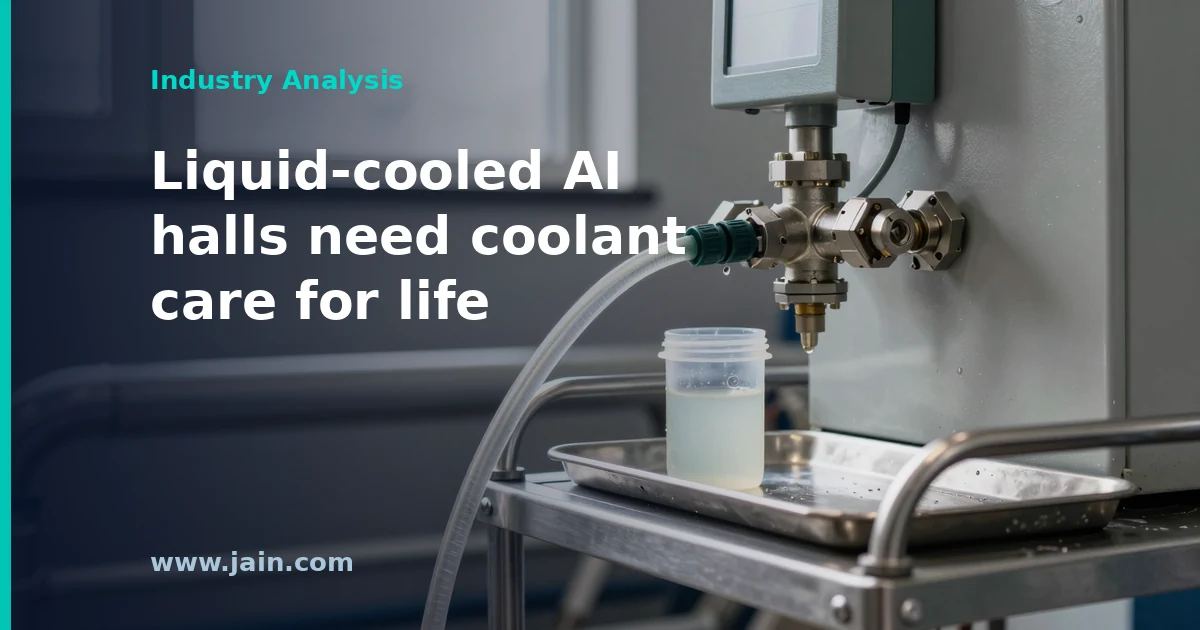
The newest AI computers run so hot that many are cooled with liquid piped right to the chips, a bit like a car’s radiator. That liquid has to stay clean, free of air bubbles and chemically balanced. If it doesn’t, the cooling quietly gets worse and parts wear out.
Vertiv, a big maker of power and cooling equipment for data centers, is buying King Environmental Services, an Irish company that specializes in exactly that upkeep. It is Vertiv’s second such purchase in under a year. Looking after the coolant is becoming an ongoing job, not a one-time setup.
Vertiv Holdings (NYSE: VRT), which makes power and cooling equipment for data centers, has agreed to acquire King Environmental Services Ltd. (KES). KES is headquartered near Dublin, Ireland, and provides fluid management, commissioning and load-testing services for high-density, liquid-cooled data centers across Europe, the Middle East and Africa (EMEA). Zawya carried the announcement on October 5, 2026.
Financial terms were not disclosed, and Vertiv said they are not expected to be material to its results. The deal is expected to close in the fourth quarter of 2026. It follows Vertiv’s December 2025 acquisition of PurgeRite, which the company describes as the foundation of its fluid management business in North America.
Executive Summary
Vertiv is buying a specialist field-services firm rather than a product line. KES flushes, filters, treats and validates the liquid that circulates through cooling systems. It also runs thermal load tests on liquid cooling infrastructure and electrical load tests on critical power systems before a facility goes live. Vertiv says the deal extends its “thermal management services capabilities” into EMEA and supports its strategy of serving customers “across the thermal chain.”
The significance is in the pattern and the scope. This is the second fluid-management acquisition Vertiv has named in roughly ten months, after PurgeRite in North America. The scope Vertiv describes runs well past installation day, covering “monitoring, maintenance and lifecycle optimization.” That is a statement about where Vertiv expects work and revenue to sit in liquid-cooled AI data centers: in the ongoing care of the coolant loop, not only in the hardware that carries it.
The Coolant Has Become Equipment That Needs Servicing
Air-cooled data centers move heat with fans and air handlers. Liquid-cooled AI halls instead pump a water-based coolant through cold plates mounted on the chips, then through coolant distribution units (pumps and heat exchangers) that pass the heat to the building’s water system. Vertiv’s announcement lists what goes wrong in that loop: contamination, trapped air, corrosion, improper chemistry and flow imbalances. Each reduces heat-transfer efficiency, degrades equipment and creates risk both at startup and in operation. The fluid’s condition changes over time, which makes it a component to be maintained, not plumbing to be installed and forgotten.
That mechanism explains why Vertiv describes KES’s scope in lifecycle terms: “system preparation, performance validation, monitoring, maintenance and lifecycle optimization.” It also says outright that “beyond initial commissioning, customers need lifecycle fluid management services.” CEO Gio Albertazzi framed it this way: “the performance of cooling and power infrastructure will depend as much on execution in the field as on engineering and system design.” Every liquid-cooled rack adds piping and fluid volume. That fluid must be flushed and validated before go-live, then sampled, treated and balanced for as long as the facility runs. Work of that kind recurs; it does not end at handover.
The people affected are the operators of AI data centers, whose uptime depends on fluid quality, and the tenants leasing that capacity. Also affected are the mechanical contractors and independent specialists who have historically done flushing and commissioning as project work. One caveat applies: Vertiv has not disclosed how much of this business is recurring maintenance versus one-time commissioning. The recurring-service thesis is clearly stated in the company’s strategy, but not yet shown in numbers.
Two Deals, Two Regions, One Template
PurgeRite gave Vertiv a fluid management base in North America; KES is meant to do the same for EMEA. Two acquisitions by one company do not make an industry trend. They do show a deliberate geographic build-out of the same capability, by a supplier whose equipment already sits inside the cooling loops these teams service. KES’s Dublin-area base puts it in one of Europe’s established data center markets.
KES also brings load testing. Thermal load testing uses heat-generating equipment to simulate a full room of running servers, so operators can confirm the cooling performs before costly AI hardware arrives. Electrical load testing does the equivalent for backup and critical power systems. Finding a flow imbalance or a power fault before the servers are installed is far cheaper than finding it afterward. Vertiv’s pitch is that one “single accountable partner” can handle commissioning, testing, fluid management and ongoing operations, plus compliance with regional rules on fluid handling, treatment and disposal.
A Small Price, a Clear Signal and a Neutrality Question
Vertiv says the terms are not material to its financial results. That suggests KES is small next to Vertiv’s business, and that this is a purchase of capability and footprint rather than revenue. Experienced field teams, local regulatory know-how and a safety record take years to build, and buying them is the faster route into a region. Vertiv’s own risk disclosures name the obvious exposure: keeping KES’s management and key employees, and maintaining its customer and supplier relationships, after the deal closes.
There is a fair question for buyers too. Commissioning is often valued as an independent check on what a vendor delivered. When the company supplying cooling equipment also validates and maintains it, customers may reasonably ask how independence is preserved. Vertiv’s single-partner model offers clear accountability. Whether customers weigh that above independent verification is something the market, not the announcement, will settle.
Background
Vertiv, headquartered in Westerville, Ohio, and listed on the New York Stock Exchange, supplies power, cooling and IT infrastructure, along with software, analytics and services, to data centers, communication networks and commercial and industrial facilities. It does business in more than 130 countries.
The shift behind this deal is the rise of liquid cooling. As AI and high-performance computing workloads push more heat into each rack, air alone struggles to remove it, and operators increasingly pipe coolant directly to the hardware. That makes the condition of the fluid, along with the testing and upkeep of the systems that carry it, a factor in uptime. Field services such as commissioning and fluid maintenance are becoming a larger part of how cooling suppliers compete.
Artificial intelligence runs inside warehouse-sized buildings packed with computers that get extremely hot. Getting that heat out has become one of the hardest and costliest parts of building them.
On September 19 in Santa Clara, California, the Italian air-conditioning maker Clivet showed a new range of cooling equipment built for those buildings, including its largest heat-removal unit yet.
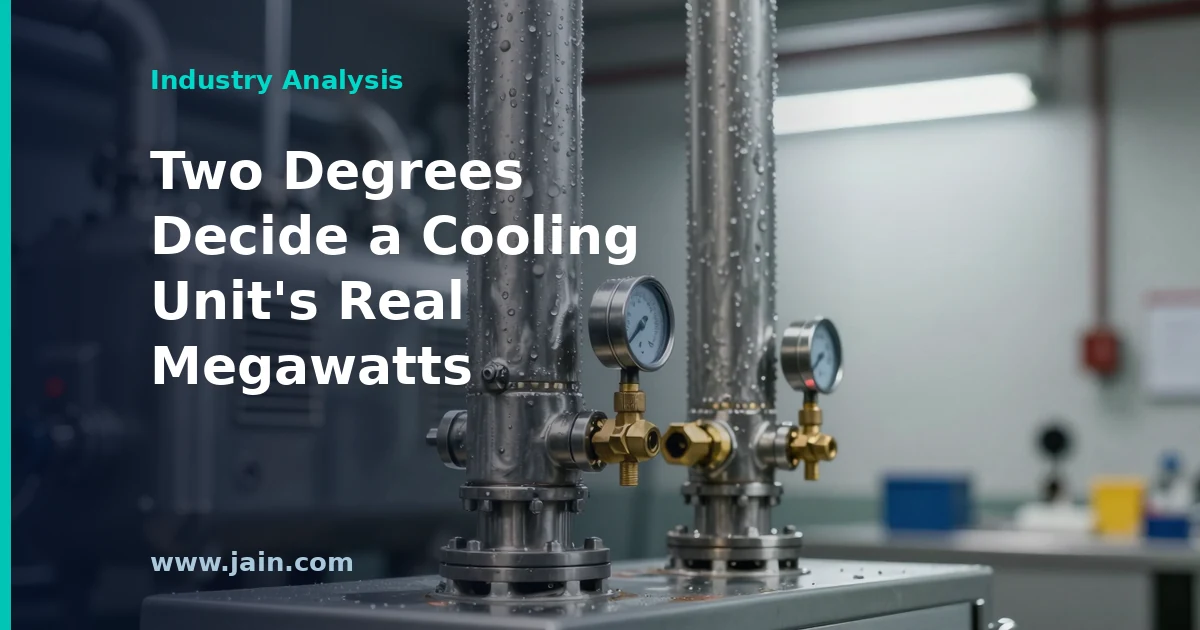
The catch is in the fine print. That unit only reaches full strength if operators let the cooling water run slightly warmer. Ask it for water two degrees colder and it carries about 40 percent less heat — so you need more machines, and more floor space to put them on.
Clivet said in a September 19 press release that it made the global debut of its next-generation magnetic levitation compressor at AI Infra Summit 2026 in Santa Clara, California, under a “DUO POWER BOOST” theme. The compressor uses a dual-rotor, two-stage architecture in which each rotor and impeller varies speed independently to suit different flow rates and pressure ratios.
Alongside it, the company showed a data center cooling portfolio spanning air-cooled magnetic levitation chillers, a “magnetic CDU” that merges the cooling source with liquid-cooling distribution, high-capacity coolant distribution units, fan walls and terminal units. The largest CDU on display is rated up to 3 MW at a 3K approach temperature difference or 5 MW at 5K, with predictive control holding temperature fluctuation within ±0.5°C and key components replaceable online. Clivet also staged a joint power-and-cooling coordination demonstration with CLOU, which supplied energy storage and power delivery.
Executive Summary
This is a product debut rather than a contract announcement: no customer, no order book, no ship date. What makes it worth reading closely is a single line in the specification. The same coolant distribution unit — the box that takes heat from the water loop running through server racks and hands it to the building’s chilled-water system — is rated at 3 MW or 5 MW depending on nothing more than how close the two water temperatures are allowed to get.
That gap, called the approach temperature difference, is normally treated as a plumbing detail. At AI rack densities it is a capacity decision. A two-kelvin change in the specification moves roughly 2 MW of heat rejection per unit, which translates directly into how many CDUs an operator buys, how much floor space they consume and how much pipework threads the room.
The wider signal is a European HVAC manufacturer re-pointing core product lines — chillers, compressors, air handling — at AI thermal loads, and pairing them with an energy-storage partner so that power and cooling arrive as one conversation. Clivet has disclosed an architecture and a capacity envelope. It has not disclosed efficiency ratings, availability, pricing or a single deployment.
The Spec Sheet, Not the Steel, Sets the Megawatts
Read the CDU rating again: up to 3 MW at 3K approach temperature difference, or 5 MW at 5K. Approach temperature is the gap between the facility water a chiller plant delivers and the warmer technology-side water that actually circulates through cold plates on the processors. A heat exchanger’s duty scales with the temperature difference driving it, so widening the approach from 3K to 5K — a factor of 1.67 — lifts the rating from 3 MW to 5 MW, also a factor of 1.67. The ratings track heat-exchanger physics almost exactly. Nothing inside the cabinet changed.
The operational consequence is the part buyers underestimate. An operator whose chip vendor mandates cold inlet water, and who therefore specifies a tight 3K approach, is buying a 3 MW machine at the price and footprint of a 5 MW one. Sizing a 30 MW hall needs ten units instead of six, with the extra floor area, valve sets, pipe runs, commissioning hours and maintenance headcount that go with them. Conversely, an operator who can accept warmer technology-side water recovers roughly 67 percent more capacity per unit — and typically unlocks more free-cooling hours upstream, because warmer facility water lets the chiller’s compressors idle for more of the year.
That uplift is not free, and Clivet’s release does not price it. Moving 5 MW instead of 3 MW through the same unit means proportionally more flow at a given temperature rise, which means pump power, larger secondary pipework and higher pressure drop. Flow rates, pump curves and pressure-drop figures were not published. The honest reading is that the 5 MW headline number is real but conditional, and the condition is set by the silicon vendor’s inlet temperature limit, not by the cooling vendor.
Why Magnetic Levitation, and Why the Compressor Is the Announcement
A magnetic levitation compressor spins its impellers on magnetic bearings rather than oil-lubricated ones. Removing oil removes a chronic efficiency tax: over time, oil migrates into heat exchangers and films the tube walls, degrading heat transfer in exactly the equipment whose job is heat transfer. Oil-free machines also tolerate frequent starts and hold efficiency well at part load — which matters because a data center chiller plant almost never runs at design load.
Clivet’s specific claim is architectural. The DUO POWER BOOST design puts two rotors in a two-stage compression path and lets each vary speed independently, so the machine can trade flow against pressure ratio as ambient conditions and IT load move. In principle that widens the efficient operating envelope, which is the right target for a facility whose load profile swings with training runs and whose lift changes with the seasons.
What is substantiated here is a design description. What is not substantiated is performance. The release contains no coefficient of performance, no part-load efficiency figure such as IPLV or NPLV, no capacity range for the chillers, no refrigerant, no sound data and no third-party certification. Those are the numbers a consulting engineer actually specifies against, and until they exist the compressor is an architecture rather than a comparable product.
Selling Power and Cooling as One Problem
The joint demonstration with CLOU — energy storage and power delivery on one side, thermal management on the other — is commercially more interesting than it looks. Clivet’s own framing is that power configuration, thermal design, space layout and maintenance planning have to be settled together in a project’s earliest stages. That is a fair description of where high-density projects slip: the electrical and mechanical designs are often procured by different teams on different schedules, and the mismatch surfaces at commissioning.
Packaging across that boundary is a recognisable vendor strategy in this market, and it is a response to buyer behaviour rather than a technical breakthrough. Operators building AI halls increasingly want a single party accountable for the megawatt from the switchgear to the cold plate, because integration risk is what delays revenue.
The limits should be stated plainly. What was shown was a coordinated demonstration, not a disclosed commercial arrangement. Neither company published a joint product, a reference architecture, a territory split, an exclusivity term or a customer that has bought the combination. Until one of those appears, this is a booth, not a venture.
A European HVAC Line Re-Aimed at AI Heat
The portfolio’s shape is the story for the wider industry. Clivet showed facility-side air-cooled chillers, a magnetic CDU that folds the cooling source and the liquid distribution loop into one machine, high-capacity CDUs for secondary-side distribution, fan walls and terminal units — coverage from outdoor heat rejection to the rack. That is a general-purpose comfort-and-process HVAC catalogue being re-cut for a single vertical, and it puts Clivet into a tier already crowded with Vertiv, Schneider Electric’s Motivair, Boyd, nVent, Munters and Modine.
The magnetic CDU is the genuinely differentiated item in the list, because combining chiller and distribution in one enclosure removes an interface — and interfaces are where commissioning time and finger-pointing live. It also concentrates risk, which is presumably why the release stresses online replacement of key components and ±0.5°C predictive control. Tight temperature stability matters for cold-plate systems because dew point and thermal cycling both sit close to the operating envelope; a loop that overshoots risks condensation on cold plates or stress on solder joints.
For buyers, the practical takeaway is that the competitive question in this tier is no longer whether a vendor offers liquid cooling. It is whose ratings survive the approach temperature their silicon demands, and who will put efficiency and availability numbers behind the architecture.
Background
Clivet is an Italian heating, ventilation and air-conditioning manufacturer based in Feltre, in the Veneto region, and has been majority-owned by China’s Midea Group since 2016. Its traditional business spans chillers, heat pumps and air-handling equipment for commercial and industrial buildings — a catalogue it is now re-aiming at data centers, where thermal design has become a primary constraint on how much computing capacity a building can hold.
AI Infra Summit, held in Santa Clara in the heart of Silicon Valley, has become a gathering point for the supply chain behind AI buildout: chips, power, networking and increasingly cooling. The shift to direct-to-chip liquid cooling has drawn in vendors from adjacent markets — industrial refrigeration, automotive thermal, building HVAC — because a coolant distribution unit is, at bottom, a pump, a heat exchanger and a controller, all of which these companies already build at scale. What they must prove to data center buyers is uptime, serviceability and certified performance, which is why the specification sheet, not the stage demonstration, is where these launches are ultimately judged.
Modine, a century-old Wisconsin maker of heating and cooling equipment, is splitting off its vehicle parts business and merging it into another company, Gentherm.
To keep the split free of a large tax bill, Modine will collect about $51 million less cash than planned: $159 million instead of $210 million.
Gentherm’s existing owners get a one-time payment of about $1.90 per share to balance things out.
What remains of Modine will focus on cooling the huge computer buildings that run the internet and online services.
Modine Manufacturing (NYSE: MOD) and Gentherm (NASDAQ: THRM) on September 17, 2026 revised the terms of their pending combination, under which Modine spins off its Performance Technologies business and merges it into a Gentherm subsidiary. Gentherm now expects to issue about 2,902,466 additional shares in the merger. To offset that, the cash Modine receives from the spun-off business falls from $210 million to $159 million, and Gentherm will pay its existing shareholders a special dividend of about $58.35 million, or an estimated $1.90 per share. Stock Titan first reported the revised terms.
Modine set September 28, 2026 as the record date for the spin-off. The distribution and merger are expected to close on October 1, 2026. After closing, legacy Gentherm shareholders are expected to own about 56.4% of the combined company, and former Modine shareholders about 43.6%.
Executive Summary
The update is a mechanical adjustment, but it shows what Modine will accept to keep its restructuring intact. The merger agreement contains a provision designed to preserve the tax-free treatment of parts of the deal for Modine and its shareholders. That provision has now been triggered, so Modine’s shareholders receive more Gentherm stock and Modine the company receives $51 million less cash at closing.
This matters for data-center infrastructure because of what Modine becomes afterward. In a September 10 release, Modine said it will rename itself Modexus Solutions, a thermal management company serving data center cooling, commercial HVAC (heating, ventilation and air conditioning) and refrigeration. The company that will sell chillers and cooling systems into data halls will start its new life with less deal cash than it had planned. In exchange, it avoids the tax exposure the adjustment mechanism exists to prevent.
Both companies describe the adjustment as economically neutral. The final exchange ratio, cash reduction and dividend will be set at closing and may differ from the current estimates.
Why Modine Accepts $51 Million Less at Closing
The deal is a Reverse Morris Trust. In this structure, a company spins a division off to its own shareholders and that division immediately merges with another company, which can let the parent shed the business without a corporate tax bill on the separation. Tax treatment for these deals broadly depends on the parent’s shareholders ending up with enough of the combined company. The joint release says the adjustment turns principally on how many investors are treated as holding both Gentherm and SpinCo stock just before the merger.
That overlap has shrunk. According to the joint release, trading in both stocks since the merger agreement was signed reduced the number of shared holders. The agreement’s mechanism therefore raises the exchange ratio, the number of Gentherm shares each SpinCo share converts into, by roughly 2.9 million shares in total. Those extra shares go to Modine’s shareholders. To keep the negotiated split of value in place, Modine the corporation takes a 24% smaller cash distribution: $159 million instead of $210 million.
The trade-off is clear from the order of the terms. Protecting the tax-free status of the separation takes priority over the size of the cash payment. For a company repositioning around data-center cooling, a clean exit from its vehicle-related business matters more than the last $51 million of proceeds.
What the Cooling Company Carries Out of the Deal
After closing, Modine will be a narrower business. Its September 10 release describes the future Modexus Solutions as serving ‘high-growth markets, including data center cooling, commercial HVAC and refrigeration.’ It will keep the MOD ticker, and CEO Neil Brinker and CFO Mick Lucareli will stay in place. Shareholders will vote on the name change within three months of closing.
Data-center cooling is capital- and capacity-hungry. Suppliers compete on manufacturing footprint, lead times and engineering for denser, hotter server racks. Cash from a divestiture is one of the cleaner ways to fund that. The revision leaves Modine with less of it: $159 million instead of $210 million. Modine’s shareholders keep the value as Gentherm stock, but that value sits in an automotive-focused company, not in the cooling business.
The companies have not said how the lower proceeds change Modine’s capital plans, if at all. Operators and investors watching Modine’s data-center capacity should look for that answer at its next disclosures, not assume the reduction is immaterial.
Who Absorbs the Adjustment
Each group is made whole in a different currency. Modine shareholders receive more Gentherm shares but are expressly excluded from the special dividend on those shares. Legacy Gentherm shareholders receive about $1.90 per share in cash, payable October 7 and only if the merger closes, to compensate for dilution from the added shares.
The combined Gentherm keeps $51 million inside SpinCo that would otherwise have gone to Modine, then pays out about $58.35 million to its legacy holders. On the current estimates, the combined company ends up with a few million dollars less cash than under the original terms, while Modine absorbs the full $51 million reduction. The two offsets together total roughly $109 million against about 2.9 million additional shares.
The companies say the adjustment has ‘a neutral effect on the economics of the transaction.’ That holds at the level of total value. It does not mean each corporate balance sheet is unaffected, and the balance sheet that shrinks most is the one aimed at data-center cooling.
Background
Modine, headquartered in Racine, Wisconsin, has made heating and cooling technology for more than 100 years and employs more than 13,000 people. It has been reshaping its portfolio toward what it calls high-growth thermal markets, most visibly cooling for data centers, where rising server power density makes heat removal a central design constraint.
Gentherm, based in Novi, Michigan, supplies thermal and comfort technologies, mainly to the automotive industry. Combining it with Modine’s Performance Technologies business gives Gentherm a larger vehicle-related platform. Modine keeps its climate, HVAC and data-center cooling operations under the planned Modexus Solutions name.
Modine, a Wisconsin manufacturer more than a century old, plans to change its name to Modexus Solutions.
The company is splitting in two. The half that makes parts for cars and trucks is being spun out and combined with another company, Gentherm, on October 1. What stays behind is the business that cools buildings and, increasingly, the huge computer warehouses that run artificial intelligence.
Those computers run hot enough that hauling the heat away is now a business of its own. Shareholders still have to approve the new name.
Modine Manufacturing said on September 10 that it will rename itself Modexus Solutions once it completes the spinoff of its Performance Technologies business and that unit’s merger with Gentherm. The plan appeared in an 8-K filed the same day, with the press release attached as Exhibit 99.1, and in a parallel Form 425 covering merger communications. Gentherm shareholders approved the transaction at a special meeting on September 10, and the parties expect to close on October 1, 2026, subject to customary closing conditions.
The renamed company will keep the MOD ticker on the New York Stock Exchange. Neil D. Brinker and Michael Lucareli stay on as chief executive and chief financial officer, alongside the current board. The name itself needs a separate shareholder vote to amend Modine’s articles of incorporation, and the company expects to call that special meeting within three months of closing. Investing.com reported that Modine shares rose after the rebranding plan was announced.
Executive Summary
The announcement is the branding capstone on a structural change that has been in motion for months. Platinum SpinCo Inc., a wholly owned Modine subsidiary holding the Performance Technologies business, filed a Form 10 registration statement that the SEC declared effective; Gentherm filed a Form S-4 that was also declared effective and includes the proxy statement mailed to its shareholders. That combination of filings describes a spinoff followed immediately by a share-issuing merger, the standard plumbing for separating a division and delivering it to another public company’s shareholder base.
What remains at Racine after October 1 is a heat-transfer business aimed at buildings and computing equipment rather than vehicles. Modine’s own framing in the release is careful: it calls the result a “diversified thermal management company serving high-growth markets, including data center cooling, commercial HVAC and refrigeration.” That is diversification across end markets inside one discipline, not diversification across industries.
For buyers of data center cooling equipment, nothing changes on October 1 except the letterhead, eventually. For investors, the change is more consequential. A company whose results were previously smoothed by two loosely correlated cycles, vehicles and buildings, now reports against one demand story that the market has already decided is about artificial intelligence.
The Word “Diversified” Is Doing Real Work Here
Read the release closely and you find the company resisting the label the market is likely to apply to it. Modine describes Modexus Solutions as diversified. The market will describe it as a cooling company. Both can be true, and the gap between them is where the investment case gets argued.
The remaining portfolio spans three end markets with genuinely different rhythms. Commercial HVAC, meaning the heating, ventilation and air conditioning systems in schools, warehouses and offices, tracks construction and retrofit budgets. Refrigeration follows food retail and cold chain spending. Data center cooling follows hyperscale and colocation capital expenditure, which has been running on a very different clock. Those cycles do not move together, and that is a legitimate defense against the pure-play characterization.
What is harder to dispute is where the incremental attention goes. Nobody re-rates a thermal manufacturer on refrigeration. The company put data center cooling first in its own list of high-growth markets, and it is the market that determines how the shares trade. Losing the vehicular business removes a hedge, and a drag, at the same time.
Heat Is the Constraint, and That Is the Whole Opportunity
The reason cooling has become interesting is arithmetic. A rack of servers running artificial intelligence training workloads can draw several times the power of a conventional rack, and essentially all of that power turns into heat that has to leave the building. Past a certain density, blowing cold air over the equipment stops working, and operators move to liquid cooling, where coolant is piped directly to the chips. That transition changes what a data center buys, from fans and air handlers to pumps, heat exchangers, coolant distribution units and controls.
Companies with heat-exchanger engineering in their DNA are well placed for that shift, and Modine has more than a century of it. But the same shift has attracted every large thermal and electrical infrastructure vendor, from power-and-cooling specialists to the big building systems conglomerates. Incumbency in air-cooled equipment does not automatically convert into share in liquid-cooled equipment, because the buying decision moves closer to the chip vendor’s reference design and the customer set concentrates into a handful of very large, very demanding accounts.
That concentration cuts both ways. Large orders arrive in size and give good visibility, then they pause in size too. A cooling business inside a diversified manufacturer can absorb a lumpy quarter. A cooling business that is most of the story cannot.
What Shareholders Are Actually Being Asked to Approve
There are two separate votes here, and conflating them is easy. Gentherm’s shareholders have already voted, on September 10, and approved the transaction. Modine’s shareholders have not yet voted on the name, because under Wisconsin law changing the corporate name means amending the articles of incorporation, which requires shareholder approval. That meeting is expected within three months of closing, with no date set.
This is worth understanding for what it is: low-risk housekeeping, not a referendum on strategy. The strategic decision was made when the transaction was signed. Shareholders who dislike the direction have no mechanism in the name vote to reverse it. Continuity reinforces the point, since the ticker stays MOD, the chief executive and chief financial officer stay in place, and the board stays intact.
Brinker’s reference to the “80/20 framework” is the substantive line in the release. It refers to the Pareto discipline of concentrating resources on the minority of products and customers that generate the majority of profit, and pruning the rest. Applied to a company that has just shed its largest structural distraction, it signals more portfolio surgery ahead, not less. That is a promise about future decisions rather than a disclosed plan, and it should be read as such.
Rebrands Signal Intent; Results Settle It
Corporate renamings after a separation are conventional, and usually sensible. A name tied to a legacy business becomes a liability when that business has left the building, and sales teams, recruiters and analysts all benefit from a label that matches what the company now does. The cost is the erosion of a century of brand equity, which the release explicitly tries to preserve by keeping the Mod- root.
The risk is one of expectation management. Naming yourself after a repositioning invites the market to price the repositioning immediately, while the operating proof arrives over several reporting periods. Separations consume management attention, generate one-time costs, and leave stranded overhead behind. The company’s own forward-looking statement section lists exactly these hazards: unexpected costs and charges, delay or failure in integration, difficulty achieving synergies, and inability to retain key personnel.
The fair assessment is that this announcement is a well-executed milestone in a transaction that is nearly done, not new information about the business. It confirms timing and leadership continuity. It does not, on its own, tell anyone how much cooling equipment Modexus Solutions will ship in 2027.
Background
Modine has operated from Racine, Wisconsin for more than a century, building heat-transfer equipment for applications where thermal failure is not an option. The company employs more than 13,000 people across North America, South America, Europe and Asia, and its stated purpose, “Engineering a Cleaner, Healthier World,” spans heating, cooling and ventilation products aimed at cutting energy and water use, lowering emissions and using more benign refrigerants.
For most of its modern history the company straddled two worlds: thermal systems for vehicles, sold to automotive and commercial vehicle manufacturers, and heating, cooling and ventilation equipment for buildings. The Gentherm transaction separates those worlds. Gentherm is a supplier of thermal management technology to the automotive sector, which makes it a natural home for the vehicular assets. What remains with the renamed company is the building and computing side, where data center cooling has become the demand story that matters most to how the shares are valued.
Two thermal-management suppliers moved in opposite directions in the same news cycle. Aggregated coverage carried by Google News reports that shares of Vertiv Holdings (NYSE: VRT), one of the largest vendors of data center power and cooling systems, fell 12%, under a headline asking whether the decline is a buying opportunity. A separate item reports that Modine Manufacturing (NYSE: MOD) gained on a $4 billion data center figure.
The available source material is limited to those two aggregated headlines. The Modine headline is truncated in the feed as “$4B data center c…” and no underlying release text, dated filing, customer name, or delivery window accompanies either item.
Executive Summary
The news itself is small: one stock down 12%, another up on a large dollar figure. What makes it worth an article is the divergence. Vertiv and Modine sell into the same demand driver — the buildout of AI data centers, whose dense computing racks generate far more heat per square foot than conventional servers and increasingly require liquid cooling rather than air. If that demand were the only variable, the two share prices would tend to move together. They did not.
The most defensible reading is that investors are no longer pricing thermal-management companies purely on demand. They are pricing the gap between demand and what is already embedded in each share price. A supplier can book record orders and still see its stock fall if the market had assumed even more; a smaller supplier can rerate sharply on a single large figure because far less was assumed to begin with.
For infrastructure buyers, none of this changes physics or lead times. But supplier share prices influence capital costs, capacity expansion decisions and acquisition activity, so procurement teams have a legitimate reason to watch the tape — without mistaking it for operational news.
Order Books and Share Prices Answer Different Questions
A backlog or contract figure answers a backward-looking question: what has a customer already committed to buy? A share price answers a forward-looking one: is the expected future stream of profits better or worse than what buyers had already paid for? These can diverge for long stretches, and the reported moves are consistent with exactly that. A $4 billion data center figure at Modine is large relative to the company’s historical association with vehicular and building HVAC heat exchangers, so it plausibly resets expectations upward. Vertiv, by contrast, has been among the most visible listed proxies for AI infrastructure spending, which means a good deal of optimism can already sit inside the price before any new information arrives.
This is the ordinary mechanics of expectations, not evidence that AI cooling demand is weakening. Nothing in the source material states why Vertiv shares fell. A 12% single-move decline in a high-expectation industrial name can follow guidance, margin commentary, a customer concentration disclosure, a sector-wide rotation, or an analyst action. Attributing it to any one cause without the underlying report would be speculation.
Liquid Cooling Is Real Revenue, Not Just a Theme
The substantive point beneath both headlines is that thermal management has moved from a line item to a gating factor. When a rack of AI accelerators draws many times the power of a traditional server rack, air alone stops working economically well before it stops working physically. That pushes operators toward direct-to-chip cold plates, rear-door heat exchangers and, at the extreme, immersion — all of which involve pumps, manifolds, coolant distribution units and heat rejection equipment that did not exist in volume in the previous generation of data centers.
That shift widens the addressable market and, importantly, widens the supplier set. Cooling was historically dominated by a small group of specialists selling precision air-conditioning units. Liquid cooling draws in companies with heat-exchanger and fluid-handling engineering heritage from adjacent industries. Modine’s move is the clearest illustration in this news cycle of an adjacent-industry entrant being repriced as a data center supplier. The competitive implication for incumbents is not that demand disappears; it is that the premium for scarcity may compress as more credible suppliers qualify.
What Procurement Teams Should Actually Do With This
Buyers should separate two signals. The first is capacity: a supplier reporting a very large committed order book is telling you its factories and engineering teams are spoken for, which is a lead-time warning as much as a growth story. The second is durability: a supplier whose equity falls sharply is facing a higher cost of capital, which can constrain the very capacity expansion buyers are counting on. Neither headline here is severe enough to warrant requalifying vendors, but both argue for the standard disciplines — dual sourcing on long-lead thermal components, contractual delivery remedies, and design choices that do not lock a hall to a single vendor’s coolant distribution architecture.
For investors, the fair conclusion from two aggregated headlines is narrow: the market is differentiating within a trade it previously bought as a block. Whether Vertiv’s decline is an entry point or a repricing of expectations cannot be determined from the material available, and the source headline poses that as a question rather than answering it.
Background
Data center cooling was for decades a specialist niche dominated by precision air-conditioning vendors serving halls of relatively uniform, air-cooled servers. The economics were stable and the engineering incremental. The arrival of high-density AI computing changed that: rack power densities rose to levels where air cooling becomes impractical, pushing operators toward liquid-based approaches and turning cooling from a supporting utility into a constraint on how much computing a site can host.
That transition has made listed suppliers of power and thermal equipment, Vertiv among the most prominent, into widely traded proxies for AI capital spending, while opening the market to manufacturers such as Modine whose heat-exchanger engineering originated in other industries. Because both the demand and the expectations attached to it have risen quickly, share prices in this group have become sensitive to small revisions in outlook — the backdrop against which these two contrasting headlines should be read.
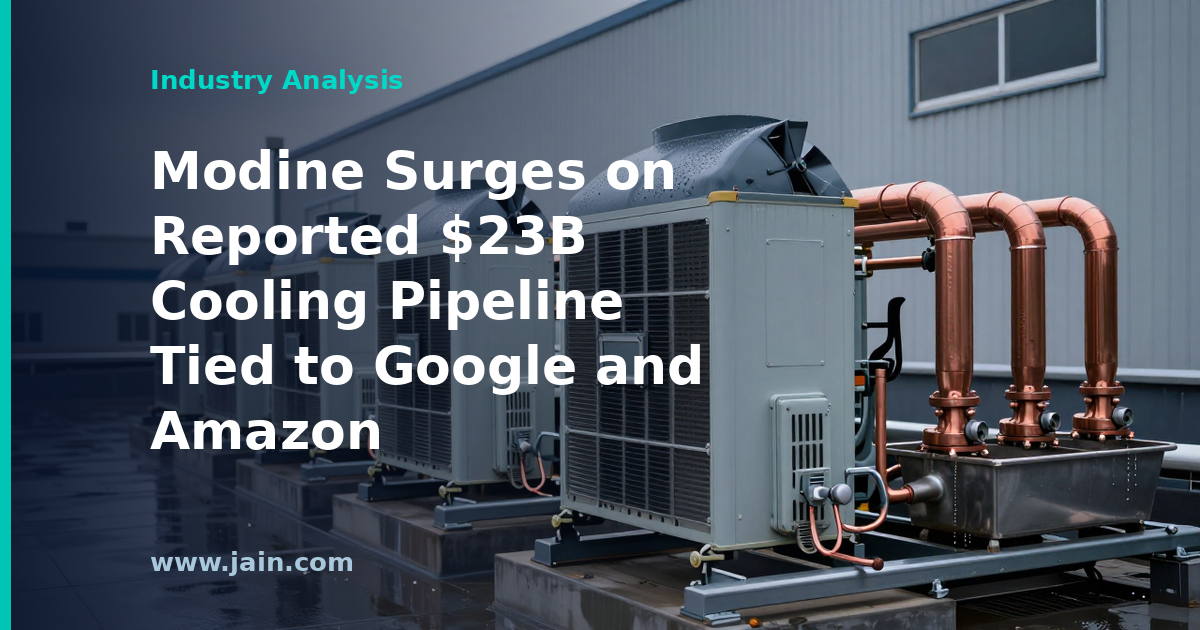
Shares of Modine Manufacturing (NYSE: MOD) jumped after Hunterbrook published a report, based on what it describes as leaked files, claiming the thermal-management company has a roughly $4 billion deal tied to Google and a data center cooling demand pipeline of about $23 billion that also links Amazon as a customer. Multiple financial outlets, including Benzinga, Proactive, and Pluang, relayed the report on August 22, 2026.
Neither Modine, Google, nor Amazon has publicly confirmed the figures, which originate from the report rather than from any company disclosure.
Executive Summary
The claim at the center of the move is simple but large: a report by Hunterbrook, citing leaked documents, names Google and Amazon as customers behind a data center cooling pipeline it sizes at $23 billion, including a reported $4 billion arrangement connected to Google. For a company of Modine’s size — a century-old industrial thermal specialist rather than a hyperscale household name — numbers of that magnitude, if borne out, would represent a step-change in the scale of its data center business.
The market’s reaction is as informative as the claim itself. Investors bid the stock up on an unverified, third-party report — a signal of how hungry the market is for pure-play exposure to data center cooling. As artificial intelligence workloads push server racks toward power densities that air cooling alone cannot handle, the companies that move heat — through chillers, coolant distribution units, and liquid cooling systems — are being repriced as strategic AI infrastructure suppliers rather than cyclical industrial vendors.
What matters now is verification: whether the companies involved confirm, deny, or stay silent, and whether the reported pipeline reflects contracted backlog or aspirational opportunity. Those are very different things for a stock that just moved on the distinction being blurred.
Cooling Is Becoming the Buildout’s Next Bottleneck
For most of the data center industry’s history, cooling was a solved problem: blow enough cold air across the servers and manage the electric bill. AI has broken that model. Modern accelerator racks can draw many times the power of traditional server racks, concentrating heat beyond what air-based systems efficiently remove. The industry’s answer — liquid cooling, where coolant is piped directly to chips or to heat exchangers at the rack — requires specialized equipment, and the supplier base for that equipment is far smaller than the demand now chasing it.
That is the structural story that makes a report like this land so hard. Investors have already repriced power equipment makers, transformer suppliers, and generator manufacturers as AI bottleneck trades. Thermal management is the logical next link in that chain: every megawatt of new AI compute is also a megawatt of heat that must go somewhere. A report naming the two largest cloud builders as anchor customers of a mid-cap cooling specialist fits a narrative the market was already primed to believe.
What the Report Claims Versus What Is Confirmed
It is worth being precise about the evidentiary chain here. The $4 billion and $23 billion figures come from a media report citing leaked files — not from a Modine securities filing, an earnings call, or a customer announcement. Hyperscalers rarely confirm their suppliers, and suppliers are often contractually barred from naming hyperscaler customers, so silence from Google and Amazon would be unremarkable either way. As of the coverage cited, none of the three companies had substantiated the numbers.
The word “pipeline” also deserves scrutiny. In industrial sales, a pipeline is typically the total value of opportunities being pursued — not signed contracts, not backlog, and not revenue. If the $23 billion figure describes potential demand Modine is quoting against, the economic reality could differ substantially from what a headline reader might assume. The reports available do not make that distinction clear, and the distinction is worth billions.
The Messenger Matters: Reading a Hunterbrook Report
The source of the claim adds its own analytical wrinkle. Hunterbrook operates an unusual model in financial media: a newsroom paired with an affiliated investment fund that can trade on its reporting before publication. In this case the report is bullish — a departure from the short-seller-style exposés such outlets are better known for — but the incentive question cuts the same way in both directions. Readers and investors should ask of any market-moving report: who benefits from the move, and was the evidence strong enough to justify it?
None of that makes the reporting wrong. Leaked documents can be accurate, and Hunterbrook’s work has moved markets before precisely because it is often substantive. But the fair standard is symmetrical: the same skepticism this publication would apply to an unverified vendor press release applies to an unverified media report, however sophisticated the outlet. Until Modine addresses the figures directly — in a filing, an earnings call, or a formal statement — the $23 billion number is a claim, not a fact.
Concentration Risk Hides Inside the Opportunity
Suppose the report is directionally right. Even then, the economics carry a caveat familiar to anyone who supplies hyperscalers: customer concentration. A supplier whose growth story rests on two buyers — however creditworthy — inherits their capital-expenditure cycles, their pricing leverage, and their willingness to dual-source or bring capabilities in-house. Hyperscalers have a long record of commoditizing their supply chains once a technology matures, from servers to networking gear.
The competitive field is also crowding fast. Established HVAC and infrastructure giants, specialist liquid cooling firms, and well-funded startups are all racing into the same thermal market. A large pipeline today says little about margins three years from now if the bidding field triples. For buyers of cooling equipment, that competition is good news — more capacity and better pricing. For any single supplier’s shareholders, it is the risk that tempers the headline number.
Background
Modine Manufacturing, founded in 1916 and headquartered in Racine, Wisconsin, spent most of its history as a heat-transfer specialist serving automotive and industrial markets. In recent years it has pivoted deliberately toward higher-growth thermal businesses, with data center cooling — including chillers and precision cooling systems — becoming a centerpiece of its climate solutions segment. That repositioning has coincided with the AI-driven data center boom, which has turned formerly unglamorous supply categories like power distribution and heat rejection into some of the market’s most closely watched bottleneck trades.
Hunterbrook, the report’s source, represents a newer breed of financial media: an investigative newsroom paired with an affiliated fund that can trade on its findings. Its reports have moved stocks in both directions before, which is why a bullish claim about Modine’s customer pipeline traveled so quickly through financial media despite lacking company confirmation.
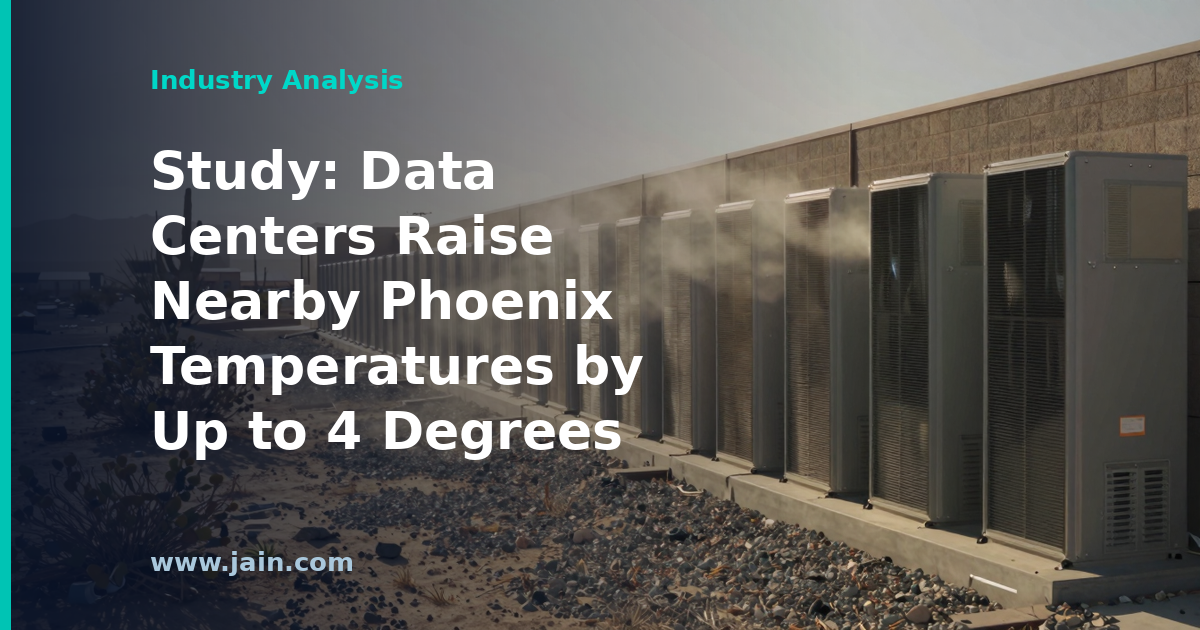
A peer-reviewed study published in ASME’s Journal of Engineering for Sustainable Buildings and Cities (Vol. 7, Issue 2) reports that data centers raise temperatures in their surrounding areas by up to 4 degrees in Phoenix, Arizona — one of the largest and fastest-growing data center markets in the United States.
The research, which frames data center waste heat as an emerging urban heat source, drew broad attention on August 19, 2026, when it reached the Hacker News front page with 267 points and more than 375 comments — a signal that the industry itself is taking the question seriously.
Executive Summary
The finding is simple to state and hard to dismiss: the electricity a data center consumes does not disappear. Nearly all of it becomes heat, and cooling systems must eject that heat into the surrounding air. In a dense cluster of facilities, that ejected heat measurably warms the neighborhood — by as much as 4 degrees, according to this study of Phoenix.
Why it matters: Phoenix is both a top-tier data center hub and the hottest major city in America, where summer heat is already a public-health and grid-reliability issue. A peer-reviewed number linking data centers to local warming gives residents, city councils, and regulators something they have not had before — citable evidence. Expect it to surface in zoning hearings, permitting conditions, and community-benefit negotiations well beyond Arizona.
For operators and their customers, the study reframes waste heat from an engineering afterthought into a siting externality alongside power draw, water use, and noise — one that will increasingly shape where and how new capacity gets built.
Heat Is the New Noise: An Externality Goes on the Record
Data center opposition has historically centered on three complaints: power consumption, water use, and the low-frequency hum of cooling plants. Localized warming now joins that list with something the others took years to acquire — a peer-reviewed citation. Once a measurable external cost is published in an engineering journal, it tends to migrate into environmental-impact reviews, zoning board testimony, and eventually permit conditions. That is how noise limits and water-reporting requirements became standard, and waste heat is positioned to follow the same path.
The practical consequence is that thermal impact modeling may become part of the pre-construction diligence package. Developers who can show — with sensors and models, not assurances — that a facility’s heat plume will not worsen conditions for adjacent neighborhoods will move through approvals faster than those who cannot. In a market where time-to-power already decides deals, an avoidable six-month permitting fight over heat is real money.
Why Phoenix Is the Stress Test for the Whole Industry
Phoenix became a data center magnet for rational reasons: comparatively cheap land, available power, low natural-disaster risk, and proximity to California customers without California costs. But the same desert climate that makes the land cheap makes cooling expensive and makes every added degree socially costly. Extreme heat is already the region’s deadliest weather phenomenon, so a study saying nearby temperatures rise by up to 4 degrees lands very differently in Phoenix than it would in a temperate metro.
There is also an economic feedback loop worth naming: hotter ambient air makes chillers and evaporative systems work harder, which consumes more electricity and water, which ejects more heat. If clustered facilities are warming their own microclimate, they are marginally degrading their own cooling efficiency — and everyone else’s. That is a classic commons problem, and commons problems invite regulation when the industry does not self-organize first.
From Liability to Asset: The Waste-Heat Reuse Question
In Nordic countries, data center waste heat is piped into district heating networks that warm homes — the externality becomes a product. The awkward truth is that this playbook works worst exactly where the U.S. is building fastest: Phoenix has essentially no heating demand for most of the year, and the low-grade heat that air-cooled facilities reject is difficult to transport or upgrade economically. Reuse candidates exist — industrial preheating, water treatment, agriculture — but none absorb hyperscale volumes in a desert.
That points the mitigation conversation toward engineering rather than reuse: liquid cooling that captures heat at higher, more usable temperatures; facility siting and airflow design that lofts exhaust away from neighborhoods; and honest accounting of the water-versus-heat trade-off, since evaporative cooling ejects less sensible heat into the air but consumes scarce water to do it. Operators who get ahead of this with published thermal data will own the narrative; those who wait will have it written for them.
Background
Metro Phoenix has spent a decade becoming one of America’s leading data center markets, attracting hyperscale and colocation development with affordable land, available power, low disaster risk, and proximity to West Coast demand. The AI buildout has accelerated that growth just as the region confronts record-breaking heat and long-term water constraints.
Urban heat island science, meanwhile, has decades of history attributing city warming to pavement, buildings, and vehicles. What is new is peer-reviewed work isolating data centers — among the most energy-dense buildings ever constructed — as a distinct and growing contributor, arriving at the exact moment communities nationwide are weighing the local costs and benefits of hosting them.
On July 14, 2026, 3M and Microsoft announced a strategic partnership focused on advancing AI data center infrastructure and enterprise transformation. The announcement was carried on Microsoft’s own newsroom (Microsoft Source).
The headline positions the collaboration around AI-era infrastructure — a domain where 3M has historically supplied materials, adhesives, films and thermal management products, and where Microsoft is one of the world’s largest hyperscale operators.
Executive Summary
The release frames a tie-up between an industrial materials incumbent and a hyperscale cloud operator at a moment when AI compute is straining the physical envelope of data centers. Power density per rack, heat rejection, and materials that can survive higher junction and coolant temperatures have all become gating factors for GPU deployments.
What is substantiated in the headline is intent: a strategic partnership, AI data center infrastructure as the target, and enterprise transformation as a secondary theme. What is not yet substantiated — at least in the excerpt available to us — is scope: which 3M product lines, which Microsoft facilities, on what timeline, and under what commercial structure.
For readers evaluating the announcement, the useful posture is neither dismissal nor hype. Materials science is a genuine bottleneck for AI infrastructure, and 3M has relevant portfolios. Whether this specific partnership delivers meaningful capacity or is primarily a marketing framing will depend on details the release, as published, does not spell out.
Why Materials Suddenly Matter to Hyperscalers
For most of the cloud era, hyperscale data centers were an integration problem: racks of commodity servers, air cooling, and steady incremental efficiency gains. AI training and inference clusters have changed the physics. Modern GPU accelerators dissipate hundreds to over a thousand watts each, and racks are moving from the 10–20 kW range typical of general-purpose cloud toward 50–100 kW and beyond. At those densities, the materials in contact with silicon — thermal interface materials, dielectric fluids for immersion cooling, cold-plate seals, and vapor-barrier films — become first-order engineering constraints rather than commodity inputs.
3M’s historical relevance here is real: the company has long supplied fluorinated dielectric fluids used in two-phase immersion cooling, thermal interface products, and specialty films and tapes used inside servers and networking gear. Microsoft, for its part, has publicly experimented with immersion cooling in prior years. A partnership badged as targeting AI data center infrastructure sits squarely in this well-established technical overlap, even if the announcement itself does not enumerate specific product families.
What a Strategic Partnership Actually Buys
"Strategic partnership" is one of the more elastic phrases in corporate communications. In practice, such arrangements range from joint marketing and preferred-supplier status at the light end, to co-development agreements, capacity reservations, and equity or offtake commitments at the heavy end. The release headline as available does not disclose where on that spectrum this deal sits.
For 3M, a formal alignment with a top-three hyperscaler is commercially valuable regardless of the exact contract structure: it validates its materials portfolio for AI workloads at a moment when the company has been repositioning after divesting parts of its business and navigating environmental litigation around per- and polyfluoroalkyl substances (PFAS). For Microsoft, tying a materials supplier more closely into its infrastructure roadmap is consistent with a broader hyperscaler trend of pushing further down the stack — into custom silicon, custom racks, and now, plausibly, custom materials specifications.
Enterprise Transformation: The Ambiguous Second Leg
The headline also references enterprise transformation, a phrase that in Microsoft’s usage typically implies Azure adoption, Microsoft 365, and Copilot-branded AI products. Read literally, it suggests 3M is also a customer — modernizing its own IT and manufacturing operations on Microsoft’s stack — not only a supplier.
Two-way arrangements of this kind are common in hyperscaler deal-making: the supplier commits materials or capacity, and in return standardizes on the buyer’s cloud and AI platforms. Whether that reciprocity is present here, and on what scale, is not stated in the available excerpt. Buyers and investors should treat the enterprise-transformation framing as a signal to look for future disclosures around Azure commitments or Copilot deployments at 3M.
Risks and Open Questions on Both Sides
Any materials-heavy AI infrastructure story now runs into the PFAS question. Several of the dielectric and thermal fluids historically associated with immersion cooling belong to fluorochemical families that are under increasing regulatory scrutiny in the United States and European Union. 3M has publicly stated it intends to exit PFAS manufacturing by the end of 2025. A partnership announced in mid-2026 targeting AI infrastructure therefore raises a legitimate, non-inflammatory question: what chemistries are in scope, and how does the roadmap reconcile with that exit commitment? The release excerpt does not answer this.
On Microsoft’s side, the risk is narrative. Hyperscalers have announced many AI-era infrastructure partnerships in the past two years — with utilities, nuclear developers, chipmakers, and cooling specialists. Each individually is plausible; collectively, they can create an impression of capacity certainty that specific contracts may not yet support. The measured read is that this announcement adds one more supplier relationship to that mosaic, and its weight will be visible only when product-level or facility-level detail follows.
Background
3M is a diversified U.S. industrial company whose materials science portfolio has long included products used inside data centers — thermal interface materials, films, adhesives, filtration and, historically, dielectric fluids associated with immersion cooling. The company has been repositioning in recent years, including a stated intent to exit PFAS manufacturing by the end of 2025 amid regulatory and litigation pressure.
Microsoft is among the top three hyperscale cloud operators globally and has publicly committed to a large multi-year build-out to support AI training and inference workloads. That build-out has surfaced physical constraints — power, cooling, and materials — that were secondary concerns in the pre-AI cloud era, prompting a wave of supplier and infrastructure partnerships across the industry.
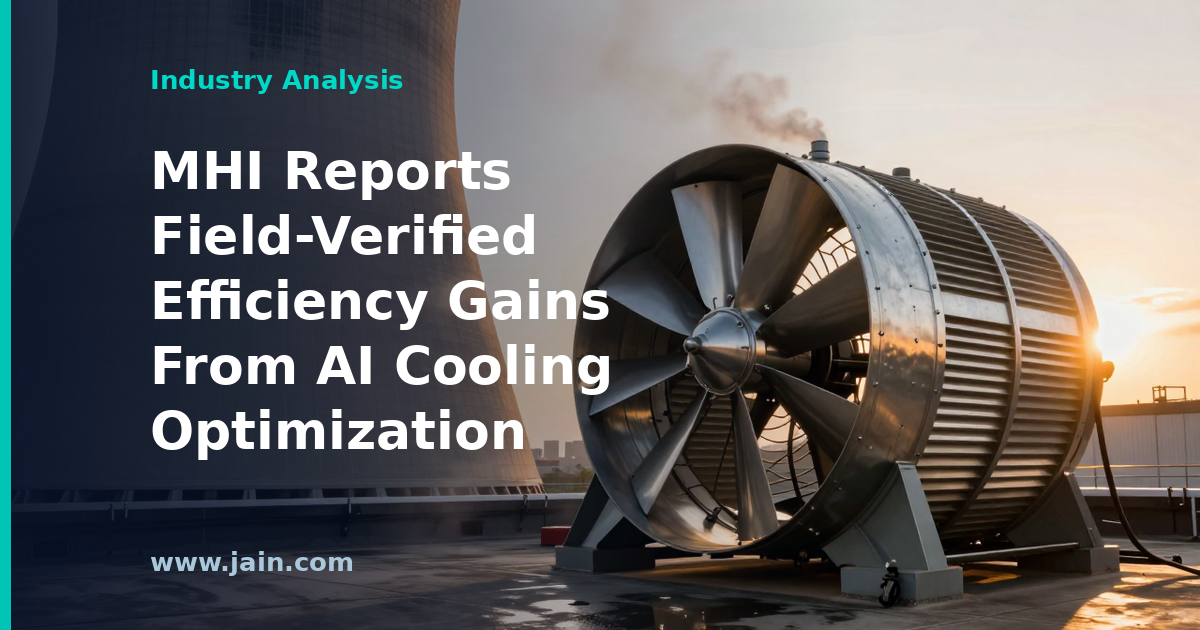
Mitsubishi Heavy Industries (MHI) announced on July 9, 2026 that it has demonstrated energy-efficiency improvements through cooling optimization in an operational data center. Rather than a lab simulation or a controlled test bed, the demonstration ran in a live facility — the setting where cooling systems must respond to real, fluctuating IT loads.
Executive Summary
MHI, the Japanese heavy-industry group whose portfolio spans power generation, HVAC and thermal systems, says it has shown measurable energy-efficiency improvements by optimizing cooling in a data center that was actively serving production workloads. The approach centers on smarter control of cooling equipment — adjusting how chillers, air handlers and airflow respond to actual conditions rather than running at conservative fixed settings.
The announcement matters for a simple reason: cooling is one of the largest non-IT consumers of electricity in a data center, and it is one of the few places where efficiency gains can be captured without touching the servers themselves. With AI workloads pushing rack power densities sharply higher, operators are looking hard at control-layer optimization as a way to cut operating costs and free up power capacity. A field demonstration in a live facility — as opposed to vendor modeling — is the kind of evidence buyers increasingly demand, though the syndicated version of this release does not carry the underlying figures, which readers should verify against MHI’s full publication.
Why a Live-Facility Demonstration Matters
Cooling-optimization claims are easy to make in simulation and hard to prove in production. A real data center has messy thermal behavior: IT load rises and falls with customer demand, outside temperatures swing by season and hour, and no operator will tolerate a control experiment that risks overheating servers. Demonstrating gains in an operational facility means the system had to deliver savings while respecting those constraints — which is why field verification is the credibility bar for this product category.
That said, a single-site demonstration is evidence, not proof of general applicability. Results depend heavily on the baseline: a facility with poorly tuned cooling will show dramatic improvement from almost any optimization, while a well-run site will show far less. The commercial question is not whether MHI improved one building, but how transferable the method is across climates, cooling architectures and load profiles — something only multi-site data can answer.
Cooling Is the Biggest Efficiency Lever Left
In most data centers, cooling is the largest energy consumer after the IT equipment itself, which is why the industry’s standard efficiency metric — PUE, or power usage effectiveness, the ratio of total facility power to IT power — is largely a measure of cooling overhead. Servers get more efficient with every silicon generation, but the facility side improves only when operators invest in it. Control-layer optimization is attractive because it can often be applied to existing equipment: the chillers stay, the software running them gets smarter.
The economics have sharpened as AI infrastructure scales. Grid connections are constrained in many markets, so every kilowatt not spent on cooling is a kilowatt available for revenue-generating compute. For operators facing multi-year waits for new power capacity, efficiency gains at the cooling layer function as found capacity — frequently at a fraction of the cost of new construction.
MHI Enters a Crowding Field
MHI is not alone here. AI-assisted cooling control has been pursued by hyperscalers internally and by facility-equipment and building-management vendors for several years, and the space now includes established cooling manufacturers, controls specialists and software startups. MHI’s differentiation, if it holds, comes from owning the equipment side: a company that builds chillers and thermal systems can integrate control optimization more deeply than a software-only vendor, and can stand behind the combined result.
For MHI, the strategic logic is also defensive. As liquid cooling, heat reuse and AI-driven operations reshape data center thermal design, equipment makers that offer only hardware risk being commoditized while the value migrates to the control and services layer. A demonstrated optimization capability positions MHI to sell outcomes — efficiency, capacity headroom — rather than just machines. Whether that translates into a commercial product with published pricing and guarantees is the next thing to watch.
Background
Mitsubishi Heavy Industries is a diversified Japanese engineering group whose thermal-systems businesses build chillers, HVAC and industrial cooling equipment — the physical machinery that data center cooling optimization software ultimately controls. Like other established equipment makers, MHI has been extending from hardware into the control and services layer as data center operators demand measurable efficiency outcomes rather than standalone machines.
The push comes amid a broader industry squeeze: AI-driven demand has data center construction booming while grid power in major markets is scarce, making energy efficiency both a cost issue and a capacity issue. Cooling, as the largest non-IT energy consumer in most facilities, has become the primary battleground, with hyperscalers, controls vendors and equipment manufacturers all pursuing AI-assisted optimization of the thermal plant.
Cooling vendor Wafr Technologies has raised $100 million, according to a report carried by Data Center Dynamics on July 7, 2026. The publication characterized the raise as a report rather than a company announcement, and the item available to us does not name the investors, the round structure, or the intended use of proceeds.
Executive Summary
According to the Data Center Dynamics item, Wafr Technologies — identified simply as a cooling vendor — has reportedly secured $100 million in new funding. That is the extent of what the source substantiates: a company name, a sector, a dollar figure, and the qualifier “report,” which signals the news has not been confirmed in detail by the company itself.
Even in that skeletal form, the story matters because of what it represents. Cooling — the unglamorous business of moving heat away from computer chips — has become one of the tightest constraints on data center construction in the AI era. A nine-figure round for a cooling specialist, if confirmed, would be another data point in a clear pattern: capital that once flowed almost exclusively to chips, land, and power is now chasing thermal management, because without it the rest of the AI buildout stalls.
Why Heat Became the Industry’s Chokepoint
For most of the data center industry’s history, cooling was a solved problem: blow chilled air across servers, exhaust the hot air, repeat. That model works up to roughly the power density of a traditional enterprise rack. AI training hardware broke the equation. Modern accelerated-computing racks draw many times what air can economically remove, which is why the industry is shifting to liquid cooling — circulating fluid directly to cold plates on the chips, or immersing hardware in dielectric fluid — to carry heat away far more efficiently than air ever could.
That transition is not optional for AI-class facilities, and it is happening faster than the supply chain matured. Cold plates, coolant distribution units, rear-door heat exchangers, and the engineering talent to deploy them have all been in tight supply. When a component becomes the binding constraint on a trillion-dollar buildout, capital follows. A reported $100 million round for a cooling vendor fits that logic precisely.
What a Nine-Figure Round Signals About the Market
Cooling has historically been the domain of large industrial incumbents — the Vertivs and Schneider Electrics of the world — for whom thermal management is one product line among many. Venture-scale money flowing to independent cooling specialists suggests investors believe the liquid-cooling transition is big enough, and moving fast enough, to support new entrants rather than simply enlarging incumbents’ order books.
It also says something about where returns are perceived to be. Building data centers is capital-intensive and increasingly commoditized; supplying the critical components that gate construction can carry better margins and faster growth. Investors who missed the GPU wave or the land-and-power wave may see thermal management as the remaining underpriced layer of the AI infrastructure stack. Whether that thesis pays off depends on execution questions this report cannot answer — but the direction of the money is itself informative.
Winners, Losers, and the Scaling Test Ahead
If the raise is confirmed, the most immediate beneficiaries are data center operators and their customers: more capitalized suppliers mean more manufacturing capacity, shorter lead times, and more competitive pricing in a segment where demand has outrun supply. Chipmakers benefit indirectly, since every rack that can be cooled is a rack that can be sold.
The harder question is whether a funded challenger can convert capital into share. Cooling is a trust business — operators are conservative about anything that puts liquid near multi-million-dollar hardware — and incumbents hold deep service networks and long-standing customer relationships. History in this industry suggests that well-funded specialists either scale into meaningful suppliers, get acquired by incumbents seeking their technology, or burn capital competing on price. A $100 million war chest buys time to find out which path applies; it does not guarantee the answer.
Reading a Report, Not a Press Release
It is worth being precise about the evidentiary status here. The source is a trade-press item flagged as a report — not a company announcement, not a regulatory filing. The figure could ultimately prove different in size, structure (equity versus debt), or timing. Trade reporting on private raises is often directionally right and precisely wrong. Until Wafr Technologies or its investors confirm the details, the responsible reading is: a credible industry publication believes a cooling vendor has attracted roughly $100 million, and that belief is consistent with everything else happening in the thermal-management market.
Background
For decades, data center cooling meant air: chillers, raised floors, and hot-aisle containment, handled largely by big industrial suppliers as one product line among many. The AI era upended that. Racks built around modern accelerators draw several times the power of traditional enterprise racks, pushing the industry toward direct-to-chip liquid cooling and immersion systems that can remove heat air cannot. That transition turned a mature, sleepy segment into one of the most supply-constrained corners of the infrastructure market, and capital has followed — into incumbents’ expansion and, increasingly, into independent specialists.
Wafr Technologies enters the public record here with little published history: the report available to us identifies it only as a cooling vendor. That thinness is itself common in this cycle, where private thermal-management companies often surface in trade press via funding reports before making detailed public disclosures.