
Tag: Texas

  • Jacobs Takes On Hut 8’s Second Texas AI Data Center

    Jacobs Takes On Hut 8’s Second Texas AI Data Center

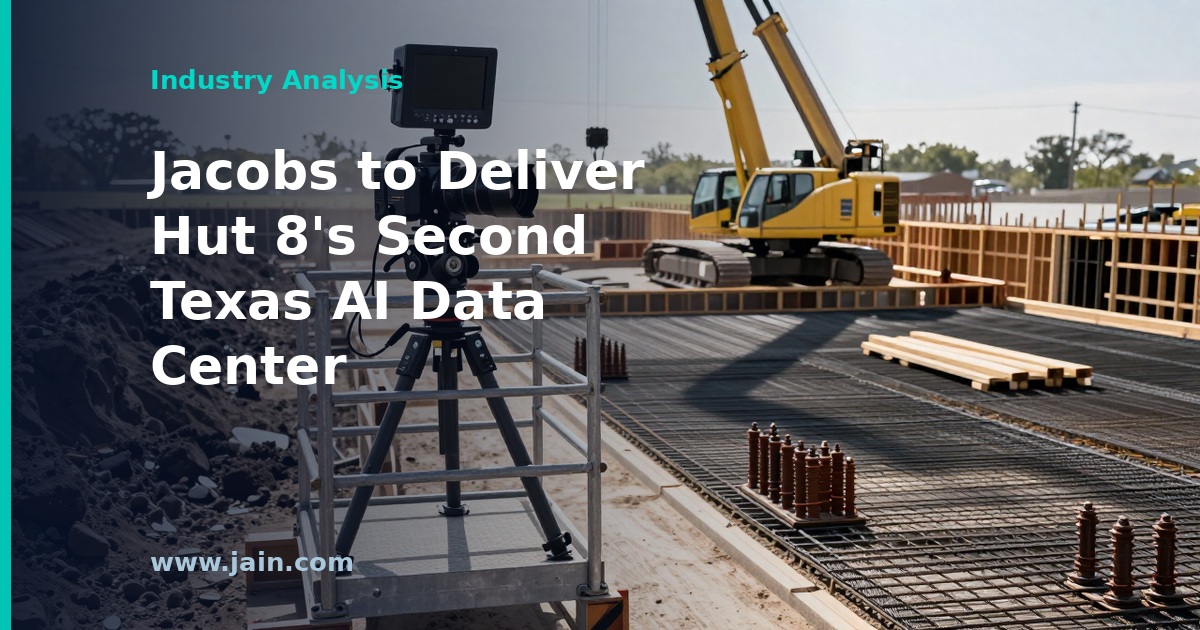
    Jacobs, the Dallas-headquartered engineering and professional services firm, said on 13 May 2026 that it has been awarded an engineering, procurement and construction management (EPCM) contract to deliver a second artificial-intelligence data center in Texas for Hut 8, the US-listed digital infrastructure and bitcoin mining company.

    The announcement identifies the parties, the delivery model and the state. It does not, in the material available, disclose the site, the power capacity, the contract value, the construction schedule or the end customer for the completed facility.

    Executive Summary

    The award is short on numbers but clear on direction. Hut 8 has spent the past two years repositioning from bitcoin mining toward data centers built for AI and high-performance computing workloads, and it is now hiring a tier-one engineering house to manage delivery rather than assembling that capability entirely in-house. That it is the second such Texas project for the same pairing suggests the first engagement produced a working relationship worth repeating.

    EPCM is the operative detail. Under this model, Jacobs designs the facility, runs procurement and manages the contractors who physically build it — but does not self-perform the construction or, typically, wrap the whole job in a fixed lump-sum price. The owner keeps more cost risk and more control; the engineer supplies the discipline, drawings and supply-chain leverage. Choosing EPCM tells you Hut 8 wants speed and flexibility on a design that is still evolving, and is willing to carry risk to get it.

    The broader read: in the current AI buildout, megawatts and land are necessary but no longer sufficient. Skilled engineering, procurement slots for electrical gear and construction management bandwidth have become the scarce inputs. Hut 8 is buying those, and that is the story.

    EPCM Is the Tell: Hut 8 Is Buying Delivery Capacity

    Companies choose a contracting model the way they choose a mortgage: it reveals what they are optimising for. A lump-sum turnkey EPC contract transfers schedule and cost risk to the contractor, which prices that risk in and, in return, resists design changes. EPCM does the opposite. The engineering firm acts as the owner’s agent — producing the design, letting trade packages, sequencing the site — while the owner signs the trade contracts and absorbs the variance. It is faster to start, easier to change mid-flight, and less forgiving if the owner’s own governance is weak.

    For an AI data center in 2026, that trade is defensible. Rack densities, liquid-cooling choices and even the identity of the eventual tenant frequently change between groundbreaking and energisation. Freezing a design early enough to price it as a lump sum can cost more than the risk it transfers. Hut 8 appears to be betting that a well-run EPCM structure, with Jacobs supplying the process rigour, beats paying a contractor’s contingency for certainty it may not want.

    The implicit admission is also worth naming: a company of Hut 8’s size does not have hundreds of data center engineers on payroll, and building that bench organically would take longer than the market window allows. Renting it from Jacobs is the rational move, but it makes the relationship a dependency rather than an asset on the balance sheet.

    The Miner-to-AI Pivot Meets a Different Class of Building

    Bitcoin mining halls and AI training halls look superficially alike — big sheds, big substations — and that resemblance has powered a wave of miner repositioning stories. The engineering reality is less flattering to the analogy. A mining facility tolerates interruption, runs air-cooled hardware that is cheap to replace, and can be built to modest redundancy because downtime costs only forgone revenue. A facility hosting accelerated computing for a creditworthy tenant must meet contractual uptime, support liquid cooling loops, and satisfy the tenant’s own commissioning regime before a single invoice is issued.

    That gap in standards is precisely why an EPCM award matters more than another megawatt announcement. Converting a mining land-and-power position into a leasable AI facility requires design documentation, factory witness testing, commissioning scripts and as-built records that enterprise and hyperscale customers will audit. Hiring an established engineering firm is how a former miner acquires that credibility quickly — and it is a signal counterparties can price.

    The caveat is that the announcement, as available, does not say what the finished building will be certified to, who will occupy it, or whether it is contracted. Engineering pedigree improves the odds of a bankable outcome; it does not by itself create one.

    Texas, Again — And Why Repetition Is the Point

    Texas remains the centre of gravity for large-load computing in the United States for reasons that have not changed: abundant land, an interconnection process on the ERCOT grid that has historically moved faster than neighbouring markets, a deep industrial construction labour pool, and a policy environment friendly to large electricity consumers. It also concentrates risk — grid stress in extreme weather, growing scrutiny of large flexible loads, and competition for the same substations and transformers from every other developer in the state.

    Doing a second project in the same state with the same engineer is where the economics improve. Repeat delivery lets both sides reuse a reference design, keep the same commissioning agents, negotiate the same equipment vendors and avoid re-learning a permitting jurisdiction. In an environment where long-lead electrical gear — switchgear, transformers, generators — is the schedule driver, a standing relationship that holds order slots is worth real months. If Hut 8 is building a repeatable template rather than a series of bespoke sites, unit costs and delivery times should both improve.

    Who Gains, and What Could Still Go Wrong

    Jacobs is the clearer near-term winner. Engineering firms have watched the AI buildout push demand toward advanced-facility work, and repeat EPCM mandates provide the kind of recurring, lower-capital-intensity revenue that public markets reward. For Hut 8, the benefit is optionality: an execution partner it can scale with, without the fixed cost of an in-house delivery organisation. The losers, if any, are the smaller regional design-build firms that served the mining era and are being displaced as the customer’s standards rise.

    The risks are ordinary and real. EPCM leaves cost and schedule exposure with the owner, so escalation in electrical equipment or labour lands on Hut 8’s accounts, not the engineer’s. Power interconnection timing sits outside both parties’ control. And the commercial question — whether this capacity is pre-leased or built speculatively into a market where a great deal of AI capacity is being announced at once — is the one that determines whether the engineering award is the start of a contracted revenue stream or an investment in inventory.

    Read plainly, the announcement substantiates one thing well: Hut 8 has secured serious engineering management for a second Texas project, and Jacobs judged the work worth taking. It substantiates nothing about size, cost, timing or demand. Both statements can be true at once, and readers should hold them together.

    Background

    Hut 8 emerged from the bitcoin mining industry, where operators built large, power-hungry computing halls next to cheap electricity. When demand for AI computing accelerated, several miners discovered their most valuable assets were not the machines but the land, substations and grid interconnection rights beneath them — and began repositioning as data center developers. The transition is harder than it looks, because AI tenants require reliability, cooling and documentation standards that mining facilities were never designed to meet.

    Jacobs sits on the other side of that gap. A long-established engineering and professional services firm, it delivers complex technical facilities for clients that expect formal design, procurement discipline and construction oversight. Engagements like this one are the connective tissue of the current buildout: capital and power positions on one side, engineering and delivery capability on the other, with EPCM contracts as the mechanism joining them.

    Source: Jacobs awarded EPCM contract to deliver second Hut 8 AI data center in Texas — Jacobs announcement, published 13 May 2026, confirming the parties and delivery model without disclosing capacity, value or schedule.
  • NVIDIA–IREN 5GW Pact: GPU Vendors Now Underwrite AI Buildouts

    NVIDIA–IREN 5GW Pact: GPU Vendors Now Underwrite AI Buildouts

    NVIDIA and IREN Limited announced a strategic partnership on May 7, 2026, aimed at accelerating the deployment of up to 5 gigawatts (GW) of AI infrastructure. IREN, a Nasdaq-listed data center operator that pivoted from Bitcoin mining to AI cloud services, becomes one of the largest publicly named partners in NVIDIA’s growing web of direct infrastructure alliances.

    The announcement, issued through NVIDIA’s newsroom, frames the deal as a build-out acceleration pact; the headline figure is capacity — power, not dollars — and the companies did not disclose financial terms in the material reviewed here.

    Executive Summary

    The world’s dominant AI chipmaker and one of the fastest-rising ‘neocloud’ operators — companies that build GPU-packed data centers and rent the computing power out — have formalized a partnership targeting up to 5GW of AI infrastructure. For scale, 5GW is roughly the output of five large nuclear reactors and exceeds the total data center capacity of most major metropolitan markets today.

    Why it matters: NVIDIA has been steadily moving beyond selling chips into shaping who gets to build the facilities that consume them — through investments, supply commitments, and named partnerships with operators like CoreWeave and now IREN. A GPU vendor putting its name directly behind a gigawatt-scale buildout compresses the traditional separation between component supplier and infrastructure developer.

    For IREN, NVIDIA’s public endorsement is arguably as valuable as any commercial term: it signals priority access to scarce GPUs, the binding constraint for every AI cloud operator, and validates the company’s multi-year pivot from cryptocurrency mining to AI compute.

    The Chipmaker Becomes the Kingmaker

    Historically, semiconductor vendors sold components and let customers worry about buildings, power, and financing. That model is inverting. NVIDIA has taken equity stakes in GPU cloud providers, arranged supply priority for favored partners, and now attaches its name to a 5GW deployment target with a single operator. When allocation of the scarcest input in the AI economy — leading-edge GPUs — flows through strategic partnerships, the vendor effectively chooses which infrastructure players scale and which wait in line.

    This has real market-structure consequences. Operators inside NVIDIA’s partnership perimeter can raise capital more cheaply, because lenders and investors treat GPU access as the key execution risk. Operators outside it face a harder story. The deal is therefore best read not just as an IREN milestone but as another data point in NVIDIA’s construction of a vertically aligned ecosystem — one that competitors, regulators, and hyperscale customers are all watching closely.

    Why IREN: Power First, Chips Second

    IREN’s core asset is not silicon — it is secured electrical capacity. The company, which began as Bitcoin miner Iris Energy, spent years assembling large, renewables-oriented power positions, including a multi-gigawatt development hub in West Texas and hydro-powered sites in British Columbia. In today’s market, grid interconnection queues stretch years and available power — not capital or land — is the gating factor for AI data centers. An operator holding contracted gigawatts is holding the scarce complement to NVIDIA’s scarce GPUs.

    The partnership logic is symmetrical: NVIDIA needs credible places to deploy the chips it sells in enormous volumes; IREN needs assured chip supply to monetize its power pipeline. IREN’s late-2025 multi-billion-dollar AI cloud contract with Microsoft — reported at roughly $9.7 billion — had already demonstrated hyperscaler demand for its capacity. A named NVIDIA partnership adds the supply-side anchor.

    Reading ‘Up to 5 Gigawatts’ Carefully

    The phrase ‘up to’ is doing significant work. A 5GW ceiling is an ambition, not a contracted delivery schedule, and the announcement as reviewed does not specify phasing, capital commitments, or who funds what. Building 5GW of AI-grade data centers would plausibly require investment on the order of hundreds of billions of dollars across facilities, chips, and grid upgrades over many years — commitments far beyond what a partnership press release itself establishes.

    That is not a criticism unique to this deal; it is the standard grammar of AI infrastructure announcements in this cycle, where headline gigawatt and dollar figures routinely describe multi-year aspirations. The substantiated core here is narrower but still meaningful: NVIDIA has publicly designated IREN a strategic deployment partner at a scale ceiling few operators can claim. Investors and customers should track converted megawatts — energized, GPU-filled capacity under contract — rather than announced ceilings.

    Winners, Losers, and the Financing Question

    Winners, if the buildout converts: IREN, whose cost of capital and customer pipeline both improve; power-rich regions like West Texas that host the load; and NVIDIA itself, which locks in demand visibility for future GPU generations. Under pressure: mid-tier colocation and cloud players without vendor alignment, and any operator whose business case assumed GPU scarcity would ration competitors’ growth.

    The open question is who carries the balance-sheet risk. GPU-backed infrastructure depreciates fast — accelerator generations turn over roughly every one to two years — and neocloud operators fund buildouts with debt secured against chips and customer contracts. If AI compute pricing softens before this capacity earns out, the pain lands on whoever financed the gap between announcement and cash flow. The release, as reviewed, does not say how that risk is allocated between the partners.

    Background

    IREN began life in 2018 as Iris Energy, an Australian-founded Bitcoin miner that differentiated itself by siting operations on low-cost, renewable-heavy power in British Columbia and later Childress, Texas. It listed on Nasdaq in 2021, and as AI demand exploded it converted its power-first playbook into an AI cloud business, buying NVIDIA GPUs and building high-density data centers — a pivot capped by a reported multi-billion-dollar cloud contract with Microsoft in late 2025.

    NVIDIA, meanwhile, has evolved from graphics chipmaker into the central supplier of AI computing and, increasingly, an active architect of the infrastructure layer: investing in cloud partners, steering GPU allocation, and publicly backing large deployments. This partnership sits squarely in that pattern — a chip vendor underwriting, at least reputationally, a gigawatt-scale buildout.

    Source: NVIDIA and IREN Announce Strategic Partnership to Accelerate Deployment of up to 5 Gigawatts of AI Infrastructure — NVIDIA Newsroom announcement, May 7, 2026.

  • Trump-Branded Texas AI Megaproject Stalls, CEO Departs

    Trump-Branded Texas AI Megaproject Stalls, CEO Departs

    An AI data center megaproject carrying the Trump brand has stalled, and its chief executive has left the company, according to an Axios report published on April 20, 2026. The report is the first public signal that the venture, promoted as a large-scale AI computing campus, is not proceeding on its announced path.

    The available source is a headline-level wire item. It establishes two things: the project has stalled, and the CEO has departed. It does not, in the material available to us, set out the project’s contracted capacity, financing status, customer commitments, or the reason for the leadership change.

    Executive Summary

    The announcement of a large AI campus and the delivery of one are separated by a chain of dependencies that rarely appears in a press release: firm power, an interconnection agreement with the grid operator, long-lead electrical and generation equipment, an anchor customer willing to sign a decade-long lease, and a capital stack willing to fund construction before that customer moves in. A stall at this stage usually means one link in that chain did not close.

    Why it matters beyond one project: since 2024, the AI buildout has been announced in gigawatts rather than megawatts, and much of that pipeline is speculative. A gigawatt is roughly the output of a large power plant, enough for a mid-sized city. Projects at that scale are not real estate transactions; they are power transactions with buildings attached. Each publicly stalled project gives lenders, utilities and enterprise buyers a data point on how much of the announced pipeline converts to poured concrete.

    The political branding adds a distinct variable. A licensed name raises a project’s visibility and can widen its investor pool, but it does not shorten an interconnection queue, secure a turbine order, or substitute for a creditworthy tenant. This case tests whether that distinction is priced correctly.

    Announcements Are Cheap; Interconnection Is Not

    The binding constraint on large AI campuses today is electricity, not land or capital appetite. To draw hundreds of megawatts from a grid, a developer must enter the operator’s large-load interconnection process, fund system-impact studies, and often pay for transmission upgrades that take years to build. In Texas, the ERCOT market is attractive precisely because it is fast and deregulated by U.S. standards, but the surge of large-load requests has made a queue position an asset in itself, and grid operators have grown more demanding about which requests are financially backed rather than exploratory.

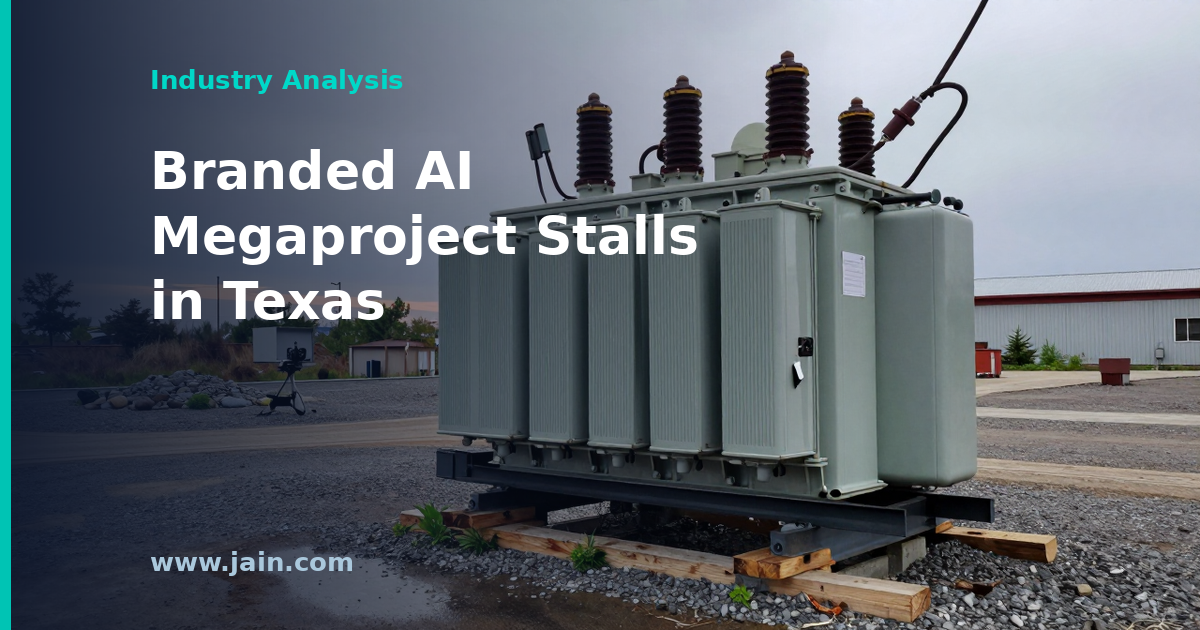
    Behind-the-meter generation, the common workaround, has its own timetable. Large gas turbines and grid-scale transformers are ordered years in advance from a small number of manufacturers, and a developer without a slot in that order book cannot buy one at any price on short notice. A project that announced first and secured equipment later is exposed to exactly this gap.

    The practical lesson for readers evaluating any megaproject: treat an announced capacity figure as an aspiration until it is paired with a signed interconnection agreement, an energy supply contract, or a filed transmission study. Those documents are frequently public. Rendering images are not evidence.

    Who Signs the Lease Decides Whether the Steel Goes Up

    The economics of a hyperscale campus rest on offtake — a long-term commitment from a creditworthy tenant to pay for capacity whether or not it uses it. That contract is what construction lenders underwrite. Without it, a developer is asking capital markets to fund a multi-billion-dollar facility on the assumption that demand will arrive, which is a materially more expensive proposition and, in tighter credit conditions, sometimes an impossible one.

    This is where independent developers face a structural disadvantage against the largest cloud and AI operators. A hyperscaler building for itself is its own anchor tenant, funds construction from operating cash flow, and can absorb a delay. A newly formed venture must persuade someone else’s balance sheet first. When a project of this type stalls, the most common explanation is not that AI demand evaporated, but that the demand went to counterparties who could deliver capacity on a credible schedule.

    Both readings deserve scrutiny. If the venture’s backers argue this is a temporary financing pause, the fair question is which specific milestone slipped and what the revised date is. If critics argue the project was never viable, the fair question is what evidence beyond the stall itself supports that — announced projects are routinely restructured, resited or resumed under new sponsors, and a stall is not a liquidation.

    A Brand Is Not a Balance Sheet

    Name licensing is a conventional real estate structure: a developer pays for the right to use a recognizable brand, which can lift marketing reach and investor attention. What it does not transfer is operational capability or credit. In digital infrastructure, buyers procure on uptime history, power availability, network density and financial durability over a fifteen-year lease. Brand recognition ranks low on that list, and a politically salient brand can cut both ways with multinational customers who prefer their infrastructure vendors to be uncontroversial.

    The CEO departure compounds this. In early-stage infrastructure ventures, the executive team is often the substance of the enterprise — the relationships with utilities, equipment vendors, and prospective tenants sit with named individuals rather than with institutional processes. Losing a chief executive before financial close therefore carries more weight than the same event at an operating company. Nothing in the available source explains the circumstances of the departure, and it would be unfair to the individual to assume any.

    For the wider market, the healthiest outcome of episodes like this is better disclosure discipline. Operators, utilities and municipalities all benefit when announcements distinguish between land under option, capacity under study, and capacity under contract. Those are three very different things that are currently reported in the same units.

    Background

    Since 2024, the buildout of computing capacity for artificial intelligence has become the largest wave of industrial construction in the technology sector, with announced projects routinely measured in gigawatts of electrical load rather than square feet. The scale changed the nature of the business: developers now compete primarily for grid capacity, generation equipment and construction credit, and only secondarily for land. Texas became a focal point because of its independent power market, generation mix and speed of permitting relative to other U.S. states.

    That environment produced a wide gap between announced and delivered capacity, and a corresponding pattern of ventures formed to capture attention and capital ahead of securing the underlying power and customers. Independent developers without a captive tenant face the hardest version of this problem, because they must persuade an external counterparty to commit before lenders will fund construction. Reports of stalled projects and leadership changes in that cohort are a recurring feature of the cycle rather than an anomaly, and each one offers a measurable test of which announcements were backed by contracts.

    Source: Trump-branded AI data center megaproject stalls, CEO departs — Axios, reported April 20, 2026, via Google News; a headline-level item establishing the stall and the leadership change without further project detail.