
TL;DR · 30-second read
The Short Version
Canaan builds machines that mine bitcoin, and demand for them has collapsed. It sold $4.8 million worth this summer, against $118.6 million a year earlier.
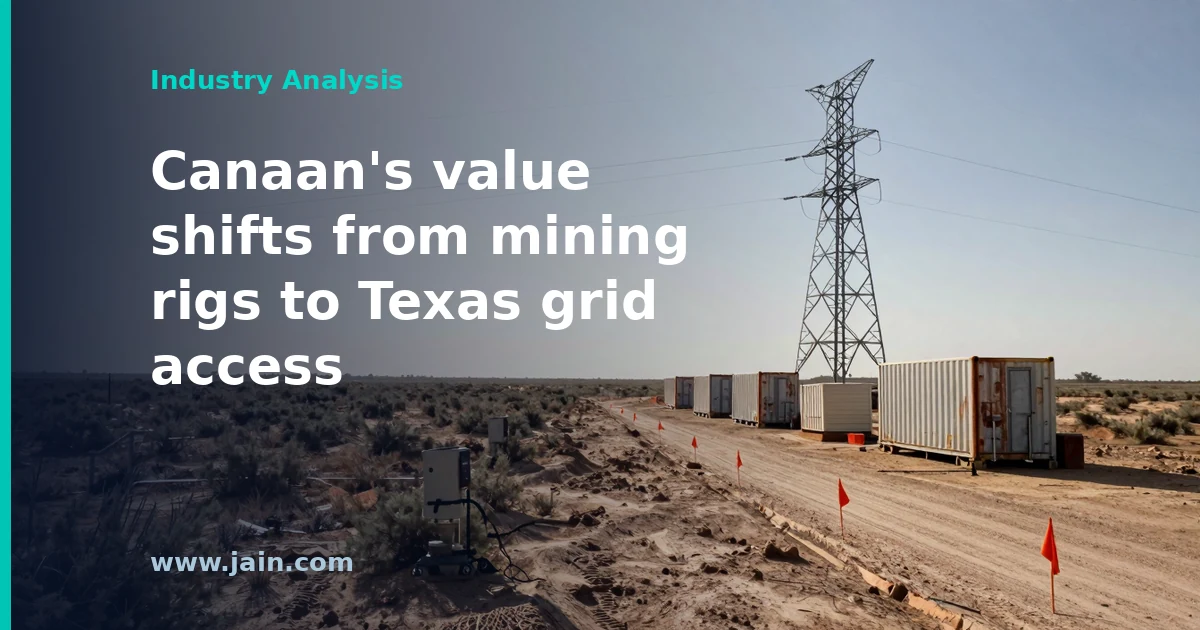
Its new bet is electricity. After an initial review, Texas’s grid operator has conditionally agreed to treat a planned Canaan site as a firm customer for 1 gigawatt of power. That is about what a large nuclear reactor produces. More studies and approvals still lie ahead.
Grid connections that size are what artificial intelligence data centers are lining up for. Canaan has not yet named a customer or said how it would pay to build.
Canaan Inc. (Nasdaq: CAN), a Singapore-based maker of bitcoin mining machines, reported unaudited third-quarter 2026 results on November 10. Revenue was $14.5 million, down from $150.5 million a year earlier. The company said its 1 gigawatt (GW) large-load project in Duval County, Texas, received a conditional “Studied Load – Firm” classification under ERCOT’s Batch Zero process. ERCOT is the operator of most of the Texas power grid. Canaan is also advancing a second 1 GW project in Zapata County, Texas, which is at an early stage.
Canaan reported GAAP net income of $8.0 million. That result was driven by a $51.9 million non-cash gain on its cryptocurrency holdings, which stood at about 1,875 BTC at quarter-end. Loss from operations was $42.9 million. The company also launched a $20 million share repurchase under a $100 million board authorization approved November 6.
Executive Summary
Canaan’s quarter has two very different halves. Its legacy business, designing and selling bitcoin mining hardware, is shrinking hard. Products revenue was $4.8 million, against $118.6 million in the same quarter of 2025, and management blamed weak demand and intense pricing competition. The forward-looking half is power. A conditional firm classification for a 1 GW load in ERCOT’s first study batch, plus a second 1 GW Texas project in early development, is where the company is directing capital.
The money backs that up. During the quarter Canaan posted $50 million of restricted cash as collateral for a letter of credit supporting long-term infrastructure contracts. It also made about $3.3 million in project prepayments, and in October it bought power-related US land for about $1.1 million. For a company with $14.5 million of quarterly revenue, that is a substantial commitment.
The milestone matters beyond Canaan because grid deliverability is the long-lead constraint for large compute campuses. What Canaan has not yet shown is the rest of the chain: a tenant, a financing structure, a construction plan and a date. TeraWulf’s results the same week show what those later steps look like.
The Grid Position Has Replaced the Hardware as Canaan’s Core Asset
Canaan’s own numbers explain why the Duval County milestone leads its release. Products revenue, meaning sales of the mining machines Canaan designs, fell to $4.8 million in the third quarter. That compares with $13.6 million in the second quarter and $118.6 million a year earlier. Mining revenue fell to $9.5 million from $30.6 million a year ago. Chairman and CEO Nangeng Zhang attributed the slump to “continued weakness in bitcoin mining equipment demand and intense industry pricing competition.” He then introduced the Texas project with the words “more importantly.” Canaan says it will keep its mining hardware and mining capabilities. It also says it will tie future R&D and production to market demand, which signals that hardware is no longer the growth engine.
What Canaan holds in Duval County is a place in the grid’s plans. Connecting a 1 GW load to ERCOT, about the output of a large nuclear reactor, requires studies of whether transmission lines and substations can carry that much power. In grid terms, a “firm” classification means the load is being studied for service the grid intends to deliver, rather than as interruptible demand. For anyone hoping to run compute at that scale, this is the long-lead item. Servers and buildings can be bought, but a studied grid position has to be waited for. Canaan now holds one, though conditionally. The company itself stresses it is “subject to further studies and approvals.”
That is why the classification functions as the asset Canaan takes to market. Canaan’s language is careful. It speaks of “compute infrastructure” and “capital-efficient partnerships in infrastructure development” and does not mention AI tenants. Still, in today’s market the main buyers of gigawatt-scale firm power are developers and operators of AI data centers. A smaller company that cannot fund a full build can still secure the interconnection and then bring it to partners who carry the construction capital.
TeraWulf Shows the Steps Between a Grid Position and Revenue
TeraWulf’s third-quarter release on November 6 lays out what turns a power position into AI revenue. TeraWulf signed a 20-year lease with Anthropic for about 401 megawatts (MW) of critical IT capacity at its Hawesville, Kentucky campus, which it values at roughly $19 billion of contracted revenue. In an 8-K filed November 4, it disclosed credit support agreements under which Google backstops certain of Anthropic’s lease obligations. It also signed a definitive engineering, procurement and construction (EPC) agreement with Fluor. Separately, TeraWulf raised contracted power at its Muskie site to 1,000 MW, subject to approval by the Kentucky Public Service Commission.
Each of those steps comes after the grid position: a named tenant, a creditworthy backstop, a construction contractor and project financing. Canaan has disclosed the grid position and an early financial commitment around it. It has not disclosed any of the later steps. That is a difference of stage, not a judgment on the project. It does mean the Duval classification is an option on future value, not contracted cash flow.
The size of the capital gap is visible in TeraWulf’s disclosures. TeraWulf guides to $8 million to $10 million of construction cost per MW of critical IT capacity. Critical IT capacity is the power that actually reaches servers, which is less than a site’s total grid draw. At that rate, even 100 MW of IT capacity would be an $800 million to $1 billion build. TeraWulf ended its quarter with about $2.4 billion of cash, cash equivalents and restricted cash. Partnership capital is therefore not optional for a developer of Canaan’s current size. It is the mechanism by which a grid classification becomes a data center.
A Profit That Came From the Bitcoin Price
Canaan’s $8.0 million of GAAP net income should be read alongside its $42.9 million loss from operations and an $8.6 million gross loss. The profit came from a $51.9 million fair-value gain on cryptocurrency holdings as bitcoin recovered toward quarter-end. CFO Jin “James” Cheng said plainly that “this non-cash gain is distinct from underlying operating performance.”
There were operating improvements. Inventory-related write-downs fell to $8.2 million from $25.3 million in the second quarter. Total operating expenses fell to $34.2 million from $40.1 million. The mining operation earned roughly a 30% gross margin before depreciation at an all-in power cost of about 4.3 cents per kilowatt-hour. That cost is evidence of the power-management skill Canaan is now pitching as a strategic capability.
The capital-allocation question is how the pieces fit together. Canaan is selectively selling crypto holdings to fund a $20 million buyback at the same time it has locked up $50 million as collateral for infrastructure contracts. With operations still loss-making, the roughly 1,875 BTC treasury is in effect the funding source for the transition. The bitcoin price will therefore help determine how far Canaan can carry the Texas projects on its own before partners arrive.
Background
Canaan Inc., listed on Nasdaq as CAN and headquartered in Singapore, is one of the longest-established designers of bitcoin mining machines. It also runs its own mining operations, with about 10 EH/s of installed non-JV computing power, and holds a 49% interest in a joint venture called Project ABC. Its hardware business depends on miners’ appetite for new equipment, and that appetite has fallen sharply over the past year. Management now describes the company as moving toward “energy and computing infrastructure.”
ERCOT manages most of the Texas power grid, which is largely separate from neighboring grids. Requests to connect very large loads, including crypto mines and data centers, have grown so quickly that ERCOT now studies them in batches. Batch Zero is the first. Several former bitcoin miners, TeraWulf among them, have used their power positions to sign long-term leases with AI and cloud tenants. That is the path Canaan’s Texas projects are now positioned to test. Source: Canaan Inc. Reports Unaudited Third Quarter 2026 Financial Results, Canaan’s November 10, 2026 release reporting quarterly results and its Duval and Zapata County power-project milestones. Primary sources (TeraWulf disclosures cited for comparison): TeraWulf Form 10-Q for the quarter ended September 30, 2026; TeraWulf Form 8-K, filed November 6, 2026; TeraWulf Reports Third Quarter 2026 Results (Exhibit 99.1); TeraWulf Q3 2026 Investor Update (Exhibit 99.2); TeraWulf Form 8-K, filed November 4, 2026 (Google Credit Support Agreements); TeraWulf Secures Google Credit Backstop for Project Financing in Support of $19 Billion Anthropic Lease; Executes Definitive Fluor EPC Agreement (Exhibit 99.1).Sources