Artificial intelligence is driving a boom in giant computer warehouses, and each one needs heavy electrical equipment before it can switch on.
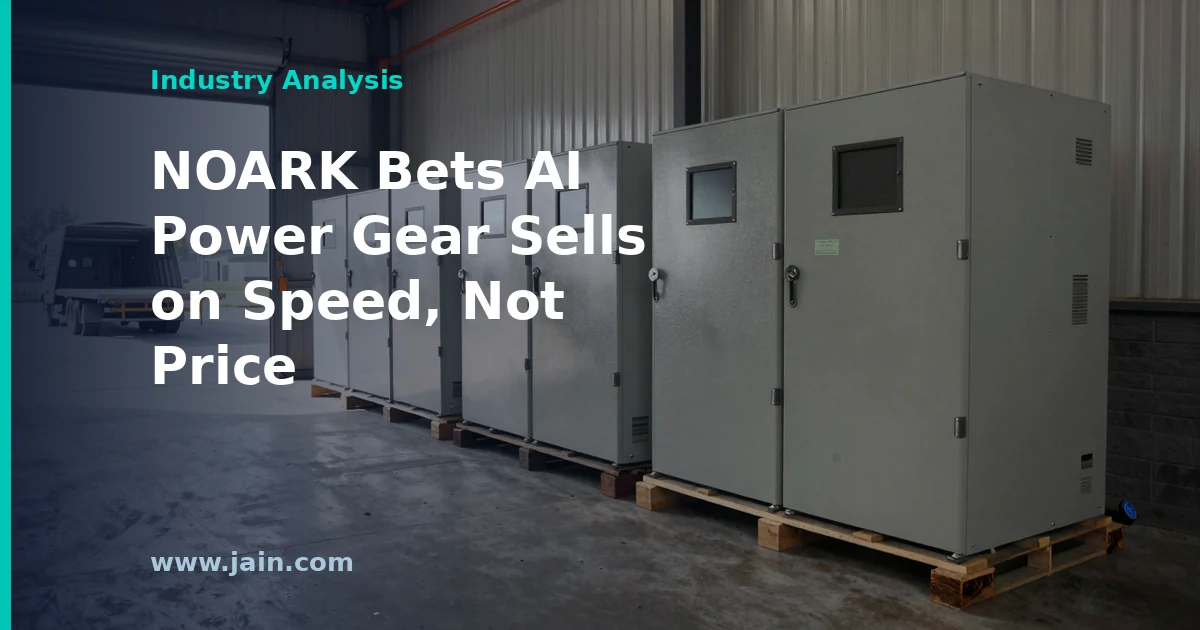
NOARK Electric, a maker of that equipment, says it got one North American order from purchase to job site in about 75 days, roughly two and a half months.
Its sales pitch is about speed and meeting local safety standards, not about being cheaper.
It has not named the customer or said what that order contained, so it is one example, not proof.
NOARK Electric said in an Oct. 10, 2026 release distributed via PR Newswire that it showcased its data center power infrastructure lineup at Yotta 2026 in Las Vegas. The equipment spans medium-voltage gas-insulated switchgear, low-voltage switchboards and busway, and air and molded-case circuit breakers, which the company is marketing under a “global-to-local” model that pairs global engineering and manufacturing with North American assembly, compliance work and service.
The release’s one hard data point: on a recent, unnamed North American project, NOARK says coordinated engineering, manufacturing, logistics and local fulfillment took the order from purchase to on-site delivery in approximately 75 days.
Executive Summary
NOARK Electric is positioning itself to win electrical-equipment orders from AI-era data center developers by competing on delivery time and regulatory readiness. The company describes a four-step model, “Engineer. Source. Qualify. Deliver,” in which global R&D and factories supply capacity while a North American team handles application engineering, UL and IEEE compliance, localized assembly, fulfillment and after-sales support.
The announcement matters because electrical gear sits on the critical path of every data center build: a facility cannot power its servers until switchgear and distribution equipment are installed and commissioned. NOARK’s release frames customer priorities as speed to power, reliability and scalability, and never mentions price, a clear signal that it believes schedule certainty is now the deciding factor in these procurements.
The supporting evidence is thin but specific: a single 75-day order-to-delivery example, plus product-level claims about where assembly and supply are localized. How far that example generalizes depends on details NOARK has not yet disclosed.
Price Never Appears in NOARK’s Pitch
NOARK builds its case around three customer priorities (speed to power, reliable performance and scalable infrastructure), and price is not among them. The only hard number the company offers is a schedule: roughly 75 days from order to on-site delivery on a recent North American project. That choice of evidence is the strategy. A supplier competing on cost would lead with cost. NOARK leads with time.
The mechanism is straightforward. Switchgear, switchboards and circuit breakers sit on the critical path of a data center build. Until they are installed and commissioned, the building cannot take power from the utility or distribute it to servers and cooling. On an AI campus, where the computing hardware is itself a large capital outlay, every week that hardware waits on electrical equipment is a week of deferred revenue. In that setting a developer can rationally accept a higher equipment price in exchange for a firmer delivery date. NOARK’s own framing, that “power availability, equipment lead times and deployment certainty are increasingly central to project planning,” is a bet that buyers now weigh the trade-off this way.
The people this targets are developers and EPC (engineering, procurement and construction) contractors who own the schedule, and the engineering firms that write equipment specifications. The limits are just as clear. The 75-day figure describes one project. NOARK has not said what equipment it covered, at what voltage class or quantity, or whether it was a standard catalog item or a custom-engineered lineup. As evidence, it illustrates the pitch. It does not establish a repeatable lead time.
Compliance Is Where a Challenger Loses Time
For a supplier that is not already on an engineer’s approved list, the slowest step can be qualification, which means getting products accepted against the codes and standards a project must meet. NOARK addresses this directly. It says its local engineering and compliance team integrates UL (Underwriters Laboratories, the North American safety certification body) and IEEE (Institute of Electrical and Electronics Engineers) requirements into product qualification and project execution, to “reduce qualification uncertainty.”
That is the second half of the lead-time argument. A fast factory helps little if a product spends months in submittal review or needs field modifications to pass inspection. By promising compliance “from the start,” NOARK is aiming at the hidden schedule risk of switching suppliers, not only at shipping time.
The specific claim is narrower than the framing. The release says a product platform shown at Yotta was “developed to meet applicable IEEE requirements.” It does not list which products carry UL listings, or for which applications. For specifiers, that product-by-product detail determines whether the compliance advantage holds on a given job.
A Hybrid Supply Chain Built for Multi-Phase Campuses
NOARK describes a layered supply model. Low-voltage switchboards and busway (prefabricated enclosed conductors that carry power along data hall rows in place of cable) draw on U.S.-based supply to “shorten supply paths.” Its ACB and MCCB platforms, meaning air circuit breakers and molded-case circuit breakers, are assembled in North America on global designs. The company’s global manufacturing footprint serves as reserve capacity for large, multi-phase deployments.
That structure fits how AI campuses are built: in phases, with repeated, standardized electrical blocks. Local assembly can shorten the final leg and make change orders easier to absorb, while global plants can supply volume when a later phase arrives. NOARK also extends its local presence to commissioning, technical assistance and after-sales support. This matters because reliability in a live facility depends on service response as much as on hardware.
The trade-off is dependency. The release says only “selected equipment” is supplied locally, which suggests much of the content still comes through the global network, so delivery certainty still depends on that network performing. The medium-voltage gas-insulated switchgear, the heaviest item in the lineup, is described in terms of compact footprint and global R&D, not local supply. Buyers weighing the model should map which parts of a lineup take the short path and which take the long one.
Background
NOARK Electric makes low- and medium-voltage electrical distribution, protection and control equipment for commercial, industrial, infrastructure and data center applications, and operates in North America and other markets. Its data center lineup covers the main electrical path inside a facility: medium-voltage switchgear that receives and controls incoming power, low-voltage switchboards and busway that distribute it, and circuit breakers that protect individual circuits.
Yotta is a data center industry event held in Las Vegas. NOARK used the 2026 edition to argue that the rapid AI-driven expansion of North American data centers has made power infrastructure, specifically equipment availability, lead times and code compliance, a deciding factor in how quickly projects move from planning to operation.
Eaton, a large electrical-equipment company, is buying COL Group, an Italian company that builds equipment for the power grid, for about 923 million dollars.
That equipment includes the heavy machinery that turns high-voltage electricity into power a building can use. It is often one of the slowest things to get when building the giant computer warehouses behind artificial intelligence.
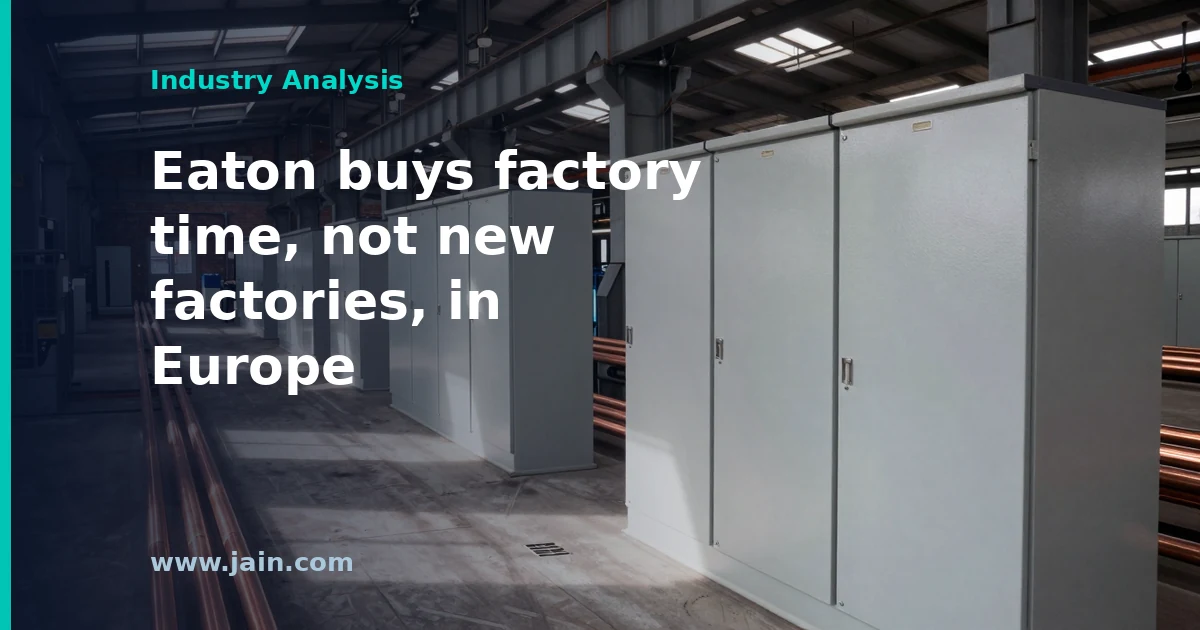
Instead of spending years building new factories in Europe, Eaton is buying factories that already run. That could speed up supply there, but it also leaves buyers with one fewer independent supplier.
Eaton Corporation has agreed to acquire COL Group, an Italian manufacturer of electrical grid equipment, for €810 million, Reuters reported. Yahoo Finance put the price at about $923 million. Eaton describes the deal as a way to expand its footprint in Europe.
Executive Summary
Eaton, one of the largest suppliers of power-distribution equipment to data centers, utilities and commercial buildings, is paying €810 million (about $923 million) for COL Group, an Italian maker of grid equipment. The stated purpose is European expansion. Eaton has not disclosed financing, an expected closing date or COL’s revenue.
The transaction matters beyond Eaton’s own geography because of what it acquires: working production. Grid equipment such as transformers and switchgear is heavy, largely built to order and slow to scale, and the rising power demands of AI data centers, electrification and renewable connections all compete for it. Buying an operating manufacturer gives Eaton plants, trained workers and qualified products at once. Building from scratch would mean waiting years for all three.
For developers, utilities and operators in Europe, the practical question is whether this adds effective supply or mainly moves existing supply under a new owner. Eaton’s answer will show up in what it does with COL’s plants after closing.
Buying a Factory Is Buying Time
The core logic of this deal is sequencing. A new plant for electrical grid equipment has to move through site selection, permitting, construction, tooling, hiring and training. Its products then have to be tested and qualified before utilities and large customers will accept them. Each step mostly waits on the one before it. An acquired manufacturer arrives with every one of those steps already done: the buildings stand, the workforce knows the processes, and the products already carry the approvals customers require.
Seen that way, the €810 million is partly a payment for time. Eaton gets European production capacity immediately, not at the end of a multi-year greenfield program (‘greenfield’ meaning built new on an empty site). The deal does not say how much capacity that is, and Eaton has not published COL’s output or revenue. The direction of the trade-off is still clear. When customers are waiting on equipment, a supplier that already has capacity in hand can capture orders that a supplier still pouring concrete cannot.
The people most affected are European data-center developers and utilities. Their project schedules depend on when electrical equipment arrives. Eaton’s competitors in the region are affected too, because they now face a rival with more local production and a broader portfolio.
Why Grid Gear Sits Upstream of Every AI Data Hall
Before a single AI server can switch on, power has to travel from the high-voltage grid into the building. Transformers step that voltage down to usable levels. Switchgear (the assemblies of breakers and switches that route and protect electrical circuits) directs it safely to each part of the facility. AI data centers need far more power per site than conventional ones, so they need more of this equipment, and they often need larger units.
Eaton already sells much of the power-distribution chain inside data centers. Adding a grid-equipment maker extends its reach toward the utility side of the connection, where equipment is heavier, more customized and typically slower to deliver. That upstream position is attractive when the binding constraint on a project is the electrical connection, not the building or the chips.
A caution applies to that thesis. The companies have framed this as European expansion, not as an AI or data-center move. Eaton has not said what share of COL’s business serves data centers versus utilities, industry or renewable projects. The AI demand case explains why grid-equipment capacity is valuable right now. It does not by itself establish that COL’s output will go to data centers.
What European Equipment Buyers Should Watch
Consolidation cuts two ways for buyers. An integrated supplier that can deliver equipment from the grid connection through to the server rack may simplify procurement and coordination on large projects. The same deal also leaves one fewer independent supplier in the market. That can weaken buyers’ negotiating position and concentrate supply risk with a single vendor.
Allocation is the other open issue. If COL’s existing customers are mainly utilities and industrial firms, they will want to know whether their orders keep their place in the queue once the plants belong to a company with heavy data-center exposure. A clear statement from Eaton on capacity expansion at COL’s sites, as opposed to reprioritizing existing output, would settle much of that uncertainty.
The Price and the Proof
The €810 million figure is the only hard number in the announcement. Without COL’s revenue, earnings or production volumes, outside observers cannot judge whether Eaton paid a premium for scarcity or a conventional industrial multiple (the price expressed as a multiple of the target’s earnings). The European-expansion claim is supported by the act of buying a European manufacturer. The larger claim, that this adds meaningful grid-equipment supply where AI and electrification projects need it, remains to be shown.
The evidence will come in stages. First is regulatory clearance. Then comes any announced investment in expanding COL’s plants. Last is whether Eaton begins quoting shorter European delivery times for the product lines COL makes. Until then, the deal is best read as a bet that owning production capacity now is worth more than building it later.
Background
Eaton is a diversified power-management manufacturer whose electrical segment supplies utilities, buildings, industrial sites and data centers. Its data-center products include power-distribution units, uninterruptible power supplies (backup systems that keep servers running through outages) and switchgear. The company has long used acquisitions to add product lines and regional manufacturing.
Europe’s grid is under pressure from several directions at once. Renewable generation needs new connections. Electrification of heating and transport raises demand. AI data centers compete for scarce connection capacity and for the equipment that makes those connections possible. That combined demand has made established grid-equipment makers valuable acquisition targets for suppliers that want production capacity quickly.
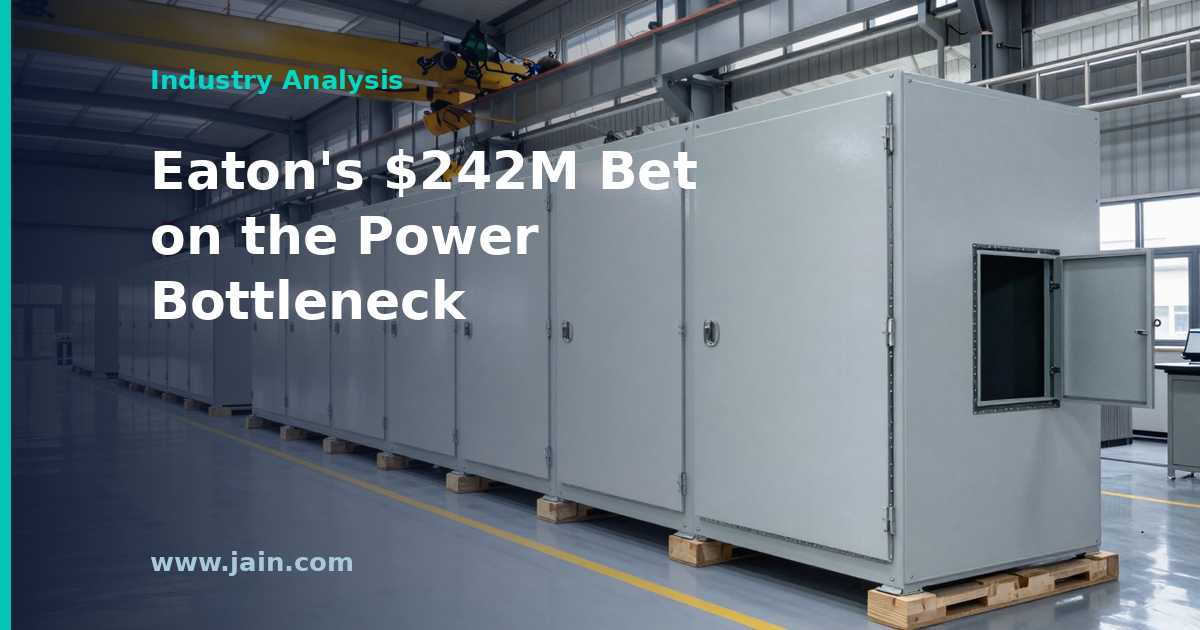
Eaton, a maker of electrical equipment, is spending more than $242 million on a new factory in North Little Rock, Arkansas. It will build the electrical rooms that feed power into data centers — assembled indoors on a production line and trucked to the site, the way a prefabricated house is.
The plant covers a million square feet, roughly seventeen football fields, and Eaton expects it to employ more than 1,200 people.
Why it matters: the thing slowing artificial intelligence down right now is not computer chips. It is getting electricity into the building.
Eaton (NYSE: ETN) announced on September 2, 2026 that it will invest more than $242 million in a new one-million-square-foot manufacturing facility in North Little Rock, Arkansas, which the company expects will double its U.S. capacity to build customized modular electrical enclosures and create more than 1,200 manufacturing, electrical and operations jobs. The plant will produce for Eaton’s Fibrebond business, which the company acquired in April 2025 and which has operated in Minden, Louisiana for more than 40 years.
Eaton says the added capacity is aimed at demand across data center, utility, industrial and digital communications markets. Arkansas Governor Sarah Huckabee Sanders, the Arkansas Economic Development Commission, the City of North Little Rock and the Metro Little Rock Alliance are named as partners on workforce development and technical-skills training tied to the site. Eaton did not announce a construction start date, a production timeline, or the value of any state or local incentives.
Executive Summary
An enclosure is the box the power gear lives in. A modular electrical enclosure is that box built in a factory — walls, switchgear, transformers, wiring, terminations — tested as a unit and shipped to site on a truck, so that work which would otherwise be done by electricians in a muddy field is instead done indoors on a production line. Eaton is committing $242 million to build more of them, and says the Arkansas plant will double what it can produce in the United States.
The scale of the check is worth keeping in proportion. Eaton reported $27.4 billion of revenue and $4.1 billion of net income in 2025; $242 million is under one percent of a single year’s sales. This is not a bet-the-company move. It is a capacity decision, and capacity decisions from component vendors are among the more honest signals available about where a supply chain is actually jammed — a factory takes years to pay back and cannot be quietly cancelled the way a press-release partnership can.
The signal here is specific: Eaton is not adding generation, or chips, or land. It is adding the ability to prefabricate the electrical middle of a data center. That points at a constraint that has migrated downstream, away from megawatts on paper and toward the physical equipment and skilled labor needed to move power the last few hundred feet into a building.
The Bottleneck Moved Downstream
For most of the current AI buildout, the public conversation about power has been about supply: whether utilities can generate enough electricity, whether gas turbines and grid interconnections can be secured, whether a region has spare capacity at all. Those constraints are real. But they are upstream constraints, and a project that clears them still has to solve a second problem — getting that power from the substation fence line into thousands of racks, through switchgear, transformers, breakers, busway and distribution equipment, all of it engineered to the specific site.
That downstream layer has become its own queue. The equipment is heavy, custom, subject to long lead times, and installed by a trade — industrial electricians — that is in short supply across the country and cannot be scaled on the schedule a hyperscale campus wants. Eaton’s own commentary points in this direction: the company said in July that it delivered record second-quarter 2026 results with accelerating orders and a growing backlog, and raised its organic growth guidance. A backlog is unshipped demand. Adding a factory is the response to a backlog you expect to persist.
Eaton’s framing supports a broad read rather than a purely AI one. The release names data center, utility, industrial and digital communications markets, and the company did not break out how much of the new capacity is earmarked for any of them. Utilities are replacing aging distribution equipment and telecom operators are densifying networks; both compete for the same factory hours. The honest statement is that Eaton sees enough aggregate demand across electrification end markets to double a product line’s U.S. footprint — with data centers as the loudest, but not the only, driver.
Why a Factory Beats a Field
The economic case for modular enclosures is a labor-arbitrage and schedule-certainty case, not a materials one. The same switchgear costs roughly the same whether it is installed on site or in a plant. What changes is who installs it, under what conditions, and when the schedule risk lands. In a factory, work is repeatable, weather-independent, inspected under controlled conditions, and performed by a trained workforce that stays put between jobs. On site, the same work is sequential, exposed to trade stacking and rain delays, and dependent on scarce electricians who must be hired into whatever county the campus was built in.
That is why Eaton’s chosen phrasing — customers wanting to deploy power infrastructure “faster, with greater certainty and less complexity” — maps onto something buyers can actually price. Certainty is the product. For an operator whose revenue starts the day the racks energize, compressing field electrical work and de-risking the commissioning date is worth paying a premium for, and it is measurable in a way that generic capacity claims are not.
The Fibrebond history explains why Eaton is doubling down rather than experimenting. Eaton bought the business in April 2025, and it had already been building enclosures in Minden, Louisiana for over 40 years; Eaton says Minden’s capacity has itself doubled over the past three years and continues to receive investment. Arkansas is therefore a second node, not a replacement — geographic diversification of a proven line, plus a labor pool in a metro area that a single small-town plant could not reach. It also fits a broader Eaton pattern of pushing toward integrated, pre-engineered data center solutions, including a reference design announced with Trane Technologies in August aimed at AI data center efficiency and installation cost.
What $242 Million Buys — and What It Doesn’t
Two arithmetic points deserve stating plainly. First, $242 million across one million square feet works out to roughly $242 per square foot of building — consistent with heavy industrial construction plus tooling, and a reminder that a meaningful share of this money is concrete and cranes, not incremental production equipment. Second, “doubles U.S. capacity” is a ratio without a denominator. Eaton has not published Minden’s current output in units, megawatts served, or dollars, so the doubling cannot be converted into how many data center halls per year the industry actually gains. Directionally credible; quantitatively opaque.
There is also a limit to what an enclosure plant can unclog. The enclosure is the wrapper; the constrained contents — large power transformers, medium-voltage switchgear, breakers, and the copper and steel behind them — have their own lead times and their own factories. Doubling enclosure assembly capacity relieves the integration and field-labor step. It does not by itself shorten the wait for a transformer. Buyers evaluating this announcement should ask which specific lead time in their own schedule it compresses.
On winners and losers: the clearest beneficiaries are large data center developers with repeatable designs, who can put standardized modular power blocks into a queue and take delivery on a predictable cadence. Regional electrical contractors lose some scope as work migrates from the field into the plant, though the field commissioning and interconnection work remains. Central Arkansas gains an anchor industrial employer and, per the release, a structured technical-training pipeline — genuinely valuable, and also the part of any plant announcement most exposed to slippage, since job counts are expectations rather than commitments and typically ramp over years. Competing enclosure and integrated-power vendors now face a rival with roughly twice the domestic assembly capacity, which is a durable competitive fact in a market where the scarce good is a delivery slot.
Background
Eaton, founded in 1911 and headquartered for operational purposes in Cleveland with legal domicile in Dublin, sells electrical and industrial power equipment into data center, utility, commercial, residential, aerospace and mobility markets. Its electrical business has been the primary beneficiary of two long-running trends the company calls electrification and digitalization — more of the economy running on electricity, and more of that electricity flowing into compute. It reported $27.4 billion of revenue in 2025 and serves customers in 180 countries.
The modular power segment it is expanding here sits at a specific choke point in data center construction. As campuses grew from tens to hundreds of megawatts, the electrical scope outgrew what could be reliably built in the field on the schedules operators demanded, and prefabrication moved from a niche option to a default for large repeatable designs. Eaton’s April 2025 purchase of Fibrebond bought it a four-decade-old position in that segment; the Arkansas plant is the first major capacity expansion announced under Eaton’s ownership, and it follows other moves toward pre-engineered data center offerings, including a reference design developed with Trane Technologies announced in August 2026.
nVent Electric (NYSE: NVT) has agreed to acquire Maverick Power for $1.75 billion, according to a deal roundup published by Benzinga and distributed via Google News. Maverick Power is positioned in the market as a maker of modular, factory-assembled power distribution equipment — the switchgear and enclosures that take utility-scale electricity and split it safely into the feeds a building actually uses.
The item appeared in a multi-company “Deal Dispatch” column that also noted Carets Corp exploring strategic alternatives, a formal phrase companies use when they open a review that can end in a sale, merger, spin-off or nothing at all. Beyond the buyer, the target and the headline price, the aggregated summary carries no further detail: no closing date, no financing structure, no management commentary and no stated revenue or earnings contribution.
Executive Summary
The transaction, as reported, is a straightforward statement of strategic intent. nVent’s core business is electrical connection and protection — enclosures, cable management, thermal management and electrical fastening. Adding a modular power distribution manufacturer moves the company further up the value chain, from housing and protecting electrical equipment toward supplying the switching and distribution gear itself, pre-integrated at a factory rather than assembled on site.
Why it matters is a question of sequencing. For three years the popular account of the AI buildout has centred on accelerators and high-bandwidth memory. Increasingly, the binding constraint sits earlier and lower in the stack: interconnection queues, transformers, breakers and medium-voltage switchgear. A campus with chips on order and no energised switchgear is not a data center; it is a warehouse. Capital is flowing accordingly, and a $1.75 billion cheque for distribution equipment capacity is a clear expression of that repricing.
A caution on evidence. The source here is a wire-service roundup, not a full company release, and the aggregated headline renders the price as “$1.75” without a unit; the billion-dollar reading is the one carried in the market framing of the deal. Everything in this article about strategic rationale, synergies and market position is analysis of a thinly documented item, not a summary of disclosed company statements. Readers should treat the price and parties as the reported facts and the rest as interpretation pending nVent’s own filings.
The Bottleneck Moved Downstream From the Chip
Every data center is, electrically, a funnel. High-voltage power arrives from the grid, a substation steps it down, medium-voltage switchgear divides and protects the resulting circuits, and transformers and low-voltage gear deliver usable power to racks. Medium voltage — broadly, the range between utility transmission levels and the volts running to equipment — is where a campus is actually carved into feeds. That equipment is heavy, custom-configured, safety-critical and made by a small number of qualified manufacturers.
AI campuses have made this segment structurally scarce in a way ordinary commercial construction never did. Density is the driver: an AI hall draws far more power per square foot than a traditional enterprise facility, so a given plot of land now demands vastly more switching apparatus. Demand for gear scaled with power draw, while the factories that build it scaled with the slower rhythms of industrial capital expansion. When order books lengthen faster than plants can be added, buying an existing manufacturer is often quicker than building one — which is a reasonable read of the logic behind a deal of this size.
The honest caveat is that no lead-time or backlog figures accompany this report. The scarcity argument is well established across the electrical equipment sector, but the specific pressure inside Maverick Power’s order book is not disclosed here, and it is the single number that would most affect how the price should be judged.
Why Factory-Built Beats Site-Built in a Labour-Constrained Market
The modular element deserves more attention than the price tag. Traditional electrical rooms are built on site: gear is delivered as components, and licensed electricians assemble, wire and commission it in place. Modular power distribution inverts this. Equipment is integrated, wired and tested in a controlled factory, then shipped as a completed unit — often an “e-house” or skid, essentially a prefabricated power room delivered on a truck — and connected on arrival.
The economics are compelling wherever skilled labour is the constraint rather than capital. Factory environments allow parallel production, repeatable quality control and testing before shipment; site work is sequential, weather-exposed and dependent on trades that are in demand across every construction sector simultaneously. For a hyperscale developer racing to energise capacity, compressing months of on-site electrical work into a delivery and a connection has value that can exceed the equipment premium several times over.
There is a trade-off buyers should weigh. Modular units are standardised by design, which limits customisation, concentrates dependency on a single supplier’s engineering, and shifts risk toward logistics — a delayed or damaged e-house is a bigger single point of failure than a delayed pallet of breakers. Whether prefabrication genuinely shortens total schedules also depends heavily on utility interconnection, which no manufacturer controls.
What nVent Gains, and What It Now Has to Prove
Strategically, the acquisition would broaden nVent from a components-and-enclosures supplier into a provider of larger integrated power blocks. That matters commercially because it changes who nVent sells to and how. Components are typically specified by engineers and bought through distribution; integrated power rooms are sold into capital projects, negotiated with developers and EPC firms — the engineering, procurement and construction contractors that build facilities — with longer cycles, larger orders and closer customer relationships.
Larger content per project also means larger exposure per project. Component suppliers are diversified across thousands of buildings; integrated-equipment suppliers concentrate revenue in a smaller number of very large customers. If AI capital expenditure moderates, or if a handful of hyperscalers reschedule campuses, that concentration cuts both ways. The premium being paid across the electrical equipment sector implicitly assumes that today’s demand curve holds long enough to earn it back.
The competitive backdrop is a field of much larger diversified electrical firms — the established switchgear incumbents — alongside specialist modular builders that emerged specifically to serve data center schedules. nVent’s plausible claim is speed and focus rather than scale. Validating it requires evidence not yet in the public record: production capacity, qualification status with major buyers, and whether the acquired plants can be expanded faster than competitors can add their own.
Reading a Thin Source Carefully
This story arrives through an aggregated deal column rather than a company announcement, and the difference is worth stating plainly for readers who track infrastructure capital flows. What is reported is the buyer, the target and a price. What is not reported — and therefore not something any analysis should assume — includes consideration mix, expected close, regulatory conditions, retained management, financial contribution and any stated synergy targets.
None of that implies anything is amiss; roundup formats simply compress. But it does mean the appropriate posture is provisional. The clean test of the thesis advanced here will be nVent’s own disclosure: if the company frames the deal around data center power capacity and order visibility, the scarcity reading is supported. If it frames it around channel breadth or industrial end markets, the AI-bottleneck framing is the market’s interpretation more than the buyer’s.
Background
nVent Electric became a standalone public company in 2018 when Pentair separated its electrical business, and it has since grown through acquisitions in enclosures, thermal management and electrical infrastructure. Its products are the unglamorous connective tissue of electrified buildings — the cabinets, mounts, heat-tracing and protection systems that let power reach equipment safely — which places it directly in the path of two structural trends: electrification of industry and transport, and the power-intensive expansion of computing.
The wider context is a repricing of the electrical supply chain. Data center construction historically consumed a modest share of global electrical equipment output; AI training and inference clusters changed that by raising power density per rack sharply. Manufacturers of transformers, breakers and switchgear moved from a slow-growth industrial category to one facing extended order books and rising valuations, prompting an active period of consolidation as suppliers buy capacity rather than wait to build it.
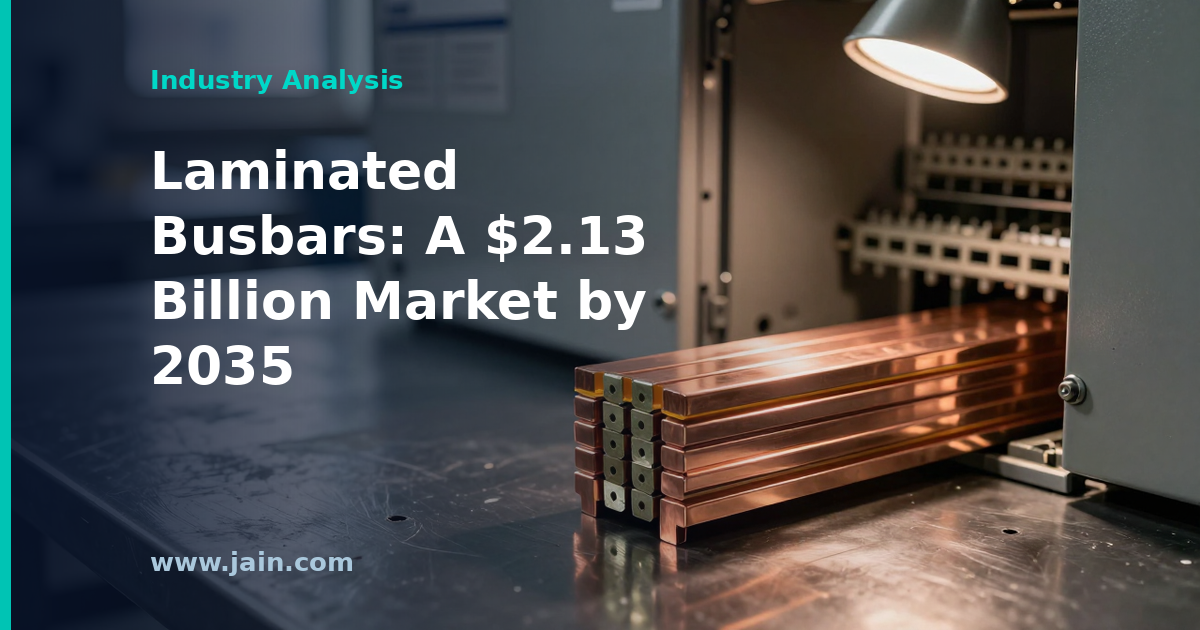
Research firm MarketsandMarkets said on August 28, 2026 that the global laminated busbar market will grow from USD 1.13 billion in 2026 to USD 2.13 billion by 2035, a compound annual growth rate (CAGR) of 7.3%. The firm puts the 2025 base at USD 1.02 billion and covers the years 2022 through 2035 in a 295-page report containing 195 data tables and 75 figures.
Within that forecast, North America is called the fastest-growing region at a 7.8% CAGR, Europe the second-largest region overall. Copper led by conductor material in 2025 and polyester by insulation material, while polyimide insulation is projected to grow fastest at 9.7%. Switchgear and power distribution was the largest application segment in 2025; utilities and grid infrastructure accounted for 20.6% of the market by end-user industry. Named suppliers include Amphenol, Methode Electronics, Mersen, Rogers, Sun King Technology Group, Zhuzhou CRRC Times Electric and Ryoden Kasei.
Executive Summary
A laminated busbar is not a glamorous product. It is a stack of flat copper or aluminium conductors separated by thin insulating film and bonded into a rigid sandwich, used in place of a bundle of cables to carry current between power-electronic components. Because the conductors sit close together in parallel planes, the assembly has very low inductance — meaning it resists sudden changes in current far less than a cable loop does — which lets switching devices run faster and cooler. That physics is why the part is quietly becoming a design constraint rather than a catalogue purchase.
The headline forecast is a near-doubling of a small market: roughly $1 billion today to roughly $2 billion in a decade. The more interesting content sits in the segment detail. The above-3,000-amp current-rating band is projected to grow at 8.3%, faster than the market as a whole, and polyimide — a high-temperature insulating film used where polyester film would soften — at 9.7%. Both are thermal signals. They say that a growing slice of demand is coming from equipment running hotter and harder than the average installed base.
For infrastructure buyers, the practical reading is about supply relationships rather than market size. The release describes a shift toward co-engineered busbars designed around a specific customer’s mechanical layout, which converts a commodity part into a single-sourced, tooling-bound component with real switching costs. That is a procurement and continuity question worth asking before the part is designed in, not after.
The Conductor Becomes a Design Decision
The economic argument for a laminated busbar has always been assembly, not electricity. Replacing a hand-built harness of cables, lugs and terminals with one bonded plate removes labour hours, removes the variance between one technician’s build and the next, and removes the tolerance stack-up that makes high-volume electrical assembly expensive to test. The release frames this directly: manufacturers want solutions that simplify assembly, improve consistency and use space efficiently. In a factory producing thousands of identical power converters, repeatability is worth more than copper savings.
The second argument is electrical, and it is the one that scales with power density. Parallel plate geometry cancels much of the magnetic field between the conductors, cutting stray inductance. Lower inductance means lower voltage overshoot when a semiconductor switches off, which means the designer can either switch faster, run at higher voltage, or specify a smaller and cheaper device for the same job. As silicon carbide and other wide-bandgap semiconductors push switching frequencies up, the interconnect stops being neutral plumbing and starts setting the ceiling on what the rest of the design can do.
That is the structural reason a low-single-digit-billion component market is worth watching from an infrastructure seat. The busbar is a small line item that gates the performance of a much larger one. Buyers who treat it as a commodity late in the design cycle tend to discover the constraint at thermal validation, when changing it is most expensive.
What the Forecast Actually Supports
The arithmetic is internally consistent: $1.13 billion compounding at 7.3% over the nine years to 2035 does land near $2.13 billion, so the headline is not a rounding artefact. The segment CAGRs are also coherent with each other — high-current, high-temperature and North American growth all running above the blended rate is the pattern you would expect if electrification and power-electronics density are the underlying drivers.
Two things are worth flagging plainly. First, the step from the stated 2025 base of $1.02 billion to $1.13 billion in 2026 is about 10.8% growth, noticeably above the 7.3% rate forecast for the following decade. That implies a near-term acceleration followed by moderation, which may well be the firm’s considered view, but the release does not explain it. Second, the release names an application segment — EV chargers — as the fastest-growing, but gives the window as 2026–2031 in the subheading and 2026–2035 in the body. One of those is a typographical slip; a reader cannot tell which, and the two imply different demand curves.
None of this makes the forecast wrong. It makes it unverifiable from the material provided, which is the normal condition for a press release whose function is to sell a 295-page report. The honest position is that the segment mix is a plausible and useful directional signal, and the specific dollar figures are a vendor estimate that no reader can independently reconstruct.
Above 3,000 Amps: Reading the Thermal Signal
The single most informative number in the release may be the 8.3% CAGR attached to the above-3,000-amp current-rating band. Very high current at modest voltage is the signature of DC distribution inside dense equipment — battery systems, energy storage, fast-charging stacks, and the low-voltage DC rails that feed racks of processors. Current heats a conductor in proportion to the square of its magnitude, so every step up in amperage makes the conductor’s cross-section, surface area and thermal path a harder problem than the step before it. Polyimide’s projected 9.7% growth points the same way: designers reach for a costlier, higher-temperature film when they have run out of thermal headroom, not when they have plenty.
It is worth being precise about what the release does and does not say here. It does not mention data centres or AI infrastructure anywhere. The named end-user concentration is utilities and grid infrastructure at 20.6% in 2025, with switchgear and power distribution the largest application and EV charging the fastest-growing one. The connection between rising rack power density and high-current busbar demand is an inference drawn from the shared physics and the shared supplier base, not a claim the report makes.
That inference is still worth making, because the constraint travels. Whoever is building 350 kW charging stalls, grid-scale storage inverters and high-current server power shelves is buying from an overlapping pool of copper, polyimide film, lamination presses and press-brake capacity. If charging and storage demand grows at the rates forecast here, data-centre power teams will feel it as lead times and qualification queues in a component category most of them have never had to plan around.
Co-Engineering Rewrites the Supplier Relationship
The release’s clearest strategic claim is that demand is shifting toward co-engineered busbars developed around a customer’s specific mechanical layout, conductor arrangement and insulation requirements, with competition moving to design support, prototyping, testing and production scalability. That description matters more than the market size. A part designed around one enclosure is, in practice, single-sourced. Requalifying a second supplier means new tooling, new dielectric and thermal validation, and often a schedule slip measured in quarters.
The winners in that model are suppliers with engineering staff sitting alongside customer design teams early — which favours incumbents with scale, and the named list spans the US (Amphenol, Methode Electronics, Rogers), France (Mersen), China (Sun King Technology Group, Zhuzhou CRRC Times Electric) and Japan (Ryoden Kasei). The release gives no revenue or share figures for any of them, so the competitive ranking within that group is not established by this material. The losers are generic fabricators competing on price per kilogram of copper, and buyers who let a sole-source dependency form without pricing it.
There is a geographic dimension too. Design-stage collaboration is easier when the supplier is reachable, which is one plausible reason North America is forecast to grow fastest, alongside its build-out of charging and grid equipment. But co-engineering also deepens exposure: a supplier chosen for its engineering depth is harder to replace if tariffs, export controls or a plant outage intervene. The mitigation is unromantic and should happen at design time — dual-qualify where volume justifies it, keep the mechanical interface documented independently of the supplier’s CAD, and price continuity into the award rather than the unit cost alone.
Background
Busbars are the workhorses of electrical distribution: solid conductors that carry current between components where cables would be bulky, lossy or hard to route. Laminated busbars are the engineered end of that category, developed originally for aerospace and traction applications where space, weight and switching performance all mattered at once. They spread into industrial drives, then into electric vehicles, renewable inverters, battery storage and switchgear as power electronics moved to higher voltages and faster semiconductor switching.
MarketsandMarkets is a business-to-business research and growth-consulting firm that publishes syndicated market forecasts across technology and industrial sectors, promoting them through wire releases like this one. Its figures are vendor estimates rather than audited or regulatory data; the value to a general reader lies mainly in the segment structure and directional signals, which should be weighed alongside supplier disclosures and buyers’ own procurement experience.
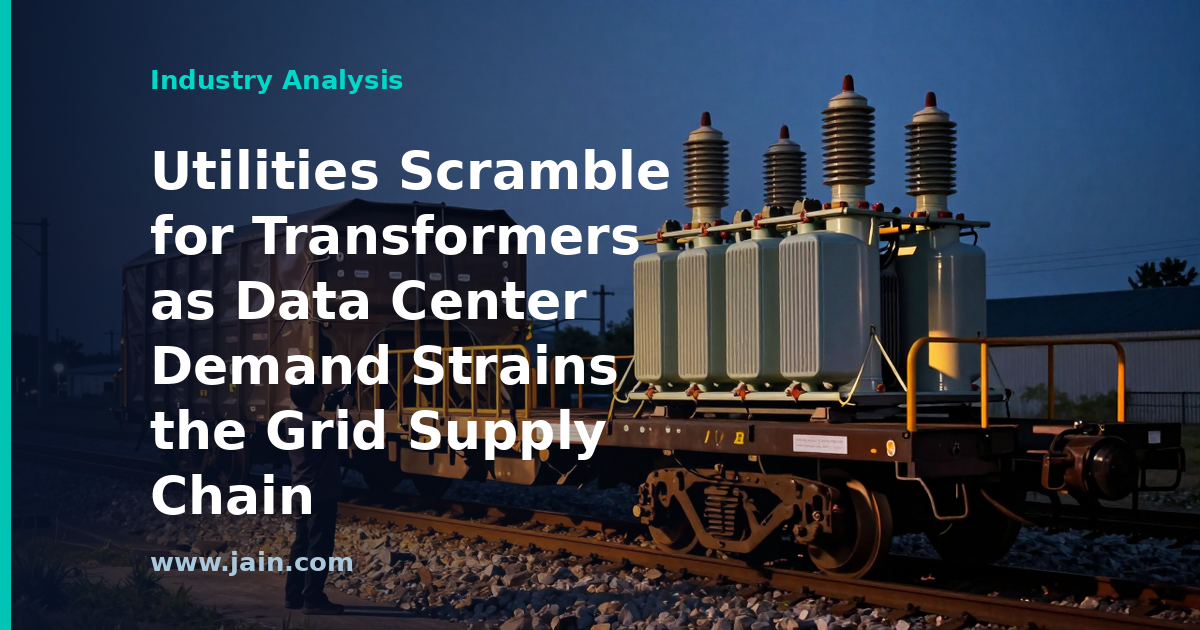
Reuters reported on July 8, 2026 that US power companies are scrambling to secure electrical equipment — the transformers, switchgear, and related grid hardware that move electricity from generators to customers — as surging demand from data centers strains available supplies. The report frames a nationwide procurement crunch: utilities that once ordered this equipment on routine replacement cycles are now competing for constrained manufacturing capacity against a wave of new large-load projects.
Executive Summary
The headline is not about a single deal or data center campus; it is about the industrial base underneath all of them. Transformers step electrical voltage up for long-distance transmission and back down for delivery, and switchgear is the apparatus that switches, protects, and isolates circuits. Neither is optional: every new data center interconnection, substation upgrade, and grid expansion needs both. Reuters’ reporting indicates that US utilities can no longer take timely delivery of this equipment for granted.
Why it matters: for the first time in decades, US electricity demand is growing meaningfully, and data centers — particularly AI-driven facilities — are a leading cause. When the equipment supply chain becomes the pacing item, it stops being a utility procurement problem and becomes a constraint on data center delivery schedules, grid reliability investment, and ultimately on how fast the AI buildout can proceed. Power availability has already emerged as the industry’s defining bottleneck; this report locates part of that bottleneck one layer deeper, in the factories that make grid components.
Why Transformers Became the Grid’s Chokepoint
Large power transformers are among the least glamorous and most consequential machines in the economy. They are heavy, highly engineered, often custom-built to a specific substation’s requirements, and produced by a relatively small number of manufacturers worldwide. Capacity to build them cannot be added quickly: it requires specialized factories, scarce materials such as grain-oriented electrical steel, and skilled workers who take years to train.
The US grid spent roughly two decades with flat electricity demand, and the supply chain sized itself accordingly — tuned for steady replacement of aging units, not for a demand shock. When data center load growth, electrification, and grid-hardening programs all began pulling on that thin manufacturing base at once, order backlogs stretched and utilities found themselves queuing for hardware. The scramble Reuters describes is the predictable result of a just-in-time supply chain meeting a step change in demand.
When Equipment Lead Times Set the Data Center Schedule
For data center developers, this crunch changes what “time to power” means. A site can have land, fiber, permits, and even a utility willing to serve it, and still wait on a transformer delivery slot. Interconnection — the process of physically and contractually tying a new load into the grid — increasingly depends less on paperwork and more on whether the required substation equipment physically exists.
That reality is reshaping behavior on both sides of the meter. Utilities are reported to be securing equipment earlier and more aggressively, which effectively shifts them from reactive procurement to strategic stockpiling. Large data center operators, for their part, have strong incentives to lock in capacity years ahead, pre-order long-lead equipment themselves, or favor sites where grid infrastructure already exists — one reason established carrier hotels and campuses with existing substation capacity have gained strategic value relative to greenfield sites.
The Economics of Scarcity: Who Absorbs the Cost
Scarcity moves pricing power toward manufacturers. Electrical-equipment makers with transformer and switchgear capacity are in an unusually strong position, and the open question is how much they will invest in expansion — factories are decade-scale bets, and executives remember the last long stretch of flat demand. Utilities, meanwhile, typically recover equipment costs through regulated rates, which means sustained price inflation in grid hardware eventually reaches ratepayers and invites regulatory scrutiny over how much of the buildout data center customers should fund directly.
Among data center players, scarcity favors scale and incumbency. Hyperscale operators can pre-purchase equipment, sign long-term supply agreements, and absorb schedule risk in ways smaller developers cannot. If the crunch persists, expect it to act as a filter: well-capitalized projects with early equipment commitments proceed, while speculative projects — announced capacity without secured power and hardware — quietly slip or die. That could rationalize an overheated development pipeline, but it also raises barriers to entry across the industry.
What Could Break the Bottleneck
Several paths out exist, none fast. Manufacturers can and do add capacity, but new production lines take years to reach output. Standardizing transformer designs — reducing the custom engineering in each order — could raise effective throughput. Utilities can extend the life of existing units, share spares, and prioritize deployments. On the demand side, data centers that bring their own generation or agree to flexible operation reduce the immediate grid equipment burden.
The honest assessment is that this is a multi-year imbalance. Equipment supply is a lagging system responding to a leading demand signal, and the gap between them is where project delays, price escalation, and strategic maneuvering will play out. For infrastructure operators, the practical takeaway is that secured power and in-hand electrical equipment are now assets in their own right, worth nearly as much as the buildings around them.
Background
For most of the 2000s and 2010s, US electricity demand barely grew, thanks to efficiency gains offsetting economic expansion. That era ended as data centers — driven most recently by AI training and inference workloads — joined manufacturing reshoring and electrification as major new sources of load. Utilities, regulators, and grid operators have spent the past several years revising demand forecasts upward and confronting the fact that generation, transmission, and the equipment supply chain were all sized for a slower world.
Concerns about transformer supply predate the AI boom — the aging of the US transformer fleet and the concentration of manufacturing capacity have been discussed in grid-security circles for years — but data center growth has converted a slow-burning replacement problem into an acute procurement race. The July 2026 Reuters report captures that shift from the utilities’ side of the table.