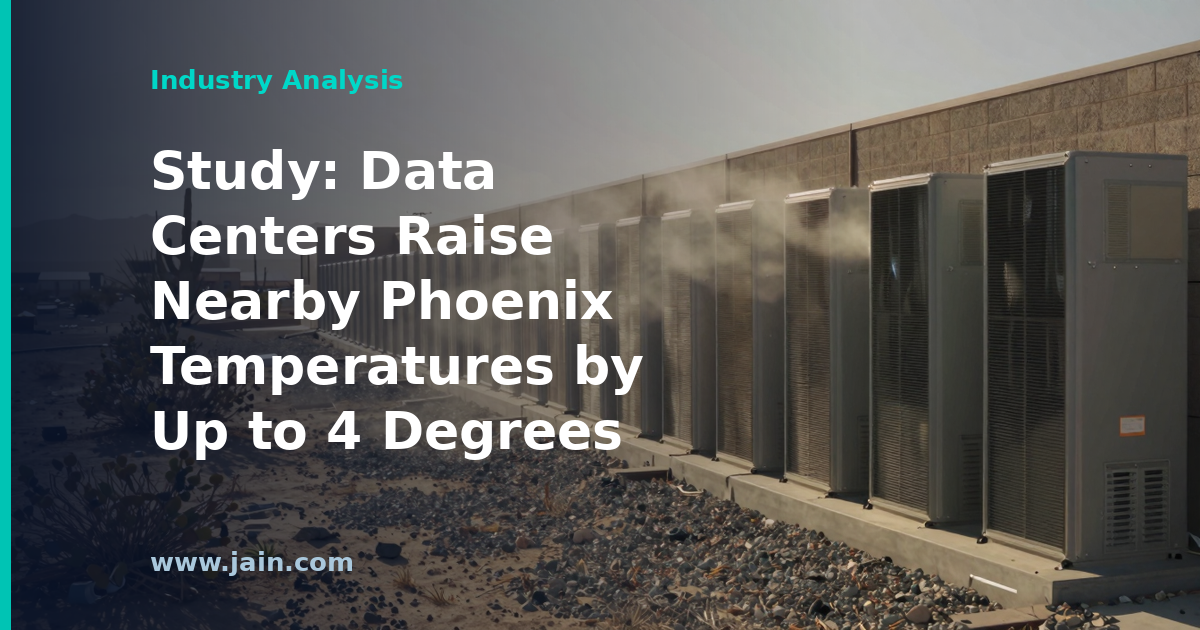
A peer-reviewed study published in ASME’s Journal of Engineering for Sustainable Buildings and Cities (Vol. 7, Issue 2) reports that data centers raise temperatures in their surrounding areas by up to 4 degrees in Phoenix, Arizona — one of the largest and fastest-growing data center markets in the United States.
The research, which frames data center waste heat as an emerging urban heat source, drew broad attention on August 19, 2026, when it reached the Hacker News front page with 267 points and more than 375 comments — a signal that the industry itself is taking the question seriously.
Executive Summary
The finding is simple to state and hard to dismiss: the electricity a data center consumes does not disappear. Nearly all of it becomes heat, and cooling systems must eject that heat into the surrounding air. In a dense cluster of facilities, that ejected heat measurably warms the neighborhood — by as much as 4 degrees, according to this study of Phoenix.
Why it matters: Phoenix is both a top-tier data center hub and the hottest major city in America, where summer heat is already a public-health and grid-reliability issue. A peer-reviewed number linking data centers to local warming gives residents, city councils, and regulators something they have not had before — citable evidence. Expect it to surface in zoning hearings, permitting conditions, and community-benefit negotiations well beyond Arizona.
For operators and their customers, the study reframes waste heat from an engineering afterthought into a siting externality alongside power draw, water use, and noise — one that will increasingly shape where and how new capacity gets built.
Heat Is the New Noise: An Externality Goes on the Record
Data center opposition has historically centered on three complaints: power consumption, water use, and the low-frequency hum of cooling plants. Localized warming now joins that list with something the others took years to acquire — a peer-reviewed citation. Once a measurable external cost is published in an engineering journal, it tends to migrate into environmental-impact reviews, zoning board testimony, and eventually permit conditions. That is how noise limits and water-reporting requirements became standard, and waste heat is positioned to follow the same path.
The practical consequence is that thermal impact modeling may become part of the pre-construction diligence package. Developers who can show — with sensors and models, not assurances — that a facility’s heat plume will not worsen conditions for adjacent neighborhoods will move through approvals faster than those who cannot. In a market where time-to-power already decides deals, an avoidable six-month permitting fight over heat is real money.
Why Phoenix Is the Stress Test for the Whole Industry
Phoenix became a data center magnet for rational reasons: comparatively cheap land, available power, low natural-disaster risk, and proximity to California customers without California costs. But the same desert climate that makes the land cheap makes cooling expensive and makes every added degree socially costly. Extreme heat is already the region’s deadliest weather phenomenon, so a study saying nearby temperatures rise by up to 4 degrees lands very differently in Phoenix than it would in a temperate metro.
There is also an economic feedback loop worth naming: hotter ambient air makes chillers and evaporative systems work harder, which consumes more electricity and water, which ejects more heat. If clustered facilities are warming their own microclimate, they are marginally degrading their own cooling efficiency — and everyone else’s. That is a classic commons problem, and commons problems invite regulation when the industry does not self-organize first.
From Liability to Asset: The Waste-Heat Reuse Question
In Nordic countries, data center waste heat is piped into district heating networks that warm homes — the externality becomes a product. The awkward truth is that this playbook works worst exactly where the U.S. is building fastest: Phoenix has essentially no heating demand for most of the year, and the low-grade heat that air-cooled facilities reject is difficult to transport or upgrade economically. Reuse candidates exist — industrial preheating, water treatment, agriculture — but none absorb hyperscale volumes in a desert.
That points the mitigation conversation toward engineering rather than reuse: liquid cooling that captures heat at higher, more usable temperatures; facility siting and airflow design that lofts exhaust away from neighborhoods; and honest accounting of the water-versus-heat trade-off, since evaporative cooling ejects less sensible heat into the air but consumes scarce water to do it. Operators who get ahead of this with published thermal data will own the narrative; those who wait will have it written for them.
Background
Metro Phoenix has spent a decade becoming one of America’s leading data center markets, attracting hyperscale and colocation development with affordable land, available power, low disaster risk, and proximity to West Coast demand. The AI buildout has accelerated that growth just as the region confronts record-breaking heat and long-term water constraints.
Urban heat island science, meanwhile, has decades of history attributing city warming to pavement, buildings, and vehicles. What is new is peer-reviewed work isolating data centers — among the most energy-dense buildings ever constructed — as a distinct and growing contributor, arriving at the exact moment communities nationwide are weighing the local costs and benefits of hosting them.
Forbes reported on July 10, 2026 that a Meta AI data center has been linked to rare bacteria detected in a city’s water system — a striking escalation of the long-running debate over how much water AI data centers consume, into a question about what they may put back. The headline alone frames the story; the publicly circulated material does not name the city, identify the bacteria, or explain the mechanism of the alleged link.
The report lands as Meta and its hyperscale peers are in the middle of the largest data center construction wave in history, much of it cooled — directly or indirectly — with municipal water.
Executive Summary
According to Forbes, a Meta data center built to serve the company’s artificial-intelligence workloads has been connected to the presence of a rare bacteria in the water system of a nearby city. If substantiated, this would mark a significant shift in the data center water debate: for years the argument has centered on quantity — how many millions of gallons evaporative cooling draws from local supplies — while this story raises a quality and public-health dimension.
Why it matters: water is the quiet dependency of the AI buildout. Many large data centers use evaporative cooling, in which water absorbs server heat and is partially evaporated away, because it is dramatically more energy-efficient than pure air-based cooling. That efficiency comes with entanglement — data centers become major customers of, and in some configurations discharge back into, the same municipal systems that serve residents.
Important caveat up front: ‘linked’ is doing heavy lifting in this headline. The available material does not establish causation, name a health authority’s finding, or describe Meta’s response. This article analyzes the stakes while flagging exactly what remains unverified.
When the Water Debate Becomes a Public-Health Story
Data center water use has been a community flashpoint for several years, but the framing has been almost entirely volumetric: how many gallons per day, whether aquifers or reservoirs can sustain it, and whether households pay more as a result. A bacteria-in-the-water-system story changes the emotional and regulatory register entirely. Volume disputes are negotiated in rate cases and zoning hearings; contamination questions summon health departments, environmental regulators, and — fairly or not — a much deeper reservoir of public anxiety.
Mechanically, there are plausible pathways for a large industrial water user to interact with a municipal system’s water quality: heavy draws can change pressure and flow patterns in distribution pipes, warm discharge or blowdown water (the mineral-concentrated water periodically flushed from cooling systems) must be treated and returned somewhere, and large open-loop cooling towers are themselves known habitats for waterborne bacteria such as Legionella. To be clear, none of these mechanisms is confirmed in this case — the source material does not say which, if any, applies. But they explain why a ‘link’ claim is at least technically conceivable rather than absurd on its face.
What ‘Linked’ Does and Does Not Establish
The scrutiny has to run in every direction. For the reporting: what evidence supports the link — sampling data, a utility investigation, a health-department finding, or expert inference? Correlation between a new industrial water customer and a new detection is not causation; municipal systems detect unusual organisms for many reasons, including aging pipes, source-water changes, and improved testing. For Meta: what water does the facility draw, what does it discharge, under what permit, and what monitoring does it publish? For the utility and local officials: what does the testing history show before and after the facility came online, and has anyone actually been harmed?
The honest answer, based on what has circulated publicly, is that we cannot yet distinguish between three very different stories: a genuine contamination pathway traced to the facility, a coincidental detection amplified by the data center’s high profile, or something in between — for example, system stress that made an existing problem visible. Each has radically different implications, and readers should hold all three open until primary documents surface.
The Economics of Water in the AI Buildout
Hyperscalers use water because physics and economics reward it. Evaporative cooling can cut a facility’s cooling energy dramatically compared with mechanical chillers, lowering both operating cost and the grid capacity a site must secure — often the binding constraint on AI campuses measured in hundreds of megawatts. The industry’s own metric, water usage effectiveness (WUE), exists precisely because operators know the trade-off is real: save electrons, spend water.
That calculus is shifting. Direct-to-chip liquid cooling and closed-loop systems — which recirculate a fixed volume of water or coolant rather than continuously evaporating fresh supply — are increasingly standard for dense AI hardware, and several operators have announced designs that consume little or no water for cooling. A public-health controversy, even an ultimately unproven one, accelerates that shift by adding reputational and permitting risk to the cost side of the evaporative-cooling ledger. Communities negotiating with data center developers now have one more reason to demand closed-loop designs, discharge transparency, and independent water-quality monitoring as conditions of approval.
Winners, Losers, and the Precedent That Matters
If the link is substantiated, the losers are obvious: the affected community first, then Meta’s siting pipeline, and then every operator whose pending permits get re-examined through a public-health lens. The beneficiaries would be vendors of waterless and closed-loop cooling, water-treatment and monitoring firms, and jurisdictions that wrote strong discharge and reporting requirements into their agreements and can now point to them.
If the link is not substantiated, the story still matters, because permitting battles run on narrative as much as data. The industry has often been slow to publish site-level water data, treating it as competitively sensitive; that opacity leaves a vacuum that headlines fill. The durable lesson either way is that transparency is cheaper than suspicion: operators who publish withdrawal, discharge, and monitoring data before a controversy get to argue from their own numbers rather than someone else’s framing.
Background
Meta operates one of the world’s largest data center fleets and has been expanding it aggressively to support its artificial-intelligence ambitions, with new campuses whose power demands are measured in the hundreds of megawatts and beyond. Like its hyperscale peers, the company has faced recurring community scrutiny over local resource impacts — power, land, and especially water — and, like those peers, has publicized water-restoration commitments intended to offset consumption.
Until now, the water controversy around AI infrastructure has been overwhelmingly about scarcity: whether local systems can supply large evaporative-cooling loads without straining households and agriculture. A report tying a facility to bacteria in a municipal system — whatever its ultimate substantiation — moves the debate from resource competition to public health, a categorically more sensitive terrain for operators, regulators, and residents alike.
Mitsubishi Heavy Industries (MHI) announced on July 9, 2026 that it has demonstrated energy-efficiency improvements through cooling optimization in an operational data center. Rather than a lab simulation or a controlled test bed, the demonstration ran in a live facility — the setting where cooling systems must respond to real, fluctuating IT loads.
Executive Summary
MHI, the Japanese heavy-industry group whose portfolio spans power generation, HVAC and thermal systems, says it has shown measurable energy-efficiency improvements by optimizing cooling in a data center that was actively serving production workloads. The approach centers on smarter control of cooling equipment — adjusting how chillers, air handlers and airflow respond to actual conditions rather than running at conservative fixed settings.
The announcement matters for a simple reason: cooling is one of the largest non-IT consumers of electricity in a data center, and it is one of the few places where efficiency gains can be captured without touching the servers themselves. With AI workloads pushing rack power densities sharply higher, operators are looking hard at control-layer optimization as a way to cut operating costs and free up power capacity. A field demonstration in a live facility — as opposed to vendor modeling — is the kind of evidence buyers increasingly demand, though the syndicated version of this release does not carry the underlying figures, which readers should verify against MHI’s full publication.
Why a Live-Facility Demonstration Matters
Cooling-optimization claims are easy to make in simulation and hard to prove in production. A real data center has messy thermal behavior: IT load rises and falls with customer demand, outside temperatures swing by season and hour, and no operator will tolerate a control experiment that risks overheating servers. Demonstrating gains in an operational facility means the system had to deliver savings while respecting those constraints — which is why field verification is the credibility bar for this product category.
That said, a single-site demonstration is evidence, not proof of general applicability. Results depend heavily on the baseline: a facility with poorly tuned cooling will show dramatic improvement from almost any optimization, while a well-run site will show far less. The commercial question is not whether MHI improved one building, but how transferable the method is across climates, cooling architectures and load profiles — something only multi-site data can answer.
Cooling Is the Biggest Efficiency Lever Left
In most data centers, cooling is the largest energy consumer after the IT equipment itself, which is why the industry’s standard efficiency metric — PUE, or power usage effectiveness, the ratio of total facility power to IT power — is largely a measure of cooling overhead. Servers get more efficient with every silicon generation, but the facility side improves only when operators invest in it. Control-layer optimization is attractive because it can often be applied to existing equipment: the chillers stay, the software running them gets smarter.
The economics have sharpened as AI infrastructure scales. Grid connections are constrained in many markets, so every kilowatt not spent on cooling is a kilowatt available for revenue-generating compute. For operators facing multi-year waits for new power capacity, efficiency gains at the cooling layer function as found capacity — frequently at a fraction of the cost of new construction.
MHI Enters a Crowding Field
MHI is not alone here. AI-assisted cooling control has been pursued by hyperscalers internally and by facility-equipment and building-management vendors for several years, and the space now includes established cooling manufacturers, controls specialists and software startups. MHI’s differentiation, if it holds, comes from owning the equipment side: a company that builds chillers and thermal systems can integrate control optimization more deeply than a software-only vendor, and can stand behind the combined result.
For MHI, the strategic logic is also defensive. As liquid cooling, heat reuse and AI-driven operations reshape data center thermal design, equipment makers that offer only hardware risk being commoditized while the value migrates to the control and services layer. A demonstrated optimization capability positions MHI to sell outcomes — efficiency, capacity headroom — rather than just machines. Whether that translates into a commercial product with published pricing and guarantees is the next thing to watch.
Background
Mitsubishi Heavy Industries is a diversified Japanese engineering group whose thermal-systems businesses build chillers, HVAC and industrial cooling equipment — the physical machinery that data center cooling optimization software ultimately controls. Like other established equipment makers, MHI has been extending from hardware into the control and services layer as data center operators demand measurable efficiency outcomes rather than standalone machines.
The push comes amid a broader industry squeeze: AI-driven demand has data center construction booming while grid power in major markets is scarce, making energy efficiency both a cost issue and a capacity issue. Cooling, as the largest non-IT energy consumer in most facilities, has become the primary battleground, with hyperscalers, controls vendors and equipment manufacturers all pursuing AI-assisted optimization of the thermal plant.
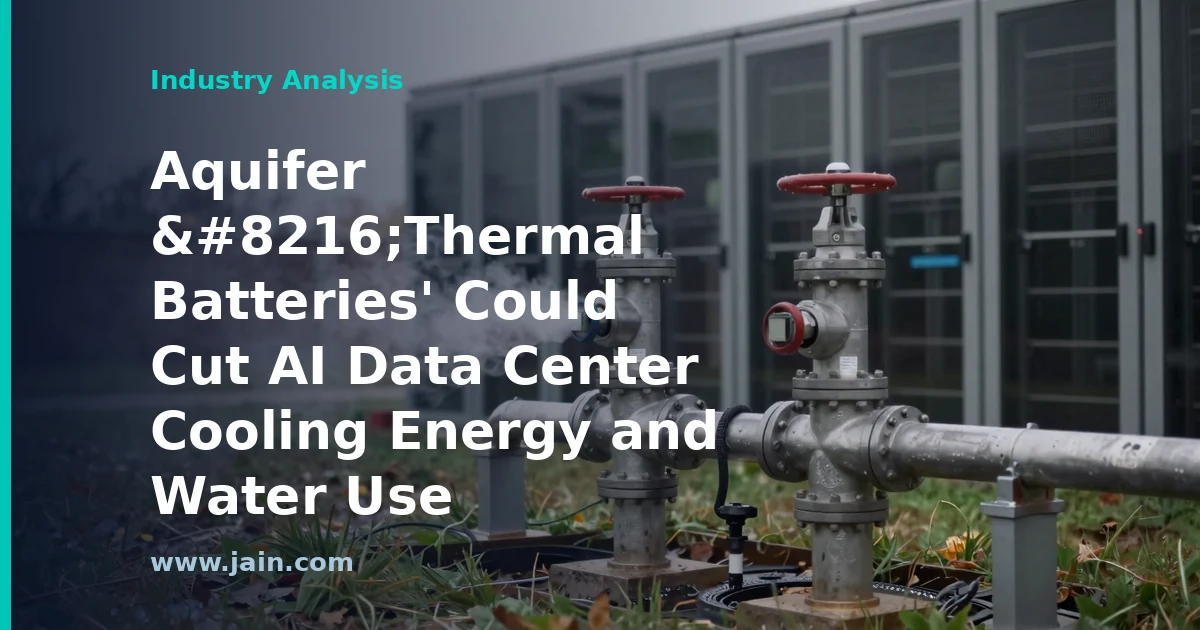
Research publicized June 29, 2026 via Tech Xplore suggests that aquifers — naturally occurring layers of water-bearing rock underground — could serve as ‘thermal batteries’ for data centers, storing heat and cold across seasons. According to the report, the approach may reduce the cooling energy AI data centers consume and cut their water use, two of the industry’s fastest-growing environmental pressure points.
Executive Summary
The announcement is a research finding, not a product launch: scientists propose using aquifer thermal energy storage — pumping water underground to bank cold in one season and withdraw it in another — as a way to offset the enormous cooling loads created by AI computing. The headline claim is twofold: lower cooling energy demand and reduced water consumption compared with conventional approaches such as evaporative cooling, which loses large volumes of water to the atmosphere by design.
Why it matters: cooling is one of the largest non-compute energy costs in a data center, and water use has become a siting and permitting flashpoint in drought-prone regions. AI accelerators run hotter and denser than traditional servers, magnifying both problems. A storage-based approach that shifts cooling work to underground reservoirs — rather than burning electricity on chillers or evaporating potable water in real time — would attack both constraints at once. The open question, which the source headline’s own careful ‘may cut’ phrasing acknowledges, is whether the technique scales from research findings to the round-the-clock, high-density heat loads of production AI facilities.
Why Cooling Is the Quiet Crisis of the AI Buildout
Every watt a server consumes becomes heat that must be removed, and AI hardware has pushed rack power densities far beyond what legacy air-cooling systems were built for. Operators today choose among imperfect options: mechanical chillers, which are reliable but electricity-hungry; evaporative cooling, which trades electricity for significant water consumption; and liquid cooling, which moves heat efficiently at the rack but still needs somewhere to reject it. Cooling efficiency is captured in metrics like PUE (power usage effectiveness — total facility power divided by computing power), and shaving it has direct economic value at AI campus scale.
Water has arguably become the more politically sensitive constraint. Data center water consumption has drawn scrutiny from communities and regulators in water-stressed regions, and several jurisdictions now weigh water impact in permitting decisions. A cooling architecture that credibly reduces both energy and water use addresses the industry’s two most visible externalities simultaneously — which explains why a research result, rather than a commercial deployment, is drawing attention.
How an Aquifer Becomes a Battery
Aquifer thermal energy storage, often abbreviated ATES, is conceptually simple: use paired wells to circulate groundwater, storing thermal energy in the aquifer itself. In winter, cheap ambient cold is banked underground; in summer, that stored cold is withdrawn to absorb data center heat, with the warmed water returned to a separate zone of the aquifer for later use or dissipation. The ‘battery’ framing is apt — the aquifer shifts cooling capacity across time, much as an electrical battery shifts energy from cheap hours to expensive ones.
The underlying technique is not new. ATES has been deployed for decades in district heating and cooling systems, particularly in the Netherlands, where favorable geology and supportive regulation made it routine for buildings. What the new research explores is its application to a much harder customer: data centers, whose heat output is continuous, dense, and growing. Because the water circulates in a closed loop underground rather than evaporating into the air, the approach could sidestep the consumptive water losses that make evaporative cooling controversial.
Who Wins If It Works — and What Stands in the Way
The clearest beneficiaries would be operators in regions with suitable aquifer geology and strong seasonal temperature swings, where winter cold can be banked cheaply. Utilities and grid planners would welcome anything that flattens data center cooling load, since peak cooling demand coincides with summer grid stress. Drilling, geothermal, and groundwater engineering firms would gain a new market adjacent to the booming data center construction sector.
The obstacles are equally concrete. ATES only works where the geology cooperates — the right aquifer depth, permeability, and low natural groundwater flow — which makes it a siting-dependent solution, not a universal one. Groundwater is heavily regulated nearly everywhere, and injecting warmed water underground raises legitimate environmental review questions about thermal plumes and water chemistry. And AI’s heat load is continuous rather than seasonal, so an aquifer system would likely supplement, not replace, conventional cooling. None of these hurdles is disqualifying, but each stands between a promising research finding and a bankable design that a hyperscaler would commit to.
Background
Data center cooling has evolved through waves of pressure: from raised-floor air cooling, to hot/cold aisle containment, to economizers and evaporative systems, and most recently to direct liquid cooling as AI accelerators pushed rack densities beyond what air can handle. Each wave traded among the same three currencies — electricity, water, and capital — and the AI buildout has sharpened all three constraints at once, with water use in particular becoming a community and permitting issue in water-stressed markets.
Aquifer thermal energy storage sits within a broader family of underground thermal techniques, alongside borehole storage and geothermal heat pumps. ATES matured in northern Europe over several decades as a building heating-and-cooling technology; the research reported here represents an attempt to carry that mature concept into the much more demanding environment of AI computing infrastructure.
Microsoft is claiming water positivity across its data center operations, according to a June 27, 2026 report from Data Center Dynamics. Water positivity means an operator replenishes more water to stressed watersheds than its facilities consume — a milestone Microsoft first committed to reaching by 2030 when it announced its water-positive pledge in 2020.
The claim spans one of the world’s largest cloud footprints, and it arrives at a moment when AI-driven capacity growth has put data center water consumption under intense public and regulatory scrutiny. The available report is headline-level, so the scope, accounting method, and verification behind the claim remain to be detailed.
Executive Summary
Microsoft has publicly positioned its data center operations as water positive — consuming less water, net of replenishment projects, than it returns to the watersheds where it operates. If the claim holds up under scrutiny, it would represent the first time a hyperscale cloud operator has asserted that its fleet, as a whole, has crossed that line, and it would land years ahead of the company’s stated 2030 target.
Why it matters: water has become the second front, after power, in the fight over data center siting. Communities from Arizona to the Netherlands have pushed back on facilities that draw millions of gallons for evaporative cooling, and regulators increasingly ask for water commitments alongside grid commitments. A credible water-positive benchmark from the market’s second-largest cloud provider would reset expectations for every operator negotiating a site — including colocation and wholesale providers who compete for the same land, power, and permits.
The operative word is credible. Water positivity is an accounting construct, not a physical description of any single site, and its value depends entirely on scope, measurement, and where the replenishment actually happens. The source reporting available at publication does not yet answer those questions, and they are the right ones to ask of any operator making a similar claim.
What “Water Positive” Actually Means — and What It Doesn’t
Water positivity is a ledger claim: over a defined period, the volume of water an operator restores — through wetland restoration, leak-repair programs, irrigation efficiency projects, aquifer recharge, and similar investments — exceeds the volume its operations consume. Consumption here typically means water evaporated or otherwise not returned to the source, which for data centers is dominated by evaporative cooling, the technique of cooling air or water by letting some of it evaporate, trading water for large electricity savings.
What the construct does not mean is that any individual data center stopped drawing water. A facility in a drought-stressed basin can keep consuming while the corporate ledger balances with a restoration project elsewhere. That is not inherently bad-faith accounting — carbon markets work on a similar logic — but water is far more local than carbon. A gallon replenished in one river basin does nothing for the aquifer under a different one. The strongest version of a water-positive claim is basin-matched: replenishment in the same watersheds where consumption happens, weighted toward the most stressed ones. Whether Microsoft’s claim is basin-matched is exactly the kind of detail the headline-level reporting leaves open, and it is the difference between a milestone and a marketing line.
The Cooling Economics Behind the Claim
Data centers face a three-way trade among water, energy, and capital. Evaporative cooling is cheap and energy-efficient but water-hungry. Closed-loop and air-cooled designs eliminate most on-site water consumption but raise electricity use or capital cost, and in hot climates they can strain the power budget that operators are already fighting to secure. Microsoft has spent several years publicizing designs that move toward zero-water cooling for new builds, alongside efficiency metrics like WUE — water usage effectiveness, the liters of water consumed per kilowatt-hour of IT load.
A fleet-level water-positive result, if achieved early, most plausibly reflects three levers working together: newer builds consuming less per megawatt, replenishment portfolios scaling faster than consumption, and — the uncomfortable variable — how fast AI capacity growth adds consumption to the denominator. The AI buildout cuts both ways here. High-density AI halls increasingly use direct liquid cooling, which circulates coolant in a closed loop and can actually reduce on-site water consumption per unit of compute, but the sheer volume of new capacity can swamp per-unit gains. Any operator’s water math in 2026 is a race between those two curves.
A Benchmark With Teeth — If the Methodology Is Public
The industry consequence of this claim depends less on Microsoft than on procurement. Enterprise cloud buyers and public-sector tenders already ask for carbon disclosures; a hyperscaler asserting water positivity gives sustainability teams a new line item to demand from every provider. Google and Amazon have announced their own 2030-era water goals, so competitive pressure to demonstrate progress — not just pledge it — will rise. Colocation operators, who often lack the balance sheet for large replenishment portfolios, may feel the squeeze most: their water story is largely their cooling design, not an offsetting ledger.
For communities and regulators, the useful move is to treat the claim as an invitation to standardize. Today there is no universally accepted audit standard for water positivity comparable to the frameworks maturing around carbon. Claims are only comparable across operators if consumption scope (owned versus leased capacity, construction water, upstream power-generation water), replenishment crediting rules, and basin matching are disclosed. An early, well-documented claim from a market leader could seed that standard. A thinly documented one would invite the same greenwashing skepticism that has dogged renewable energy certificates — and would make life harder for operators doing the work rigorously.
Background
Microsoft is one of the world’s largest data center operators, running cloud infrastructure across dozens of countries to serve its Azure, Microsoft 365, and AI businesses. In 2020 the company pledged to become water positive by 2030 as part of a broader sustainability program that also targets carbon-negative operations, and it has since promoted lower-water cooling designs for new facilities alongside a portfolio of watershed replenishment projects.
The claim lands in an industry racing to build AI capacity while facing growing scrutiny over resource consumption. Water has joined electricity as a gating factor for new data center permits, and no common audit standard yet exists for corporate water-positivity claims — which makes the methodology behind any such announcement as consequential as the announcement itself.
Nvidia has announced a liquid cooling system for AI data centers that circulates water described as running “hotter than a hot tub,” a design the company says can reduce electricity consumption and cut water use by up to 100%. The announcement, reported June 24, 2026 by Tom’s Hardware, targets one of the AI build-out’s most scrutinized side effects: the enormous water and energy appetite of the facilities that host Nvidia’s chips. The same report notes that sustainability challenges remain despite the headline claims.
Executive Summary
Nvidia, the dominant supplier of AI accelerators, is moving further down the stack — from chips and rack-scale systems into the cooling infrastructure that keeps them running. The newly announced system uses hot-water liquid cooling: instead of chilling coolant to low temperatures before it reaches the hardware, the loop runs deliberately warm, hotter than the roughly 40°C (104°F) at which a typical hot tub is kept, which is the comparison Nvidia’s framing invites.
Why does that matter? Warmer coolant is the key that unlocks both of the claimed benefits. If the water returning from the chips is already hot, a facility can often reject that heat to the outside air with simple dry coolers rather than energy-hungry chillers — cutting electricity — and without evaporative cooling towers, which consume water by design. That is the engineering logic behind the “up to 100%” water-reduction figure. The claim is significant if it holds up at scale, but as reported it is a vendor claim with important qualifiers, and the source coverage itself flags that sustainability challenges remain.
Water Is Becoming AI’s Second Resource Fight
Electricity has dominated the AI infrastructure debate, but water is close behind. Many conventional data centers cool themselves with evaporative systems: they literally evaporate water to carry heat away, because evaporation is cheap and effective. As hyperscale and AI campuses have multiplied, their water draw has become a flashpoint in drought-prone regions and a recurring obstacle in permitting and community relations.
Nvidia has a direct commercial stake in defusing that fight. Its rack-scale AI systems concentrate so much heat that air cooling is no longer practical, which already pushed the industry toward liquid cooling. If the company can also credibly claim its reference designs eliminate on-site cooling water, it removes an objection that slows down the very data center projects that buy its chips. In that sense this is as much a market-access play as an engineering one.
The Counterintuitive Physics of Cooling with Hot Water
“Hot-water cooling” sounds like a contradiction, but it rests on straightforward thermodynamics. A chip does not need cold coolant; it needs coolant that is cooler than the chip and flowing fast enough to carry heat away. Liquid is far denser than air as a heat-transfer medium, so even warm water can hold chip temperatures within limits.
The payoff comes at the other end of the loop. Cold-water systems need chillers — essentially industrial refrigerators — whose compressors are among the largest energy consumers in a data center. Evaporative towers avoid some of that electricity but spend water instead. A loop that returns water hotter than the outdoor air can shed its heat through dry coolers, closed radiators that use neither compressors nor evaporation. That is the mechanism behind both claims in the announcement: less electricity because chillers shrink or disappear, and less water because nothing is evaporated. Hotter return water is also more useful for heat reuse, such as district heating, though the reporting here does not say whether Nvidia is claiming that benefit.
Reading the “Up to 100%” Claim Carefully
“Up to 100%” is a ceiling, not a promise. Real-world results will depend on climate — dry cooling gets harder on very hot days, when some designs fall back on water assist — as well as on facility design and how much of a site’s load actually sits on the new system. The reported claim does not, on its face, distinguish between a best-case new build in a favorable climate and a typical deployment.
There is also a boundary question. Eliminating on-site cooling water does not eliminate a data center’s water footprint, because the power plants that generate its electricity often consume water themselves. Reduced electricity consumption helps on that front too, but “water-free” at the fence line is not the same as water-free end to end. The source’s own caveat — that sustainability challenges remain — is best read in this light: the announcement addresses a real problem without dissolving it.
Who Feels This Announcement
Cooling incumbents and the liquid-cooling supply chain feel it first. When the dominant chip vendor blesses a particular thermal architecture, it tends to become the default for new AI capacity, shaping demand for cold plates, coolant distribution units, and dry coolers, and putting pressure on vendors invested in evaporative or chilled-water designs. Operators, meanwhile, gain a potential permitting and siting advantage: a campus that can credibly promise near-zero cooling-water draw is an easier sell to water-stressed municipalities.
The open competitive question is whether this arrives as an open reference design others can build on or as another layer of the Nvidia-specified stack. The reporting available here does not say. Either way, buyers should expect warm-water readiness — higher allowable coolant temperatures across IT hardware — to show up in procurement requirements, because the economics above only materialize if the whole rack tolerates the heat.
Background
Nvidia is the world’s leading supplier of the GPUs (graphics processing units) that train and run modern AI models, and its data center business has grown into one of the largest in the technology industry. As its systems evolved from individual chips into full pre-integrated racks drawing unprecedented power, the company has taken an increasingly active role in specifying the surrounding infrastructure — power delivery and cooling included — because its hardware roadmap now depends on facilities that can handle the heat.
Data center cooling has historically split between air cooling, chilled-water systems, and evaporative designs that trade water for electricity. AI’s density has pushed the industry rapidly toward direct liquid cooling, and water consumption has become a headline issue in siting battles. Warm-water liquid cooling — long used in some high-performance computing installations — is the established engineering idea this announcement scales up and brands for the AI era.
Data Center Knowledge published a report on June 18, 2026 examining why the data center industry continues to rely on evaporative cooling — a heat-rejection method that consumes large volumes of water — even as public and regulatory backlash over water use intensifies. The piece frames the industry’s position as hesitation rather than refusal: operators broadly acknowledge the water problem but have been slow to abandon a technology that remains cheaper and more energy-efficient than the alternatives.
Executive Summary
The report’s core subject is a tension the industry has lived with for years and that the AI build-out has sharpened: evaporative cooling rejects heat by evaporating water, which makes it highly energy-efficient but water-hungry, while the main alternatives — dry (air-cooled) systems and refrigerant-based chillers — save water at the cost of higher electricity consumption, larger equipment footprints, or both. In markets where power is the scarcest commodity a data center can buy, trading water savings for a bigger electrical load is not a simple upgrade; it is a genuine engineering and economic trade-off.
That trade-off is why the headline speaks of hesitation. Operators face mounting pressure from drought-affected communities, local governments, and sustainability commitments to cut water use, and technologies such as closed-loop liquid cooling and hybrid systems are maturing. But retrofitting existing facilities is expensive, and for new builds the calculus depends heavily on local climate, water price, and power availability — variables that differ from one metro to the next. The result is an industry moving unevenly rather than uniformly, which is precisely the dynamic worth understanding for anyone siting capacity or evaluating operators’ sustainability claims.
The Water-for-Energy Trade at the Heart of Cooling
Every data center must move heat from chips to the outside world, and the physics offers no free option. Evaporative systems — cooling towers and their variants — exploit the fact that evaporating water absorbs enormous amounts of heat, which lets a facility reject heat with comparatively little electricity. Dry coolers and air-cooled chillers avoid consuming water but must push heat into the air mechanically, which takes more fan and compressor power, especially on hot days when the temperature difference working in the operator’s favor shrinks. In plain terms: saving water usually means burning more electricity, and in an era when grid connections are the binding constraint on data center growth, extra megawatts spent on cooling are megawatts not available for revenue-generating compute.
This is the economic logic the Data Center Knowledge piece points at with its framing of industry hesitation. An operator that switches a large campus from evaporative to dry cooling is not just paying for new equipment; it is accepting a permanently higher power draw — degrading power usage effectiveness, the industry’s standard efficiency metric — and potentially reducing the sellable IT capacity of a power-constrained site. Where water is cheap and power is scarce, the incumbent technology keeps winning on spreadsheets even as it loses in public opinion.
Why the Backlash Is Getting Harder to Price at Zero
For most of the industry’s history, water was effectively an afterthought in site selection — abundant, inexpensive, and invisible to the public. That has changed. Data center water consumption has become a recurring flashpoint in drought-prone regions, a subject of local permitting fights, and a standard line of questioning for journalists and community groups evaluating new projects. Operators now routinely publish water usage effectiveness figures and, in some cases, commit to becoming “water positive” — replenishing more water than they consume.
The practical consequence is that water carries a growing shadow price beyond the utility bill: longer permitting timelines, conditions attached to approvals, reputational exposure, and in the worst case the loss of a site altogether. The report’s premise — that the industry hesitates rather than transitions — suggests that many operators still judge those risks manageable relative to the hard costs of switching. Whether that judgment holds depends largely on how regulators and communities act next, which varies enormously by jurisdiction.
The Alternatives Are Real, but Not Drop-In
The transition options are well understood in engineering terms. Dry cooling eliminates onsite water evaporation at the cost of energy and space. Hybrid systems run dry most of the year and evaporate water only during peak heat, cutting consumption substantially without the full energy penalty. Direct-to-chip liquid cooling and immersion cooling — increasingly common in AI deployments because high-density chips demand them — move heat in closed loops that consume little or no water onsite, though the heat still has to be rejected somewhere, and that final stage can itself be wet or dry. None of these is a simple swap for an operating facility: cooling infrastructure is capital-intensive, deeply integrated with a building’s design, and typically replaced on decade-plus cycles.
That replacement cycle is the quiet variable in the whole debate. The realistic path for the industry is less about retrofitting the installed base and more about what gets designed into the enormous wave of new construction now underway. If new AI-era facilities standardize on low-water designs where climate and economics allow, the fleet’s water profile shifts over years, not quarters. If they default to evaporative cooling because power constraints dominate, the backlash the report describes is likely to intensify.
Winners, Losers, and the Siting Chessboard
The cooling transition redistributes advantage. Cooler, water-rich regions gain appeal because they make both wet and dry cooling cheaper; hot, arid markets that boomed on cheap land and power face the sharpest version of the water-versus-energy dilemma. Vendors of hybrid and liquid cooling systems benefit from every tightening of water rules. Utilities and municipalities gain leverage, since water service is becoming a negotiated element of large deals rather than a formality. And operators that invested early in low-water designs acquire a permitting and public-relations asset that is difficult for laggards to replicate quickly. Buyers of colocation and cloud capacity should read cooling architecture as a proxy for siting risk: a facility’s water dependence is now part of its long-term cost and continuity profile.
Background
Cooling is one of the two great resource demands of data centers, alongside electricity: every watt a server consumes becomes heat that must be removed. For decades, evaporative cooling towers have been a workhorse of large-scale heat rejection across many industries because evaporating water is thermodynamically cheap. Data centers adopted the approach widely as the industry scaled through the cloud era, and it helped drive the sector’s headline efficiency gains. The AI construction boom that accelerated through the mid-2020s raised the stakes on both sides of the equation — far denser computing produces far more heat, while the communities hosting these facilities have grown increasingly vocal about local water and power impacts. Trade publication Data Center Knowledge, which published the report discussed here, has tracked this cooling debate as one of the defining infrastructure questions of the AI build-out.
Elemental Impact, a nonprofit climate-technology investor, has launched a Data Center Innovation Initiative that will provide up to $5 million in funding for cooling technologies that reduce energy and water consumption in data centers. The announcement, reported June 15, 2026 by the trade publication Natural Refrigerants, positions the initiative squarely at the intersection of the AI-driven data center boom and growing scrutiny of the industry’s resource footprint.
Executive Summary
The headline commitment is modest by data center standards — up to $5 million — but the target is one of the industry’s most consequential engineering problems. Cooling is typically among the largest energy loads in a data center after the IT equipment itself, and many facilities also rely on evaporative systems that consume significant volumes of water. Technologies that cut both at once address the two resource concerns that most often put data center projects in conflict with host communities and utilities.
The initiative’s framing in a natural-refrigerants publication is itself a signal: it suggests interest in cooling approaches built on refrigerants such as CO2, ammonia, or hydrocarbons, which avoid the high-global-warming-potential fluorinated gases (HFCs) that regulators in the U.S. and elsewhere are phasing down. For a nonprofit investor like Elemental Impact, the play is catalytic — using relatively small, early money to help promising cooling technologies reach commercial deployment faster than conventional venture or infrastructure capital would carry them.
Cooling Is Where Efficiency Gains Are Still on the Table
A data center’s power draw splits between the computing hardware and the overhead needed to keep it running — chiefly cooling and power distribution. Operators measure this with power usage effectiveness (PUE), the ratio of total facility power to IT power, and the gap between an average facility and a best-in-class one is largely a cooling story. As AI accelerators push rack densities far beyond what traditional air cooling was designed for, the industry is being forced toward liquid cooling, advanced heat rejection, and smarter refrigeration cycles anyway. Funding aimed at this transition arrives with the market already moving in its direction.
Water is the quieter half of the problem. Evaporative cooling saves electricity precisely by consuming water, so operators often face a trade-off between energy efficiency and water efficiency. Technologies that genuinely reduce both — rather than shifting the burden from one resource to the other — are the harder engineering target, and the initiative’s dual framing suggests that is the bar Elemental Impact intends to set.
What $5 Million Can and Cannot Do
Five million dollars does not build data center infrastructure; a single large facility can represent hundreds of millions or billions in capital expenditure. But that comparison misses how catalytic capital works. Early-stage cooling hardware faces a well-known commercialization gap: pilots are expensive, data center operators are conservative buyers who rarely gamble uptime on unproven equipment, and the revenue that would fund a first deployment depends on having done a first deployment. Philanthropic and nonprofit capital is one of the few tools designed to absorb exactly that risk.
The realistic measure of success for an initiative this size is not megawatts cooled but proof points created — field data, reference customers, and validated performance claims that let follow-on investors and buyers commit with confidence. That leverage effect is the standard theory of change for organizations like Elemental Impact, which has spent years funding climate technologies through the awkward stage between lab and market.
The Regulatory Tailwind Behind Natural Refrigerants
The venue for the announcement matters. Conventional cooling systems have long depended on fluorinated refrigerants with high global warming potential, and those chemicals are now being phased down under the international Kigali Amendment and, in the United States, the AIM Act. Natural refrigerants — carbon dioxide, ammonia, propane, and similar substances — sidestep that regulatory curve entirely, but they bring their own engineering challenges around pressure, toxicity, or flammability that have slowed adoption in data centers.
If the initiative channels money toward natural-refrigerant cooling for data centers specifically, it is betting that regulatory pressure plus AI-era density demands will finally pull these systems into a market that has historically been cautious about them. That is a defensible bet, though the announcement as reported does not detail how prescriptive the initiative will be about refrigerant choice.
Winners, Losers, and Who Should Pay Attention
The most direct beneficiaries are early-stage cooling companies that need pilot funding and credibility. Data center operators benefit indirectly: a broader menu of proven, efficient cooling options lowers operating costs and eases the permitting and community-relations friction that increasingly delays projects over power and water concerns. Utilities and water authorities in data center markets gain, too, if efficiency gains materialize at scale.
The competitive question is whether small, mission-driven funding can move faster than the incumbents. Major cooling vendors and hyperscale operators are investing heavily in their own thermal management roadmaps. A $5 million initiative will not outspend them — but it can back approaches those incumbents consider too early or too unconventional, which is historically where nonprofit climate capital has earned its keep.
Background
Elemental Impact, previously known as Elemental Excelerator, is a nonprofit investing platform that has spent more than a decade funding climate technologies across energy, transportation, water, and industry, with an emphasis on getting first deployments into the ground alongside community partners. The data center initiative extends that model into digital infrastructure at a moment when the sector’s growth has made its energy and water footprint a mainstream policy issue.
Data center cooling itself is in the middle of a generational transition: AI accelerators are pushing power densities beyond what conventional air cooling handles economically, while refrigerant regulations and water scarcity are constraining the traditional fixes. That convergence has turned thermal management — long a back-of-house discipline — into one of the most actively funded corners of data center technology.
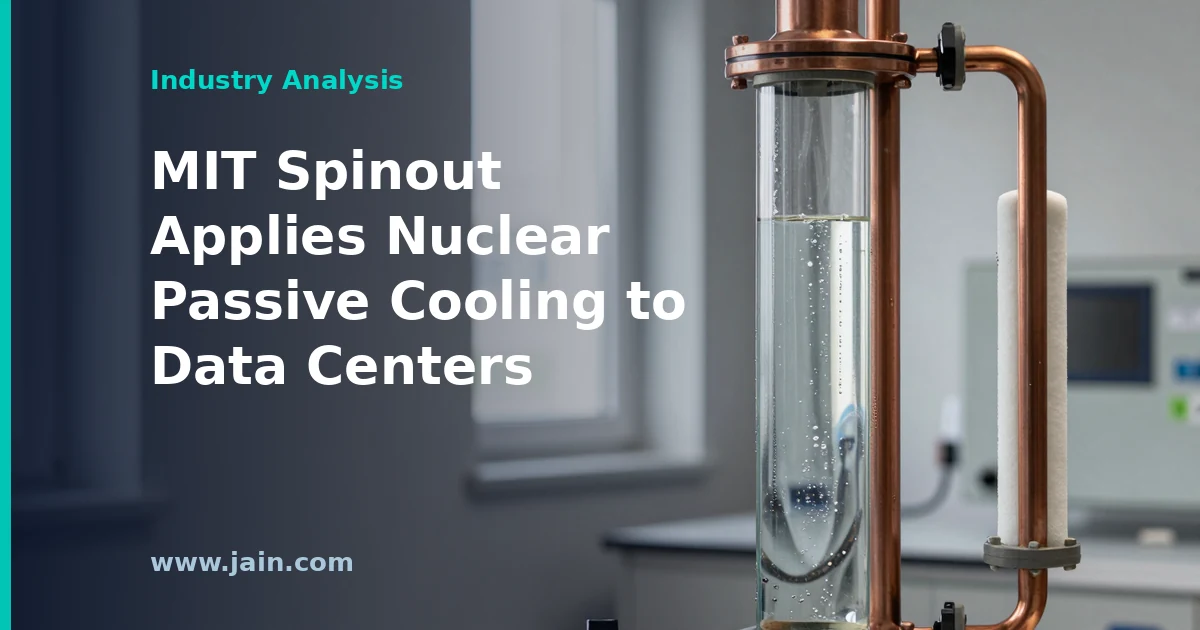
MIT News reported on June 9, 2026, that a startup spun out of the university is commercializing a data-center cooling system inspired by the passive heat-removal designs used in nuclear reactors, with the stated goal of making data centers more sustainable by reducing the energy — and, per the editorial framing, the water — that cooling consumes.
The syndicated release available to us carried the headline and framing but few technical or commercial specifics; we analyze the concept on its merits and flag what remains unsubstantiated below.
Executive Summary
The announcement matters because cooling is one of the largest costs — in electricity, in water, and increasingly in permitting friction — of operating a data center. A system that borrows from nuclear engineering’s passive-safety playbook, where heat is removed by natural physical forces rather than powered machinery, is aimed squarely at that cost. In a reactor, passive cooling means hot fluid rises and cooler fluid sinks, circulating heat away without pumps; the appeal for data centers is the same: fewer energy-hungry moving parts between the hot chip and the outside air.
The timing is not accidental. AI training and inference hardware has pushed per-rack power to levels that conventional air cooling struggles to handle, and communities hosting data centers are scrutinizing water withdrawals from evaporative cooling systems. Any credible technology that reduces both the electric and water bills of heat rejection will get a hearing from operators.
What the source material does not yet establish is whether this particular system works at commercial scale: no performance figures, customer deployments, funding details, or timelines were available in the release we reviewed. The physics pedigree is real; the commercial case is, for now, a thesis.
From Reactor Safety to Server Racks
Nuclear plants pioneered passive cooling for a stark reason: a reactor must shed heat even when the power fails. Designs built on natural circulation exploit the fact that heated fluid becomes less dense and rises while cooled fluid sinks, creating a self-sustaining loop that moves heat with no pumps, no fans, and no operator action. Decades of licensing scrutiny have made these principles among the most carefully validated in thermal engineering.
A data center’s problem is gentler — servers fail safely when they overheat, reactors do not — but structurally similar: concentrated heat that must move continuously to the outdoors. Today that journey is powered at nearly every step, by server fans, chilled-water pumps, compressors, and cooling towers. A passive or semi-passive loop that lets buoyancy or phase change do part of that work attacks the electricity bill directly, and if it rejects heat without evaporating water, it attacks the water bill too. The startup’s bet, as framed by MIT News, is that reactor-grade thermal design can be repackaged at data-center price points.
Why Cooling Is the Data Center’s Second Power Bill
For a typical facility, the electricity that does computing is only part of the meter; a meaningful share of total load goes to moving heat, which is why the industry obsesses over power usage effectiveness (PUE) — the ratio of total facility power to IT power. Every point of cooling overhead removed either cuts operating cost or frees grid capacity for more servers, and grid capacity is currently the scarcest input in the AI buildout.
Water is becoming the second constraint. Many large facilities cool cheaply by evaporating water, and withdrawals have become a flashpoint in drought-prone regions, slowing permits and souring community relations. A technology that credibly reduces both energy and water use would not just trim costs — it would widen the map of places a data center can be built. That is the strategic prize behind this announcement, and it explains why a cooling story from a university lab merits industry attention.
A Crowded Race, and a Conservative Customer
The spinout is not entering an empty field. Direct-to-chip liquid cooling is already shipping at scale from established vendors, immersion cooling has committed adopters, and rear-door heat exchangers are a common retrofit. Most of these still depend on pumped loops and mechanical chillers, so a passive approach is differentiated in principle — but it must prove it can handle the extreme heat density of modern AI racks, where natural circulation alone has historically been hardest to apply.
The harder obstacle may be cultural. Data-center operators are deeply conservative buyers: uptime is the product, and unproven thermal systems are among the last things they will gamble on. The path for a startup here almost always runs through small pilot deployments, published performance data, and partnerships with equipment incumbents or colocation providers willing to host a proving ground. None of those milestones is evidenced in the material released so far, which is normal for a lab-to-market story at this stage — but it defines exactly what to watch for next.
Background
Data-center cooling has been through several generations: raised-floor air cooling, hot/cold aisle containment, evaporative economization, and most recently liquid cooling driven by AI accelerators whose heat output overwhelms air. Each generation traded capital cost against energy and water consumption, and the AI era has sharpened that trade-off — power and water availability now routinely determine where facilities can be built at all.
Nuclear engineering, meanwhile, spent decades perfecting passive heat removal for safety reasons, producing some of the most rigorously validated thermal designs in existence. The MIT spinout profiled here sits at the intersection of those two histories, part of a broader wave of university-born startups applying energy-sector engineering to computing infrastructure.
Google is advocating for industry-wide standards on how data centers measure and disclose their water use, according to a June 4, 2026 report from Axios. The move comes as public and political backlash over data-center water consumption intensifies, driven by the rapid buildout of AI computing capacity in communities that are increasingly asking what these facilities take from local water supplies.
Executive Summary
According to the Axios report, Google — operator of one of the world’s largest data-center fleets — is pushing for water-use standards across the data-center industry at a moment when the sector’s social license to build is under real strain. Water has joined electricity as the most contested resource in data-center siting fights, and operators have historically disclosed water consumption inconsistently, if at all, often citing competitive sensitivity.
The significance is less about any single company’s practices than about the reporting baseline. Today there is no universally applied, apples-to-apples standard for how a data center reports water withdrawal, consumption, and offsetting. If a major hyperscaler — one of the handful of companies operating cloud infrastructure at global scale — succeeds in normalizing common metrics and disclosure, it changes the conversation for every operator, utility, and permitting authority in the market. The available reporting is brief, so the details of what Google is proposing, and to whom, remain to be seen.
Why Water Became the AI Buildout’s Flashpoint
Data centers consume water primarily for cooling: many facilities use evaporative systems, which lower temperatures by evaporating water and are energy-efficient but consumptive — much of that water leaves as vapor rather than returning to the local system. As AI training and inference drive a historic wave of data-center construction, the aggregate water question has moved from sustainability reports to city-council meetings, especially in drought-prone regions where residents and farmers compete for the same supply.
The backlash dynamic is straightforward: communities are asked to approve large industrial facilities, often under non-disclosure agreements during site selection, and then struggle to learn how much water those facilities actually use. That information vacuum breeds distrust regardless of the underlying numbers. In several well-publicized siting disputes, the absence of clear water data has itself become the story.
Transparency as a Strategic Play, Not Just a Virtue
A push for common standards from a company of Google’s scale is best read as both principled and pragmatic. Voluntary, industry-defined standards frequently emerge when an industry senses that mandatory, jurisdiction-by-jurisdiction regulation is the alternative. A single common disclosure framework is far cheaper for a global operator to comply with than fifty different state or municipal reporting regimes — and it lets efficient operators demonstrate that efficiency in a comparable way.
Standardized metrics also reframe the competitive field. Water-use effectiveness (WUE) — a ratio of water consumed to computing energy delivered, analogous to the industry’s PUE metric for energy — only becomes meaningful if everyone measures it the same way. Operators that have invested in air cooling, recycled or non-potable water sources, or closed-loop liquid cooling would benefit from a regime that makes those investments visible. Operators that have relied on cheap potable water in stressed basins would face uncomfortable comparisons. That is how standards shift markets: not by mandate, but by making differences legible.
What It Could Mean for Communities, Utilities, and the Rest of the Industry
For host communities and water utilities, credible standardized disclosure would change permitting conversations from adversarial guesswork into negotiations over real numbers — how much withdrawal, how much consumption, from what source, with what offsets. For colocation providers and smaller operators, an emerging standard cuts both ways: it adds reporting burden, but it also offers a ready-made framework to answer the water question before it derails a project.
The open risk is that voluntary standards become a ceiling rather than a floor — disclosure calibrated to what the largest operators are already comfortable reporting. Fair questions apply in both directions here: critics should ask whether an industry-authored standard will require site-level data in water-stressed basins, and operators can fairly ask whether blanket opposition to data centers engages with actual consumption figures or with worst-case anecdotes. Standards only defuse a backlash if both sides accept the numbers they produce.
Background
Google operates one of the world’s largest fleets of data centers and, alongside the other major cloud providers, is in the midst of an unprecedented expansion to serve AI workloads. The company has positioned itself as a sustainability leader among hyperscalers, publishing water usage data for its operations and pledging in 2021 to replenish more freshwater than it consumes by 2030. The industry as a whole, however, has no universally applied standard for water reporting: metrics, boundaries, and disclosure practices vary widely between operators, and some have historically treated water data as competitively sensitive. That inconsistency has collided with a wave of community opposition to data-center construction — particularly in water-stressed regions of the United States — making water disclosure one of the sector’s most consequential unresolved questions.