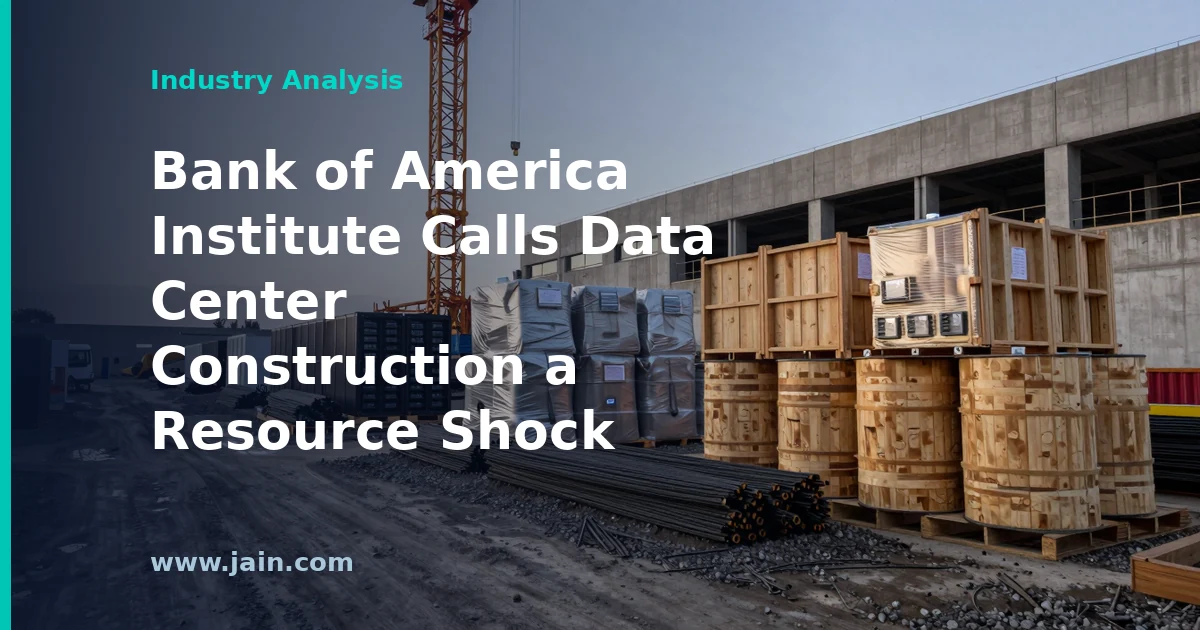
The Bank of America Institute, the research arm of Bank of America that publishes economic analysis drawn from the bank’s data and economists, released a report on June 2, 2026 characterizing the ongoing wave of data center construction as a “resource shock.” The framing points to strain across the three inputs every large-scale digital infrastructure project competes for: skilled construction labor, building materials and electrical equipment, and electric power supply.
Executive Summary
When a major bank’s in-house think tank labels an investment cycle a “resource shock,” it is making an economic claim, not just a descriptive one. A resource shock is a sudden shift in demand for inputs that outruns the supply side’s ability to respond, pushing up prices and lead times for everyone competing for the same resources. Applied to data centers, the term asserts that the AI-driven construction boom is no longer just a story about one industry’s capital spending — it is large enough to move markets for electricians, transformers, generators, concrete, steel, and grid capacity.
That matters because the effects of a resource shock do not stay contained. Other construction sectors — housing, manufacturing plants, public infrastructure — draw on the same labor pools and equipment supply chains. Utilities planning grid investments must now weigh data center load requests against other customers. For an institution with Bank of America’s lending and card-spending visibility into the real economy, elevating this to a formal research theme signals that the strain is showing up in measurable economic data, not just industry anecdote.
Why a Bank Is Sounding This Note
The Bank of America Institute exists to translate the bank’s proprietary vantage point — payments flows, commercial lending, economic research — into public analysis. Its choice of subject is itself informative: research arms of large banks tend to formalize themes their client-facing businesses are already encountering, such as construction lenders seeing bid inflation or corporate clients reporting equipment delays. A “resource shock” framing suggests the institute sees data center demand as a macroeconomic force rather than a niche real-estate story.
It also reflects where the money is going. Data centers have shifted from a specialized corner of commercial real estate to one of the most capital-intensive construction categories in the United States, propelled by hyperscale cloud providers and AI infrastructure buildouts. When a single project can require hundreds of megawatts of power and years of specialized electrical work, a national pipeline of such projects mechanically competes with everything else being built.
The Three Bottlenecks: Labor, Materials, Power
The report’s headline identifies the three constraints practitioners consistently cite. Labor is the most immediate: data centers need unusually high concentrations of electricians, pipefitters, and mechanical trades, and those skills take years to develop. Materials and equipment form the second constraint — long-lead electrical gear such as transformers, switchgear, and backup generators has been the industry’s chronic pain point, with order backlogs measured in years at various points in this cycle.
Power is the deepest constraint because it is the slowest to fix. A data center is ultimately a machine for converting electricity into computation, and connecting large new loads requires generation and transmission investments that operate on utility timescales — often five to ten years for major grid upgrades. This is why power availability, more than land or capital, has become the primary siting criterion for new facilities.
Winners, Losers, and the Cost Question
A resource shock redistributes advantage. Operators with land already secured, grid interconnection agreements signed, and equipment orders placed hold assets that are increasingly difficult to replicate — which supports valuations for incumbent data center platforms. Electrical contractors, equipment manufacturers, and utilities with capacity to sell are on the receiving end of the demand surge. The squeezed parties are those competing for the same inputs without data-center-scale budgets: other construction sectors facing higher trade wages and equipment prices, and potentially ordinary ratepayers if grid upgrade costs are socialized across utility customers rather than assigned to the large loads that drive them.
For enterprises buying colocation or cloud capacity, the practical translation is that scarcity flows through to pricing and lead times. When new supply is gated by labor, equipment, and power, existing capacity commands a premium — a dynamic already visible in historically low vacancy rates across major data center markets. Fair questions run in both directions, though: resource-shock framings can also overstate permanence if demand forecasts prove optimistic or if supply responds faster than expected, as it eventually did in previous infrastructure cycles.
Background
Data centers — the specialized buildings that house the servers behind cloud services, websites, and AI systems — have grown from a niche real-estate category into one of the largest construction stories in the United States. The acceleration began with cloud computing in the 2010s and intensified sharply after 2022, when the generative AI boom pushed hyperscale operators and AI companies into a race for computing capacity, with individual campuses now sized in the hundreds of megawatts. The Bank of America Institute, launched by the bank in 2022 as a public-facing research arm, has made the economic ripple effects of this buildout a recurring subject, and its June 2026 report places the construction surge in macroeconomic terms: as a demand shock hitting labor, materials, and power markets simultaneously.
The Semiconductor Industry Association (SIA) published a report finding that semiconductors account for roughly 95% of the value of an AI data server rack, announced May 31, 2026. The figure is not limited to headline AI accelerators: it encompasses the full stack of chip technologies inside a rack — processors, memory, networking, power management and supporting silicon.
Executive Summary
The SIA — the trade association representing the U.S. semiconductor industry — says that when you total up what an AI server rack is worth, about 95 cents of every dollar is silicon. A rack, the refrigerator-sized cabinet that holds stacked servers in a data center, has traditionally been valued as a mix of metal, boards, drives, cabling and chips. The report’s claim is that in the AI era, nearly everything else has become rounding error.
Why it matters: the finding reframes AI data centers as, economically speaking, chip-delivery vehicles. For operators, investors and policymakers, it concentrates attention — and risk — on the semiconductor supply chain. If 95% of rack value is silicon, then chip pricing, chip availability and chip export policy effectively set the cost curve for the entire AI buildout.
The Rack Is Now a Chassis for Silicon
The most useful part of the SIA’s framing is the phrase “full stack of chip technologies.” Public attention fixates on GPUs — the graphics-derived accelerators that do AI’s heavy math — but an AI rack is dense with other semiconductors: CPUs that orchestrate work, high-bandwidth memory stacked next to the accelerators, networking chips that lash thousands of processors into one machine, and power-management silicon that converts and conditions the enormous electrical loads involved. Counting all of that, a 95% share implies the sheet metal, boards, cabling and mechanical components that once defined “server hardware” now carry almost none of the value.
That inversion matters for anyone modeling AI infrastructure costs. In a conventional enterprise server, silicon was one line item among many. In an AI rack, the SIA’s figure suggests everything else — chassis, rails, fans, distribution — is a thin wrapper. The practical consequence: rack-level cost forecasting is essentially chip-price forecasting.
Concentration of Value Means Concentration of Risk
If nearly all rack value is semiconductors, then the risks that matter are semiconductor risks: fabrication capacity concentrated in a small number of foundries and regions, advanced-memory supply that has repeatedly run tight, and export-control regimes that can reprice or block hardware across borders. A data center operator can second-source steel and switchgear; it cannot easily second-source leading-edge accelerators or the memory bonded to them.
There is also a depreciation angle. Buildings depreciate over decades; chips depreciate on silicon product cycles, which in AI have been running fast. When 95% of a rack’s value sits in the component category with the shortest useful life, the refresh economics of an AI facility look less like real estate and more like a rolling fleet of rapidly aging assets. That affects how lenders, insurers and investors should think about collateral value in AI infrastructure deals.
Read the Messenger Along With the Message
The SIA is a trade association, and it is fair to note that this finding serves its members’ interests: a report showing semiconductors as the overwhelming source of AI value strengthens the industry’s case for policy support, incentives and favorable treatment in trade debates. That does not make the number wrong — the direction of the claim is consistent with what the market can observe, namely that AI systems are priced overwhelmingly by their compute and memory content. But readers should treat the precise 95% as an association-produced estimate until the methodology is examined: what rack configuration was assumed, whose prices were used, and whether “value” means bill-of-materials cost, market price, or something else.
The same scrutiny cuts the other way. Critics of AI-infrastructure spending sometimes describe the buildout as overpriced real estate; a full-stack accounting like this one, if its methodology holds up, is a substantive counterpoint — the money is going into the most technologically dense components, not the shell around them.
Background
The Semiconductor Industry Association has represented U.S. chipmakers since the industry’s early decades and regularly publishes data on semiconductor sales, manufacturing and policy. Its research gained a wider audience as governments moved to subsidize domestic chip manufacturing and as AI demand made semiconductor supply a mainstream economic concern.
The report lands amid a historic buildout of AI data centers, in which hyperscalers and specialized operators are deploying racks of accelerator-dense servers at unprecedented scale. Understanding where the money in that buildout actually goes — construction, power equipment, or chips — has become a live question for investors, utilities and policymakers alike.
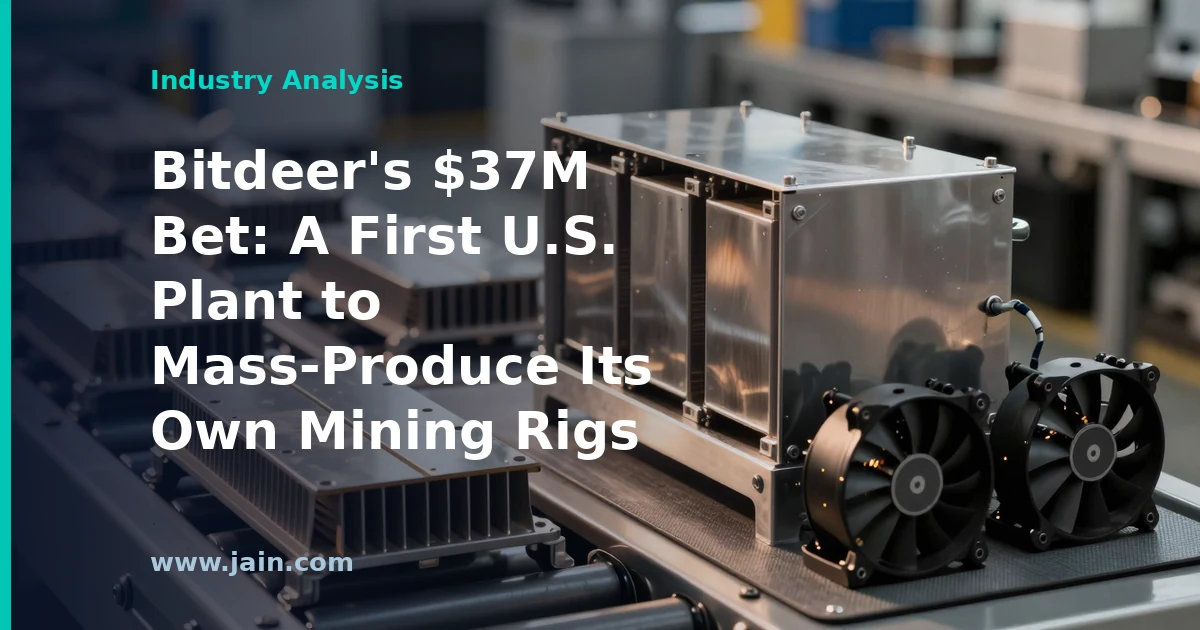
Bitdeer Technologies Group, the Nasdaq-listed bitcoin miner and mining-hardware developer, announced on May 26, 2026 that it will invest approximately $37 million to establish its first manufacturing facility in the United States, dedicated to mass-producing its own proprietary mining machines. The company’s shares rose about 14% on the news.
Executive Summary
The announcement marks a notable step in a trend the mining industry has discussed for years but rarely executed: moving hardware production onto U.S. soil. Bitcoin mining machines — specialized computers built around custom ASIC chips (application-specific integrated circuits designed to do one task, in this case bitcoin’s hashing algorithm, extremely efficiently) — have historically been designed and assembled in China and Southeast Asia. A U.S. plant puts final production of Bitdeer’s rigs inside the same borders as the large American mining fleets that deploy them.
For Bitdeer, which both operates its own mining data centers and develops its SEALMINER line of rigs, the move deepens a vertical-integration strategy: controlling the machine, not just the megawatts. The 14% share-price jump suggests investors read it as strategically meaningful, though at roughly $37 million the commitment is modest by manufacturing standards — a scale worth keeping in perspective when weighing the announcement.
Onshoring the Rig Supply Chain
The economics of bitcoin mining are dominated by two inputs: electricity and machines. U.S. miners have long controlled the first — cheap domestic power — while depending almost entirely on overseas suppliers for the second. That dependence became expensive and unpredictable as U.S. tariff policy toward Chinese-linked electronics hardened, and as shipping, customs, and export-control friction added cost and lead time to every container of rigs. A domestic production line is a direct hedge: machines assembled in the U.S. can reach U.S. deployment sites without crossing the tariff and logistics gauntlet.
It also carries an industrial-policy resonance. Reshoring advanced electronics assembly aligns with the broader U.S. push to localize technology supply chains, which can translate into goodwill with regulators and utilities — intangible but real assets for a company whose core business depends on grid access and permitting.
What $37 Million Buys — and What It Doesn’t
It is worth being precise about scale. Roughly $37 million funds a serious assembly, integration, and testing operation; it does not fund semiconductor fabrication, which requires capital measured in billions. The ASIC chips at the heart of any mining rig will still come from offshore foundries, as they do for the entire industry. What moves onshore is the downstream work: board assembly, enclosures, hashboard integration, quality testing, and logistics. That is genuinely valuable — it shortens delivery times, reduces tariff exposure on finished goods, and improves repair turnaround — but the deepest layer of the supply chain remains abroad.
The headline framing of “mass-producing proprietary machines” is therefore best read as a supply-chain restructuring, not full technological self-sufficiency. Investors and buyers should watch for disclosed production capacity figures to judge how much of Bitdeer’s fleet demand the plant can actually serve.
Vertical Integration as Competitive Strategy
Most large mining operators buy rigs from third-party giants — a market long led by China-linked manufacturers Bitmain and MicroBT. Bitdeer, whose founder previously co-founded Bitmain, is one of the few operators attempting the harder path: designing its own chips and machines while also running the data centers that consume them. If it works, the payoff is structural — capturing the manufacturer’s margin, tuning hardware to its own facilities, and insulating itself from the allocation queues and pricing power of dominant suppliers.
The risk is equally structural. Hardware development is capital-hungry and unforgiving; a rig generation that lags competitors on efficiency (measured in joules per terahash — how much energy it takes to produce a unit of computing work) can strand the investment. A U.S. factory raises the fixed-cost base, which cuts both ways: leverage if demand holds, drag if the bitcoin cycle turns.
Why the Market Cheered
A 14% single-day move on a $37 million investment says the market is pricing the signal, not the sum. The plausible reading: investors see the plant as evidence that Bitdeer’s hardware business is graduating from R&D project to commercial product line, and that the company is positioning for a world where U.S.-made mining and compute hardware commands a premium. It may also reflect optimism that manufacturing capability is transferable — companies with rig-assembly lines and power-rich data centers have optionality toward adjacent high-performance-computing and AI-infrastructure work. That optionality, however, is inference, not commitment; the announcement itself concerns mining machines.
Background
Bitdeer was spun off from Bitmain — the world’s dominant maker of bitcoin mining hardware — and listed on Nasdaq in 2023. Unlike most mining operators, which are pure consumers of third-party machines, Bitdeer runs mining data centers across multiple countries while also developing its own SEALMINER line of rigs, a vertical-integration strategy few in the industry have attempted.
The move lands amid a broader realignment of technology supply chains: U.S. tariff policy and export-control friction have made imported electronics costlier and less predictable, pushing companies across the compute-hardware spectrum to localize final assembly. Mining hardware, long an almost entirely Asia-manufactured category, has been among the most exposed.
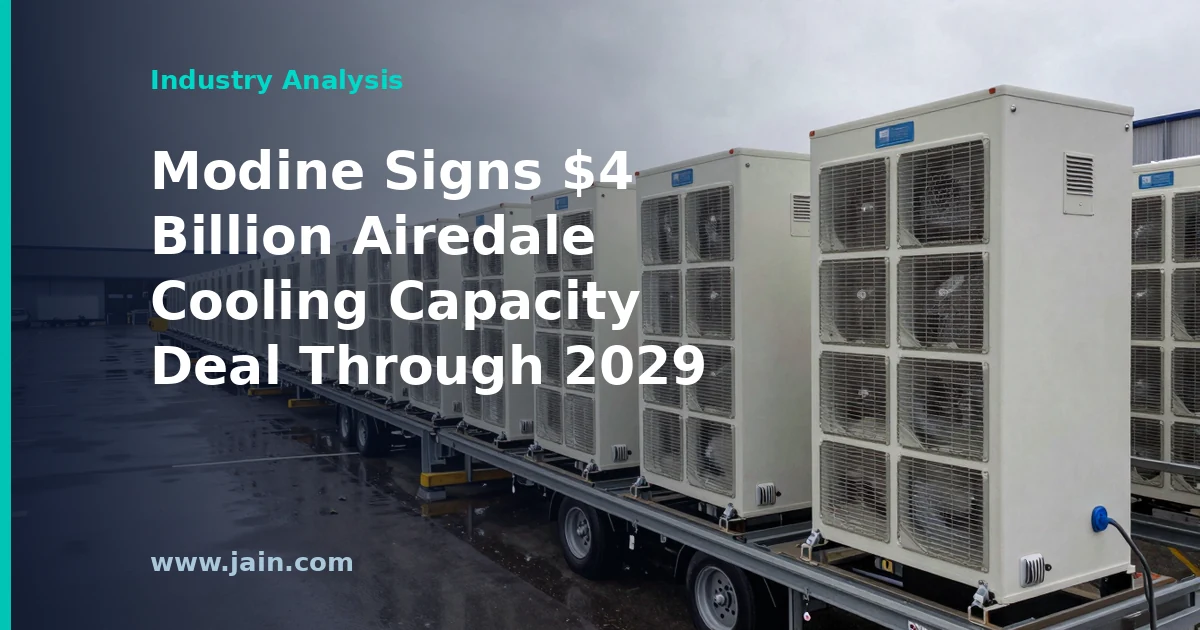
Modine Manufacturing announced a long-term capacity agreement valued at $4 billion, running through 2029, with an unnamed strategic data-center customer for its Airedale by Modine cooling solutions. The announcement was made May 26, 2026 via PR Newswire, which Modine itself characterized as a landmark deal.
Executive Summary
Modine, the Wisconsin-based thermal-management company behind the Airedale precision-cooling brand, says it has secured a long-term capacity agreement worth $4 billion through 2029 with a single strategic data-center customer. “Capacity agreement” is the operative phrase: rather than a conventional purchase order for a defined set of equipment, the customer is effectively reserving a share of Modine’s future manufacturing output for years in advance.
That structure matters more than the headline number alone. Reserving cooling capacity years ahead is the kind of behavior the industry previously reserved for scarce inputs like advanced chips, transformers, and grid interconnection. If cooling equipment now warrants the same treatment, it confirms that thermal management — the systems that remove the enormous heat generated by dense AI computing — has moved from a routine line item to a strategic bottleneck in data-center construction.
Cooling Joins the Reservation Economy
AI data centers concentrate far more electrical power — and therefore heat — into each rack than traditional facilities, and every watt that goes in must be removed as heat. That has strained the supply chains for chillers, computer-room air handlers, coolant-distribution units, and related gear, with lead times for major thermal equipment stretching well beyond what developers were accustomed to. In that environment, a developer that cannot lock in cooling deliveries risks having a building, power, and chips ready with no way to keep the hardware from overheating.
A multi-year capacity agreement is the rational response: the customer trades flexibility for certainty of supply, and the manufacturer trades some future pricing freedom for guaranteed volume. The fact that a single data-center customer is willing to commit at a reported $4 billion scale through 2029 is itself a market signal — it implies that the buyer expects its own construction pipeline to remain heavy for years and considers cooling supply a risk worth paying to retire early.
What Locked-In Volume Does for a Manufacturer
For Modine, the appeal of an agreement like this is visibility. Industrial manufacturers typically expand factories cautiously because demand can evaporate faster than a new production line pays for itself. A multi-year committed customer changes that calculus, giving management cover to invest in capacity, hire, and negotiate with its own component suppliers from a position of predictable demand.
The mirror image is concentration risk. A deal this size with one customer ties a meaningful share of the Airedale business to that customer’s continued buildout. If the buyer’s AI capacity plans slow — or if the agreement contains generous rescheduling or exit provisions, which the announcement does not describe — the guaranteed volume may prove softer than the headline suggests. How much of the $4 billion is firmly committed versus a framework ceiling is the single most important unknown, and it is one investors in similar announcements across the industry have learned to probe.
A Data Point in the AI Infrastructure Debate
Announcements like this land in the middle of a live argument about whether AI infrastructure spending is durable or overheated. Skeptics note that multi-year, multi-billion-dollar commitments amplify the damage if demand disappoints; proponents answer that customers do not reserve factory capacity for years unless their own order books justify it. Both readings can be tested against the same evidence: the disclosed terms.
Here, the disclosure is limited — a value, an end date, and an unnamed customer. That is not unusual for supply agreements, where customers often insist on anonymity, but it means outside observers cannot yet verify the deal’s firmness, product mix, or margin profile. The reasonable conclusion is narrower but still significant: at least one major data-center operator judged cooling supply scarce enough, for long enough, to warrant contracting for it the way the industry contracts for chips and power.
Background
Modine Manufacturing, founded in 1916 in Racine, Wisconsin, built its business on heat-transfer technology — radiators, heat exchangers, and HVAC equipment. Its Airedale brand, rooted in UK-based Airedale International Air Conditioning, specializes in precision cooling for critical facilities, and Modine has repositioned the company in recent years around data-center thermal management as its principal growth engine.
That repositioning coincided with the AI construction boom, which transformed cooling from a routine building system into a supply-constrained input. Data-center operators now contend with multi-year lead times across power and thermal equipment, prompting the kind of long-term capacity reservations that this agreement exemplifies.
Reuters reported on May 24, 2026 that Schneider Electric — the French energy-management and industrial-automation group — says its data center business in India is now growing faster than its core business, propelled by the country’s AI-driven data center buildout. The comment positions India as one of the standout markets in a global surge of demand for the electrical equipment that powers AI computing.
Executive Summary
The substance of the report is a growth signal, not a contract or a capacity announcement: Schneider Electric, one of the world’s largest suppliers of the switchgear, uninterruptible power supplies (UPS — the battery-backed systems that keep servers running through grid disturbances), and power-distribution equipment that data centers depend on, says demand from India’s data center sector is expanding faster than the rest of its business there.
That matters for two reasons. First, it is a read on where the AI infrastructure wave is spreading: hyperscale-style demand is no longer confined to the United States and a handful of established hubs. Second, it comes from the supply side. Data center operators announce ambitions; equipment vendors see purchase orders. When a major electrical supplier says one segment is outgrowing everything else it does in a market, that is a comparatively hard signal that capital is actually being spent.
The caveat is proportionality: “outpacing core growth” describes a rate, not a size, and the report as available does not quantify either. A fast-growing segment can still be a small one.
The AI Boom Is Really an Electrical Equipment Boom
Every AI data center is, underneath the servers, an electrical engineering project. Racks of AI accelerators draw several times the power of conventional servers, and that power has to be received from the grid, transformed, distributed, conditioned, and backed up — all with equipment from a fairly short list of global vendors, of which Schneider Electric is one of the largest alongside the likes of ABB, Siemens, Eaton, and Vertiv. This is why the AI cycle has been felt so strongly by electrical suppliers: compute demand converts almost directly into orders for switchgear, transformers, UPS systems, busway, and cooling infrastructure.
Schneider’s India comment extends a pattern the industry has watched for two years in the US and Europe: the constraint on AI capacity is increasingly power delivery, not chips alone. When equipment vendors describe data centers as their fastest-growing segment in a new geography, it signals that the buildout — and potentially the associated equipment lead-time pressure — is going global.
Why India Is the Market to Watch
India combines several ingredients that data center investors look for: a very large and growing base of internet users, data-localization rules that encourage storing Indian data in-country, comparatively low construction costs, and government interest in domestic AI capability. Global cloud providers and regional operators have all announced Indian expansion in recent years, concentrated around hubs such as Mumbai, Chennai, and Hyderabad.
For an equipment vendor, India offers something else: Schneider Electric has a long-established manufacturing and commercial presence there, so local data center demand can be served substantially from local operations. If AI-driven orders are now growing faster than the company’s traditional Indian business — which spans buildings, industry, and grid infrastructure — it suggests the data center segment is becoming a structural growth pillar rather than a side market.
Supply-Side Signals Deserve Attention — and Context
It is worth being precise about what this report does and does not establish. A vendor saying a segment is “outpacing core growth” is a directional claim about relative growth rates. As reported, it does not disclose the segment’s revenue, its share of Schneider’s India business, order backlog, or a forecast horizon. Growth from a small base can outpace a large core for years without changing the overall business mix, so the claim is credible but not yet quantified in the material available.
It is also a statement any vendor has an interest in making during an AI investment cycle: data center exposure is currently rewarded by investors. That does not make the claim wrong — Schneider’s global results through this cycle have consistently shown genuine data center strength — but buyers and investors should look for the numbers behind the narrative when the company next reports segment detail. For data center operators, the practical takeaway is less about Schneider specifically and more about the market it describes: if India’s buildout is accelerating, competition for equipment, grid connections, and skilled electrical contractors in that market will accelerate with it.
Background
Schneider Electric traces its roots to 1836 in France and has evolved from heavy industry into a global leader in energy management and automation. Its data center relevance deepened with the 2007 acquisition of APC, a leading UPS maker, and the company now supplies integrated power, cooling, and management systems to hyperscale and colocation operators worldwide. Throughout the current AI investment cycle, data centers have been among the strongest demand drivers across the electrical equipment industry.
India’s data center market has expanded rapidly since the country’s 2020s push on data localization and digital infrastructure, attracting investment from global cloud providers and domestic operators alike. The AI wave has added a second demand layer on top of that cloud-driven growth, with power availability widely viewed as the buildout’s key constraint.
Axios reported on May 21, 2026 that Chinese-made components and materials are quietly flowing into the United States data-center construction boom, even as Washington tightens export controls on advanced chips headed the other direction. The piece frames the dependency as a geopolitical risk for the AI infrastructure now being stood up at record pace.
Executive Summary
The Axios story argues that America’s data-center surge — the physical backbone of the current AI wave — leans on a supply chain in which Chinese firms still play a meaningful, if under-discussed, role. That includes hardware, electrical gear, and construction inputs sourced directly or through intermediaries.
The reason it matters is straightforward: policymakers have spent two years hardening the outbound side of the US–China technology relationship, restricting what advanced silicon and tools American companies can sell to Chinese buyers. The inbound side of the same relationship — what the US buys to build the facilities that host AI — has drawn far less scrutiny, and the article suggests that gap is now visible in the numbers.
The Buildout Nobody Fully Sourced
Hyperscale data-center construction is a bill of materials problem as much as a real-estate problem. A single campus consumes transformers, switchgear, busways, generators, cabling, cooling coils, racks, and structural steel in volumes that already exceed what Western manufacturers can supply on the timelines operators want. When Tier-1 vendors are booked out, buyers turn to whoever can ship — and Chinese factories remain the marginal supplier for a long list of electrical and mechanical components. The Axios framing is that this quiet substitution is bigger than the industry publicly acknowledges.
None of that is inherently a scandal; global sourcing is how infrastructure gets built. It becomes a policy question when the same components sit inside facilities that host frontier AI training runs, defense workloads, or critical services, and when the exporting country is also the strategic competitor the export-control regime is designed around.
Asymmetric Controls, Symmetric Exposure
US policy since 2022 has focused almost entirely on the outbound flow: chips, chip-making equipment, and increasingly the model weights and cloud capacity that could be used to train frontier AI abroad. The inbound flow — grid-scale transformers, power distribution units, network gear, cooling hardware — has been governed by a patchwork of tariffs, Section 232 reviews, and Buy American rules that were not designed with AI infrastructure in mind.
If the Axios reporting holds, the practical implication is that America’s ability to build AI capacity is partly gated by a country it is simultaneously trying to slow down in AI. That is a fragile equilibrium: a future round of tariffs or export restrictions from either side could stretch already long lead times for the exact components operators need most.
Who Gains, Who Gets Squeezed
Western manufacturers of transformers, switchgear, and cooling equipment stand to benefit if buyers and regulators push harder on country-of-origin — but only if they can add capacity, which takes years and skilled labor that is itself in short supply. Hyperscalers with the balance sheets to pre-buy multi-year allocations from domestic and allied suppliers are best positioned; smaller colocation operators and enterprise builders, who buy in smaller lots and later in the cycle, would feel any supply squeeze first.
For AI customers, the second-order effect is schedule risk. A data-center delivery pushed from Q2 to Q4 because a Chinese-sourced transformer was reclassified or a substitute part is on allocation translates directly into delayed GPU deployments and delayed model training. In an environment where compute is the binding constraint on product roadmaps, that is a real cost.
Reading the Claim Carefully
The Axios piece is a framing article, not a forensic supply-chain audit, and the responsible read is to hold both possibilities open. It is plausible that Chinese content in US data-center construction is material and under-reported, given how opaque multi-tier supply chains are. It is also fair to ask how much of the reported exposure is finished Chinese-branded equipment versus subcomponents inside Western-branded gear, and how much is displaceable at reasonable cost versus genuinely single-sourced. Those distinctions determine whether this is a policy problem, a procurement problem, or a headline.
Background
The US data-center industry is in the middle of the largest capacity expansion in its history, driven by generative AI training and inference demand from hyperscalers and a new tier of AI-native operators. That expansion has already collided with constraints on grid interconnection, transformer supply, water, and permitting.
In parallel, the US and China have spent the past several years decoupling on advanced semiconductors, with successive rounds of US export controls on chips and chip-making tools and Chinese retaliation on critical minerals. The Axios story sits at the intersection of those two trends, arguing that the physical layer of the AI economy is still more entangled with China than the policy conversation has acknowledged.
Dow, one of the world’s largest materials science companies, has launched a liquid cooling support network for data centres, according to a report published by Data Centre Magazine on 18 May 2026. The reported launch positions Dow — a supplier of silicones, fluids, and specialty chemistries — as an organized participant in the fast-growing market for cooling the dense computing racks that power artificial intelligence.
Executive Summary
The announcement, as reported, is simple in outline: Dow is standing up a formal support network around liquid cooling for data centres. Support or partner networks in the materials world typically bundle products with validation, compatibility guidance, and access to a vetted ecosystem of collaborators — though the source report does not detail which of these Dow’s network includes.
Why it matters is larger than the announcement itself. Liquid cooling — circulating fluid to chips or immersing hardware in it, instead of relying on air — has moved from niche to necessity as AI servers pack more power into each rack than air can practically remove. When a company of Dow’s scale builds formal structure around that market, it signals that liquid cooling is graduating from a collection of point products into an industrial supply chain, with the materials layer — coolants, silicones, seals, thermal interfaces — treated as critical infrastructure rather than a commodity input.
Why a Chemicals Giant Is Organizing Around Server Cooling
Air cooling has a physics problem. Modern AI accelerators concentrate so much power in each rack that moving enough air through them becomes impractical, which is why the industry has shifted toward direct-to-chip liquid cooling (piping coolant across a cold plate mounted on the processor) and, in some deployments, immersion cooling (submerging entire servers in a non-conductive fluid). Every one of those approaches depends on chemistry: the coolant itself, plus the hoses, seals, gaskets, and thermal interface materials that keep fluid where it belongs for years at a time.
That is Dow’s home turf. Materials suppliers have historically sold into this market indirectly, through the vendors that build cooling hardware. A formal support network — if it follows the usual shape of such programs — moves the materials maker closer to the operators and equipment builders who actually deploy the technology, which matters because coolant compatibility failures (degraded tubing, fouled cold plates, additive breakdown) are among liquid cooling’s most feared operational risks.
Formalizing the Supply Chain Is the Real Story
The editorial significance here is less any single product and more the institutional signal. Liquid cooling’s early years were characterized by fragmented suppliers, proprietary fluids, and limited interoperability guidance. Buyers — hyperscale cloud providers, colocation operators, enterprises — have been pushing for validated, multi-vendor supply chains before committing facilities designed to run for decades. Ecosystem programs are how industrial suppliers answer that demand: they convert one-off product sales into standing relationships with documented compatibility.
Dow is not moving into an empty field. Fluid and chemistry players including Chemours, Shell, and Castrol have courted the data centre cooling market, while 3M’s announced exit from PFAS manufacturing by the end of 2025 removed a prominent supplier of certain engineered fluids and sharpened questions about fluid chemistry choices across the industry. Against that backdrop, a structured support offering from a major materials company is a bid for trust as much as for revenue: operators want assurance that the fluid in their loops will be supported, supplied, and compliant for the life of the facility.
What Buyers Should Watch For
For data centre operators and cooling equipment makers, the practical questions are concrete. Does the network provide compatibility validation across pumps, cold plates, and piping from multiple hardware vendors? Does it address regulatory exposure — notably the tightening scrutiny of per- and polyfluoroalkyl substances (PFAS) that affects some classes of engineered cooling fluids? And does it shorten the qualification cycle, which today can add months to a liquid cooling deployment?
The source report does not answer these questions, and it would be premature to credit the network with capabilities it has not publicly detailed. What can be said fairly is that the direction of travel — materials incumbents building formal, supported ecosystems around data centre liquid cooling — is exactly what a maturing market looks like, and buyers benefit when more credible suppliers compete to underwrite reliability.
Background
Dow traces its roots to 1897 and today ranks among the world’s largest materials science companies, supplying silicones, fluids, and specialty chemistries across dozens of industries. Its materials have long appeared inside electronics and thermal management applications, though typically sold through intermediaries rather than under a data centre-branded program.
The data centre cooling market has been reshaped by the AI build-out: rack power densities have climbed beyond what air cooling comfortably handles, pushing direct-to-chip and immersion cooling from experimental to mainstream. That shift has drawn fluid and chemistry suppliers — and their partner ecosystems — into a market once dominated by mechanical and HVAC vendors.
Reuters reported on May 17, 2026 that the ongoing rush to build data centers — driven above all by AI computing demand — is worsening shortages of power equipment and of the skilled workers needed to build and connect electrical infrastructure. The report frames the industry’s constraint as no longer just the availability of electricity itself, but the transformers, switchgear, and trained grid workforce required to deliver it.
Executive Summary
The headline finding is a shift in where the AI infrastructure bottleneck sits. For the past several years, the dominant question in data center development has been access to megawatts — whether utilities can supply enough electricity to power ever-larger campuses. Reuters’ reporting points to a second-order problem: even where power generation exists on paper, the physical equipment that moves electricity (transformers, switchgear, high-voltage cable) and the people qualified to install and energize it (electricians, linemen, substation engineers) are in increasingly short supply, and data center demand is making both shortages worse.
This matters because equipment and labor constraints behave differently from generation constraints. A power plant shortfall is a capacity planning problem that utilities and regulators can see coming years ahead. Equipment lead times and workforce gaps are supply chain and demographic problems — they compound quietly, hit every project in the queue at once, and cannot be solved quickly by spending more money, because factories and apprenticeship pipelines take years to expand. For anyone planning, financing, or buying data center capacity, the practical effect is the same: schedules stretch, and the projects that secured equipment and crews early hold a widening advantage.
The Bottleneck Has Moved Down the Stack
Data center development has always been a race through sequential constraints: land, then fiber, then power, and now the electrical hardware and hands that turn a power allocation into an energized facility. A utility commitment to deliver megawatts is only the first step — that electricity still has to pass through high-voltage transformers, substations, and switchgear before a single server boots. Reuters’ framing suggests the industry has cleared enough of the megawatt question, at least in some markets, to expose the layer beneath it.
This is a meaningful change in how projects fail or slip. A site with signed power agreements can still sit idle waiting for a transformer delivery or a qualified crew to commission a substation. Because these inputs are procured late in a project’s life but have long lead times, the mismatch tends to surface after significant capital is already committed — the most expensive place in a project to discover a delay.
Why Equipment Shortages Are Hard to Fix Quickly
Large power transformers and switchgear are not commodity products. They are engineered-to-order equipment built in a limited number of factories worldwide, with specialized inputs like electrical steel and, critically, their own skilled manufacturing workforces. When demand surges — from data centers, but also from grid modernization, electrification, and renewable interconnection all competing for the same order books — manufacturers cannot simply add shifts. Expanding capacity means new plants and new trained workers, both multi-year undertakings.
The result is a queue that rewards incumbency and scale. Hyperscale operators and large utilities can place framework orders years ahead and absorb price increases; smaller developers and municipal utilities wait longer and pay more. If the Reuters reporting is right that data center demand is actively worsening the shortage, the competitive gap between well-capitalized builders and everyone else — including utilities buying replacement equipment for ordinary grid maintenance — likely widens before it narrows.
The Workforce Problem Is Demographic, Not Cyclical
The second shortage Reuters identifies — grid workers — is in some ways the harder one. Electricians, linemen, and substation technicians are trained through apprenticeships that take years, and the utility workforce in the United States has been aging toward retirement for over a decade. A demand spike from data center construction lands on a labor pool that was already thinning for structural reasons.
Unlike equipment, labor cannot be stockpiled or ordered ahead. Builders can and do bid up wages to pull crews toward their projects, but that reallocates a fixed pool rather than growing it — and it raises costs for utilities and other construction sectors drawing on the same trades. The durable fixes are training pipelines, union apprenticeship expansion, and making grid trades attractive careers, none of which pays off inside a single project’s timeline. For the industry, that means workforce constraints should be treated as a persistent planning input, not a temporary tightness that clears next quarter.
What It Means for Buyers, Builders, and the Grid
For enterprises and AI companies buying capacity, the practical takeaway is that delivery dates carry more risk than headline megawatt figures. A provider’s real differentiator is increasingly its position in equipment queues and its access to qualified construction and commissioning labor — questions worth asking directly during procurement. Operators with existing powered shells, spare substation capacity, or long-standing utility and contractor relationships can deliver on timelines that new entrants cannot match.
For the broader grid, there is a fairness dimension regulators will have to manage: data centers competing for scarce transformers and crews are competing, in part, with the routine reliability work utilities perform for everyone else. How that tension is priced and prioritized — who pays for grid upgrades, whose projects move first — is becoming one of the central policy questions of the AI buildout. It deserves scrutiny from both directions: utilities and communities are right to ask whether data center growth is crowding out other needs, and developers are right to note that their demand is also financing grid investment that would otherwise struggle for funding.
Background
Data centers are the industrial facilities that house computing hardware, and the surge in AI workloads since 2023 has pushed their power requirements from tens of megawatts per site toward campus-scale demands that rival heavy industry. That growth first collided with electricity generation and transmission capacity, making utility power agreements a gating factor for new projects. The electrical supply chain behind those agreements — transformer manufacturing, switchgear production, and the skilled-trades workforce that installs them — was already strained before the AI boom by aging grid infrastructure, electrification, and renewable energy buildouts. Reuters’ May 2026 reporting captures the point where data center demand and those pre-existing strains visibly compound.
Industry reporting published May 15, 2026 by Tom’s Hardware says AI data centers require roughly 36 times more optical fiber than facilities designed around standard servers, and that severe shortages of the specialty glass used to make fiber have pushed cable lead times out to as much as a full year.
Executive Summary
The headline claim is stark: an AI-optimized data center consumes on the order of 36 times the fiber optic cabling of a conventional server hall, according to the report. That multiplier reflects how modern GPU clusters are built — thousands of accelerators wired to each other through dense optical network fabrics, rather than rows of independent servers that mostly talk to the outside world.
The second half of the story is the supply chain’s response. Optical fiber begins as ultra-pure glass, and the report says shortages of that glass are now severe enough that cable orders can take a year to fill. If accurate, that puts fiber alongside GPUs, power equipment, and cooling gear on the list of long-lead items that determine when an AI facility can actually come online — a bottleneck that gets far less attention than chips or megawatts, but can stall a build just as effectively.
Why AI Clusters Devour Fiber
In a traditional data center, most traffic is “north-south”: requests come in from the internet, a server answers, and the response goes back out. AI training clusters invert that pattern. Training a large model requires thousands of GPUs to exchange intermediate results with each other constantly — so-called “east-west” traffic — over network fabrics where every accelerator may need a high-bandwidth path to many others.
Those paths run over optical transceivers and fiber because copper cabling cannot carry the required bandwidth beyond a few meters. Multiply high port counts per GPU by tens of thousands of GPUs, add multiple network planes (compute fabric, storage, management), and the cabling bill grows geometrically rather than linearly. A 36x multiplier versus a standard-server design is a dramatic figure, but the architectural logic behind heavy fiber consumption in AI facilities is well established, even though the report does not detail how that specific number was derived.
A Supply Chain Built for a Different Era
Optical fiber is drawn from glass preforms — cylinders of extremely pure silica manufactured in specialized, capital-intensive plants. That production base was scaled for telecom demand: long-haul networks, broadband buildouts, and steady data center growth. It was not sized for a scenario in which single campuses consume fiber volumes previously associated with regional networks.
Capacity of this kind does not flex quickly. New preform and draw capacity takes significant time and investment to bring online, and manufacturers burned by past boom-bust cycles in fiber tend to expand cautiously. That is how demand shocks turn into year-long lead times: the report’s claim of severe glass shortages is consistent with a supply base that responds in years while demand is compounding in quarters, though the report itself does not identify which producers are constrained or how long the shortfall may last.
Another Hidden Gate on the AI Buildout
The AI infrastructure race has repeatedly been slowed less by capital than by unglamorous physical inputs: grid interconnections, transformers, generators, chillers — and now, potentially, cabling. A data center with power, cooling, and GPUs on the floor still cannot train models if the fabric connecting those GPUs is stuck in an order backlog. For builders, that makes fiber a schedule-critical procurement item to be locked in early, not a finishing detail ordered late in construction.
If lead times hold at a year, the likely effects are familiar from other constrained components: large buyers with forecasting muscle and framework agreements absorb available supply, smaller operators and enterprises face longer waits or higher prices, and fiber and cable manufacturers gain pricing power and a rationale for capacity expansion. The caveat is that this is a single report; buyers should verify current lead times with their own suppliers rather than treating the year figure as universal.
Background
Optical fiber has been the workhorse of global connectivity since the 1980s, and the industry has weathered demand cycles before — most notably the telecom boom and bust of the early 2000s, which left manufacturers wary of overbuilding capacity. Inside data centers, fiber’s role grew steadily as network speeds passed the limits of copper, but conventional facilities still used it relatively sparingly.
The generative AI buildout that accelerated from 2023 onward changed the equation. Training clusters grew from hundreds to tens of thousands of GPUs, each demanding multiple high-bandwidth optical connections, while hyperscalers and specialist operators announced multi-gigawatt campuses worldwide. That put unprecedented demand on every physical input to a data center — power equipment, cooling, chips, and, as this report highlights, the glass and cable that tie the machines together.
The Center for Strategic and International Studies (CSIS), a Washington policy think tank, published an analysis titled The Impact of Tariffs on the AI Data Center Buildout: Balancing Supply Chain Security and AI Infrastructure Leadership. The piece frames tariffs as a policy lever that simultaneously shapes national supply chain security and the pace at which the United States can build out AI computing capacity.
The item surfaced on May 14, 2026 via Google News; the underlying CSIS piece is a policy commentary rather than a corporate announcement, and the summary text available in the feed is limited to the headline framing.
Executive Summary
CSIS is putting a name on a tension operators have been living with for the last two years: every dollar of import duty on transformers, switchgear, servers, optics, or steel lands somewhere in the AI buildout stack, and the industry cannot simply absorb it without slipping schedules or raising the price of compute. The think tank frames the debate as balancing supply chain security — reducing dependence on adversary-linked components — against AI infrastructure leadership, which depends on cheap, fast, at-scale construction.
For data center operators, hyperscalers, and their financiers, the analysis matters less for any single recommendation than for how it reframes tariffs as an input cost in AI economics rather than a purely trade-policy story. That reframing is where the interesting business questions start: who pays, who reshores, and whose megawatt timeline slips.
Tariffs Become an AI Infrastructure Input Cost
An AI data center is, in bill-of-materials terms, a stack of tariff-exposed goods: grain-oriented electrical steel for transformers, medium-voltage switchgear, generators, chillers, structural steel, copper busway, fiber optics, and the GPU-laden servers themselves. When tariffs move, they move all of those line items unevenly, and the cost does not stay with the importer — it flows into the price per kilowatt of built capacity and, ultimately, into the price of AI inference and training. CSIS’s contribution is to name that pass-through explicitly, treating tariff policy as industrial policy for compute.
The economics are unforgiving because AI campuses are being sized in gigawatts rather than megawatts. A ten-percent adjustment on a niche component can add tens of millions of dollars to a single site and, more importantly, add months to a schedule if a domestic substitute does not yet exist at the volumes required.
Supply Chain Security Versus Time-to-Power
The security case for tariffs is straightforward: reduce dependence on suppliers in jurisdictions whose interests may diverge from the buyer’s, and rebuild domestic capacity in categories — transformers most visibly — where lead times have already blown out to multiple years. The leadership case cuts the other way: the country that stands up usable AI capacity fastest gets the workloads, the talent, and the downstream services revenue. Tariffs that protect a future domestic supplier can, in the interim, slow the very buildout they are meant to secure.
Operators have limited tools to navigate that gap. They can pre-buy long-lead equipment, sign multi-year framework agreements, qualify additional vendors, or shift build sequencing so that tariff-heavy components sit on the critical path as briefly as possible. None of these are free, and all of them favor the largest balance sheets.
Winners, Losers, and Who Actually Pays
In a tariff-heavy regime, the clearest winners are domestic manufacturers of the constrained categories — transformer makers, switchgear producers, and any server integrator with a qualified US assembly footprint. Hyperscalers with the cash and forecasting horizon to lock in supply years ahead are relative winners too, because scarcity favors those who ordered first. The clearest losers are smaller colocation operators and enterprise buyers who arrive later in the queue and pay both the tariff-inflated price and the scarcity premium on top.
The subtler question is whether tariffs accelerate domestic capacity enough, and fast enough, to matter. Factory build-outs for heavy electrical gear are themselves multi-year projects; a tariff imposed today does not deliver a domestic transformer tomorrow. If demand-side AI growth outruns supply-side reshoring, the net effect is higher costs without the intended security dividend.
Background
The US AI data center buildout has moved from a specialist infrastructure story to a macroeconomic one over the past two years, with hyperscalers and specialty developers committing to gigawatt-scale campuses and long-lead procurement of power equipment. At the same time, US trade policy has expanded the use of tariffs across categories relevant to that buildout, from steel and electrical equipment to semiconductors and finished electronics.
Think tanks including CSIS have increasingly treated data center supply chains as a national-security topic rather than a purely commercial one, arguing that where and how compute capacity is built has strategic consequences comparable to earlier debates over telecom and semiconductor manufacturing.