Tag: Supply Chain

  • Super Micro and the Export-Control Risk Behind an Nvidia Chip Case

    Super Micro and the Export-Control Risk Behind an Nvidia Chip Case

    A market-news report from Stocktwits says four Taiwan-based staff have been detained in connection with an alleged illegal export of Nvidia artificial-intelligence chips, and that shares of Super Micro Computer (SMCI) — the San Jose-based maker of GPU servers — rose in premarket trading on the news. Super Micro operates significant manufacturing and engineering capacity in Taiwan, which places its regional workforce and supplier network within the geography where the alleged conduct is said to have occurred.

    The item circulated as a headline and summary through a news aggregator; the underlying report was not accompanied by charging documents, an official statement from any prosecuting authority, or a company response in the material available to us. No individuals are named, no chip volumes or destinations are specified, and the four detained people have not been convicted of anything. Detention in many jurisdictions, including Taiwan, is an investigative step rather than a finding of guilt.

    Executive Summary

    What was announced is narrower than the headline implies. The substantiated content is that a financial-news outlet reported detentions connected to an alleged illegal Nvidia chip export, and that SMCI traded higher before the opening bell. The reporting does not, in the material available, establish that the detained individuals are Super Micro employees, that Super Micro is a subject or target of the investigation, or that any of the company’s products were diverted. Readers should hold those as open questions rather than assumptions.

    It matters anyway, and for a reason that has little to do with guilt or innocence. Advanced AI accelerators — the high-end graphics processors that train and run large AI models — are now among the most tightly controlled commercial goods in the world. Washington restricts their sale to China and several other destinations, and Taiwan has tightened its own strategic high-tech export rules. Any server vendor that builds GPU systems at scale sits inside that control perimeter, and enforcement actions anywhere along the chain create legal, operational, and reputational exposure.

    For buyers and investors, the practical question is not whether this particular case is proven. It is whether the vendors they depend on can demonstrate know-your-customer discipline, end-use verification, and channel controls strong enough that a single rogue transaction — by an employee, a distributor, or a reseller three steps removed — does not interrupt supply or trigger regulatory action. That capability is becoming a genuine differentiator in AI infrastructure procurement.

    What the Report Establishes, and What It Does Not

    Careful readers should separate three claims that the headline blends together. First: that four people based in Taiwan were detained. Second: that the detentions relate to an alleged illegal export of Nvidia chips. Third: that this is a Super Micro story. The first two are what the report asserts. The third is an inference — reasonable, given the company’s Taiwanese footprint and the fact that the item ran on an SMCI watchlist, but an inference nonetheless. The source material available to us does not name an employer, an authority, a destination country, or a product line.

    This is not a reason to dismiss the story. Export-control enforcement is real, ongoing, and has repeatedly touched intermediaries in Asia. It is a reason to be precise about exposure. A company whose employee is accused of wrongdoing faces a different problem from a company whose products were diverted by an unrelated broker, which in turn is different from a company that is itself under investigation. Those three scenarios carry very different consequences for penalties, licence privileges, and customer contracts, and nothing in the available reporting distinguishes among them.

    The fair standard to apply is the one any responsible outlet would apply to an activist claim or a short-seller thesis: what evidence is on the table, who produced it, and what would change the conclusion? Here, the evidence is a single aggregated news item. That is enough to warrant attention and enough to justify questions. It is not enough to support a verdict about any company or person.

    Export Controls Have Become a Supply Chain Design Problem

    For most of the past three decades, server manufacturing optimised for cost, speed, and thermal engineering. Compliance was a back-office function. The AI buildout changed that. High-end accelerators command scarcity pricing, and scarcity pricing creates arbitrage: a chip that cannot legally reach a restricted buyer is worth far more there than at list price. Wherever that gap exists, so does an incentive for diversion — routing goods through a permitted destination and onward to a prohibited one, often via a chain of small trading firms.

    That economic pressure lands hardest on the assembly and integration layer, where Super Micro and its peers operate. Server builders touch enormous volumes of controlled silicon, ship to a global reseller channel, and often configure systems for customers they never meet directly. Every one of those handoffs is a place where end-use assurances can fail. Controlling it requires customer screening, shipment tracking, contractual flow-down obligations on resellers, and internal separation of duties — the same discipline banks apply to anti-money-laundering, applied to hardware.

    The commercial consequence is a compliance premium. Vendors that can evidence robust controls become safer counterparties for hyperscalers, sovereign AI programmes, and regulated enterprises, all of which face their own supply chain diligence obligations. Vendors that cannot may find themselves priced out of exactly the large, long-horizon contracts that justify capacity investment. Compliance capability is migrating from cost centre to sales asset.

    Why the Stock Rose, and What That Signals

    SMCI shares moving higher on a story about detentions in an export case looks counterintuitive, but it is a familiar pattern. Equity markets price incremental information against expectations. If investors already assign meaningful probability to regulatory and compliance friction around a name, a report that contains no charges against the company, no quantified financial impact, and no disclosed licence action can resolve as less bad than feared. Premarket trading is also thin, and a single session’s move is weak evidence about anything.

    The more durable read is about what the market is actually watching. Demand for GPU server capacity has been the dominant driver for this category of stock, and headlines that do not change the demand picture or the ability to ship tend to fade quickly. That calculus reverses sharply if an enforcement action ever restricts a vendor’s access to controlled components or its right to export — which is the tail risk worth monitoring, not the headline itself.

    For institutional buyers, the signal to track is disclosure behaviour. Companies with mature compliance functions typically respond to enforcement reporting with a clear statement of scope: whether they are a subject, whether they are cooperating, whether operations are affected. Silence is not evidence of wrongdoing, but a prompt, specific response is genuine evidence of governance quality, and it is reasonable for customers to weigh it.

    Background

    Super Micro Computer builds server and storage systems and became one of the most visible beneficiaries of the AI infrastructure boom, supplying dense GPU platforms and liquid-cooled rack systems to data centre operators. Its model depends on rapid configuration and a broad global reseller channel, alongside manufacturing operations in the United States, Taiwan, and elsewhere. The company drew significant investor scrutiny during 2024 and 2025 over delayed financial filings and its auditor’s resignation, and subsequently completed its filings and regained compliance with Nasdaq listing requirements — history that helps explain why governance-adjacent headlines attract outsized attention on this name.

    The broader context is a decade-long tightening of technology export policy. Successive US rules have restricted the sale of advanced AI accelerators and semiconductor manufacturing equipment to China and other destinations, and allied jurisdictions including Taiwan have expanded their own strategic high-tech control lists. Because scarce, high-value chips create strong arbitrage incentives, enforcement has increasingly focused on intermediaries — trading firms, resellers, and logistics providers — rather than only on primary manufacturers.

    Source: SMCI Stock Rises Premarket: Four Taiwan Staff Detained In Illegal Nvidia Chip Export Case — a Stocktwits market-news item reporting detentions in an alleged Nvidia AI chip export case alongside a premarket rise in Super Micro shares.

  • LONGWELL’s FanWall Claim: 38% Less CRAH Fan Energy

    LONGWELL’s FanWall Claim: 38% Less CRAH Fan Energy

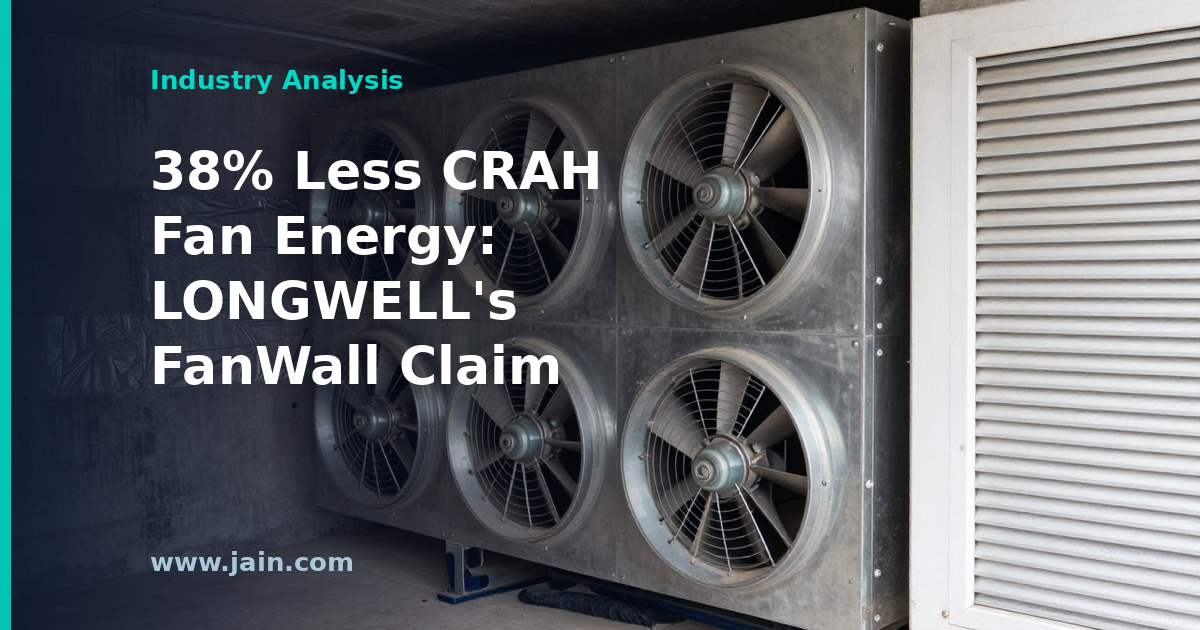
    Ningbo Longwell Electric Technology Co., Ltd. (LONGWELL), a Chinese fan and motor manufacturer founded in 1990, announced on 31 August 2026 an AI-era data center cooling line built around its LWBE3G EC plug-fan platform. Deployed as a FanWall array — a bank of smaller fans replacing one large fan — the company reports a 38% reduction in CRAH fan energy consumption, a 6.5 dB(A) noise reduction, and no field failures on the project cited.

    The work was done with what LONGWELL describes as one of the world’s top three precision-cooling OEMs, which it does not name. LONGWELL says it delivered 12 engineering samples in 35 days, passed DV/PV testing 100% on the first attempt, and went from specification validation to mass production in 90 days. The first customer order was 1,500 units; 2025 deliveries exceeded 80,000 units under a 2025–2027 framework agreement with a stated annual minimum of 60,000 units.

    Executive Summary

    The headline number is a 38% cut in the electricity drawn by the fans inside CRAH units — the computer-room air handlers that push cold air through a data hall. LONGWELL also reports that the CRAH system’s contribution to the facility energy-efficiency metric improved from a 1.42 baseline to 1.28 on the project in question. Fan power is one of the largest non-IT loads in an air-cooled hall, so a double-digit percentage cut there is economically meaningful even though it changes nothing about the servers themselves.

    The second, arguably more consequential claim is about speed. LONGWELL states that the incumbent European supplier on the same program had scheduled 14 months of development plus six months of production ramp, while LONGWELL completed spec-validation-to-mass-production in 90 days. If that comparison holds up, it says something about how quickly the precision-cooling supply chain can be re-sourced when AI buildouts compress every schedule — and about competitive pressure on established European fan vendors.

    The context is thermal density. LONGWELL cites rack loads moving from 15–20 kW to 60–100 kW in two years, with next-generation platforms exceeding 100 kW. That trajectory is usually cited as the argument for liquid cooling. This announcement makes the opposite-facing point: the air side of the plant still exists, still consumes power, and still has efficiency headroom that operators can capture without re-plumbing a building.

    Fan Power Is the Quiet Line Item in Data Center Energy

    In an air-cooled data hall, electricity splits between the IT equipment and everything that supports it: chillers, pumps, power conversion losses, and air movement. The air-movement share is easy to overlook because no single fan looks expensive, but CRAH fans run continuously, at every hour of every day, for the life of the facility. That duty cycle is what turns a percentage into money. A 38% reduction on a load that never switches off compounds differently from a 38% reduction on something that runs during business hours.

    The physics behind FanWall designs is not exotic and is worth stating plainly for non-specialists: fan power rises steeply with speed, so several smaller fans each running slower can move the same air volume for less power than one large fan running hard. EC — electronically commutated — motors, which use electronic control rather than mechanical brushes, make that easier by allowing precise, continuous speed modulation instead of on-off cycling. The array also degrades gracefully; LONGWELL cites automatic N+1 failover, meaning the array carries a spare fan’s worth of capacity so a single failure does not force a shutdown.

    None of that is unique to LONGWELL. FanWall architectures and EC motors are established practice across precision cooling, which is precisely why the interesting question in this release is not whether the approach works but what specifically LONGWELL’s platform was replacing, and at what operating point. The release’s own footnote says the comparative energy data refer to the equipment displaced on that project.

    Ninety Days Versus Twenty Months: The Real Competitive Story

    Component qualification is normally the slowest, least glamorous part of building cooling equipment. An OEM cannot simply swap a fan; it must re-run design verification and production validation testing, requalify acoustics and vibration, and re-certify the assembled unit. That is why the incumbent’s quoted 14-month development plus six-month ramp is not obviously unreasonable — it is roughly the industry’s normal cadence. LONGWELL’s claim is that it collapsed the same sequence to 90 days, with 12 engineering samples inside 35 days and a first-pass DV/PV result.

    For buyers, first-pass DV/PV is the detail worth noticing. Test cycles fail routinely, and each failure costs weeks. A supplier that passes on the first attempt is signalling that its engineering samples already matched the specification, which is a manufacturing-maturity claim as much as a design one. For the precision-cooling OEMs racing to fill AI-driven order books, a supplier who can compress twenty months into three is solving a scheduling problem, not just a component-cost problem.

    The competitive read is straightforward and should be stated without overreach: European fan suppliers have long held strong positions in HVAC and data center air movement on the strength of engineering depth and long qualification relationships. Speed of response is now being priced alongside that. The release does not claim the incumbent’s product was technically inferior — only that its timeline was longer on this program — and it explicitly disclaims any affiliation or endorsement.

    What the 38% Establishes, and What It Does Not

    LONGWELL is unusually candid in its own disclaimer: the performance data correspond to a specific project and a specific operating point, and final selection must be confirmed against operating point, voltage and control scheme, mounting arrangement, and project validation. That caveat is doing real work. Fan performance is highly sensitive to the pressure the fan works against, and a figure measured in one CRAH cabinet at one airflow does not transfer automatically to another.

    The 1.42-to-1.28 figure deserves particular care. Those numbers are in the numerical range of PUE — power usage effectiveness, the ratio of total facility power to IT power, where 1.0 is theoretically perfect — but the release describes this as the CRAH system’s contribution to the efficiency metric on this project, not a whole-facility PUE for a named site. Read as a subsystem-level improvement it is a coherent result; read as a facility PUE it would be a much larger claim than the release supports. The distinction matters for anyone modelling savings.

    The commercial figures are the most independently checkable part of the announcement, in the sense that they describe behaviour rather than test conditions. A first order of 1,500 units expanding to more than 80,000 units delivered in 2025, under a 2025–2027 framework with a 60,000-unit annual minimum, is a customer voting with volume. It is not third-party verification of 38%, but repeat purchasing at that scale is a stronger signal than a datasheet.

    Air Cooling Does Not Disappear Because Liquid Arrives

    The prevailing narrative says racks above roughly 60–100 kW must go to liquid cooling, and for the densest AI training clusters that is broadly where the industry is heading. But the transition is neither instant nor total. Direct-to-chip liquid cooling typically removes most, not all, of a rack’s heat; the remainder still leaves via air. Storage, networking, and general-purpose compute remain air-cooled. Retrofit halls with existing CRAH fleets will keep running for years on depreciation schedules that do not care about GPU roadmaps. Condensers and cooling towers — LONGWELL’s LWAE3G axial fan line targets these — are needed in liquid-cooled plants too.

    That is the strongest version of this announcement’s editorial premise: air-side efficiency has remaining headroom precisely because it is being treated as legacy. Capital and attention are flowing toward liquid, which leaves ordinary optimisation of the air path comparatively under-exploited. Operators who cannot re-plumb a building this year can still change fans.

    The counter-risk for a supplier in this position is that it is selling into a segment whose long-run share of new-build capacity may shrink even as its absolute installed base stays large. LONGWELL’s stated data center fan capacity of more than 120,000 units annually against a 60,000-unit contractual minimum suggests it has built for growth beyond this one customer; whether that growth comes from new AI halls, retrofits of existing ones, or the condenser and cooling-tower side of liquid-cooled plants is not something the release addresses.

    Background

    Precision cooling — the equipment class covering CRAC and CRAH units that hold data halls at controlled temperature and humidity — has historically been dominated by a small group of global OEMs, which in turn buy fans and motors from a specialist supply chain long anchored by European manufacturers. Fans are qualified rather than simply purchased: each one must pass verification testing inside the OEM’s cabinet, so incumbency has been durable and switching slow.

    The AI compute buildout has strained that arrangement. As per-rack heat loads climbed from the 15–20 kW typical of general-purpose servers toward 60–100 kW and beyond for accelerated computing, OEMs have needed higher-performance air movement on schedules far shorter than the industry’s traditional multi-year qualification cadence. LONGWELL, a Ningbo-area manufacturer founded in 1990 and long active in HVAC-R and industrial fans, is one of several Asian suppliers positioning against that compressed timeline — an announcement that is as much about procurement velocity as about thermodynamics.

    Source: La technologie FanWall de LONGWELL EC permet de réduire de 38 % la consommation énergétique des ventilateurs CRAH des centres de données IA de nouvelle génération — PR Newswire release, dated 31 August 2026 from Ningbo, China, detailing LONGWELL’s LWBE3G EC plug-fan platform, its reported CRAH fan energy and acoustic results, and the volumes shipped under a 2025–2027 framework agreement.

  • Laminated Busbar Market Nears $2.13B as Power Density Rises

    Laminated Busbar Market Nears $2.13B as Power Density Rises

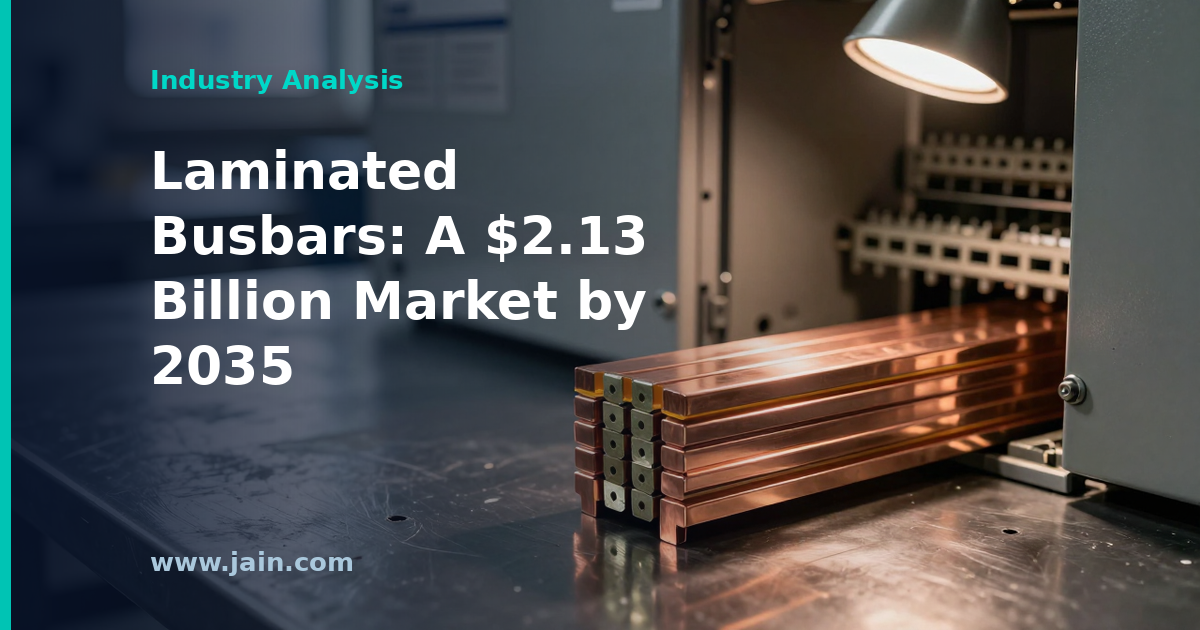
    Research firm MarketsandMarkets said on August 28, 2026 that the global laminated busbar market will grow from USD 1.13 billion in 2026 to USD 2.13 billion by 2035, a compound annual growth rate (CAGR) of 7.3%. The firm puts the 2025 base at USD 1.02 billion and covers the years 2022 through 2035 in a 295-page report containing 195 data tables and 75 figures.

    Within that forecast, North America is called the fastest-growing region at a 7.8% CAGR, Europe the second-largest region overall. Copper led by conductor material in 2025 and polyester by insulation material, while polyimide insulation is projected to grow fastest at 9.7%. Switchgear and power distribution was the largest application segment in 2025; utilities and grid infrastructure accounted for 20.6% of the market by end-user industry. Named suppliers include Amphenol, Methode Electronics, Mersen, Rogers, Sun King Technology Group, Zhuzhou CRRC Times Electric and Ryoden Kasei.

    Executive Summary

    A laminated busbar is not a glamorous product. It is a stack of flat copper or aluminium conductors separated by thin insulating film and bonded into a rigid sandwich, used in place of a bundle of cables to carry current between power-electronic components. Because the conductors sit close together in parallel planes, the assembly has very low inductance — meaning it resists sudden changes in current far less than a cable loop does — which lets switching devices run faster and cooler. That physics is why the part is quietly becoming a design constraint rather than a catalogue purchase.

    The headline forecast is a near-doubling of a small market: roughly $1 billion today to roughly $2 billion in a decade. The more interesting content sits in the segment detail. The above-3,000-amp current-rating band is projected to grow at 8.3%, faster than the market as a whole, and polyimide — a high-temperature insulating film used where polyester film would soften — at 9.7%. Both are thermal signals. They say that a growing slice of demand is coming from equipment running hotter and harder than the average installed base.

    For infrastructure buyers, the practical reading is about supply relationships rather than market size. The release describes a shift toward co-engineered busbars designed around a specific customer’s mechanical layout, which converts a commodity part into a single-sourced, tooling-bound component with real switching costs. That is a procurement and continuity question worth asking before the part is designed in, not after.

    The Conductor Becomes a Design Decision

    The economic argument for a laminated busbar has always been assembly, not electricity. Replacing a hand-built harness of cables, lugs and terminals with one bonded plate removes labour hours, removes the variance between one technician’s build and the next, and removes the tolerance stack-up that makes high-volume electrical assembly expensive to test. The release frames this directly: manufacturers want solutions that simplify assembly, improve consistency and use space efficiently. In a factory producing thousands of identical power converters, repeatability is worth more than copper savings.

    The second argument is electrical, and it is the one that scales with power density. Parallel plate geometry cancels much of the magnetic field between the conductors, cutting stray inductance. Lower inductance means lower voltage overshoot when a semiconductor switches off, which means the designer can either switch faster, run at higher voltage, or specify a smaller and cheaper device for the same job. As silicon carbide and other wide-bandgap semiconductors push switching frequencies up, the interconnect stops being neutral plumbing and starts setting the ceiling on what the rest of the design can do.

    That is the structural reason a low-single-digit-billion component market is worth watching from an infrastructure seat. The busbar is a small line item that gates the performance of a much larger one. Buyers who treat it as a commodity late in the design cycle tend to discover the constraint at thermal validation, when changing it is most expensive.

    What the Forecast Actually Supports

    The arithmetic is internally consistent: $1.13 billion compounding at 7.3% over the nine years to 2035 does land near $2.13 billion, so the headline is not a rounding artefact. The segment CAGRs are also coherent with each other — high-current, high-temperature and North American growth all running above the blended rate is the pattern you would expect if electrification and power-electronics density are the underlying drivers.

    Two things are worth flagging plainly. First, the step from the stated 2025 base of $1.02 billion to $1.13 billion in 2026 is about 10.8% growth, noticeably above the 7.3% rate forecast for the following decade. That implies a near-term acceleration followed by moderation, which may well be the firm’s considered view, but the release does not explain it. Second, the release names an application segment — EV chargers — as the fastest-growing, but gives the window as 2026–2031 in the subheading and 2026–2035 in the body. One of those is a typographical slip; a reader cannot tell which, and the two imply different demand curves.

    None of this makes the forecast wrong. It makes it unverifiable from the material provided, which is the normal condition for a press release whose function is to sell a 295-page report. The honest position is that the segment mix is a plausible and useful directional signal, and the specific dollar figures are a vendor estimate that no reader can independently reconstruct.

    Above 3,000 Amps: Reading the Thermal Signal

    The single most informative number in the release may be the 8.3% CAGR attached to the above-3,000-amp current-rating band. Very high current at modest voltage is the signature of DC distribution inside dense equipment — battery systems, energy storage, fast-charging stacks, and the low-voltage DC rails that feed racks of processors. Current heats a conductor in proportion to the square of its magnitude, so every step up in amperage makes the conductor’s cross-section, surface area and thermal path a harder problem than the step before it. Polyimide’s projected 9.7% growth points the same way: designers reach for a costlier, higher-temperature film when they have run out of thermal headroom, not when they have plenty.

    It is worth being precise about what the release does and does not say here. It does not mention data centres or AI infrastructure anywhere. The named end-user concentration is utilities and grid infrastructure at 20.6% in 2025, with switchgear and power distribution the largest application and EV charging the fastest-growing one. The connection between rising rack power density and high-current busbar demand is an inference drawn from the shared physics and the shared supplier base, not a claim the report makes.

    That inference is still worth making, because the constraint travels. Whoever is building 350 kW charging stalls, grid-scale storage inverters and high-current server power shelves is buying from an overlapping pool of copper, polyimide film, lamination presses and press-brake capacity. If charging and storage demand grows at the rates forecast here, data-centre power teams will feel it as lead times and qualification queues in a component category most of them have never had to plan around.

    Co-Engineering Rewrites the Supplier Relationship

    The release’s clearest strategic claim is that demand is shifting toward co-engineered busbars developed around a customer’s specific mechanical layout, conductor arrangement and insulation requirements, with competition moving to design support, prototyping, testing and production scalability. That description matters more than the market size. A part designed around one enclosure is, in practice, single-sourced. Requalifying a second supplier means new tooling, new dielectric and thermal validation, and often a schedule slip measured in quarters.

    The winners in that model are suppliers with engineering staff sitting alongside customer design teams early — which favours incumbents with scale, and the named list spans the US (Amphenol, Methode Electronics, Rogers), France (Mersen), China (Sun King Technology Group, Zhuzhou CRRC Times Electric) and Japan (Ryoden Kasei). The release gives no revenue or share figures for any of them, so the competitive ranking within that group is not established by this material. The losers are generic fabricators competing on price per kilogram of copper, and buyers who let a sole-source dependency form without pricing it.

    There is a geographic dimension too. Design-stage collaboration is easier when the supplier is reachable, which is one plausible reason North America is forecast to grow fastest, alongside its build-out of charging and grid equipment. But co-engineering also deepens exposure: a supplier chosen for its engineering depth is harder to replace if tariffs, export controls or a plant outage intervene. The mitigation is unromantic and should happen at design time — dual-qualify where volume justifies it, keep the mechanical interface documented independently of the supplier’s CAD, and price continuity into the award rather than the unit cost alone.

    Background

    Busbars are the workhorses of electrical distribution: solid conductors that carry current between components where cables would be bulky, lossy or hard to route. Laminated busbars are the engineered end of that category, developed originally for aerospace and traction applications where space, weight and switching performance all mattered at once. They spread into industrial drives, then into electric vehicles, renewable inverters, battery storage and switchgear as power electronics moved to higher voltages and faster semiconductor switching.

    MarketsandMarkets is a business-to-business research and growth-consulting firm that publishes syndicated market forecasts across technology and industrial sectors, promoting them through wire releases like this one. Its figures are vendor estimates rather than audited or regulatory data; the value to a general reader lies mainly in the segment structure and directional signals, which should be weighed alongside supplier disclosures and buyers’ own procurement experience.

    Source: Laminated Busbar Market worth $2.13 billion by 2035 | MarketsandMarkets™ — an August 28, 2026 PR Newswire release summarising the research firm’s paid forecast of the global laminated busbar market through 2035.

  • TSMC’s $100 Billion Arizona Bet: Can Leading-Edge Chipmaking Be Onshored?

    TSMC’s $100 Billion Arizona Bet: Can Leading-Edge Chipmaking Be Onshored?

    Taiwan Semiconductor Manufacturing Company (TSMC), the world’s largest contract chipmaker, is drawing fresh investor and press attention around two threads: its $100 billion expansion of manufacturing capacity in Arizona, and reports that its 1.6nm-class process technology is progressing ahead of expectations, even as its 2nm node ramps.

    The coverage — led by investment commentary at The Motley Fool and Yahoo Finance calling the stock a “no-brainer buy,” and Android Central’s report on the 1.6nm roadmap — frames TSMC as simultaneously extending its process-technology lead and deepening its US manufacturing footprint.

    Executive Summary

    Two storylines are converging. First, TSMC’s $100 billion Arizona expansion — one of the largest foreign direct investments in US history — is being cited by financial media as evidence of durable demand and strategic positioning. Second, reports claim TSMC is “surging ahead” on its 1.6nm chip technology, the node expected to follow 2nm at the leading edge of semiconductor manufacturing.

    Why it matters: every AI data-center buildout in the United States ultimately sits downstream of leading-edge fabrication. The GPUs and AI accelerators filling new halls are overwhelmingly made by TSMC. Whether the most advanced nodes can be manufactured on US soil, at volume and at competitive cost, is the linchpin question for the resilience of the entire AI infrastructure supply chain.

    A caveat up front: the source material here is media and investment commentary, not a primary TSMC disclosure. The “no-brainer buy” framing is an analyst opinion, and the 1.6nm progress claims are attributed to reports rather than confirmed company announcements. We treat both accordingly.

    The Onshoring Test Case the Whole Industry Is Watching

    For decades, the economics of chipmaking pushed leading-edge fabrication — the multi-billion-dollar plants, called fabs, that print transistors measured in nanometers — toward Taiwan, where TSMC perfected a clustered ecosystem of suppliers, engineers, and around-the-clock operations. The $100 billion Arizona program is the largest attempt yet to replicate that model in the United States.

    The open question is not whether TSMC can build fabs in Phoenix — it already operates there — but whether US-made wafers can approach Taiwan-level cost and yield. Labor, construction, permitting, and supply-chain density all historically favored Taiwan. If Arizona closes that gap, onshoring becomes a template. If it doesn’t, US production remains a strategic insurance policy that someone — customers, taxpayers, or TSMC’s margins — pays a premium for. The coverage prompting this article asserts confidence; it does not publish the cost data that would settle the question.

    1.6nm and the Widening Process Lead

    Node names like 2nm and 1.6nm are marketing shorthand for successive generations of transistor density and efficiency rather than literal measurements, but each generational step matters enormously: smaller nodes deliver more computing performance per watt, and power efficiency is now the binding constraint on AI data centers. Android Central’s report claims TSMC’s 1.6nm technology is progressing faster than expected, positioning it as the successor to the 2nm node.

    If accurate, that extends TSMC’s lead at a moment when rivals Intel and Samsung are fighting to prove their own next-generation processes can win major external customers. A widening lead concentrates the world’s AI chip supply on one company’s execution — a boon for TSMC shareholders, but a single point of dependency for everyone downstream. It is worth noting the sourcing: these are “reports claim” stories, not a TSMC roadmap announcement, and node schedules in this industry routinely shift.

    What This Means Downstream for AI Data Centers

    Data-center operators, cloud providers, and enterprises planning AI capacity should read this news through a supply-chain lens. Accelerator availability, pricing, and generational cadence all trace back to how fast TSMC can add leading-edge capacity and where that capacity sits. Arizona fabs shorten the logistical and geopolitical distance between chip production and the US facilities consuming those chips.

    But onshored fabrication is also a new demand center competing for the same scarce inputs data centers need: grid power, water, skilled construction labor, and electrical equipment. Arizona is already a major data-center market; a $100 billion fab program deepens the regional competition for those resources even as it strengthens the chip supply those data centers depend on.

    Separating the Investment Pitch from the Industrial Facts

    The headline framing — that the Arizona expansion shows the stock is a “no-brainer buy” — is a claim about valuation, and it deserves the same scrutiny we would apply to any vendor’s marketing. Capital intensity of this magnitude is a bet, not a guarantee: it assumes AI demand persists at extraordinary levels, that US fab economics prove workable, and that geopolitics neither disrupts Taiwan operations nor reshapes trade policy in ways that strand assets.

    None of that makes the bullish case wrong. TSMC’s scale, customer roster, and technology position are real and well documented. But an investment headline is not a substitute for the disclosures that would substantiate it — yield data, US cost structures, and confirmed node timelines — and readers should note that those specifics are absent from this coverage.

    Background

    TSMC pioneered the pure-play foundry model — manufacturing chips exclusively for other companies rather than selling its own — and rode it to a commanding share of global advanced-node production from its base in Taiwan. Its customers include the designers of essentially all leading AI accelerators, which has made TSMC’s capacity roadmap a proxy for the pace of the AI buildout itself.

    The company began US expansion in Phoenix, Arizona with a first fab that reached volume production in 2024, then progressively enlarged its American commitment, culminating in the $100 billion expansion program now drawing coverage. The buildout unfolds against sustained AI-driven chip demand, US industrial policy aimed at reshoring semiconductor manufacturing, and persistent strategic concern about the concentration of leading-edge production in Taiwan.

    Source: TSMC’s $100 Billion Arizona Expansion Shows The Stock Is a No-Brainer Buy — investment commentary via The Motley Fool and Yahoo Finance, alongside Android Central’s report on TSMC’s 1.6nm process progress.

  • GE Vernova’s AI Order Surge Signals Power and Cooling Are the New AI Bottleneck

    GE Vernova’s AI Order Surge Signals Power and Cooling Are the New AI Bottleneck

    Financial media reports in August 2026 highlight that GE Vernova’s orders for AI data-center equipment in the first half of the year have already doubled the total it booked in all of 2025, according to coverage from The Motley Fool syndicated across Yahoo Finance and The Globe and Mail. In parallel, Yahoo Finance analysis asks whether Eaton Corporation and Trane Technologies — suppliers of electrical distribution gear and cooling systems, respectively — can emerge as major winners from the same AI data-center boom.

    None of the items is a company press release; they are investor-focused analyses built around the order-growth headline. But taken together, they point at a consistent industry story: the equipment that powers and cools AI facilities, not the chips inside them, is where demand is now outrunning supply.

    Executive Summary

    The headline claim is striking: in one half-year, GE Vernova — the energy-equipment company spun out of General Electric — booked more AI data-center orders than in the entire previous year. The coverage frames this as evidence that hyperscalers and data-center developers are racing to lock in turbines, grid equipment, and electrical infrastructure years ahead of need. The companion piece extends the thesis to Eaton, which makes the switchgear, transformers, and power-distribution systems inside data centers, and Trane, whose chillers and thermal-management systems remove the enormous heat that AI server racks generate.

    Why it matters: for the past two years, the constraint on AI capacity was widely assumed to be GPU supply. These reports suggest the constraint is migrating downstream — to megawatts and cooling tons. A data center without secured power generation, electrical distribution, and heat rejection cannot deploy a single chip, no matter how many accelerators its owner has purchased. If order books at the equipment makers are filling this fast, delivery lead times become a strategic variable for everyone building AI infrastructure.

    A caveat up front: the source material is investment commentary, not audited disclosure. The doubling claim originates in stock-analysis coverage, and the articles supply no dollar figures, customer names, or delivery schedules that we can independently verify from the release text alone. The direction of the signal is consistent across outlets; the precision of it is not something this coverage establishes.

    The Bottleneck Has Moved Downstream from Chips to Electrons

    Every AI data center is, functionally, a machine for converting electricity into computation and heat. The industry spent 2023–2025 focused on the computation side — who could get GPUs, and how many. But GPUs are a fast-cycle product: fabs can expand output on a timescale of quarters. Heavy electrical equipment is not. Gas turbines, large power transformers, and high-capacity switchgear are engineered-to-order products with lead times measured in years, built in a small number of factories worldwide. When demand doubles, capacity cannot.

    That asymmetry is what makes the reported GE Vernova order surge significant beyond one company’s income statement. If AI data-center orders in six months exceeded all of last year’s, buyers are effectively queueing — paying now for delivery slots later. In infrastructure markets, a lengthening queue is the classic signature of a bottleneck: the constraint on how fast the AI buildout can proceed stops being capital or chips and becomes the physical delivery calendar of the equipment supply chain.

    Three Companies, Three Layers of the Same Stack

    The coverage bundles GE Vernova, Eaton, and Trane together for a reason: they occupy successive layers of the same value chain. GE Vernova sits upstream, supplying power generation and grid-scale equipment — the megawatts themselves. Eaton sits in the middle, making the electrical distribution gear — switchgear, uninterruptible power supplies, transformers — that moves power safely from the substation to the server rack. Trane sits at the end of the energy journey, providing the chillers and cooling systems that reject the heat those racks produce. In a conventional data center, cooling can consume a substantial share of total power; AI racks, which run far denser than traditional IT loads, intensify that thermal problem.

    The strategic implication is that AI demand does not create one winner but a chain of them — and a chain of potential choke points. An operator who secures generation but not switchgear, or switchgear but not chillers, still cannot open. That is why the market is asking the Trane-and-Eaton question at all: if the upstream layer (GE Vernova) is visibly capacity-constrained, the same dynamic plausibly applies to the layers behind it. Plausibly — the coverage poses the question about Eaton and Trane rather than documenting equivalent order data for them, and that distinction matters.

    Reading Order Books Honestly: Signal, Not Revenue

    Orders are a forward indicator, not money in the bank. An order becomes backlog, backlog becomes revenue only upon delivery, and the coverage here does not disclose the dollar value of the orders, their delivery timeline, cancellation terms, or margin profile. History counsels some humility: capital-equipment cycles have seen order books swell during booms and thin out when customers re-time projects. If AI capital spending decelerates — because model economics disappoint, power prices spike, or financing tightens — equipment orders placed years ahead of need are among the first things large buyers revisit.

    There is also a framing question worth noting even-handedly. All three source articles are investor commentary keyed to stock tickers, published across financial outlets asking “is the stock still a buy?” That genre rewards dramatic framing of growth statistics. The underlying fact pattern — surging demand for power and cooling equipment from AI builders — is consistent with what the broader industry has been experiencing, and nothing in the coverage appears contrived. But readers should distinguish between the well-supported directional claim (demand is heavily outrunning historical levels) and the precise multiples in headlines, which the articles as syndicated do not source to specific filings in the material available here.

    What This Means for Anyone Building or Buying Capacity

    For data-center operators and enterprise buyers, the practical takeaway is that procurement of electrical and thermal equipment has become a competitive discipline, not a back-office function. When lead times stretch, operators who ordered early hold an asset — a delivery slot — that late movers cannot buy at any price in the short run. Expect that advantage to show up in which projects actually energize on schedule, and in the pricing power of colocation providers who already hold contracted power and installed cooling.

    For the equipment makers, the boom is an opportunity wrapped in a capacity-planning dilemma: expand factories aggressively and risk overcapacity if AI spending normalizes, or expand cautiously and cede share. How GE Vernova, Eaton, and Trane each answer that question — none of which this coverage addresses — will shape the supply side of the AI buildout for the rest of the decade.

    Background

    GE Vernova became an independent company in 2024 when General Electric split into separate aviation, healthcare, and energy businesses, giving the energy unit a standalone identity spanning power generation, wind, and grid electrification. Eaton is a long-established power-management company whose electrical segment supplies the distribution and backup-power equipment inside commercial facilities and data centers. Trane Technologies, formed from the 2020 separation of Ingersoll-Rand’s climate businesses, is one of the world’s largest suppliers of commercial HVAC and chiller systems.

    The market context is the AI infrastructure buildout that accelerated from 2023 onward, as hyperscale cloud providers and specialized developers began constructing data centers of unprecedented power density to train and run large AI models. That expansion has pushed demand for generation capacity, grid interconnection, electrical gear, and industrial cooling well beyond historical data-center norms — turning previously unglamorous equipment categories into strategically contested supply.

    Source: Can Trane Technologies plc (TT) and Eaton Corporation, PLC (ETN) Become Major Winners from the AI Data Center Boom? — Yahoo Finance analysis, alongside syndicated Motley Fool coverage reporting that GE Vernova’s first-half AI data-center orders doubled its full-2025 total.

  • Advantech’s New Tustin HQ Is a Bet on North American Edge AI Demand

    Advantech’s New Tustin HQ Is a Bet on North American Edge AI Demand

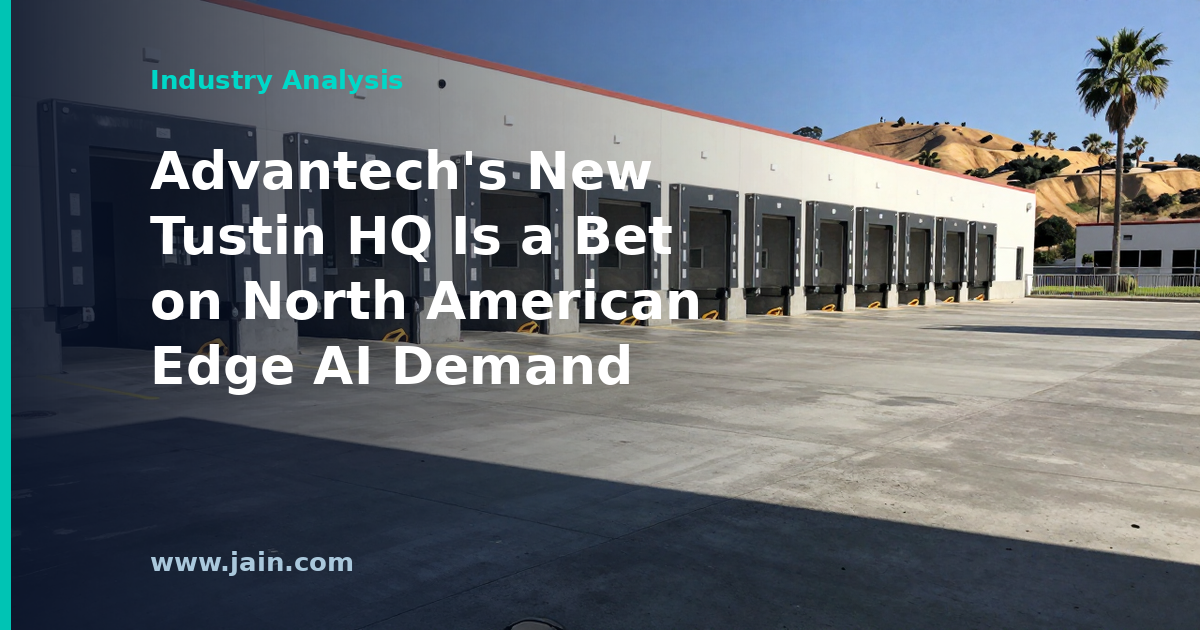
    Advantech (TWSE: 2395), the Taiwan-based edge computing and industrial IoT company, announced on August 19, 2026 the opening of its new North American headquarters in Tustin, California. The 10-acre campus at Tustin Legacy in Orange County pairs a six-story, 110,000-square-foot corporate headquarters with a 79,000-square-foot Integration & Service Center.

    The company says the site — located near the Ports of Los Angeles and Long Beach, John Wayne Airport, and major Southern California freight corridors — will anchor product innovation, customer collaboration, and expanded integration and logistics operations across the region, alongside its existing Milpitas, California and Ottawa, Illinois facilities.

    Executive Summary

    Advantech is consolidating its North American presence into a purpose-built campus that puts engineering, sales, customer experience, technical support, and executive leadership under one roof — plus an immersive AIoT showroom where customers can explore real-world applications across vertical markets. Ween Niu, General Manager of Advantech North America, framed the move as “a long-term investment in innovation, our employees, our partners, and the future of Edge AI.”

    The more strategically interesting half of the announcement is the Integration & Service Center: 79,000 square feet of dedicated integration and warehouse space with expanded dock bays, advanced scanning and routing systems, cross-dock operations supporting same-day and next-day processing, and automation infrastructure designed to scale. For a hardware company whose products — industrial PCs, embedded platforms, edge AI systems — typically require configuration before deployment, that is a statement about where value gets added: increasingly, on US soil, close to the customer.

    Why it matters: edge computing means putting processing power at or near where data is generated (a factory floor, a retail store, a cell tower) rather than in a distant cloud data center. As enterprises deploy AI at the edge in volume, the vendors who can integrate, stage, and ship configured hardware fastest gain a real advantage — and Advantech is spending to be one of them.

    Edge AI Is a Logistics Business, Not Just a Silicon Business

    Cloud AI concentrates hardware in a handful of hyperscale data centers; edge AI scatters it across thousands of customer sites. That inversion changes what wins deals. A customer rolling out AI-enabled systems across dozens of locations cares less about a spec-sheet edge and more about whether units arrive configured, imaged, and ready to mount — and whether a failed unit can be swapped quickly. Advantech’s investment in cross-dock operations, staging areas, and shipment-accuracy technology treats fulfillment and service as product features, which for industrial hardware they effectively are.

    The site selection reinforces this reading. Proximity to the Ports of Los Angeles and Long Beach — the primary gateway for trans-Pacific goods entering the US — shortens the distance between inbound manufactured hardware and outbound integrated systems. For a company headquartered in Taiwan, that positioning compresses the slowest part of the supply chain.

    Onshoring Support Capacity Without Onshoring Manufacturing

    Advantech’s move fits a broader pattern among Asia-based hardware vendors: rather than relocating manufacturing wholesale, they are onshoring the final, high-touch stages — integration, configuration, service, and warehousing — where proximity to the customer matters most. The release describes a two-hub integration footprint (Tustin, California and Ottawa, Illinois) that gives the company coverage on both the West Coast and the Midwest, while Milpitas continues supporting customers through the transition.

    This is a capital-efficient hedge. It shortens delivery times and improves responsiveness for North American buyers without the cost and complexity of standing up full production lines, and it signals commitment to a region where industrial automation, embedded AI, and IoT deployments are growth priorities for enterprise buyers.

    The Showroom as a Sales Strategy for an Invisible Product

    Edge infrastructure suffers from a demonstration problem: the product is a box in a cabinet, but the value is a transformed operation. The campus’s immersive AIoT showroom — where customers explore applications across vertical markets — is Advantech’s answer. Co-locating that experience with engineering and executive leadership turns the headquarters into a sales and co-development instrument, consistent with the company’s stated model of co-creating solutions with domain-focused partners rather than shipping components alone.

    Who Feels the Pressure

    Competing industrial PC and edge hardware vendors serving North America now face a rival with a stated same-day and next-day processing capability near the country’s busiest port complex. For customers, the practical effect — if Advantech executes — is faster deployments and shorter service loops. The risk side is equally real: a large fixed-cost campus is a bet that edge AI demand keeps growing; if enterprise edge spending slows, the company carries the overhead regardless.

    Background

    Founded in 1983, Advantech built its business on industrial computers and embedded platforms — the specialized hardware inside factory equipment, kiosks, medical devices, and network infrastructure. As industry adopted IoT (internet-connected sensors and machines), big data, and AI, the company repositioned around ‘Edge Intelligence’: hardware and software that runs analytics and AI where data is generated. It works through domain-focused partners to co-create sector-specific industrial IoT solutions rather than selling components alone.

    The Tustin campus extends a North American footprint that has included operations in Milpitas, California and integration capabilities in Ottawa, Illinois. The move lands amid broad enterprise momentum behind edge AI and industrial automation, where deployment speed and local service capacity increasingly shape vendor selection.

    Source: Advantech Announces New North American Headquarters and Service Center in Tustin, California — PR Newswire release, August 19, 2026, announcing Advantech’s 10-acre Tustin Legacy campus and Integration & Service Center.

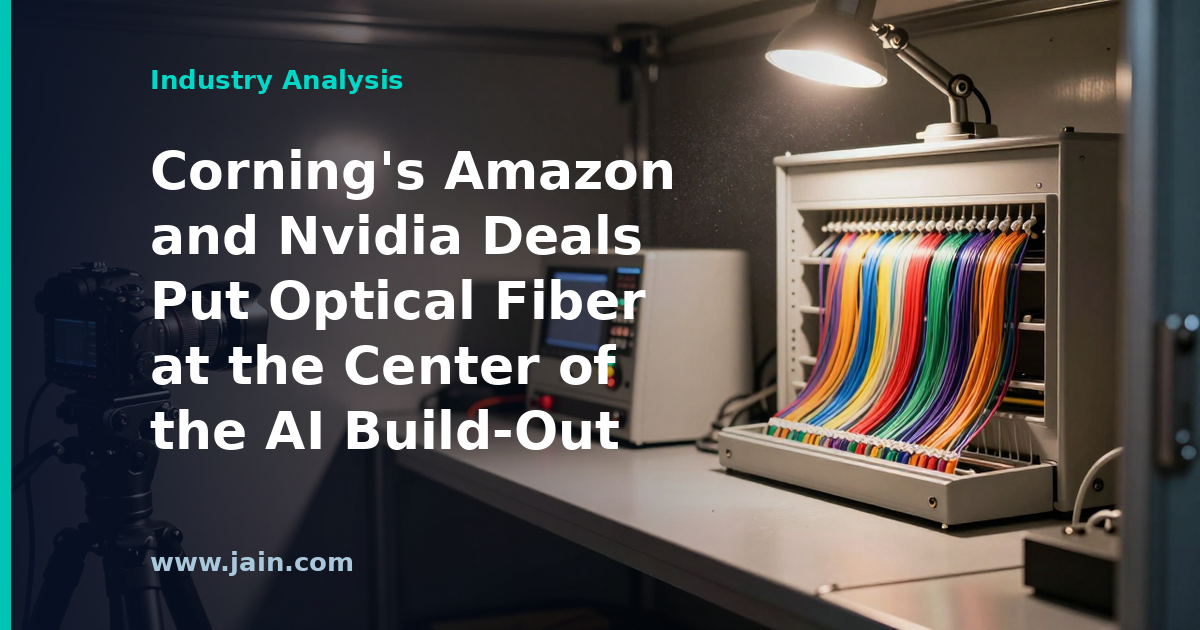
  • Corning’s Amazon and Nvidia Deals Put Optical Fiber at the Center of the AI Build-Out

    Corning’s Amazon and Nvidia Deals Put Optical Fiber at the Center of the AI Build-Out

    Corning Incorporated (NYSE: GLW), the U.S. glass and optical-fiber maker, has landed a supply deal with Amazon and a tie-up with Nvidia to support AI-driven fiber expansion, according to a Yahoo Finance report dated July 11, 2026. The report identifies the two partners and the AI-infrastructure context but discloses no financial terms, volumes, or timelines.

    Executive Summary

    According to the report, Corning has secured two of the most consequential names in AI infrastructure as partners: Amazon, the largest cloud provider through AWS, and Nvidia, whose GPUs power the bulk of AI training clusters. The pairing matters because it spans both ends of the optical market — a hyperscale buyer locking in fiber supply for data-center construction, and a chipmaker whose networking roadmap increasingly depends on optics engineered into the systems themselves.

    The deeper signal is about scarcity. For three years the AI build-out narrative has centered on GPUs, then power, then land and cooling. Deals like these suggest the industry is now moving down the stack to connectivity: the millions of fiber strands that stitch tens of thousands of accelerators into a single usable computer. When buyers of Amazon’s and Nvidia’s scale contract directly with a fiber manufacturer, it typically means they no longer trust the spot market to deliver.

    Fiber Is the Layer the AI Boom Forgot to Price In

    An AI data center is, in networking terms, unlike anything the cloud era built. Traditional cloud facilities connect servers that mostly work independently; AI training clusters must make thousands of GPUs behave like one machine, which requires every accelerator to talk to every other at extreme speed. That drives fiber consumption per megawatt to multiples of what conventional data centers use — dense mesh fabrics of optical links inside the building, plus long-haul routes connecting campuses into distributed training networks.

    Corning has been positioning for this shift for some time. In 2024 it struck a widely reported agreement with Lumen Technologies that reserved roughly 10% of its global fiber capacity to interconnect AI data centers — an early sign that fiber, a product long treated as a commodity, was becoming something buyers reserve years ahead. A reported Amazon deal would extend that pattern from carriers to the hyperscalers themselves.

    What Amazon and Nvidia Each Want — and Why It’s Not the Same Thing

    Amazon’s interest is straightforward supply security. AWS has committed to one of the largest capital programs in corporate history, building AI campuses that each require enormous quantities of fiber-optic cable, connectors, and pre-terminated assemblies. Contracting directly with the manufacturer hedges against the lead-time blowouts that hit transformers and switchgear, and can lock in pricing before competitors absorb capacity.

    Nvidia’s angle is architectural. As GPU clusters scale, the copper links traditionally used for short connections run out of reach and power budget, pushing the industry toward optics integrated ever closer to the chip — including co-packaged optics, where the optical components sit in the same package as the switch silicon. Nvidia has publicly built a silicon-photonics ecosystem around its networking platforms, and Corning has previously been named among its optics partners. A deepened tie-up would suggest fiber makers are moving up the value chain, from selling cable to co-engineering the optical guts of AI systems.

    Winners, Losers, and What the Report Actually Establishes

    If the deals are as described, Corning gains something rare for a components maker: demand visibility anchored to the two most creditworthy names in AI. Other fiber and connectivity suppliers — Prysmian, CommScope, Fujikura, Sumitomo — face a market where marquee demand is being locked up bilaterally, which can lift the whole sector’s pricing but also concentrates the best volumes with the leader. Buyers without such agreements, including telecom carriers and enterprises mid-way through their own fiber projects, may face longer lead times if AI demand absorbs available capacity.

    That said, the source material here is thin: a headline confirming that deals exist, not what they contain. No dollar values, durations, capacity commitments, or product scope are disclosed. Supply agreements in this industry range from binding take-or-pay contracts to loose framework arrangements that generate headlines but little guaranteed revenue. Until terms emerge — in an SEC filing, an earnings call, or a detailed release — the prudent reading is directional: fiber is now strategic enough that Amazon and Nvidia negotiate for it directly, and that fact alone is meaningful.

    Background

    Corning invented the first commercially viable low-loss optical fiber in 1970 and has remained one of the world’s largest fiber producers through every connectivity cycle since — the dot-com fiber glut, fiber-to-the-home, and the cloud data-center era. Its optical communications segment sells fiber, cable, and pre-connectorized hardware to carriers and, increasingly, to hyperscale data-center operators.

    The AI era reframed that business. Beginning around 2024, Corning began striking capacity-reservation agreements tied explicitly to AI data-center interconnection, including its Lumen Technologies deal, and was named among the partners in Nvidia’s silicon-photonics ecosystem. The reported Amazon and Nvidia deals of July 2026 continue that trajectory: fiber shifting from commodity purchase to strategically contracted supply.

    Source: Corning (GLW) Lands Amazon Deal And Nvidia Tie Up For AI Fiber Expansion — Yahoo Finance report, July 11, 2026, on Corning’s reported AI-related agreements with Amazon and Nvidia.

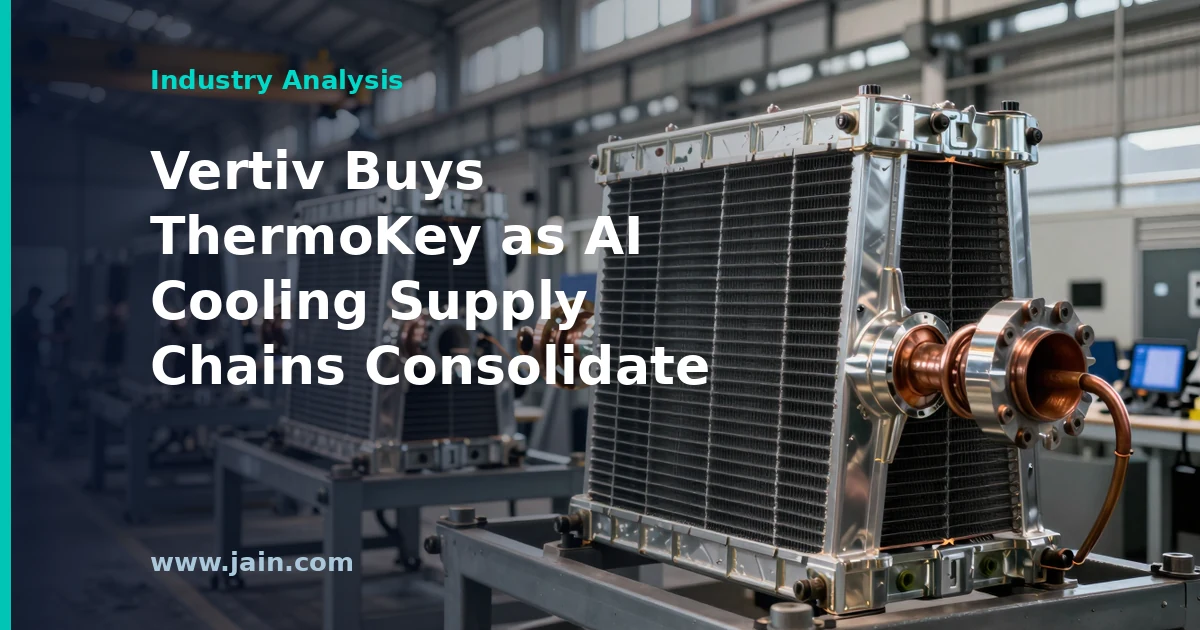
  • Vertiv Buys ThermoKey as AI Cooling Supply Chains Consolidate

    Vertiv Buys ThermoKey as AI Cooling Supply Chains Consolidate

    Vertiv, the NYSE-listed data center power and cooling vendor, announced a deal to acquire ThermoKey, an Italy-based heat-exchanger manufacturer, in a move the company frames as expanding its AI data center cooling capabilities. The announcement was reported on June 14, 2026; Vertiv’s shares slipped on the news. Financial terms were not detailed in the source report.

    Executive Summary

    The acquisition extends a clear pattern: as AI compute densities climb, the large data center infrastructure vendors are buying their way down the thermal supply chain rather than relying on third-party component makers. Heat exchangers — the coils and dry coolers that ultimately move server heat into outside air or water loops — are an unglamorous but capacity-constrained link in every cooling system, whether air-cooled or liquid-cooled.

    For Vertiv, owning that link means more control over lead times, cost, and engineering integration at a moment when hyperscalers and colocation operators are ordering thermal equipment years ahead. The market’s muted reaction — shares slipped on the announcement — is a reminder that investors are weighing acquisition spending and integration risk against the strategic logic, particularly with no publicly detailed deal terms to anchor the math.

    Why Heat Exchangers Matter in the AI Era

    Every watt a GPU consumes becomes heat that must be rejected outdoors. Whatever technology sits at the rack — air handlers, rear-door heat exchangers, or direct-to-chip liquid cooling — the chain ends at heat-rejection hardware: coils, dry coolers, and condensers of the kind ThermoKey manufactures. As rack densities move from tens of kilowatts toward 100 kW and beyond, that heat-rejection stage scales in direct proportion, and it is built from metal, fabrication capacity, and factory floor space that cannot be conjured quickly.

    By acquiring a heat-exchanger maker outright, Vertiv converts a supplier relationship into owned capacity. That matters less in a slack market and enormously in a tight one — and the AI buildout has made thermal equipment a long-lead-time item across the industry.

    Vertical Integration Follows the GPU Buildout

    This deal fits a broader consolidation wave. Vertiv itself has been assembling a fuller thermal stack for years, including its 2023 move on liquid-cooling specialist CoolTera, and competitors across the cooling landscape have pursued similar component-level acquisitions. The strategic logic is consistent: hyperscale customers increasingly want one accountable vendor for an integrated thermal chain, from the cold plate on the chip to the dry cooler on the roof, with matched controls and warranties.

    For independent component makers, that creates a squeeze. Remaining suppliers may find their largest customers are now also their competitors’ owners — which historically pushes further consolidation, as remaining independents either scale up, specialize, or sell.

    Reading the Share-Price Slip

    The headline pairing — an expansion deal and a stock decline on the same day — deserves an even-handed reading. A slip on acquisition news is common and can reflect many things: general market movement, questions about price paid, or wariness about integration workload during a demand boom. Without disclosed terms, none of these can be confirmed from the source material, and a one-day move is a weak signal of a deal’s long-term merit.

    What can be said is that investors are applying more scrutiny to AI-infrastructure spending across the board in 2026, and vendors announcing acquisitions now carry the burden of showing how each deal converts into margin or capacity rather than merely into breadth. Vertiv’s task is to demonstrate that owning heat-exchanger manufacturing shortens its lead times or improves its unit economics in ways customers and shareholders can measure.

    Background

    Vertiv became an independent company in 2016 when private equity firm Platinum Equity carved Emerson Network Power out of Emerson Electric, and it listed on the NYSE in 2020. It has since ridden the data center construction wave as one of the leading suppliers of the power distribution, thermal management, and enclosure systems that sit around the servers themselves, competing with firms such as Schneider Electric and a field of specialist cooling vendors.

    The AI boom that accelerated in 2023 transformed cooling from a mature, slow-growth product line into a strategic battleground. Heat-exchanger manufacturing — historically a fragmented, regional business serving HVAC and industrial refrigeration as well as data centers — has become a supply chain chokepoint, setting the stage for component-level acquisitions like this one.

    Source: Vertiv Expands AI Data Center Cooling With ThermoKey Deal And Shares Slip — Yahoo Finance report, June 14, 2026, on Vertiv’s acquisition of heat-exchanger maker ThermoKey.

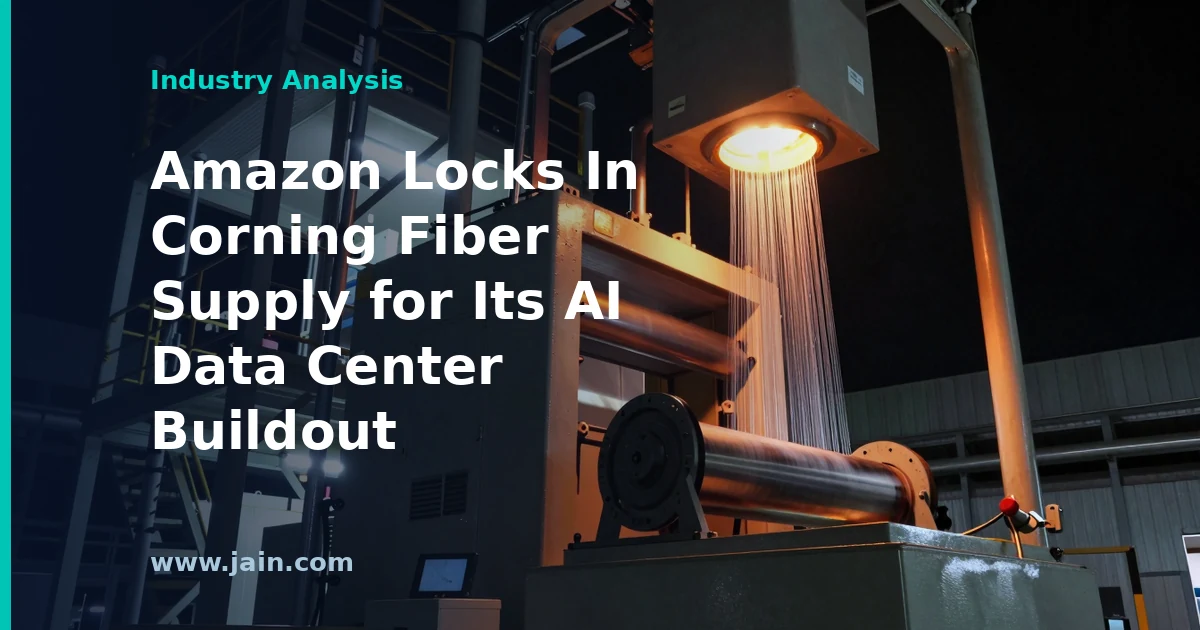
  • Amazon Locks In Corning Fiber Supply for Its AI Data Center Buildout

    Amazon Locks In Corning Fiber Supply for Its AI Data Center Buildout

    Amazon has signed a multibillion-dollar agreement with Corning to ramp up fiber-optics manufacturing, as first reported by Manufacturing Dive on June 10, 2026. The deal ties one of the world’s largest cloud and AI infrastructure builders to the world’s best-known maker of optical fiber, securing the connectivity layer — the glass strands that carry data between and within data centers — for Amazon’s ongoing AI expansion.

    Executive Summary

    The announcement is short on public detail but long on signal: Amazon is treating optical fiber the way hyperscalers have learned to treat power, land, and chips — as a scarce input to be locked down years in advance rather than bought on the spot market. A multibillion-dollar commitment to “ramp up” manufacturing suggests this is not a routine purchase order but a demand guarantee large enough to justify new or expanded production capacity on Corning’s side.

    For the infrastructure industry, the deal matters in two directions. It confirms that AI data center construction is now pulling hard on the optical supply chain, not just on GPUs and megawatts. And it raises a practical question for every other buyer of fiber — carriers, colocation operators, and enterprises — about what capacity remains available, and at what price, once the largest customers have reserved theirs.

    Fiber Is the Quiet Bottleneck of the AI Buildout

    Public attention in the AI infrastructure boom goes to chips and electricity, but the third essential ingredient is optical connectivity. Modern AI training clusters link thousands of GPUs (graphics processing units, the chips that do AI computation) into what behaves like a single machine, and the traffic between those chips — so-called east-west traffic inside the data center — dwarfs the traffic going out to users. That traffic moves over optical fiber, and an AI-optimized facility can consume many times the fiber count of a conventional cloud data center, before counting the long-haul routes needed to knit multiple campuses together.

    That demand profile changes the economics of fiber. Optical cable production is capital-intensive and slow to scale: drawing glass fiber requires specialized furnaces and facilities that take time to build and qualify. When demand surges faster than capacity, lead times stretch. A hyperscaler planning multi-year, multi-gigawatt campuses cannot afford to discover mid-project that cable is on allocation. Committing billions of dollars up front converts that risk into a contractual guarantee.

    The Offtake Playbook Comes to Connectivity

    The structure here follows a pattern hyperscalers have already applied elsewhere: long-term offtake agreements — commitments to buy future output — that give a supplier the demand certainty to invest in capacity. Amazon and its peers have signed similar multi-year deals for power generation and chip supply. Extending the playbook to fiber optics tells you the connectivity layer has crossed the threshold from commodity procurement to strategic sourcing.

    For Corning, a guaranteed buyer of this size de-risks manufacturing expansion that would be hard to justify on spot demand alone — fiber makers were burned in past cycles when telecom demand collapsed after capacity had been built. For Amazon, the deal buys priority in the queue. The open question, unanswered in the initial reporting, is how much of Corning’s output this commitment effectively reserves, and for how long. Corning has struck capacity-reservation arrangements with other large buyers before, so the cumulative effect of these deals on remaining open-market supply is the number the rest of the industry would most like to see.

    What Tighter Fiber Supply Means for Everyone Else

    When the largest buyers pre-purchase capacity, smaller buyers face a different market. Regional carriers, colocation and interconnection providers, municipal broadband projects, and enterprises building private networks all draw on the same manufacturing base. If AI-driven hyperscale demand absorbs the industry’s expansion for the next several years, other buyers should plan for longer lead times and firmer pricing — and, like the hyperscalers, may need to move from transactional purchasing toward framework agreements of their own.

    There is also a competitive-landscape angle. Corning is the most prominent name in optical fiber, but it is not the only one; other global cable makers may see openings with customers who want supply diversity, and the deal could catalyze capacity investment across the sector. Historically, that is how supply crunches resolve — though the telecom industry also remembers the early-2000s lesson that capacity built for a boom can outlive the boom. Whether AI connectivity demand proves durable enough to absorb an industry-wide ramp is the multibillion-dollar assumption embedded in deals like this one.

    Background

    Corning invented low-loss optical fiber in 1970 and has manufactured it through every networking cycle since — including the early-2000s telecom bust, when overbuilt fiber capacity took years to absorb, a memory that still shapes how cautiously fiber makers expand. Amazon, through Amazon Web Services, operates one of the world’s largest cloud platforms and has been investing heavily in data center capacity to serve AI workloads.

    The two trends converged in the mid-2020s: AI cluster architectures multiplied the fiber content of each new data center just as hyperscale construction accelerated, and large buyers began reserving optical manufacturing capacity through long-term agreements — a market where Corning, as the sector’s most prominent supplier, sits at the center.

    Source: Amazon, Corning ink multibillion-dollar deal to ramp up fiber optics manufacturing — Manufacturing Dive report, June 10, 2026, on Amazon’s fiber-optics supply agreement with Corning.

  • Bank of America Institute Calls Data Center Construction a Resource Shock

    Bank of America Institute Calls Data Center Construction a Resource Shock

    The Bank of America Institute, the research arm of Bank of America that publishes economic analysis drawn from the bank’s data and economists, released a report on June 2, 2026 characterizing the ongoing wave of data center construction as a “resource shock.” The framing points to strain across the three inputs every large-scale digital infrastructure project competes for: skilled construction labor, building materials and electrical equipment, and electric power supply.

    Executive Summary

    When a major bank’s in-house think tank labels an investment cycle a “resource shock,” it is making an economic claim, not just a descriptive one. A resource shock is a sudden shift in demand for inputs that outruns the supply side’s ability to respond, pushing up prices and lead times for everyone competing for the same resources. Applied to data centers, the term asserts that the AI-driven construction boom is no longer just a story about one industry’s capital spending — it is large enough to move markets for electricians, transformers, generators, concrete, steel, and grid capacity.

    That matters because the effects of a resource shock do not stay contained. Other construction sectors — housing, manufacturing plants, public infrastructure — draw on the same labor pools and equipment supply chains. Utilities planning grid investments must now weigh data center load requests against other customers. For an institution with Bank of America’s lending and card-spending visibility into the real economy, elevating this to a formal research theme signals that the strain is showing up in measurable economic data, not just industry anecdote.

    Why a Bank Is Sounding This Note

    The Bank of America Institute exists to translate the bank’s proprietary vantage point — payments flows, commercial lending, economic research — into public analysis. Its choice of subject is itself informative: research arms of large banks tend to formalize themes their client-facing businesses are already encountering, such as construction lenders seeing bid inflation or corporate clients reporting equipment delays. A “resource shock” framing suggests the institute sees data center demand as a macroeconomic force rather than a niche real-estate story.

    It also reflects where the money is going. Data centers have shifted from a specialized corner of commercial real estate to one of the most capital-intensive construction categories in the United States, propelled by hyperscale cloud providers and AI infrastructure buildouts. When a single project can require hundreds of megawatts of power and years of specialized electrical work, a national pipeline of such projects mechanically competes with everything else being built.

    The Three Bottlenecks: Labor, Materials, Power

    The report’s headline identifies the three constraints practitioners consistently cite. Labor is the most immediate: data centers need unusually high concentrations of electricians, pipefitters, and mechanical trades, and those skills take years to develop. Materials and equipment form the second constraint — long-lead electrical gear such as transformers, switchgear, and backup generators has been the industry’s chronic pain point, with order backlogs measured in years at various points in this cycle.

    Power is the deepest constraint because it is the slowest to fix. A data center is ultimately a machine for converting electricity into computation, and connecting large new loads requires generation and transmission investments that operate on utility timescales — often five to ten years for major grid upgrades. This is why power availability, more than land or capital, has become the primary siting criterion for new facilities.

    Winners, Losers, and the Cost Question

    A resource shock redistributes advantage. Operators with land already secured, grid interconnection agreements signed, and equipment orders placed hold assets that are increasingly difficult to replicate — which supports valuations for incumbent data center platforms. Electrical contractors, equipment manufacturers, and utilities with capacity to sell are on the receiving end of the demand surge. The squeezed parties are those competing for the same inputs without data-center-scale budgets: other construction sectors facing higher trade wages and equipment prices, and potentially ordinary ratepayers if grid upgrade costs are socialized across utility customers rather than assigned to the large loads that drive them.

    For enterprises buying colocation or cloud capacity, the practical translation is that scarcity flows through to pricing and lead times. When new supply is gated by labor, equipment, and power, existing capacity commands a premium — a dynamic already visible in historically low vacancy rates across major data center markets. Fair questions run in both directions, though: resource-shock framings can also overstate permanence if demand forecasts prove optimistic or if supply responds faster than expected, as it eventually did in previous infrastructure cycles.

    Background

    Data centers — the specialized buildings that house the servers behind cloud services, websites, and AI systems — have grown from a niche real-estate category into one of the largest construction stories in the United States. The acceleration began with cloud computing in the 2010s and intensified sharply after 2022, when the generative AI boom pushed hyperscale operators and AI companies into a race for computing capacity, with individual campuses now sized in the hundreds of megawatts. The Bank of America Institute, launched by the bank in 2022 as a public-facing research arm, has made the economic ripple effects of this buildout a recurring subject, and its June 2026 report places the construction surge in macroeconomic terms: as a demand shock hitting labor, materials, and power markets simultaneously.

    Source: Data center construction creates a resource shock — Bank of America Institute, a research report characterizing the data center construction boom as a strain on labor, materials, and power supply.