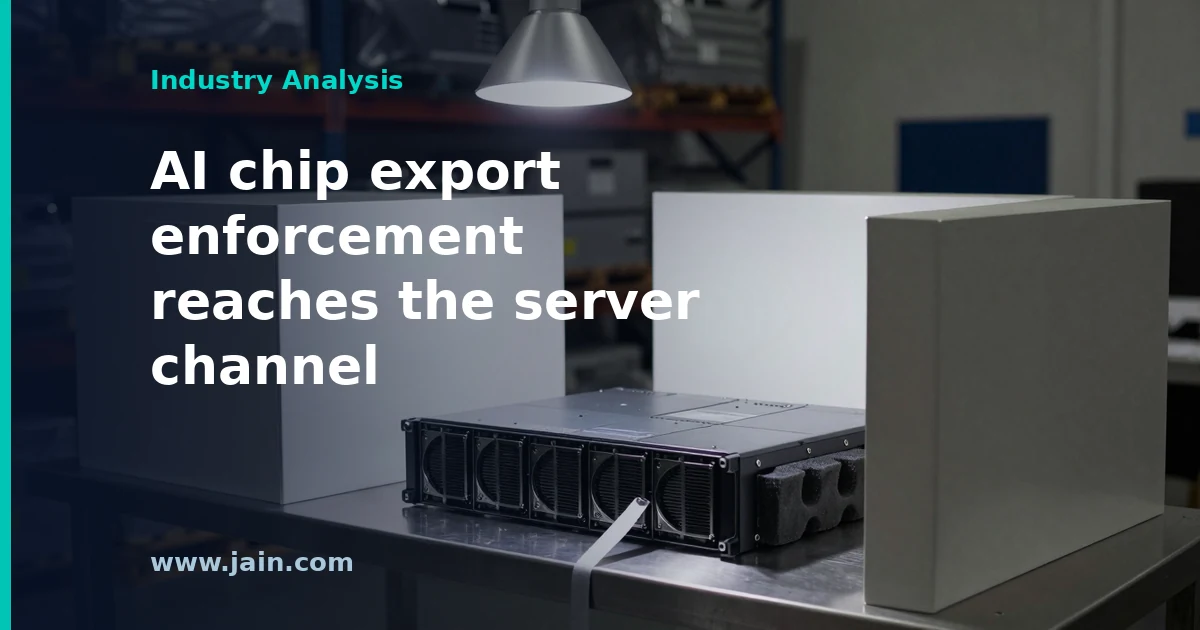
A contractor who worked with Super Micro, an American company that builds the powerful computers used to run artificial intelligence, has admitted in court to helping send those machines to China illegally. The scheme was valued at $2.5 billion.
The computers held chips from Nvidia, whose chips power much of today’s AI. US rules bar selling those advanced chips to China without government permission.
Why it matters: the case targets the people between the chipmaker and the final buyer, not the chipmaker itself. Enforcement is reaching further down the supply chain.
A contractor tied to Super Micro Computer has pleaded guilty in a scheme to divert AI servers containing Nvidia chips to China, Reuters reported. Coverage puts the scheme’s value at $2.5 billion and describes the contractor as a co-defendant of a Super Micro co-founder.
The plea comes in the same week Super Micro disclosed board changes in an 8-K filed October 8. That filing does not mention the export case.
Executive Summary
A guilty plea in a $2.5 billion AI server diversion scheme is among the clearest signals yet of where US export-control enforcement on AI hardware is landing. The equipment at issue was not loose chips but complete servers built around Nvidia GPUs (graphics processing units, the processors that do most AI computation). The person admitting guilt is a contractor, not an employee of the chipmaker.
That matters because it shifts the compliance burden. Export restrictions on advanced AI chips follow the chip into whatever system it is installed in. That makes everyone who builds, resells or ships those systems a potential point of failure, and of liability. For server makers, distributors and the data center operators who buy from them, the case is a reminder that end-user screening is part of the product, not paperwork around it.
The plea establishes guilt only for the person who entered it. Anything alleged against other defendants remains an allegation, and no charges against Super Micro as a company have been reported.
Where a GPU Becomes a Server, Control Gets Harder
Advanced AI chips leave Nvidia in large, traceable allocations to a relatively small set of server makers and cloud buyers. Once a GPU is installed in a server, it becomes one component inside a finished system. That system can then pass through distributors, contractors and resellers before reaching its final operator. US export rules still apply to the chip inside the box, but the chipmaker’s line of sight usually ends at its direct customer.
That gap is the mechanism this case exposes. The diverted goods were Super Micro AI servers with Nvidia chips inside, and the guilty party is a contractor in the server maker’s orbit. At a reported $2.5 billion, the scheme shows how much hardware value can move through the integration and resale layer, the stage after the chip is sold but before the system is plugged in. Controls written around the chip are only as strong as the checks at that downstream stage.
Those affected are the companies that sit between foundry and data hall: server builders, value-added resellers, logistics contractors, and the compliance teams that sign off on who the end user really is. Nvidia’s chips were in the boxes, but Nvidia is not reported to be a defendant and has made no material SEC filing on the matter. The enforcement weight in this case sits downstream.
What the Channel Now Has to Prove
For server makers and their partners, export compliance means knowing the end user and the end use, not just the immediate buyer. A diversion scheme works by putting a permissible-looking customer between the seller and a prohibited destination. A plea at the contractor level gives every company in that chain reason to scrutinize intermediaries, shipping patterns and resale terms more closely.
The economic effect is friction. Legitimate buyers of AI servers, from enterprise IT departments to colocation tenants, may face more documentation about where systems will be deployed and who will operate them. For integrators competing on speed of delivery during a GPU supply crunch, slower deal reviews carry a real cost. The case makes clear that the alternative cost is higher.
What Is and Isn’t Established About Super Micro
Super Micro is one of the largest builders of Nvidia-based AI servers, so any case involving its products draws attention to the company. The facts on the record are narrower than the headlines. A contractor has admitted guilt. A co-founder is described as a co-defendant, which is an allegation, not a finding. No charges against the company have been reported.
Super Micro’s most recent disclosure is an 8-K covering the appointment of former Intel IT chief technology officer Shesha Krishnapura as an independent director and the retirement of director Judy Lin. The filing states that Lin’s departure was not the result of any disagreement with the company, and it does not reference the case. Reading a connection into the timing would go beyond what either the plea or the filing supports.
Background
Since 2022 the United States has restricted exports of advanced AI chips and the systems built around them to China, through rules administered by the Commerce Department’s Bureau of Industry and Security and tightened in later rounds. Nvidia, the dominant supplier of AI accelerators, sells its GPUs largely through server makers and large cloud buyers, which turn them into finished systems.
Super Micro Computer, based in San Jose, California, is one of the biggest of those server makers and a major builder of Nvidia-based AI systems for data centers. Its fiscal year ended June 30, 2026. In early October it announced a board change, adding former Intel IT chief technology officer Shesha Krishnapura and accepting the retirement of director Judy Lin.
A market-news report from Stocktwits says four Taiwan-based staff have been detained in connection with an alleged illegal export of Nvidia artificial-intelligence chips, and that shares of Super Micro Computer (SMCI) — the San Jose-based maker of GPU servers — rose in premarket trading on the news. Super Micro operates significant manufacturing and engineering capacity in Taiwan, which places its regional workforce and supplier network within the geography where the alleged conduct is said to have occurred.
The item circulated as a headline and summary through a news aggregator; the underlying report was not accompanied by charging documents, an official statement from any prosecuting authority, or a company response in the material available to us. No individuals are named, no chip volumes or destinations are specified, and the four detained people have not been convicted of anything. Detention in many jurisdictions, including Taiwan, is an investigative step rather than a finding of guilt.
Executive Summary
What was announced is narrower than the headline implies. The substantiated content is that a financial-news outlet reported detentions connected to an alleged illegal Nvidia chip export, and that SMCI traded higher before the opening bell. The reporting does not, in the material available, establish that the detained individuals are Super Micro employees, that Super Micro is a subject or target of the investigation, or that any of the company’s products were diverted. Readers should hold those as open questions rather than assumptions.
It matters anyway, and for a reason that has little to do with guilt or innocence. Advanced AI accelerators — the high-end graphics processors that train and run large AI models — are now among the most tightly controlled commercial goods in the world. Washington restricts their sale to China and several other destinations, and Taiwan has tightened its own strategic high-tech export rules. Any server vendor that builds GPU systems at scale sits inside that control perimeter, and enforcement actions anywhere along the chain create legal, operational, and reputational exposure.
For buyers and investors, the practical question is not whether this particular case is proven. It is whether the vendors they depend on can demonstrate know-your-customer discipline, end-use verification, and channel controls strong enough that a single rogue transaction — by an employee, a distributor, or a reseller three steps removed — does not interrupt supply or trigger regulatory action. That capability is becoming a genuine differentiator in AI infrastructure procurement.
What the Report Establishes, and What It Does Not
Careful readers should separate three claims that the headline blends together. First: that four people based in Taiwan were detained. Second: that the detentions relate to an alleged illegal export of Nvidia chips. Third: that this is a Super Micro story. The first two are what the report asserts. The third is an inference — reasonable, given the company’s Taiwanese footprint and the fact that the item ran on an SMCI watchlist, but an inference nonetheless. The source material available to us does not name an employer, an authority, a destination country, or a product line.
This is not a reason to dismiss the story. Export-control enforcement is real, ongoing, and has repeatedly touched intermediaries in Asia. It is a reason to be precise about exposure. A company whose employee is accused of wrongdoing faces a different problem from a company whose products were diverted by an unrelated broker, which in turn is different from a company that is itself under investigation. Those three scenarios carry very different consequences for penalties, licence privileges, and customer contracts, and nothing in the available reporting distinguishes among them.
The fair standard to apply is the one any responsible outlet would apply to an activist claim or a short-seller thesis: what evidence is on the table, who produced it, and what would change the conclusion? Here, the evidence is a single aggregated news item. That is enough to warrant attention and enough to justify questions. It is not enough to support a verdict about any company or person.
Export Controls Have Become a Supply Chain Design Problem
For most of the past three decades, server manufacturing optimised for cost, speed, and thermal engineering. Compliance was a back-office function. The AI buildout changed that. High-end accelerators command scarcity pricing, and scarcity pricing creates arbitrage: a chip that cannot legally reach a restricted buyer is worth far more there than at list price. Wherever that gap exists, so does an incentive for diversion — routing goods through a permitted destination and onward to a prohibited one, often via a chain of small trading firms.
That economic pressure lands hardest on the assembly and integration layer, where Super Micro and its peers operate. Server builders touch enormous volumes of controlled silicon, ship to a global reseller channel, and often configure systems for customers they never meet directly. Every one of those handoffs is a place where end-use assurances can fail. Controlling it requires customer screening, shipment tracking, contractual flow-down obligations on resellers, and internal separation of duties — the same discipline banks apply to anti-money-laundering, applied to hardware.
The commercial consequence is a compliance premium. Vendors that can evidence robust controls become safer counterparties for hyperscalers, sovereign AI programmes, and regulated enterprises, all of which face their own supply chain diligence obligations. Vendors that cannot may find themselves priced out of exactly the large, long-horizon contracts that justify capacity investment. Compliance capability is migrating from cost centre to sales asset.
Why the Stock Rose, and What That Signals
SMCI shares moving higher on a story about detentions in an export case looks counterintuitive, but it is a familiar pattern. Equity markets price incremental information against expectations. If investors already assign meaningful probability to regulatory and compliance friction around a name, a report that contains no charges against the company, no quantified financial impact, and no disclosed licence action can resolve as less bad than feared. Premarket trading is also thin, and a single session’s move is weak evidence about anything.
The more durable read is about what the market is actually watching. Demand for GPU server capacity has been the dominant driver for this category of stock, and headlines that do not change the demand picture or the ability to ship tend to fade quickly. That calculus reverses sharply if an enforcement action ever restricts a vendor’s access to controlled components or its right to export — which is the tail risk worth monitoring, not the headline itself.
For institutional buyers, the signal to track is disclosure behaviour. Companies with mature compliance functions typically respond to enforcement reporting with a clear statement of scope: whether they are a subject, whether they are cooperating, whether operations are affected. Silence is not evidence of wrongdoing, but a prompt, specific response is genuine evidence of governance quality, and it is reasonable for customers to weigh it.
Background
Super Micro Computer builds server and storage systems and became one of the most visible beneficiaries of the AI infrastructure boom, supplying dense GPU platforms and liquid-cooled rack systems to data centre operators. Its model depends on rapid configuration and a broad global reseller channel, alongside manufacturing operations in the United States, Taiwan, and elsewhere. The company drew significant investor scrutiny during 2024 and 2025 over delayed financial filings and its auditor’s resignation, and subsequently completed its filings and regained compliance with Nasdaq listing requirements — history that helps explain why governance-adjacent headlines attract outsized attention on this name.
The broader context is a decade-long tightening of technology export policy. Successive US rules have restricted the sale of advanced AI accelerators and semiconductor manufacturing equipment to China and other destinations, and allied jurisdictions including Taiwan have expanded their own strategic high-tech control lists. Because scarce, high-value chips create strong arbitrage incentives, enforcement has increasingly focused on intermediaries — trading firms, resellers, and logistics providers — rather than only on primary manufacturers.