
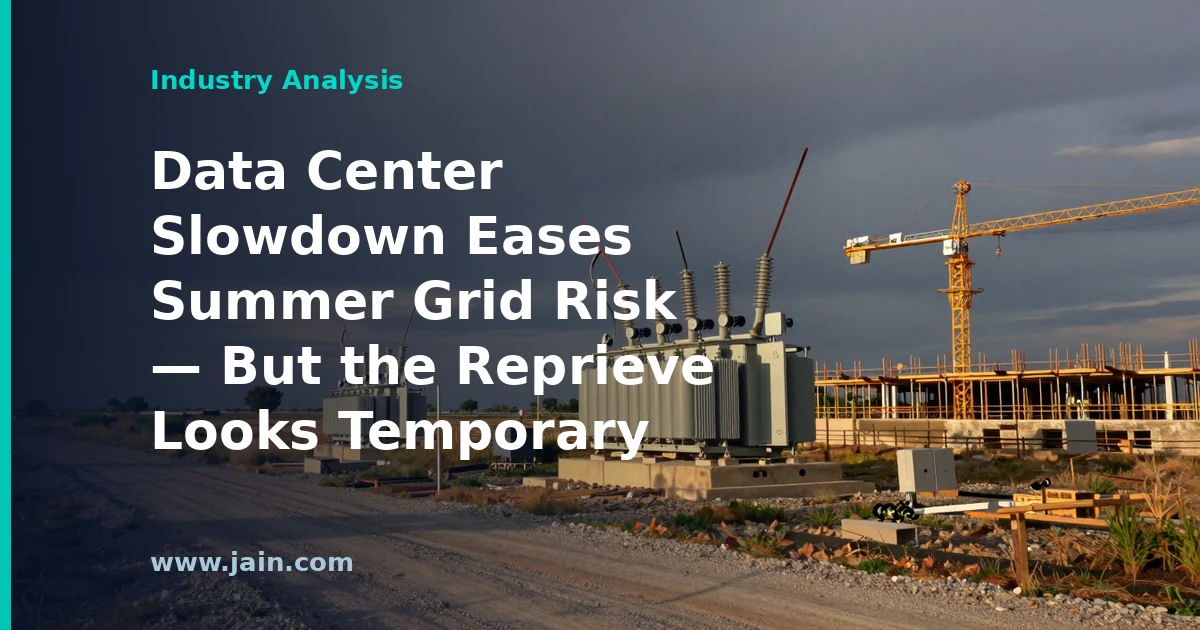
E&E News by POLITICO reported on May 21, 2026, that a slowdown in data center buildout is easing reliability risks for the U.S. electric grid heading into the summer of 2026 — the season when air-conditioning load pushes power systems closest to their limits. The report’s headline carries a caveat as important as its good news: “trouble looms.”
In plain terms: fewer new server farms plugging in right now means less new demand competing for scarce megawatts this summer, but the underlying collision between surging electricity demand and a slow-moving power supply chain has not been resolved — only postponed.
Executive Summary
The report frames a rare piece of breathing room for grid planners. For the past several years, utilities and reliability watchdogs have warned that data centers — especially those built for artificial intelligence workloads — were adding demand to the grid faster than new power plants and transmission lines could be built. A pause or deceleration in that buildout, as E&E News describes, mechanically reduces the risk that supply falls short of demand during summer heat waves.
Why it matters: summer reliability is the acid test of the U.S. power system. When a regional grid runs short, the consequences are emergency alerts, rolling blackouts, and price spikes that land on every ratepayer, not just data center customers. A slower buildout shifts near-term risk down without requiring a single new power plant.
The equally important message is the second half of the headline. A construction slowdown changes the timing of demand, not the trajectory. The structural drivers — AI computing growth, electrification, aging generators retiring, and multi-year waits to connect new supply — remain in place, which is why the report characterizes the relief as temporary rather than a turning point.
Why Slower Buildout Translates Directly Into Grid Relief
Grid reliability is a math problem: expected peak demand versus available supply, with a safety margin on top. Data centers are unusual demand because they arrive in very large blocks — a single campus can require as much power as a small city — and because they run around the clock, including during the late-afternoon summer peak when the grid is most stressed. When projects slip, pause, or get canceled, the demand side of that equation drops immediately, while the supply side (power plants and transmission already under construction) keeps arriving on schedule. That asymmetry is why even a modest deceleration in data center construction shows up quickly in seasonal reliability outlooks.
For grid operators, the near-term effect is wider reserve margins — the buffer between what the system can generate and what customers demand on the hottest day. Wider margins mean fewer emergency conservation calls and less reliance on aging plants being pushed past their planned retirement dates to keep the lights on.
Why the Reprieve Is Temporary, Not a Trend Change
The forces that created the crunch have not gone away. AI training and inference workloads continue to grow, and hyperscale operators have signaled sustained infrastructure investment even as individual projects get re-timed. Meanwhile, the supply side moves on decade-scale clocks: new gas turbines face multi-year equipment backlogs, transmission lines routinely take seven to ten years from planning to energization, and interconnection queues — the waiting lines where new power plants apply to plug into the grid — remain congested across most regions. A demand slowdown measured in quarters cannot offset a supply problem measured in decades.
There is also a rebound dynamic worth watching. If the slowdown reflects developers pausing to renegotiate power availability, tariffs on equipment, or financing terms rather than abandoning projects, the deferred demand returns — potentially in a more concentrated wave. Grid planners who treat this summer’s relief as a new baseline risk being caught out when re-timed projects come back into the queue.
Winners, Losers, and the Signal to Watch
In the near term, ratepayers and grid operators benefit: less emergency procurement, less upward pressure on capacity prices, and a summer with more margin for error. Utilities that raced to justify new generation on the back of data center forecasts face harder questions — regulators were already probing how much projected load is real versus speculative, and a visible slowdown strengthens the skeptics’ hand. For data center developers themselves, a cooler market has a silver lining: sites with secured power become more valuable relative to speculative announcements, rewarding operators who did the unglamorous work of locking in interconnection and substation capacity early.
The signal to watch is whether the slowdown shows up in canceled interconnection requests (a genuine demand reduction) or merely in slower construction starts (a deferral). The first would meaningfully rewrite load forecasts; the second only reschedules the crunch that reliability authorities have been warning about.
Background
Since the generative-AI boom began in late 2022, forecasts of U.S. electricity demand have swung sharply upward after roughly two decades of flat consumption, driven largely by planned data center campuses alongside manufacturing growth and electrification. Reliability authorities and regional grid operators have repeatedly flagged the resulting squeeze: enormous new loads seeking connection while older coal and gas plants retire and replacement generation and transmission crawl through permitting and interconnection processes.
That mismatch made every seasonal reliability assessment a referendum on data center growth, and it made the pace of buildout — not just its ultimate size — a first-order variable for grid planners. The May 2026 E&E News report lands in that context: the first widely noted moment when the demand side of the equation, rather than the supply side, moved in the grid’s favor.
Source: Data center slowdown eases risks to summer grid — but trouble looms — E&E News by POLITICO report, May 21, 2026, on how decelerating data center construction is easing U.S. summer grid reliability risk.