TL;DR · 30-second read
The Short Version
Michigan lawmakers have proposed a set of rules for data centers, the giant warehouses of computers that run apps, cloud services and artificial intelligence.
The biggest of these buildings can use up to 5 million gallons of water a day, about seven Olympic swimming pools. One bill would limit the water a site can permanently use up to about three pools’ worth a day. Another would require cooling systems that reuse the same water over and over.
Developers would also need a signed deal with the local town before they could build or connect to the power grid.
Michigan Democrats introduced a package of bills in early July 2026 to regulate data centers’ energy use, water use, noise, labor standards and use of nondisclosure agreements, MultiState reported. The centerpiece would require operators to sign legally binding community benefit agreements with local governments before they receive site plan approvals, permits or utility interconnection. An interconnection is the approval to connect a facility to the power grid.
The package contains competing Senate and House versions on energy and water. Senate Bill 1047 would require 20-year utility contracts and 90% clean energy procurement. House Bill 6135 would create a new large-load rate class with 15-year contracts and no clean energy mandate. On water, Senate Bill 1046 would cap consumptive use at 2 million gallons per day. The House is considering a requirement for closed-loop cooling or municipal water only.
Executive Summary
Michigan’s package goes beyond one-off siting fights. It would write conditions on energy, water, labor and local benefits into state law. Most permitting disputes are settled project by project in township meetings. These bills would instead set a statewide floor that every large facility would have to clear. None of the bills has passed, and the Senate and House versions differ in important ways.
The water provisions matter most for how facilities are designed. Large data centers can use up to 5 million gallons a day. The Senate would cap consumptive use at 2 million gallons, and the House would require closed-loop cooling or municipal water. The two chambers take different routes, but both would steer developers toward cooling that evaporates less water. The community benefit agreement requirement would change the order of development. A signed local deal would come before the grid connection, not after it.
Michigan is not alone. Six other states have considered community benefit agreement mandates this year. Twelve have weighed closed-loop cooling requirements, and twelve have weighed decommissioning rules. What stands out in Michigan is how many of these ideas arrive together in a single package.
Two Competing Water Bills, One Direction
Senate Bill 1046 would create a new state permit for anyone using, or expecting to use, 550,000 gallons of water or more per day. Applicants would have to hold at least three public hearings before they apply. Permit holders would face a cap of 2 million gallons per day of consumptive use. Consumptive use means water that leaves the local supply and is not returned, mostly through evaporation in cooling towers. For comparison, large data centers can use up to 5 million gallons a day. At that scale, a design that depends on evaporating large volumes of water would struggle to fit under the cap.
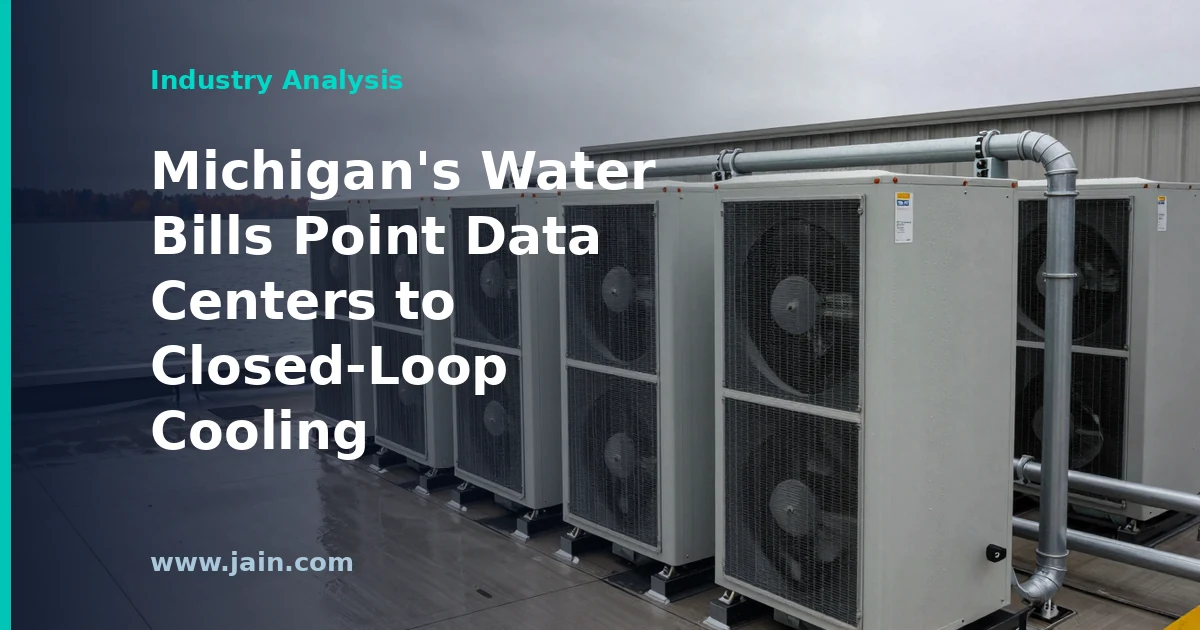
The House approach is blunter. New data centers would have to use closed-loop cooling, which recirculates the same water instead of drawing and discharging fresh supply. The only alternative would be to take water solely from a municipal system. The mechanisms differ: the Senate sets a volume limit, while the House mandates a technology or a water source. The engineering result is similar. Developers planning large campuses in Michigan would be pushed toward low-evaporation cooling, whichever version prevails.
This follows a shift the industry has already started. Operators are actively adopting less water-intensive cooling. The effects spread beyond the building itself. Cooling equipment suppliers would gain a more predictable market. Municipal water utilities could become the default supplier under the House option. Closed-loop and dry cooling generally save water but use more electricity. That puts water policy in direct contact with the energy bills moving alongside it.
The Local Deal Would Come Before the Grid Connection
House Bill 6137 and Senate Bill 1050 would reorder the development process. No local site plan approval, no local permit and no Public Service Commission approval of an interconnection could be issued until the local government approves a community benefit plan. For developers, the negotiation with the host community would move onto the critical path, ahead of the utility process that usually sets project timelines.
The agreements would have to cover at least half of five listed topics, which in practice means three. The topics are local hiring, water use, cost allocation for electrical or water upgrades, community investment funding, and home efficiency improvements. A separate pair of bills, House Bill 6140 and Senate Bill 1049, would bar elected officials and operators from signing nondisclosure agreements about construction when a project receives a tax incentive. Intellectual property could still be redacted. Together, these bills would make the terms of the local negotiation largely public for subsidized projects.
Two Chambers, Two Ways to Price Power
The energy bills share one principle: data centers should pay for their own power, so that other ratepayers do not absorb the cost. Senate Bill 1047 would set firm terms. Contracts would run at least 20 years, customers would be billed for at least 90% of their contracted demand whether they use it or not, and applications would cost $100,000. That billing floor is aimed at the risk of a utility building for a large load that never fully arrives. The Senate bill would also require operators to procure clean energy equal to 90% of their annual usage and to join a demand response program, which pays or credits large users for cutting consumption when the grid is strained.
House Bill 6135 would create a large-load commercial rate class with contracts of at least 15 years. Its financial terms are less strict, and it has no clean energy requirement. On the House side, House Bill 6142 would require every Public Service Commission-approved data center contract to include a decommissioning plan. The plan would need financial assurance, meaning money set aside, sufficient to cover dismantling the facility, and it would be reviewed every three years. Developers comparing states would treat the choice between these two frameworks as a real cost difference, not a technicality.
Labor Standards, and No Moratorium
House Bill 6141 and Senate Bill 1048 would bar the Public Service Commission from approving data center contracts unless construction and maintenance work is done under a labor agreement or collective bargaining agreement. The International Brotherhood of Electrical Workers has urged members to oppose moratorium legislation. The union argues that data centers bring well-paid construction jobs and long-term union employment. That position helps explain the package’s shape: it regulates how data centers are built, not whether they can be built.
The package contains no moratorium and no tax incentive changes. Those questions are being handled in separate Michigan bills. They include proposals to repeal incentives, to exclude data centers from certain property tax exemptions, and to extend a brownfield-zone exemption. The package’s premise is that data centers will keep coming to Michigan and the state should set the terms, which is a middle position between welcoming them unconditionally and blocking them.
Background
Data centers house the servers behind cloud computing, streaming and artificial intelligence. The largest require power on the scale of a small city, and some draw millions of gallons of water a day for cooling. As construction has spread into new regions, state legislatures have moved from offering incentives to setting conditions. States considered hundreds of data center bills last year. This year, six states other than Michigan have weighed community benefit agreement mandates, twelve have weighed closed-loop cooling requirements, and twelve have considered decommissioning rules.
Michigan’s legislature has been active on the issue throughout 2026. Separate bills address data center tax incentives: some would repeal them, one would narrow property tax exemptions, and others would extend a brownfield-zone exemption. The July package is the state’s broadest attempt yet to set operating conditions for the industry. At the federal level, a proposal from Representative Robert Bresnahan would tie federal data center tax credits to community benefit agreements. Source: Michigan Data Center Legislation Targets Energy Use and Community Benefits (MultiState), an overview of Michigan’s proposed data center bills on energy, water, community benefits, noise, nondisclosure agreements and labor standards.Sources