

Tag: speed to power

  • Bloom Energy’s Power Connect Sells Speed, Not Fuel Cells

    Bloom Energy’s Power Connect Sells Speed, Not Fuel Cells

    Bloom Energy (NYSE: BE) has launched Power Connect, an offering the company positions as a way to accelerate data center deployments by delivering on-site electricity without waiting for a utility grid connection. Shares in the company rose 7.6% in the session following the launch, according to the Yahoo Finance report that carried the news.

    The coverage available at the time of writing establishes the product name, its stated purpose and the market’s same-day reaction. It does not disclose contracted capacity, pricing, named launch customers, fuel arrangements or delivery timelines — so the scale of the initiative remains unquantified in the public record.

    Executive Summary

    The announcement is best read as a packaging decision rather than a technology one. Bloom Energy already sells solid oxide fuel cells — refrigerator-sized units that convert natural gas or hydrogen into electricity through an electrochemical reaction instead of combustion. Power Connect reframes that hardware as an answer to a procurement problem: the multi-year queue data center developers face when they ask a utility for hundreds of megawatts.

    That reframing matters because the scarce commodity in the AI build-out is no longer chips or land. It is energized capacity on a defensible schedule. Selling “speed to power” as the product, with the generating equipment as an implementation detail, targets the buyer who has already concluded that the grid cannot serve their timeline and is comparing on-site options on delivery date first and cost second.

    The market response — a 7.6% move — reflects enthusiasm for that positioning, not evidence of demand. No revenue, backlog or customer commitment has been attached to Power Connect in the reporting reviewed here. The commercial test is whether the offering converts into signed, deliverable capacity, and that evidence does not yet exist publicly.

    The Product Is the Wait, Not the Watt

    Every megawatt sold into a data center competes on three axes: cost per megawatt-hour, reliability, and time to first power. For most of the past decade, the first axis dominated, and on that axis fuel cells have historically been a premium product — they cost more per unit of electricity than grid power in most US markets. Power Connect implicitly concedes that contest and moves the argument to the third axis, where the value of arriving eighteen or twenty-four months earlier can dwarf a per-kilowatt-hour premium.

    The arithmetic behind that is straightforward for anyone building AI capacity. A hall of accelerators that sits dark is depreciating hardware and idle contracted demand. If on-site generation lets a facility monetize that hardware materially sooner, the developer is effectively buying calendar time, and the fuel cell is the delivery mechanism. Framing the offering around the interconnection queue — the line of projects waiting on utility studies, upgrades and approvals — is a recognition that the buyer’s pain is administrative and physical, not thermodynamic.

    What the naming does not change is the underlying engineering and permitting reality. On-site generation still requires gas supply, air permits in many jurisdictions, local approvals and interconnection of a different kind. A product name can compress the sales cycle; it cannot by itself compress a permitting authority’s review. Whether Power Connect bundles any of that regulatory and logistical work into a single contractual commitment is precisely the detail the available coverage does not settle.

    Why the Interconnection Queue Became a Product Category

    Bloom is not inventing this market, it is naming its position in one that has formed rapidly. Reciprocating-engine generator fleets, aeroderivative and industrial gas turbines, linear generators and utility bridge-power arrangements are all being sold into the same gap. Large-frame turbine manufacturers have order books stretching years out, which pushes developers toward whatever can be built and commissioned faster, and pushes suppliers to compete on schedule certainty rather than efficiency curves.

    Fuel cells bring genuine advantages into that comparison. Because they generate electricity electrochemically rather than by burning fuel, they emit negligible nitrogen oxides and particulates, which is often the binding constraint for siting thermal generation near populated areas or in regions with strained air quality permitting. They are modular, so capacity can be added in increments that track a phased data center build rather than requiring a single large commitment up front. They are also quiet, which matters for community acceptance.

    The offsetting realities are equally concrete. Fuel cells generally carry higher capital cost per kilowatt than reciprocating engines, they consume natural gas and therefore expose the buyer to commodity and pipeline-capacity risk, and stack replacement over the life of the asset is an operating cost that must be underwritten. None of that disqualifies the approach — it does mean that any comparison should be made on a full lifecycle basis, and that a launch announcement is not the place to find those numbers.

    Winners, Losers and the Utility Question

    The clearest beneficiary of a productized speed-to-power offer is the developer with a signed tenant and no energization date. The clearest loser is not the utility, at least not immediately. Behind-the-meter generation in this cycle is more often a bridge than a divorce: developers energize early on site, then transition to grid supply when the interconnection completes, sometimes retaining the on-site plant for resilience or peak-shaving. Utilities lose near-term load but frequently retain the customer, and in some cases gain a dispatchable resource on their system.

    The more exposed parties are competing on-site generation vendors and, over a longer horizon, developers who bet on grid timelines they cannot control. There is also a policy dimension worth watching without overstating it: as more large loads self-supply, the cost of shared transmission infrastructure is spread across a smaller base, and regulators in several markets are actively examining how large-load tariffs should handle that. This is a live question, not a settled criticism, and it applies to every on-site generation vendor rather than to Bloom specifically.

    Reading the 7.6% Move Honestly

    A same-session gain of 7.6% is a real data point about sentiment and a weak one about fundamentals. Bloom trades as a high-expectation name tied to AI power demand, and in that regime announcements that connect a company to the scarcest input in the sector tend to move the stock regardless of disclosed economics. The move tells us investors found the positioning credible. It does not tell us that anyone has bought anything.

    The disciplined way to track this is to look for the follow-through that a genuine product launch produces: named customers, contracted megawatts, revenue recognized under the offering, or backlog disclosed in subsequent quarterly reporting. Those are falsifiable. Until at least one of them appears, Power Connect is a well-aimed go-to-market motion addressed to a real and demonstrable market constraint — which is a reasonable thing to be, and less than a booked order.

    For buyers, the practical read is simpler. A vendor competing explicitly on schedule invites schedule-based diligence: what is contractually guaranteed, what remedies attach to a missed energization date, and which dependencies — gas service, permits, grid backup — remain the buyer’s risk. Those questions are answerable in a term sheet even when they are absent from a press release.

    Background

    Bloom Energy manufactures solid oxide fuel cell systems that generate electricity on site from natural gas, biogas or hydrogen without combustion. The company sells to commercial, industrial and data center customers who want power that is independent of, or supplementary to, the local grid, and it has traded publicly on the New York Stock Exchange under the ticker BE since its 2018 listing.

    The market context has shifted sharply in its favor. AI computing has driven data center power requirements to a scale that utilities in many regions cannot serve on developers’ timelines, with interconnection studies and transmission upgrades stretching over years and large turbine manufacturers carrying multi-year order backlogs. That bottleneck has created a distinct commercial category — generation that can be sited and commissioned quickly next to the load — and Power Connect is Bloom’s explicit entry into it.

    Source: Bloom Energy (BE) Is Up 7.6% After Launching Power Connect To Speed Data Center Deployments — Yahoo Finance reports Bloom Energy’s launch of Power Connect for faster data center power delivery and the resulting share-price move.
  • FERC’s Data Center Interconnection Decision: What It Means for Speed to Power

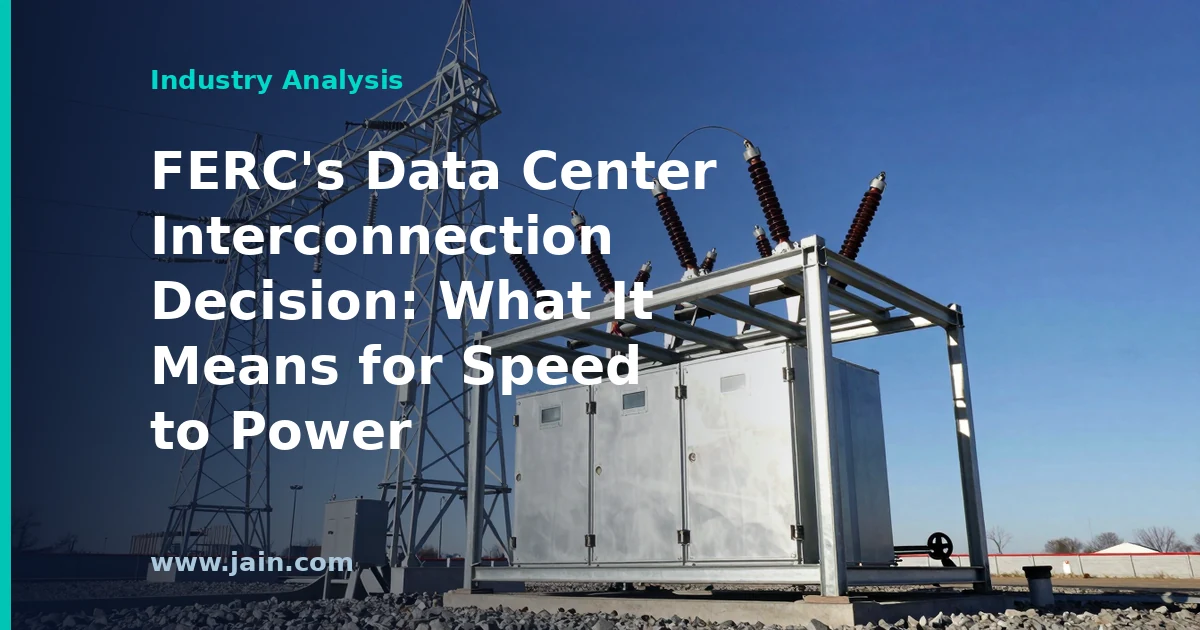
    FERC’s Data Center Interconnection Decision: What It Means for Speed to Power

    The Federal Energy Regulatory Commission (FERC) — the U.S. agency that oversees the interstate transmission grid — has issued a decision on how data centers and other very large electricity loads interconnect to that grid, according to a June 21, 2026 Utility Dive analysis distilling the ruling into six takeaways. The decision lands in the middle of the defining constraint of the AI buildout: data center campuses now requesting hundreds of megawatts, and in some cases gigawatts, of power from a grid whose connection processes were never designed for loads of that scale.

    Executive Summary

    For most of the grid’s history, connecting a new factory or office park was a routine utility matter. AI-era data centers broke that model: single campuses now ask for as much power as a mid-sized city, and the question of how — and how fast — they plug into the high-voltage grid has escalated from a paperwork exercise into a national policy fight. FERC’s decision, as covered by Utility Dive, speaks directly to that question of large-load interconnection.

    Why it matters: ‘speed to power’ has become the number-one site-selection criterion in the data center industry, ahead of land, fiber, and even tax incentives. Any FERC ruling that clarifies the rules of the road for large-load interconnection reshapes where capital flows — which utilities and regions can credibly promise fast connections, which co-location strategies (siting data centers next to power plants) remain viable, and who pays for the grid upgrades these loads trigger. The six-takeaways framing of the trade-press coverage signals a decision with multiple moving parts rather than a single yes/no outcome; the specifics of each takeaway are not enumerated in the source material available to us, and we flag that plainly in the gaps below.

    Why the Grid’s Referee Stepped Into the Load Line

    FERC regulates the interstate transmission system and the wholesale power markets that run on it, while states regulate retail electric service. Data centers sit awkwardly across that seam: they are retail customers, but at gigawatt scale their connections have unmistakable effects on the interstate grid — congestion, reliability margins, and the cost of upgrades shared across entire regions. That is why disputes over large-load and co-located interconnection have been climbing toward FERC for the past two years, most visibly in the PJM region (the 13-state mid-Atlantic grid operator), where fights over siting data centers behind the meter at existing power plants forced the commission to examine the rules directly.

    The deeper issue is asymmetry. FERC’s Order 2023 overhauled how new generators queue up to connect — moving to clustered, first-ready-first-served studies — but no equivalent standardized federal framework existed for very large loads. Each utility and regional grid operator improvised its own process, producing wildly different timelines and study requirements. A FERC decision on data center interconnection is significant precisely because it addresses that gap: it tells utilities, grid operators, and developers what the referee expects when a gigawatt-class customer knocks on the door.

    Speed to Power Is the Whole Ballgame

    In today’s market, the scarce input for AI infrastructure is not chips or capital — it is energized megawatts on a firm date. Interconnection timelines of four to seven years for large loads in constrained markets have pushed developers toward workarounds: co-locating next to nuclear or gas plants, contracting for on-site generation, or chasing secondary markets with spare grid headroom. Every one of those strategies is priced off the baseline question of how long a conventional grid connection takes, which is exactly the variable a FERC interconnection ruling moves.

    The economics cut both ways. Clearer, faster, more standardized processes would compress project timelines and reduce the option value of exotic workarounds. But greater rigor — more demanding studies, firmer cost-allocation rules, or requirements that large loads demonstrate readiness — could slow the most speculative requests. That would be a feature, not a bug, for grid planners: utilities report far more requested data center load than will ever be built, as developers file duplicate requests across multiple territories, and ‘phantom load’ distorts forecasts and infrastructure spending that ratepayers ultimately fund.

    Winners, Losers, and the Cost-Allocation Question

    Watch three constituencies. Hyperscalers and large developers benefit from any added certainty, even if the rules tighten — sophisticated players with real projects and balance sheets clear readiness screens that speculative filers cannot. Utilities in load-growth regions gain a firmer basis for the tens of billions in transmission investment that data center demand justifies, but inherit whatever process obligations the decision imposes. Existing ratepayers have the most at stake and the least voice: the central distributive question in every large-load proceeding is whether the data center pays the full cost of the grid capacity it triggers or whether some of it socializes into everyone’s bills.

    There is also a competitive-geography effect. Interconnection friction has been quietly redistributing the data center map away from saturated hubs like Northern Virginia toward regions marketing surplus grid capacity. A federal ruling that harmonizes how large-load requests are handled would narrow the arbitrage between jurisdictions — good for national planning coherence, less good for regions whose pitch was procedural speed rather than physical capacity.

    What a Six-Takeaways Ruling Usually Signals

    When the trade press needs six takeaways to summarize a decision, the outcome is rarely a clean win for any single party — it typically indicates a framework ruling that resolves some questions, defers others to compliance filings or regional processes, and draws jurisdictional lines that will themselves be tested. Readers should treat the decision as the start of an implementation phase, not the end of the argument: FERC orders of this consequence routinely draw rehearing requests and appellate challenges, and the practical effect on connection timelines will depend on how grid operators and utilities translate the ruling into tariff language over the following months. We note candidly that the source material available for this article does not enumerate the six takeaways themselves; the analysis here reflects the well-documented context of the proceeding rather than the order’s specific holdings.

    Background

    The road to this decision runs through two years of escalating conflict between the AI buildout and the grid. FERC’s Order 2023 modernized interconnection for generators but left large loads without a standardized federal process. Then the co-location fights began: high-profile disputes in the PJM region over siting data centers behind the meter at existing power plants — including the commission’s closely watched 2024 rejection of an expanded arrangement at a nuclear station — pushed FERC to open proceedings examining large-load and co-located interconnection directly. Meanwhile, utility load forecasts, flat for two decades, turned sharply upward on data center demand, making the question of how these loads connect one of the most consequential in U.S. energy policy.

    Utility Dive, the trade publication behind the six-takeaways analysis, is a widely read source of daily coverage of the U.S. electric power sector, and its framing of commission orders is a common first read for industry professionals tracking regulatory developments.

    Source: 6 takeaways from FERC’s data center interconnection decision — Utility Dive’s June 21, 2026 analysis of the commission’s ruling on how large loads connect to the grid.

  • DOE ‘Speed to Power’ Targets AI Data Center Grid Delays

    DOE ‘Speed to Power’ Targets AI Data Center Grid Delays

    The U.S. Department of Energy has publicized a ‘Speed to Power’ effort focused on accelerating electric grid capacity for artificial intelligence data centers. Coverage surfaced via a DOE.gov item aggregated in June 2026, framing the initiative as a federal response to grid delays constraining large AI compute buildouts.

    Executive Summary

    DOE’s ‘Speed to Power’ is positioned as a program to compress the timelines that stand between AI data center projects and the megawatts they need to operate. The core problem it targets is well documented: interconnection queues, transmission siting, and new generation approvals routinely take years, while proposed AI campuses are being sized in hundreds of megawatts to multiple gigawatts.

    The materials available at publication are thin on operational specifics, but the signal itself matters. When a cabinet department brands an initiative around ‘speed,’ it typically foreshadows a package of permitting guidance, loan-program alignment, and coordination with grid operators and states. For hyperscalers, colocation developers, and utilities, even a directional federal posture reshapes how projects are staged and financed.

    Why Power, Not Chips, Is Now the Bottleneck

    For roughly two decades, data center growth was gated by capital, land, and semiconductor supply. In the AI era, the binding constraint has shifted to electricity: the ability to interconnect large loads to a transmission system that was not planned for gigawatt-scale campuses on short timelines. Interconnection studies, transmission upgrades, and new generation each carry multi-year lead times, and they must line up in sequence. A federal ‘Speed to Power’ framing is an acknowledgment that no single utility or state can solve this alone.

    For laypeople: ‘interconnection’ is the technical and legal process by which a new large customer — or a new power plant — is allowed to plug into the grid. It requires engineering studies to confirm the grid can handle the flows without instability, and often triggers upgrades that the requester helps fund. Queues at major U.S. grid operators have grown into the thousands of projects.

    What a Federal ‘Speed’ Program Can and Cannot Do

    DOE has real levers: loan guarantees through the Loan Programs Office, coordination authority on transmission corridors, research funding, and convening power with the Federal Energy Regulatory Commission (FERC), regional transmission organizations, and state public utility commissions. It can also fund studies that let utilities pre-position upgrades rather than wait for individual customer requests. Those tools can meaningfully shorten some timelines.

    What DOE cannot do unilaterally is override state siting authority, compel a utility’s integrated resource plan, or bypass the rate cases that determine who pays for new transmission. If ‘Speed to Power’ is largely exhortation and coordination, its impact will depend on whether FERC rulemakings and state commissions move in parallel. If it comes with binding funding conditions or new categorical permitting pathways, the effect could be larger — but those details are not visible in the source material.

    Winners, Losers, and the Cost Question

    The clearest beneficiaries of a faster interconnection regime are hyperscale operators and AI-focused developers with projects already in queue, along with the utilities serving load-growth regions such as Northern Virginia, central Ohio, and parts of Texas and the Southeast. Independent power producers with dispatchable capacity — gas, nuclear, and storage-paired renewables — also stand to gain if new generation approvals accelerate.

    The harder question is cost allocation. Grid upgrades funded to serve very large single customers can, under some tariff structures, socialize costs onto residential and small commercial ratepayers. Consumer advocates and several state commissions have already begun pushing back on that outcome. Any federal ‘speed’ initiative that does not address who pays risks trading one delay — engineering queues — for another: contested rate cases and political backlash.

    Background

    Electricity demand in the United States was essentially flat for over a decade before roughly 2022, when a combination of AI compute growth, domestic manufacturing reshoring, and electrification began pushing utility load forecasts sharply higher. Data center power demand has become the most visible driver, with major hubs in Northern Virginia, Ohio, Texas, Arizona, and the Southeast reporting multi-gigawatt pipelines.

    The U.S. Department of Energy sets national energy policy, administers loan programs for energy projects, funds research through the national labs, and coordinates with independent regulators including the Federal Energy Regulatory Commission. It does not directly permit most power plants or transmission lines — those authorities generally rest with states and regional grid operators — but its convening role and funding levers give it meaningful influence over the pace of buildout.

    Source: Speed to Power – Department of Energy (.gov) — DOE-branded initiative framed around accelerating grid capacity for AI data centers.