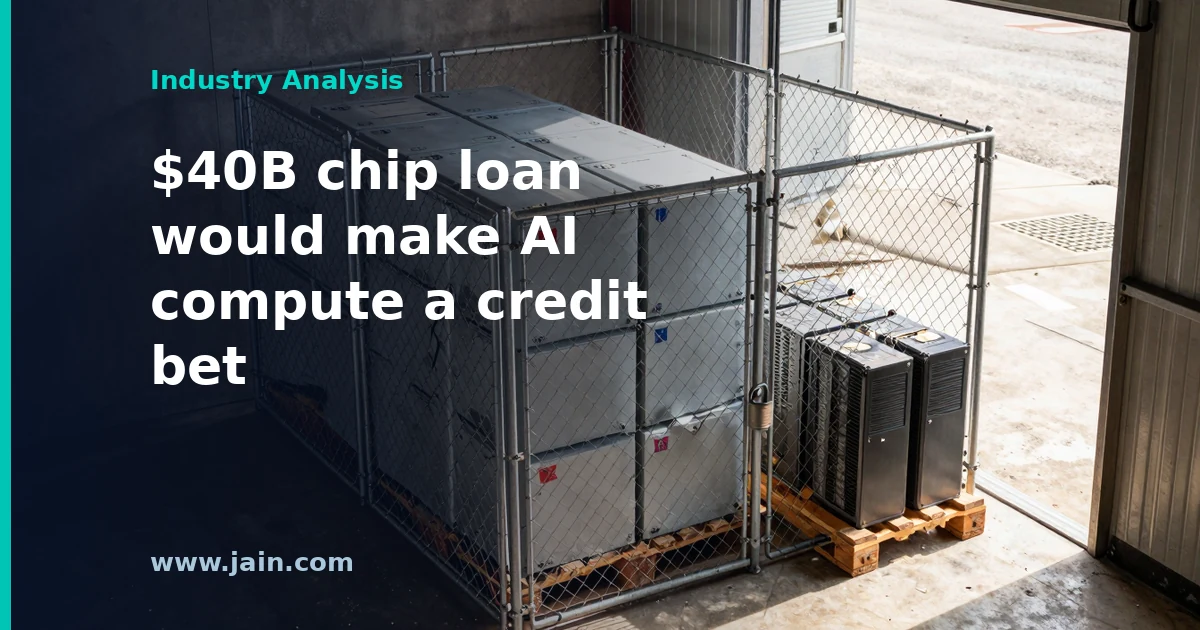
SpaceX, the rocket and satellite company, is reportedly negotiating to borrow $40 billion to buy computer chips from Nvidia, the company whose chips run most artificial intelligence tools.
Apollo, a giant investment firm, would lead the lending, so the chips would be bought with borrowed money rather than money SpaceX already has.
Why it matters: when buying chips depends on loans this large, the AI boom also depends on lenders getting repaid, and AI chips lose value quickly as newer ones arrive.
SpaceX is in talks to borrow $40 billion to buy Nvidia chips, Bloomberg reported. The Financial Times, in a report relayed by Reuters, said Apollo Global Management is leading the financing. No signed agreement has been announced. SpaceX and Apollo have not disclosed terms, the chip quantities, or a timeline.
Executive Summary
The reported financing would put a $40 billion debt package, led by one of the largest private-credit managers, behind a single company’s purchase of AI chips. Private credit means loans made by investment firms rather than banks. Nvidia’s graphics processing units (GPUs) are the specialised processors that train and run most large AI models, and they are the most expensive line item in an AI data center.
It matters because of how the purchase is paid for, not only because of its size. A buyer that pays for chips from operating cash or new equity bears the risk itself. A buyer that borrows $40 billion takes on fixed repayment obligations, and its lenders take on part of the risk. If the talks conclude, how fast SpaceX adds AI computing capacity would depend partly on lender terms, collateral and repayment schedules.
Why a $40 Billion Loan Turns Compute Into a Credit Question
A company that buys AI chips with its own cash answers mainly to its shareholders. If the chips earn less than expected, the owners absorb the loss. A company that borrows $40 billion for the same purchase faces a different test. Interest and principal fall due on a schedule whether or not the hardware is fully used. The lenders, here a group led by Apollo, have to decide in advance how much the chips will earn and how quickly that cash will come in.
That changes the questions that decide the deal. Before committing, lenders typically ask what revenue the computing capacity will produce, how quickly the chips lose value, what they could recover if repayment faltered, and how long the loan runs compared with the hardware’s useful life. None of the terms have been made public. Still, at $40 billion, the answers to those questions would shape the pace and cost of SpaceX’s chip purchases as much as Nvidia’s supply would.
Several groups are exposed. SpaceX would take on fixed obligations. Apollo and any co-lenders, along with the investors whose money they deploy, would take on part of the hardware risk. Nvidia would book demand that rests partly on borrowed money rather than the buyer’s own funds.
Why a Private-Credit Manager Would Lead
Private-credit firms raise long-term capital from insurers, pension funds and other institutions. They can commit large sums to a single borrower and set terms privately, without the public pricing of a bond sale. That makes them a natural fit for a borrower seeking a very large, bespoke package. Reports describe Apollo as leading the financing, which suggests other lenders could take part, though no participants have been named.
Apollo’s balance sheet shows why insurance-linked capital matters to firms like it. In an 8-K filed October 5, Apollo said Athene, its retirement-services subsidiary, holds most of its alternative investments, and estimated third-quarter alternative net investment income of about $375 million pre-tax, an annualised return of roughly 10%. That filing previews quarterly results and does not mention SpaceX or Nvidia. Whether any of the SpaceX exposure would end up on Athene’s books has not been disclosed.
The Depreciation Problem Lenders Have to Price
AI chips lose value faster than most assets usually financed with long-term debt. Nvidia releases new GPU generations frequently, and each one cuts the market value of the last. A loan secured against chips, or repaid from the revenue they generate, is only as sound as its assumptions about how long the hardware stays competitive.
Lenders in AI financings have used the chips themselves as collateral (security that a lender can seize if a loan is not repaid). SpaceX and Apollo have not said whether this deal would be secured that way, or backed instead by SpaceX’s broader business. The difference matters. A loan backed by GPUs ties the lender’s recovery to second-hand chip prices. A loan backed by the whole company ties it to SpaceX’s overall cash flow.
What Follows Downstream: Sites, Power and Cooling
Chips bought with $40 billion of debt only start earning once they are installed and running, so delays in data center capacity become delays in repaying the loan. Each rack of high-end GPUs needs floor space, a reliable electricity supply and, increasingly, liquid cooling, because air alone cannot remove the heat dense AI hardware produces.
For data center developers, utilities and cooling suppliers, debt-financed purchases make the timetable less forgiving. Hardware that sits in a warehouse waiting for power still accrues interest. SpaceX has not disclosed where the chips would be deployed or how much electrical capacity they would require.
Background
Nvidia’s GPUs, originally built for graphics, became the default hardware for training and running large AI models. They are now the most expensive single component of an AI data center, and buyers have funded them through operating cash, equity and, increasingly, debt. SpaceX is best known for rocket launches and satellite services.
Apollo Global Management is a New York-based alternative asset manager. Its businesses include private credit and retirement services through its subsidiary Athene. Apollo is scheduled to report third-quarter results on November 3, 2026, according to its October 5 SEC filing.
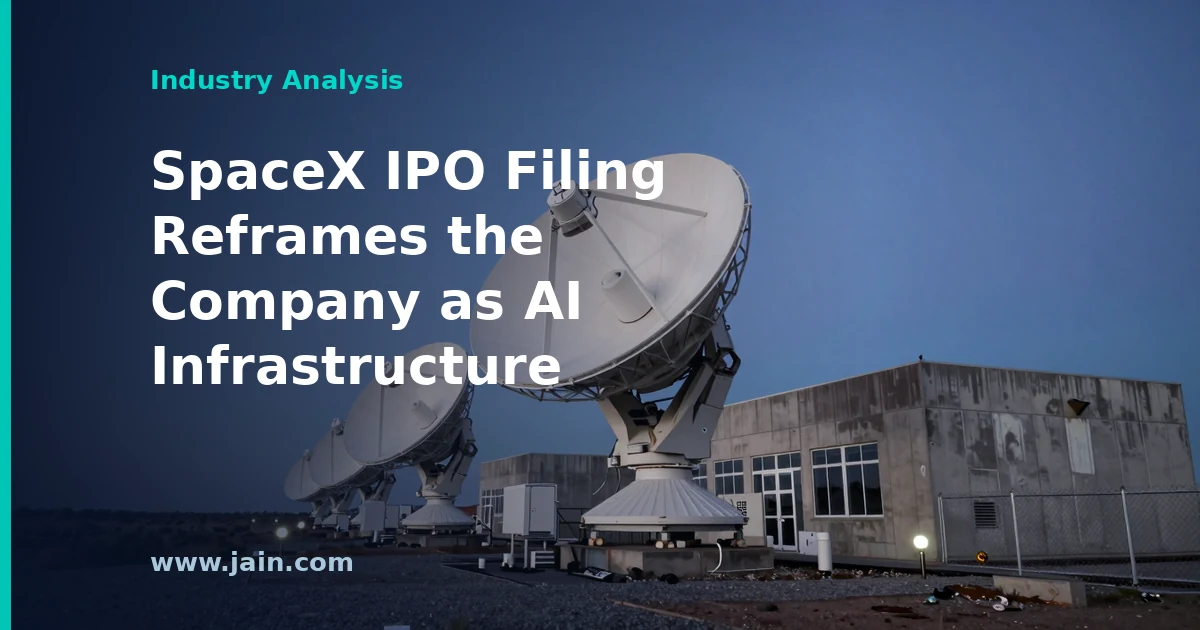
SpaceX has filed for an initial public offering that positions the company not primarily as a launch provider or satellite broadband operator, but as an AI infrastructure company, according to a May 20, 2026 report from Data Center Knowledge. The framing places one of the most valuable private companies in the world directly into the capital-markets conversation that has, until now, centered on terrestrial data centers, chips, and power.
The aggregated report is headline-level: it confirms the filing and the AI-infrastructure positioning, but the underlying financial details, offering terms, and the specific claims SpaceX makes in its prospectus were not included in the source material available at publication.
Executive Summary
The significance of the reported filing is less the IPO itself — SpaceX going public has been speculated about for years — than the identity the company has reportedly chosen for its public debut. “AI infrastructure” is today’s most valuation-rich category in public markets, encompassing the data centers, accelerated computing, power, and networks that train and serve artificial-intelligence models. By recasting itself under that banner, SpaceX invites comparison not with aerospace peers but with the companies building gigawatt-scale compute campuses on the ground.
For the data center industry, the filing is a signal worth taking seriously even before the prospectus details emerge. SpaceX uniquely controls two assets that any credible orbital-compute story requires: low-cost, high-cadence launch capacity, and an operating satellite constellation with optical inter-satellite links. If the public markets fund an orbital extension of AI infrastructure, the competitive and complementary effects on terrestrial operators — in power procurement, connectivity, and edge architecture — become a live strategic question rather than a thought experiment.
That said, the reporting available so far substantiates a positioning choice, not a product roadmap. What SpaceX has actually committed to build, on what timeline, and with what economics remains to be read in the filing itself.
From Rockets to Racks: Why the Reframing Matters
Capital markets price companies by category as much as by cash flow. Launch services are a lumpy, contract-driven business; consumer broadband is a subscription business with heavy capital expenditure. AI infrastructure, by contrast, has commanded premium multiples because investors see structural, multi-year demand from model training and inference outrunning the supply of powered data center capacity. If SpaceX can persuade the market that its launch system and satellite constellation are ingredients of AI infrastructure — the way land, power, and fiber are for a terrestrial operator — it changes the comparison set used to value the company.
The reframing is not baseless on its face. SpaceX’s core capabilities map onto real AI-infrastructure bottlenecks: launch is the logistics layer for putting hardware where energy is abundant, and a laser-linked satellite network is, functionally, a global backbone. But a positioning statement in a filing is a claim, not a delivered capability, and the burden of proof — deployed compute, paying customers, unit economics — sits with the prospectus, which the available reporting does not yet detail.
Orbital Compute: The Physics Is the Business Case — and the Obstacle
The idea behind space-based data centers is straightforward: in the right orbit, a satellite can collect solar power nearly continuously, without land acquisition, grid interconnection queues, water permits, or local opposition — the very constraints that have slowed terrestrial data center construction. For an industry whose defining shortage is powered land, that pitch has obvious appeal.
The counterweights are equally physical. Vacuum removes the two workhorses of terrestrial cooling — air and water — so waste heat must be shed by radiators, which grow large and heavy as compute density rises. Radiation degrades commercial silicon, hardware cannot be swapped by a technician on a three-year refresh cycle, and every kilogram of server, radiator, and solar array must be launched. The economics therefore hinge almost entirely on launch cost per kilogram, which is precisely the variable SpaceX controls better than anyone — and precisely why the company, rather than a startup, can make this argument credibly. Whether the math closes at scale is the question the filing needs to answer with numbers.
What It Means for Terrestrial Data Centers
Near term, orbital compute is not a substitute for ground infrastructure. Latency to low Earth orbit is workable for batch workloads such as model training but adds constraints for interactive inference, and any orbital fleet still depends on ground stations, terrestrial fiber, and earthbound data centers for ingest, storage, and distribution. The more realistic framing is a new tier in the infrastructure hierarchy — a place to put energy-hungry, latency-tolerant workloads — alongside, not instead of, terrestrial campuses.
For operators and buyers on the ground, the second-order effects may arrive sooner than orbital racks do. A publicly traded SpaceX marketing itself as AI infrastructure creates a new benchmark for how investors value connectivity plus compute; it strengthens satellite backhaul as a connectivity option for remote and edge sites; and it intensifies the argument that the binding constraint in AI is energy, not silicon. Data center firms whose value proposition is secured power, dense fiber, and operational reliability should read this filing as validation of that thesis — and as notice that new forms of competition for AI capital are emerging.
Reading a Headline, Not a Prospectus
It is worth being plain about what the source material supports. A single aggregated report confirms that a filing exists and that its framing emphasizes AI infrastructure. It does not, in the material available, disclose revenue mix, profitability, offering size, valuation, or any specific orbital-compute commitment. Headlines about repositioning can reflect a genuine strategic pivot, or they can reflect narrative packaging for an offering into a receptive market — and those two explanations are not mutually exclusive.
The fair test, applied here as we would apply it to any terrestrial operator’s announcement, is disclosure: does the prospectus quantify AI-attributable revenue today, name customers or contracts, and put capital and timelines against the orbital ambitions? Until those pages are public and parsed, the measured conclusion is that SpaceX has made a consequential claim about what kind of company it is — and the evidence for that claim is still to be examined.
Background
Founded in 2002, SpaceX transformed the launch industry by developing reusable rockets, and its Falcon 9 became the workhorse of global spaceflight with a launch cadence no competitor has matched. The company then vertically integrated into satellite services with Starlink, a low-Earth-orbit constellation providing broadband to consumers, enterprises, governments, and maritime and aviation customers. Through repeated private funding rounds, SpaceX became one of the most valuable private companies in the world while developing Starship, a fully reusable heavy-lift vehicle intended to cut launch costs further.
The reported IPO filing lands amid an AI-driven infrastructure boom in which data center development has been constrained less by demand than by electric power and buildable land — conditions that have pushed the industry to examine unconventional sites, and now, potentially, orbit.