
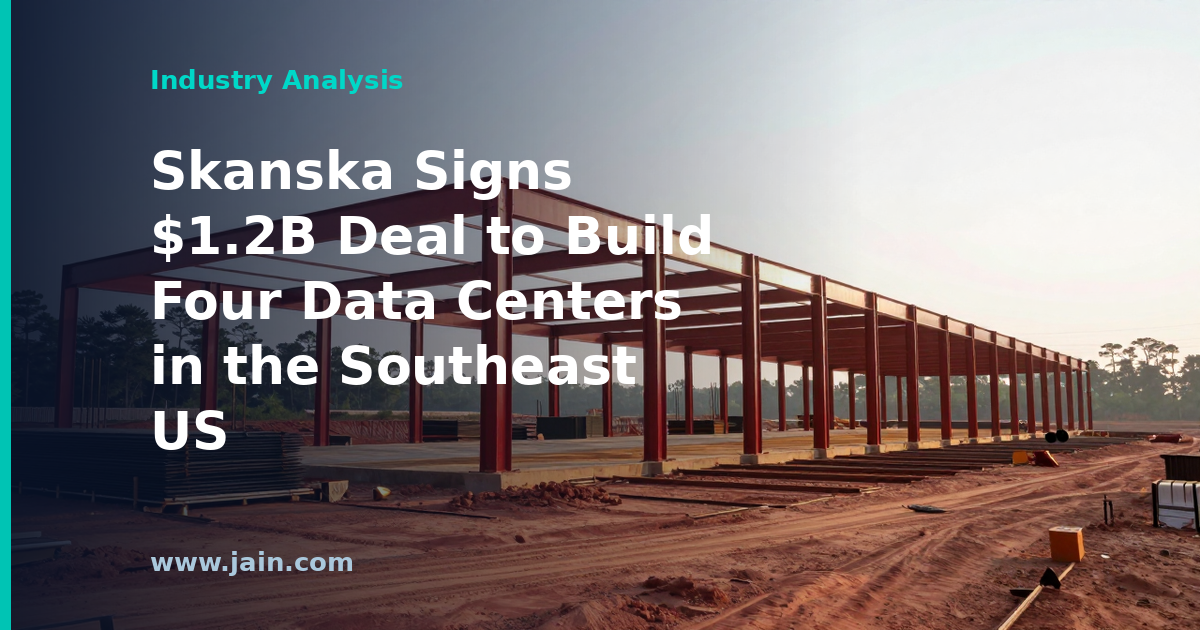
Swedish construction group Skanska announced on August 20, 2026 that it has signed a contract with an existing client to build four new data centers in the southeast United States. The contract is worth USD 1.2 billion (about SEK 11.2 billion) and will be booked in Skanska’s US order bookings for the third quarter of 2026.
The four facilities total approximately 75,000 square meters (808,000 square feet). Skanska’s scope covers the building shell plus interior fit-out for technical spaces, support areas, and offices. Construction begins in the third quarter of 2026 and is expected to finish in the third quarter of 2028.
Executive Summary
Skanska’s announcement is short on specifics — the client, the exact locations, and the facilities’ power capacity are all undisclosed — but the headline numbers tell a clear story: a single customer is committing to four buildings at once, worth $1.2 billion in construction value alone, on a two-year delivery clock. That is a program, not a project, and it reflects how hyperscale and large-enterprise data center buyers now procure capacity in multi-site batches rather than one building at a time.
The deal also reinforces the southeast US as a serious data center growth corridor. As land, power interconnection queues, and community pushback tighten conditions in established hubs like Northern Virginia, developers have increasingly looked south for available land, comparatively faster utility timelines, and business-friendly permitting. A four-facility award in the region — from a repeat client, no less — suggests that migration of demand is continuing.
For the construction industry, the contract underscores that data centers have become a core revenue engine for major contractors. Skanska separately announced an additional $238 million data center contract in Virginia, indicating a pipeline of repeat data center work across multiple US regions.
A Program Buy, Not a Building Buy
The most telling detail in this release is not the dollar figure but the structure: one client, four facilities, one contract. Data center customers with large, predictable capacity needs — typically cloud platforms, AI companies, or the developers who serve them — increasingly bundle construction into multi-site programs. Bundling locks in contractor capacity, standardizes designs across sites, and compresses delivery schedules, all of which matter when the constraint on growth is how fast physical capacity can be stood up rather than how much capital is available.
The ‘existing client’ framing matters too. Repeat awards are how construction firms build durable data center franchises: a contractor that has already delivered for a customer carries proven designs, familiar subcontractor networks, and established safety and quality track records into the next award. For Skanska, converting one relationship into a four-building, $1.2 billion follow-on is evidence that this flywheel is working — though it also concentrates revenue exposure in a single customer relationship, a tradeoff worth noting.
Why the Southeast, and What It Strains
The southeast US has become one of the fastest-growing data center regions because the traditional hubs are congested. Northern Virginia — the world’s largest data center market — faces multi-year waits for grid interconnection (the process of getting a utility to deliver large blocks of power to a new site), rising land costs, and local zoning battles. States across the southeast have courted the industry with available land, tax incentives, and utilities willing to plan for large new loads.
But four facilities landing at once in one region illustrates the strain this growth creates. Data centers are extraordinarily power-dense buildings, and every new campus adds load that regional utilities must generate, transmit, and balance. Meanwhile, the specialized trades that data center construction depends on — electricians, mechanical fitters, controls technicians — are in short supply nationally, and the southeast’s simultaneous boom in chip plants, battery factories, and other industrial projects competes for the same workers. The release does not say how these projects will be powered or staffed, and those are precisely the variables that determine whether a Q3 2028 completion date holds.
The Economics of Shell and Fit-Out
Skanska’s scope — shell construction plus interior fit-out of technical, support, and office spaces — works out to roughly $300 million per building, or on the order of $1,500 per square foot across the 808,000-square-foot program based on the disclosed figures. That is far above typical commercial construction costs, which reflects what a data center actually is: the building is effectively a machine, dense with structural, electrical, and mechanical infrastructure long before any servers arrive. It is worth remembering that construction cost is only one layer of total project cost; the IT equipment the eventual owner installs typically represents a further large investment not captured in a construction contract.
For Skanska, the award lands in Q3 2026 order bookings, giving investors a concrete signal about the health of its US commercial pipeline. For the broader market, it is one more data point that data center construction spending remains robust — a useful counterweight to periodic debate about whether AI-driven infrastructure investment is decelerating. One contract cannot settle that debate, but a repeat client committing to four buildings through 2028 is not the behavior of a customer pulling back.
Background
Skanska, founded in Sweden and headquartered in Stockholm, is one of the world’s largest construction and development companies, with the United States among its most important markets. Data centers have become a growing line of business for major contractors as cloud and AI operators race to add physical capacity; alongside this award, Skanska announced a further $238 million data center contract in Virginia and a $957 million light rail contract in California, illustrating the breadth of its US order book.
The US data center market has historically concentrated in hubs like Northern Virginia, but constraints on power, land, and permitting there have pushed a growing share of new development into the southeast, where utilities and state governments have actively courted the industry. Multi-building, single-client construction programs like this one have become a hallmark of how hyperscale capacity is now procured.
Source: Skanska builds data centers in southeast USA worth USD 1.2 billion, about SEK 11.2 billion — Skanska press release via PR Newswire, August 20, 2026, announcing a four-facility data center construction contract with an existing client.