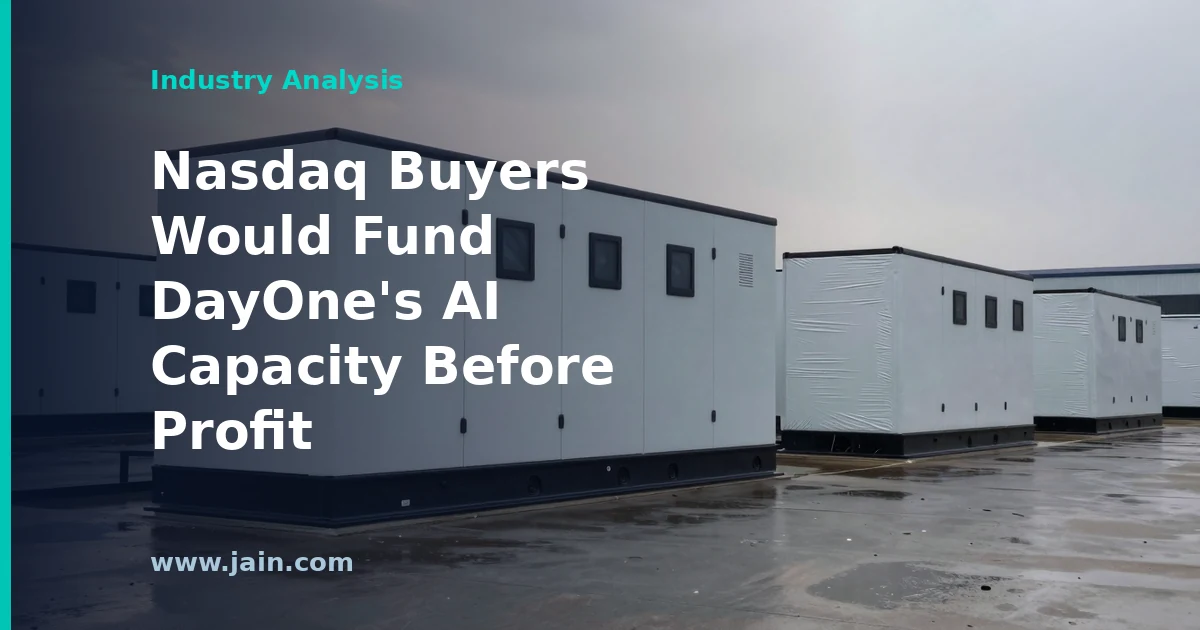
DayOne, a Singapore company, builds huge warehouses full of computers. These buildings run online services and artificial intelligence. It has now asked to sell shares on Nasdaq, the American stock market.
DayOne is only four years old and already has sites in ten places across Asia and Europe. Its sales are climbing fast, but it lost about $77 million in the first six months of this year.
So the share sale is a test. Will investors pay now for buildings that may only make money years from now?
DayOne Data Centers Limited, a Singapore-headquartered data center developer and operator founded in 2022, announced on October 5, 2026 that it has filed a registration statement on Form F-1 with the U.S. Securities and Exchange Commission. The filing covers a proposed initial public offering (IPO) of American Depositary Shares (ADSs), and DayOne has applied to list them on the Nasdaq Global Select Market under the ticker “DODC.” Morgan Stanley, J.P. Morgan, BofA Securities and Citigroup are the underwriters. The number of ADSs and the price range have not been set.
TNGlobal reported that DayOne’s net loss widened to $77.2 million in the first half of 2026. Klsescreener.com reported that the filing shows a revenue surge. DayOne’s footprint spans ten markets: Singapore; Johor and Greater Kuala Lumpur in Malaysia; Indonesia; Thailand; Tokyo and Kyushu in Japan; Hong Kong SAR; Finland; and Spain.
Executive Summary
DayOne is seeking a U.S. listing for a business that is still growing faster than it is earning. The company describes its campuses as “AI-ready” and says leading global hyperscalers, the very large cloud and AI companies that rent capacity at scale, are among its customers. It has grown from founding in 2022 to a ten-market footprint across Asia Pacific and Europe.
The central fact for investors is that the company is not yet profitable. A $77.2 million net loss in the first half of 2026 means there is no earnings figure to apply a conventional valuation multiple to. Public buyers would instead be pricing DayOne’s capacity pipeline, its customer contracts and its growth rate. In effect, they would be supplying equity for data center capacity before that capacity produces net profit.
The offering size and price are still blank. The four-bank underwriting syndicate and the Nasdaq Global Select listing tier signal a substantial deal, but the market’s appetite will only become measurable once a price range is filed.
Why the Loss Makes This a Capacity Bet
Data center development front-loads its costs. An operator has to secure land, power connections, buildings, cooling and electrical equipment before a tenant moves in. Revenue arrives later, as halls are handed over and leases ramp up. During an expansion phase, depreciation on new buildings, interest on construction debt and pre-opening costs can weigh on net income even while revenue climbs. A rising top line next to a widening loss is therefore a common profile for a young operator building in many markets at once. It is not proof of distress, and it is not proof of health.
That profile shapes what an IPO buyer is actually purchasing. With a $77.2 million first-half net loss, DayOne cannot be valued on a price-to-earnings basis. Its valuation will rest on forward-looking measures: how much capacity is contracted, how long the leases run, who the customers are, and when new sites are expected to become profitable. Investors would be paying today for AI-era capacity whose earnings sit in the future. The price they set becomes DayOne’s cost of equity for the next round of construction.
Three groups are affected. Prospective shareholders take on the build-out risk. DayOne’s existing private backers gain a public market valuation and an eventual route to sell. Hyperscale tenants, which depend on operators like DayOne delivering capacity on schedule, have a stake in whether this financing channel opens.
Ten Markets Built in Four Years Is the Pitch and the Bill
DayOne’s footprint is unusually broad for a company established in 2022. It spans the Singapore and Johor corridor, Greater Kuala Lumpur, Indonesia, Thailand, two Japanese regions, Hong Kong and two European countries. The company credits a “proprietary integrated delivery model,” meaning it handles engineering, construction and operations in-house. It also claims a track record of pioneering and scaling new markets.
Breadth cuts both ways. Each market has its own grid operator, permitting regime, power tariff and land market, and building in many of them at once multiplies capital needs. Johor, across the causeway from Singapore, has become a major data center destination because Singapore has limited land and power for new facilities. That demand also makes Johor competitive for power allocations and sites. Finland and Spain add European exposure but are a separate operating environment. The diversification argument is strongest if contracted demand in each market is visible. It is weakest if the footprint is mostly land and plans.
What the Underwriters and Listing Venue Signal
DayOne has lined up four of the largest U.S. investment banks and chosen Nasdaq’s top listing tier, which has the strictest financial and governance standards. As a foreign issuer, it filed on Form F-1 and will sell ADSs. These are U.S.-traded certificates that each represent underlying shares of a non-U.S. company, so American investors can buy them in dollars on a domestic exchange.
These choices indicate an offering the banks expect to be sizeable and widely distributed. They do not establish valuation or demand. Until DayOne files a price range, the market’s view of loss-making data center growth in Asia cannot be read from this announcement.
The ‘AI-Ready’ Label Needs Specifications
DayOne describes its campuses as “high-capacity, AI-ready.” In industry terms, AI readiness usually means power and cooling designed for much denser racks of GPU servers, often including liquid cooling. That positioning is central to the growth story the IPO asks investors to price.
The phrase has no standard definition. Its value to investors depends on details such as design power density, cooling architecture and how much capacity is already leased to AI workloads. Without those details, “AI-ready” describes an ambition rather than a measured capability.
Background
DayOne Data Centers Limited was established in 2022 and is headquartered in Singapore. It engineers, builds and operates large data center campuses aimed at hyperscale cloud and AI customers, using what it calls an integrated delivery model that keeps design, construction and operations in-house. Its footprint spans ten markets in Asia Pacific and Europe.
Southeast Asia has become one of the most active regions for data center construction. Singapore’s limited land and power have pushed new capacity into neighboring Johor and other regional markets. Data center operators are capital-intensive businesses: they spend heavily upfront and recover that investment over long lease terms. That makes access to cheap, patient capital, whether private or public, a core competitive factor.
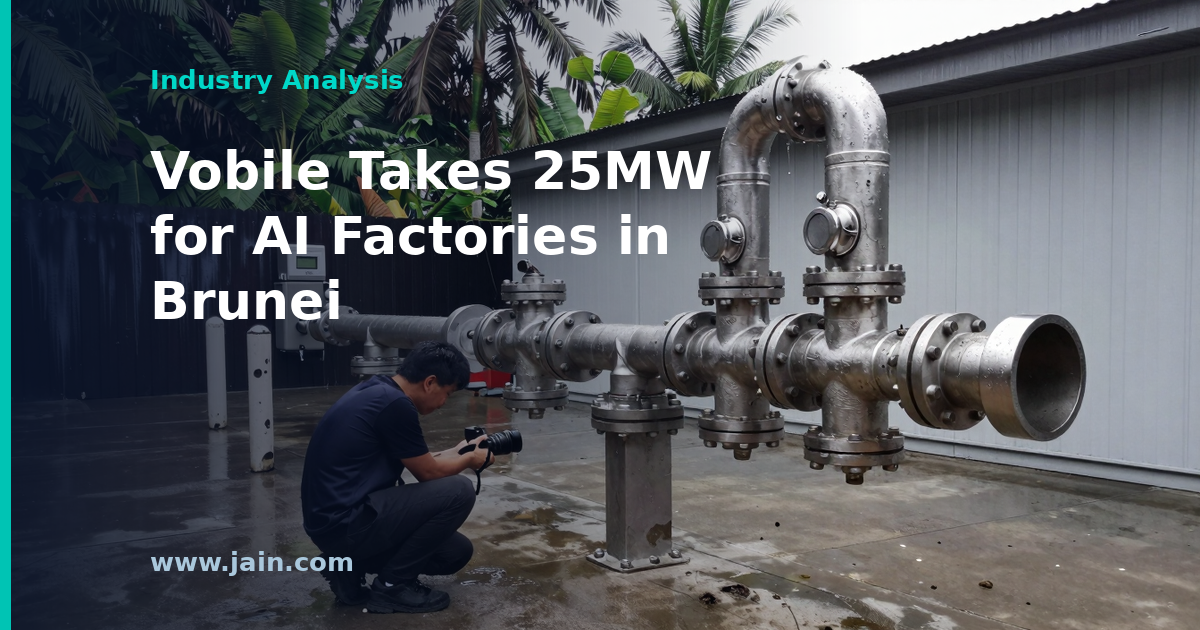
A Silicon Valley company that helps film studios protect and make money from their movies and music is setting up banks of powerful computers in Brunei, a small, oil-rich country on the island of Borneo.
Brunei’s national phone and internet company is building the facility and setting aside enough electrical supply for Vobile to run those machines — roughly what a small town uses.
Why it matters: tiny countries rarely host this kind of computing. Brunei is betting it can turn cheap energy and undersea internet cables into a new industry.
Vobile, a Santa Clara, California company that provides digital content protection and transaction services to studios, platforms, music labels and sports leagues, has signed strategic cooperation and commercial agreements with Unified National Networks Sdn Bhd (UNN), the integrated national telecommunication network operator of Brunei Darussalam. The agreements were signed on September 3, 2026 at UNN’s Tungku Submarine Cable Landing Station by UNN Acting Chief Executive Officer Christopher Phan and Vobile CEO Yangbin Wang, and witnessed by Yang Mulia Haji Hairul Mohd Daud bin Haji Abd Karim, Deputy Permanent Secretary (Infocommunications) at the Ministry of Transport and Infocommunications and a UNN board director. Vobile announced the deal on September 4.
Under the arrangement, UNN’s new AI-capable data center — designed with liquid cooling and high power density to support NVIDIA’s latest GPU systems — will allocate 25 megawatts (MW) of capacity to Vobile, with a further 25MW reserved for Vobile’s future expansion. Vobile says the capacity will run “AI factories” that scale DreamMaker, its platform for helping studios, independent producers and creators generate video with AI while protecting and monetizing their intellectual property.
Executive Summary
Stripped to its essentials, this is a capacity deal with a national carrier, dressed in the language of industrial policy. UNN gets a named anchor tenant for a new high-density facility; Vobile gets a claim on 25MW of GPU-ready space — enough to house a meaningful accelerator fleet — plus an option on the same again. A megawatt, in data center shorthand, is a unit of electrical draw; 25MW is not hyperscale, but it is a serious commercial footprint anywhere, and an unusually large one for a country of well under a million people.
The strategic logic is legible on both sides. Brunei has energy, political stability and, at Tungku, a submarine cable landing station — the point where intercontinental fiber optic cables come ashore. Those are the three ingredients a small state can plausibly offer an AI hosting market that is currently constrained by power and grid connection queues in Singapore, northern Virginia, Dublin and Amsterdam. Vobile, for its part, is a software and services company whose newer generative-video product implies compute costs it would otherwise rent from hyperscalers at retail cloud prices.
What is announced and what is contracted are not the same thing, and the release does not close that distance. Neither company has disclosed financial terms, an energization date, who buys the GPUs, or whether the 25MW allocation is a binding take-or-pay commitment or a reservation. Those are the details that determine whether this is a data center deal or a memorandum with a ceremony attached — and they are the right questions to put to both parties.
A Content-Protection Company Starts Buying Power Like a Cloud Provider
Vobile’s established business is fingerprinting and enforcement: identifying copyrighted video and audio wherever it surfaces online, and converting detections into licensing revenue for rights holders. That is a software business with a modest compute bill, largely inference at scale on commodity hardware. DreamMaker, the product this deal is meant to feed, is a different animal — generative video creation for studios, producers and creators, with rights protection built in. Generative video is among the most compute-hungry workloads in commercial AI, and the economics move from software margin toward infrastructure margin.
Taking 25MW of allocated capacity is therefore a genuine change in posture, not a press-release flourish. A company that rents inference by the hour is a customer; a company that anchors a facility is exposed to utilization risk. If DreamMaker demand arrives as forecast, owning the capacity floor is cheaper than paying hyperscaler retail rates and gives Vobile a cost advantage over rivals reselling someone else’s cloud. If demand lags, fixed capacity becomes a fixed cost — the same trap that has caught crypto miners and several AI hosting entrants pivoting between workloads.
The unanswered variable is who carries that risk. The release describes an allocation of capacity within UNN’s facility, not a Vobile-owned building, which suggests a colocation or hosting relationship rather than a self-build. Whether Vobile purchases the NVIDIA systems, leases them, or buys compute as a service from UNN determines how much capital this commits and how much of the downside sits on Vobile’s balance sheet. Neither company has said.
Why Brunei Can Compete — and Where the Depth Runs Out
The choice of venue is more considered than it first appears. The signing took place at a submarine cable landing station, which is the tell: for AI training workloads, latency matters less than it does for consumer applications, but international bandwidth, route diversity and the ability to move very large datasets still matter enormously. Brunei sits on the northern coast of Borneo, adjacent to the trunk routes linking Southeast Asia to East Asia and, onward, to the United States. An energy-exporting state with domestic generation and a government visibly present at the signing can move faster on power and permits than jurisdictions where a grid connection is a multi-year queue.
That is the genuine arbitrage in “sovereign AI” for small markets: not that Brunei can outbid Singapore or Johor on scale, but that it can offer a mid-sized tenant a decision timeline and a power allocation that larger markets currently cannot. Singapore’s constraints on new data center power have pushed capacity into the region for several years; Malaysia’s Johor corridor absorbed much of it and has itself begun to face grid and water questions. A 25MW block in an underbuilt market is a real product.
The limits are equally real, and they are structural rather than a criticism of either party. Hyperscalers demand deep, diverse power — multiple substations, firm redundancy, a credible path to hundreds of megawatts — plus multiple independent fiber routes, a large pool of electrical and mechanical technicians, and neighbors to share risk with. A single national operator with a single new facility offers concentration on every axis: one grid, one carrier, one landing station, one construction program. That concentration is survivable for a single anchor tenant with a specific workload. It is precisely what a hyperscaler screens out. This deal tests whether the mid-market between those two poles is a real, bankable segment.
Liquid Cooling, Tropical Heat and the 25MW Engineering Bill
The technical detail worth pausing on is that the facility is described as designed for liquid cooling and high power density. That is not decoration. Current NVIDIA GPU systems draw enough power per rack that air cooling has largely stopped being viable; liquid cooling circulates coolant directly to the chips or through rear-door heat exchangers. It raises capital cost and demands mechanical skills that are scarce almost everywhere, but it is the only way to land these densities.
In an equatorial climate, heat rejection is the hard part. High ambient temperatures and humidity year-round reduce the efficiency of the outdoor side of any cooling system, which pushes operators toward either higher energy overhead or water-consuming approaches. Neither company has described the cooling architecture beyond the phrase “liquid cooling,” the expected efficiency, or the water strategy — all of which are increasingly material to enterprise buyers with sustainability reporting obligations, and to any lender underwriting the build.
Then there is the supply chain. Advanced accelerators remain allocation-constrained and are subject to export control regimes that vary by destination and end user. A commitment to support “NVIDIA’s latest GPU systems” is a design statement, not a delivery guarantee. How many accelerators are actually secured, on what schedule, and under what licensing posture is the difference between 25MW of announced capacity and 25MW of working capacity.
Anchor Tenancy Cuts Both Ways
For UNN, a named anchor tenant is the single most valuable asset in early-stage data center development. It de-risks financing, justifies grid investment and gives a national carrier a credible story to tell prospective second and third tenants. UNN’s Chief Digital Officer framed the relationship as more than a customer-provider engagement, and that framing is consistent with the structure: strategic cooperation alongside commercial agreements suggests joint go-to-market ambitions in the region, not just a lease.
For Vobile, the reserved second 25MW is the more interesting term. Reserved capacity is effectively a call option on growth — valuable if DreamMaker scales, cheap to hold if the reservation carries no fee, expensive if it does. What triggers conversion, how long the reservation stands, and whether Vobile has any exclusivity in the facility are the terms that determine whether this option is worth much. None has been disclosed.
The broader read for the industry: this is the shape sovereign AI increasingly takes outside the largest economies — a national carrier, a government witness, a single foreign anchor tenant with a specific workload, and capacity measured in tens rather than hundreds of megawatts. It is a plausible model. Whether it produces durable digital-economy capability, as both parties argue, or a well-located facility serving one overseas customer, depends on whether the second and third tenants arrive. That evidence does not exist yet, and neither company claims it does.
Background
Vobile, founded in Silicon Valley and headquartered in Santa Clara, built its business on content identification: fingerprinting video, audio and music so rights holders can find unauthorized copies online and convert them into licensed, revenue-generating views. Its customers include entertainment companies, platforms, music labels, sports leagues and publishers, and it has operations across North America, Asia, Australia and Europe. Its parent, Vobile Group Limited, is publicly listed in Hong Kong. The company has been extending from protection into AI-assisted creation and monetization, of which DreamMaker is the flagship, alongside recent products such as an AI song detector and a program for tokenizing creative IP rights.
Brunei Darussalam is a small, energy-rich sultanate on the island of Borneo that has spent years pursuing economic diversification away from oil and gas. UNN was established to consolidate the country’s national network infrastructure under a single operator, giving it control of the fixed and mobile backbone as well as international connectivity through submarine cable landings. The presence of a senior Ministry of Transport and Infocommunications official at the signing reflects how closely digital infrastructure projects in Brunei are tied to national policy — a pattern common across the region, where governments treat AI-ready data centers as strategic assets rather than purely commercial real estate.