TL;DR · 30-second read
The Short Version
- A startup called Blue Energy asked federal nuclear regulators for permission to build a power plant on the Texas coast that runs on both natural gas and small nuclear reactors.
- The electricity would feed a computing site built by Crusoe for artificial intelligence — buildings full of computers that need power around the clock.
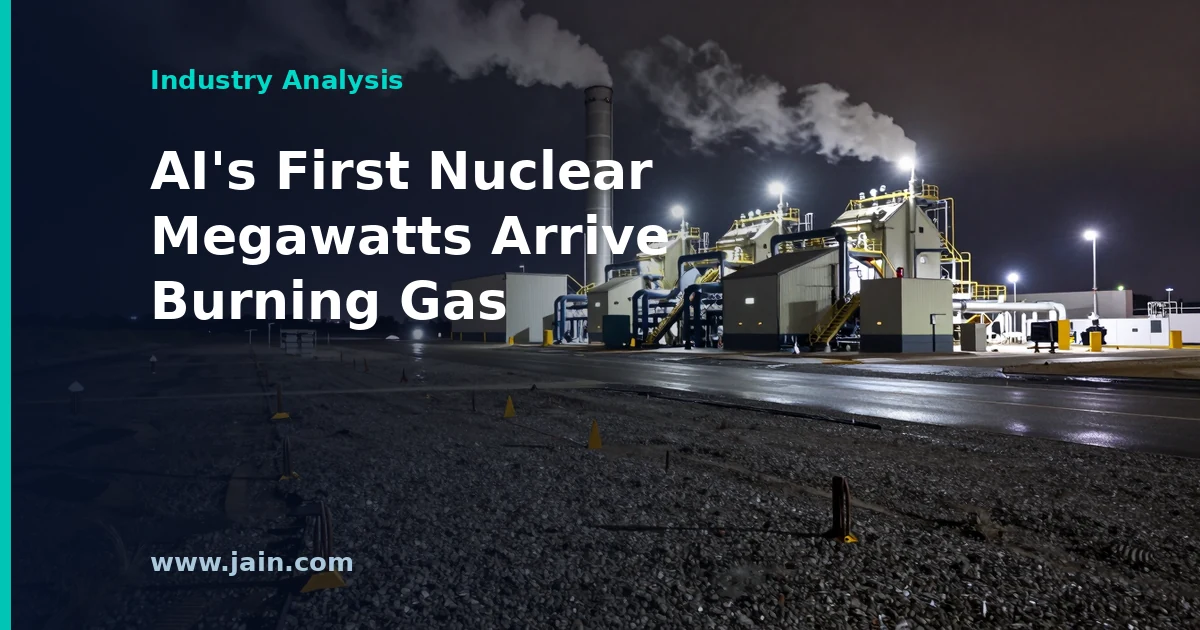
- Here is the catch: the gas part gets built first, by around 2030. The reactors come later, in the 2030s.
- So the plant sold as nuclear will spend its early years running mostly on gas.
EnergyTech reported that North Carolina-based startup Blue Energy has submitted its first construction permit application to the U.S. Nuclear Regulatory Commission for a hybrid gas-and-nuclear generating station at the Port of Victoria, Texas. The project would pair a GE Vernova 7HA.02 gas turbine with the GE Vernova-Hitachi BWRX-300 small modular reactor, building toward a 2.5-gigawatt plant by the early 2030s that would serve an AI data center — an “AI factory” — developed by Crusoe, along with other loads.
The build is staged. Phase one centers on the gas turbines, which the company says are the quickest to install and commission, targeted for the end of this decade. Phase two would add perhaps five BWRX-300 units, each generating close to 300 megawatts at capacity, with the gas units eventually phased out or reduced. Blue Energy estimates project cost at more than $6 billion, with Société Générale acting as lead financial advisor.
Executive Summary
The filing is a procedural milestone rather than a construction start, and that distinction matters. No small modular reactor has been fully approved or begun construction in the United States. Federal applications of this kind typically take years to move through technical and environmental review before a permit issues. Blue Energy is entering a queue that also contains the Tennessee Valley Authority’s BWRX-300 application at Clinch River — which GE Vernova Hitachi says is approaching a decision — and applications from other developers including X-energy.
What makes the Victoria project analytically interesting is not the reactor. It is the sequencing. A 2.5-gigawatt site whose first phase is combustion turbines and whose second phase is five reactors is, for the first several years of its operating life, a gas plant with a nuclear option attached. If roughly five units at close to 300 megawatts each eventually arrive, that implies on the order of 1.5 gigawatts of nuclear capacity and the balance from gas — meaning the gas fleet is not a token bridge but a substantial share of the nameplate.
For GE Vernova, the strategic value is fleet economics: the same reactor design, the same licensing work and the same supply chain applied across multiple sites, so that each project is cheaper and faster than the last. For data center developers, the practical value is that a credible nuclear pathway may make a gas-first interconnection easier to defend to customers and communities that have made carbon commitments.
The Permit Is Nuclear. The First Electrons Are Gas.
Read the phasing literally. Blue Energy says phase one focuses on the gas turbines because they are the quickest to install and commission, with a target of the end of this decade. Phase two would add perhaps five BWRX-300 reactors, each producing close to 300 megawatts — a megawatt being roughly the power draw of a few hundred homes, and 300 megawatts being enough for a serious data center campus on its own. The total plant is described as 2.5 gigawatts by the early 2030s. Subtract the nuclear arithmetic from the total and roughly a gigawatt of gas-fired capacity is carrying the site before the reactors show up, and continuing alongside them after.
That is the operational conclusion buried in an otherwise routine regulatory filing. Crusoe’s AI factory, if it energizes on the announced schedule, will be a nuclear-adjacent load long before it is a nuclear-powered one. Nobody has misstated this — the release is explicit that gas comes first and that the gas units would later be “phased out or reduced.” But the framing of hybrid gas-nuclear projects generally, and the headlines they generate, tend to lead with the reactor rather than with the turbine that will actually be spinning in 2030.
Who this affects: any hyperscaler or AI developer signing power agreements against projects like this one needs to price two different assets. The near-term asset is dispatchable gas generation with commodity and emissions exposure. The long-term asset is a first-of-a-kind reactor deployment with schedule and licensing risk. Blending them into one “clean firm power” line item on a sustainability disclosure understates the first and overstates the certainty of the second. The honest version is that gas is buying time for nuclear to clear regulatory review — which is a defensible strategy, just not the same claim.
Fleet Licensing Is the Product GE Vernova Is Actually Selling
Jason Cooper, CEO of GE Vernova Hitachi Nuclear Energy, framed the Blue Energy filing around repeatability: “This is what fleet deployment looks like: projects advancing on common technology, licensing work and supply chain capabilities, allowing us to apply lessons from one project to the next.” That sentence is the commercial thesis of the entire small modular reactor category, compressed.
Conventional nuclear construction in the United States has been defeated less by physics than by one-off engineering. Every plant a bespoke design, every licensing review starting near zero, every supply chain assembled and then dispersed. The BWRX-300 bet is that if the same design goes through the Nuclear Regulatory Commission repeatedly — Clinch River with the Tennessee Valley Authority, now Victoria with Blue Energy — the review gets shorter, the vendors keep their tooling, and the crews carry experience forward. Blue Energy’s Jake Jurewicz echoed the point, saying the team moved from technology selection to construction permitting “in a matter of months.”
The claim is plausible and, so far, unproven at the only point that counts: a completed unit. Nothing in the release establishes that the second application will be reviewed faster than the first, or that fabrication cost falls on unit two. Investors and buyers should watch the Clinch River decision closely, because it is the first real data point on how much of the fleet argument the regulator is prepared to credit.
More Than $6 Billion, and the Project-Finance Test
Blue Energy puts the project above $6 billion and has engaged Société Générale as lead financial advisor. Kim Hill, the bank’s transaction lead, described the mandate as a step toward deploying private capital markets for advanced nuclear “just like it has for wind, solar, and battery technologies.” That comparison is the tell. Wind, solar and storage became bankable because their capital costs are predictable, their construction windows are short, and their revenue is typically locked to long-term contracts before anyone breaks ground.
Advanced nuclear does not yet satisfy the first two conditions in the United States — no unit has been built to prove them. Which is another reason the gas-first phasing is more than an engineering convenience: turbines are a financeable, well-understood asset class with an established construction schedule, and early cash flow from gas generation changes the risk profile a lender sees when it underwrites the reactors behind it. The strategic investor list, which includes Constellation Technology Ventures, VXI, Engine Ventures, At One Ventures and Tamarack Global, reflects venture-stage risk tolerance; a $6 billion project needs a different class of capital entirely.
Why the Load Growth Argument Has Real Force — and Its Limits
Nuclear supplies about 18% of the U.S. utility-scale electricity mix, and the fleet spent years under pressure from operating costs, cheap gas, renewables and, critically, flat demand. Data center growth has reversed the demand assumption, and the industry’s argument is that carbon-free baseload — power that runs continuously rather than when the wind blows — is the natural answer for loads that run at high utilization around the clock.
The counterargument, which the release also records, is that nuclear projects remain expensive, slow and contested on health and safety grounds. Both positions can be evaluated on evidence rather than assertion, and the evidence arrives on a schedule: permit decisions, construction starts, and the first concrete date. Until then, the sharpest thing to say about Victoria is that it is a credible attempt at a genuinely difficult sequencing problem — build generation fast enough for AI load that exists now, while licensing generation clean enough for the commitments that load has already made.
Background
Blue Energy is a North Carolina-based startup pursuing what it describes as a repeatable, rapidly built approach to new nuclear construction — EnergyTech has previously reported the company raised $380 million to advance prefabricated reactor construction. It selected the BWRX-300 design earlier this year for co-location with gas turbines and, by its own account, moved from technology selection to federal construction permitting within months.
The BWRX-300 is a boiling water small modular reactor from GE Vernova Hitachi Nuclear Energy, a joint venture between GE Vernova and Hitachi. It is the design furthest along in the U.S. licensing process, through the Tennessee Valley Authority’s Clinch River project, and has been selected by several developers internationally. The broader context is a U.S. power sector that spent a decade planning around flat demand and is now contending with data center and AI load growth that has made firm, round-the-clock generation scarce and valuable again. Source: SMR Startup Blue Energy, GE Vernova-Hitachi Seek Federal Construction Permit for Gas-Nuclear Hybrid — EnergyTech’s report on Blue Energy’s NRC construction permit application for a 2.5-GW gas-and-SMR plant at the Port of Victoria, Texas, intended to serve a Crusoe AI data center.Sources