
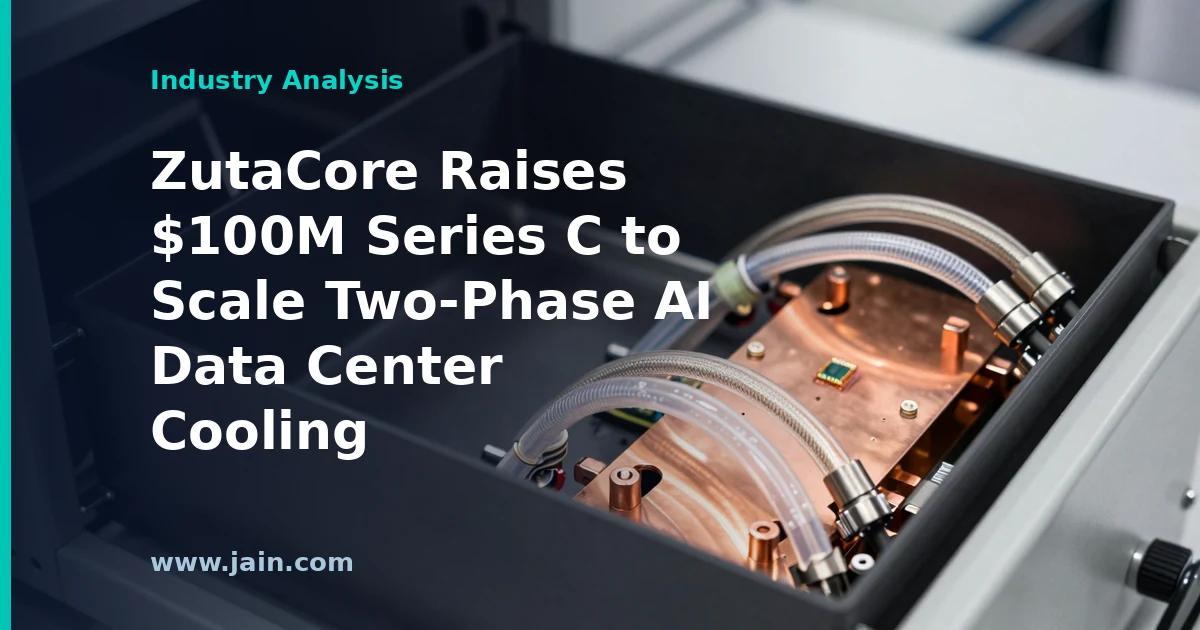
ZutaCore, a developer of two-phase, direct-to-chip liquid cooling technology, has raised a $100 million Series C round to expand its cooling platform for AI data centers, according to a report published by Pulse 2.0 on June 6, 2026. The reported purpose of the raise is to scale the company’s platform as AI workloads push rack power densities beyond what air cooling can handle.
Executive Summary
The headline fact is simple: ZutaCore has secured $100 million in Series C funding to expand its AI data center cooling platform. At that size, the round places ZutaCore among the better-capitalized independent players in liquid cooling, a segment that has moved from niche engineering concern to strategic infrastructure category in roughly three years.
Why it matters: modern AI accelerators draw hundreds of watts per chip, and racks packed with them can reach power densities that air-based cooling physically cannot dissipate economically. That has turned the cooling layer — cold plates, coolant distribution units, dielectric fluids, and the engineering services around them — into one of the most actively funded niches in data center infrastructure. A $100 million commitment to a two-phase cooling specialist signals that investors believe the transition to liquid cooling is durable, and that there is room in the market beyond the largest incumbent thermal vendors.
Capital Keeps Flooding the Cooling Layer
Cooling used to be a line item buyers negotiated down. In the AI build-out it has become a gating constraint: if you cannot remove the heat, you cannot deploy the chips, no matter how much power or floor space you have. That inversion explains why investors have poured money into thermal specialists across every approach — single-phase cold plates, immersion tanks, rear-door heat exchangers, and two-phase systems like ZutaCore’s. A $100 million Series C for a company focused specifically on the AI cooling problem fits squarely into that pattern and suggests the funding window for the category remained open as of mid-2026.
The strategic logic for investors is that cooling vendors sit at a chokepoint. Every generation of AI accelerator raises thermal design power — the amount of heat a chip is engineered to shed — and each increase expands the addressable market for liquid cooling retrofits and new builds alike. The risk, equally, is that a crowded field of well-funded competitors compresses margins before any single vendor achieves scale.
What Two-Phase Cooling Actually Is — and Why It Is Contested Ground
Most liquid cooling deployed today is single-phase direct-to-chip: water or a water-glycol mix flows through a cold plate bolted to the processor, absorbs heat, and carries it away without changing state. Two-phase cooling instead uses an engineered dielectric fluid — a liquid that does not conduct electricity — that boils on contact with the hot chip. The phase change from liquid to vapor absorbs far more energy per unit of fluid than simple warming does, which is the core efficiency argument for the approach. ZutaCore has long positioned its platform around this waterless, two-phase principle, marketing it as eliminating the risk of water leaks onto expensive electronics.
The counterarguments are practical rather than theoretical. Two-phase systems are mechanically more complex, the specialty fluids cost more than water, and the fluorinated chemistries commonly used in the category face growing regulatory scrutiny in several jurisdictions. Meanwhile single-phase cold plates have become the default choice for the current generation of AI racks because hyperscalers understand water. ZutaCore’s raise is, implicitly, a bet that as chip power keeps climbing, the physics advantage of phase change wins share back from the simpler incumbent approach. The release, as reported, does not detail how the company plans to argue that case to buyers.
Winners, Losers, and the Consolidation Question
If the round accelerates ZutaCore’s manufacturing and deployment capacity, the immediate beneficiaries are data center operators seeking alternatives to water-based cooling — particularly in facilities where water usage or leak risk is a board-level concern. Chipmakers benefit from any credible expansion of thermal headroom, since cooling capability directly constrains how they can specify future products.
The open competitive question is whether independent cooling specialists remain independent. The thermal management sector has seen sustained acquisition interest from large industrial and infrastructure players, and a well-funded specialist with differentiated technology is a natural target. A Series C of this size can be read two ways: as fuel for a run at standalone scale, or as valuation-building ahead of eventual consolidation. The reporting available does not indicate which trajectory ZutaCore’s investors have in mind.
Background
ZutaCore is a specialist in waterless, two-phase, direct-to-chip liquid cooling, an approach it has promoted for years as a safer and denser alternative to water-based cold plates. The company sells the hardware and supporting infrastructure that let standard servers shed heat through a dielectric fluid that vaporizes on the processor, and it has positioned that platform squarely at the AI data center market as accelerator power consumption has climbed.
The broader context is a rapid industry transition: liquid cooling moved from a high-performance-computing niche to mainstream AI infrastructure in the mid-2020s, drawing venture capital, private equity, and acquisition interest across cold plate, immersion, and two-phase vendors alike. ZutaCore’s Series C lands in the middle of that capital wave.
Source: ZutaCore: $100 Million Series C Raised To Expand AI Data Center Cooling Platform — Pulse 2.0 report, June 6, 2026, on ZutaCore’s Series C funding round for AI data center cooling.