
TL;DR · 30-second read
The Short Version
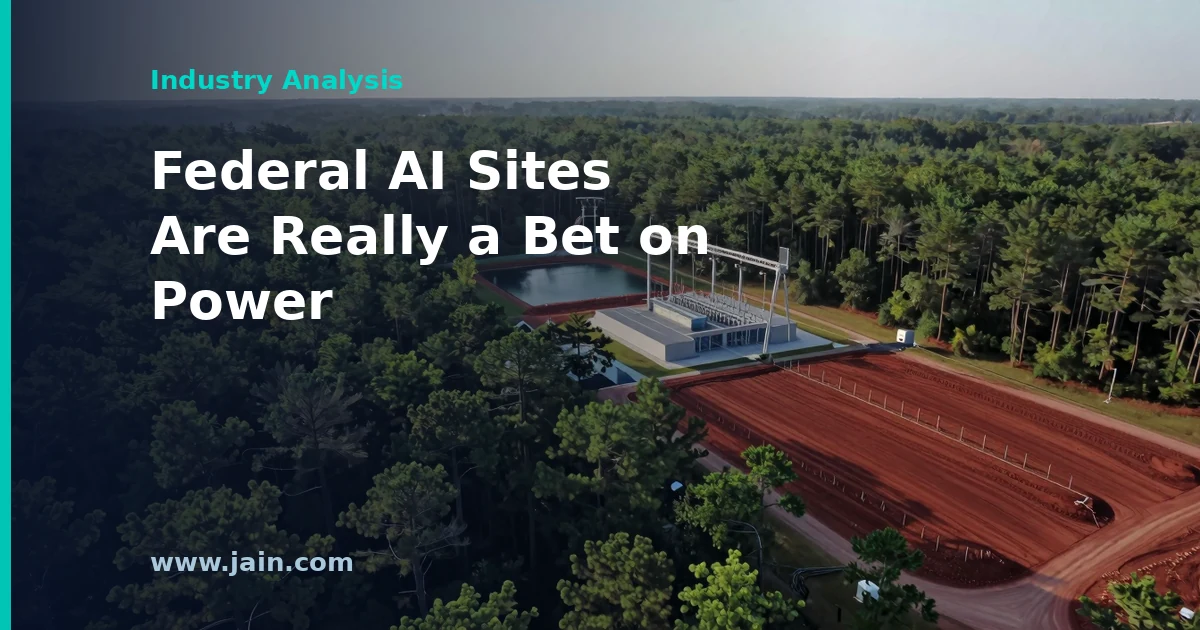
The United States government is opening some of its own land to companies that want to build the huge computer warehouses that run artificial intelligence. One of the first chosen sites is in South Carolina, at a lab that supports the nation’s nuclear weapons work.
The twist: these projects are meant to come with their own power plants. The biggest artificial intelligence facilities can need as much electricity as a large power plant produces, and building power on-site is meant to keep that cost off ordinary households’ bills.
Engineering firm Amentum was picked to build it. No price, size or start date has been announced.
Microgrid Knowledge reported on July 20, 2026 that the National Nuclear Security Administration (NNSA), part of the U.S. Department of Energy (DOE), has selected Virginia-based engineering firm Amentum to develop a co-located artificial intelligence data center and on-site power generation project at the Savannah River National Laboratory site in South Carolina. The selection followed a competitive request for proposals that DOE began last year, after identifying 16 federal sites it judged could host AI data centers paired with their own energy infrastructure.
The effort, formally the Savannah River Site Artificial Intelligence Infrastructure and Energy Generation Project, has no announced timeline, generating technology, capacity or cost. DOE says the project could meet its own electricity needs without shifting large costs to utility customers and could also increase the power available to the grid.
Executive Summary
NNSA has named Amentum to lead construction of both an AI data center and the power plant that would feed it, on federal land at one of the country’s principal nuclear security sites. It is a concrete step in DOE’s program to put AI computing on government property, and the first selection at Savannah River under that program.
The significance lies less in the land than in the pairing. DOE did not simply offer acreage; it screened its sites for their ability to host data centers together with co-located generation, and it justified the Savannah River project on the grounds that it would not push large grid-upgrade costs onto utility customers. That makes federal sites a potential route around the slowest and most politically sensitive part of AI buildout: getting enough electricity to the building.
What has been announced is a selection and a scope, not a financed, sized project. The generating technology, megawatt capacity, tenant, financing and schedule are all still undisclosed, so the model’s claims about cost and grid benefits remain untested.
Sixteen Sites, One Condition: Bring the Power
DOE’s list of 16 federal sites was not a catalogue of empty lots. According to the department, it identified sites that could support AI data centers paired with co-located energy infrastructure. The Savannah River award makes that pairing explicit: generation is in the project’s official name, and Amentum is contracted to build the power supply alongside the data center rather than to plug into whatever the local utility can provide.
The reason is the grid connection itself. A large new electricity user normally joins the grid through an interconnection process, in which the utility studies whether its lines and power plants can serve the new load and what must be built if they cannot. At AI scale, those upgrades are substantial: industry projections cited in the coverage put future AI server racks at up to 1 megawatt each and the largest AI campuses at around 1 gigawatt, roughly the output of a large power plant. When a utility builds for a customer that size, the question of who pays tends to fall on its other customers. DOE’s stated case for Savannah River answers that directly, saying the project could generate its own needs “without shifting huge costs to utility customers.”
That is where federal land earns its place. A large, secured, government-controlled site offers space, a single landowner and an existing security perimeter for putting generation right next to the load, which many sites closer to population centers struggle to offer. The trade-off is engineering: AI training creates wide, fast swings in power demand, and a self-supplied site has less grid backing to absorb them. Whatever generation Amentum ultimately builds will need to be designed around that volatility, which makes the power system as central to the project as the data center it serves.
Why a Nuclear Security Site, and Why Amentum
NNSA Administrator Brandon Williams framed the award as a way to “move faster, apply innovative technologies, and make productive use of federal land while maintaining our commitment to mission delivery.” That last clause matters. Savannah River hosts sensitive defense work, and any private-sector partner operating there has to coexist with it. Amentum already does; it was selected earlier this year to provide design and engineering services for the site’s Tritium Finishing Facility, which supports the nuclear weapons program.
That existing footprint is a competitive advantage that is hard to replicate. Contractors that already understand federal security, procurement and site operations are positioned to win the first wave of these awards, while conventional data center developers may find their route onto federal land runs through partnerships with such firms. Amentum and NNSA say they will collaborate on expanding private-sector partnerships in the project, which leaves room for tenants, financiers or generation owners still to be named.
What Is Settled, and What Still Rests on “Could”
The announcement establishes a selection made through a competitive process, a defined scope covering both compute and generation, and a named site. Those are real commitments of intent from a federal agency. The headline benefits are conditional, however: the project could meet its own electricity needs, and it could increase power available to the grid. Williams himself called it a “proposed partnership.”
Until the parties disclose the generation type, capacity and commercial structure, the ratepayer-protection claim cannot be measured. Its value depends on details not yet public: whether the site stays connected to the grid for backup, who pays for that connection, and on what terms any surplus power is sold. The first projects under DOE’s program will set the template for the remaining sites, so those terms will matter well beyond South Carolina.
Background
The Savannah River Site in South Carolina is a Department of Energy complex overseen by the National Nuclear Security Administration, the DOE agency responsible for nuclear weapons and nuclear security. Its national laboratory supports defense programs including tritium production. Amentum, a Virginia-based firm spun out of AECOM about six years ago, ranks as the second-largest U.S. government services contractor behind Leidos and was already working at the site on the Tritium Finishing Facility.
The award sits within a wider federal push to use government land for AI infrastructure. DOE identified 16 of its sites as candidates for data centers paired with their own power, and Energy Secretary Chris Wright has described the AI race as “the next Manhattan project.” The pressure behind that push is electricity: an analysis by the Penn State Institute of Energy and the Environment projects AI’s share of global electricity use could rise from 4% to 20% by 2035. Source: Amentum to Develop Co-Located AI Data Center and Power Infrastructure at Savannah River National Laboratory (Microgrid Knowledge, July 20, 2026): NNSA selects Amentum to build an AI data center with on-site power generation at the Savannah River Site.Sources