Tag: Rockdale

  • Riot Clears a $200M Bitcoin Loan Before Its 191 MW AI Lease Tests the Balance Sheet

    Riot Clears a $200M Bitcoin Loan Before Its 191 MW AI Lease Tests the Balance Sheet

    TL;DR · 30-second read

    The Short Version

    Riot Platforms, a company that runs huge warehouses of computers that mine bitcoin, has paid off a $200 million loan from the crypto exchange Coinbase about seven months early, with no penalty.

    To get that loan, Riot had set aside about half of its bitcoin as a guarantee, the way a house backs a mortgage. That bitcoin is no longer tied up.

    The timing is the interesting part. Riot recently signed a 20-year deal to rent a large, power-hungry part of its site to an artificial intelligence company, and getting that space ready will take money.

    Riot Platforms (Nasdaq: RIOT) repaid all outstanding principal and accrued interest on its fully drawn $200 million credit facility with Coinbase Credit on September 21 and terminated the agreement, according to an 8-K filed with the SEC on September 25. The Energy Mag reported that the repayment carried no early termination fee, that Coinbase’s commitment to lend further ended, and that its security interests in Riot’s pledged bitcoin, USDC and cash were released at the same time.

    As of June 30, Riot had pledged 5,821 bitcoin, valued at about $340.7 million, roughly 51% of its 11,380-bitcoin holdings, to secure the loan. The facility carried a fixed 6.15% annual rate and was not due until April 20, 2027.

    Executive Summary

    Riot has retired a bitcoin-backed loan that, at its fixed 6.15% rate, cost about $12.3 million a year in interest, and in doing so lifted a lender’s claim on what was, at last disclosure, about half of its bitcoin treasury. The repayment came one month after the facility’s early termination fee window closed on August 21, so Riot exited about seven months ahead of maturity at no penalty.

    The move matters beyond crypto treasury management because of what Riot is building. In August, the company announced a 20-year lease for 191 megawatts of computing capacity at its Rockdale campus with an unnamed artificial intelligence developer, which it said was expected to generate about $9.1 billion in revenue over the initial term. Riot now approaches the delivery of that capacity with no Coinbase debt outstanding and no lender holding a lien on its bitcoin under this agreement.

    What Riot has not said is how it intends to fund the AI build, or where the cash for the repayment came from. The payoff widens the company’s options; it does not by itself reveal which option Riot will take.

    The Balance Sheet Riot Carries Into a 191 MW AI Build

    A megawatt is a unit of electrical power, and data center capacity is quoted in megawatts because power, not floor space, is what limits how many AI servers a site can run. A 191 MW lease is utility-scale: Riot has committed to deliver computing capacity on that scale to a single AI tenant for 20 years, against expected revenue of about $9.1 billion over the initial term. Riot has not disclosed what readying that capacity will cost or how it will be financed, but converting mining infrastructure into AI-grade data halls typically requires substantial capital before lease revenue arrives.

    That is the context in which the Coinbase payoff reads as more than housekeeping. While the facility was in place, Riot carried a $200 million liability due April 2027, roughly $12.3 million a year in interest, and a lien over pledged assets that stood at 5,821 bitcoin on June 30. Pledged coins cannot be freely sold or offered to a different lender. With the security interests released, those assets are back under Riot’s unrestricted control, where they can be held, sold, or used to back new financing sized for a data center build rather than a crypto credit line.

    The test the headline refers to is still ahead: delivering 191 MW on schedule for a single counterparty is a capital and execution exercise, and lenders, the AI tenant and shareholders will all be watching how Riot funds it. The repayment does not answer that question. It means Riot enters it without this particular claim on its largest liquid asset.

    Why Repay 6.15% Debt Seven Months Early

    The timing lines up closely with the agreement’s own terms. The early termination fee applied only through the four-month anniversary of the facility’s original April 21, 2026, maturity date, a window that closed on August 21. Riot repaid on September 21, one month later, and paid nothing beyond principal and accrued interest. At a 6.15% fixed rate on $200 million, the roughly seven months of remaining term would have carried on the order of $7 million in interest, a simple arithmetic estimate rather than a disclosed figure.

    The facility’s history shows why Riot may have been content to close it. When first opened in April 2025 as a $100 million line, it priced at the greater of the federal funds target range’s upper limit or 3.25%, plus 4.5 percentage points, implying a minimum of 7.75%. Doubling it the following month cost a one-time $1 million fee. The April 2026 amendment fixed the rate at 6.15% and extended maturity, but it remained a loan secured by a volatile asset from a crypto-native lender.

    There is a trade-off. Coinbase’s commitment to provide further loans also ended, so Riot gave up an established borrowing relationship, and the cash used to repay is no longer available for other purposes. Whether that is a sound exchange depends on what the money would otherwise have earned and on what financing Riot lines up next.

    Bitcoin Collateral Is Cheap Until the Price Moves

    On June 30 figures, the $200 million loan equaled about 59% of the reported $340.7 million value of the pledged coins. Loans secured by an asset as volatile as bitcoin generally leave the borrower exposed to its price: a sharp decline can erode the collateral cushion and pressure the borrower to add assets or reduce debt. For a company whose strategy increasingly rests on long-dated data center contracts, removing a financing arrangement tied to bitcoin’s price reduces one source of balance-sheet volatility.

    That observation should not be stretched into a verdict on the wider sector. This is one company clearing one facility, and it says nothing definitive about how other miners pursuing AI hosting will finance themselves. What it does show is a practical point for anyone evaluating a miner’s AI ambitions: the size of its bitcoin treasury matters less than how much of that treasury is already spoken for.

    Background

    Bitcoin miners run large fleets of specialised computers that consume enormous amounts of electricity, which means they have spent years securing sites, power connections and cooling at scale. Those same assets are what AI developers need to run their servers, and several miners have begun leasing capacity to AI tenants alongside, or instead of, mining. Many miners also hold bitcoin on their balance sheets and have used it as collateral for loans.

    Riot Platforms is one of the larger US-listed miners. It took out a bitcoin-backed loan from Coinbase Credit in April 2025, expanded it to $200 million a month later, and refinanced it to a fixed 6.15% rate in April 2026. In August 2026 it announced its 191 MW, 20-year AI lease at Rockdale, marking a significant step into data center leasing.

    Sources

    Source: Riot Repays Coinbase Loan, Ends $200 Million Bitcoin-Backed Facility — report on Riot’s early repayment and termination of its Coinbase credit facility and the release of pledged collateral.

    Primary sources: Riot Platforms Form 8-K filed September 25, 2026.

  • Riot Has Delivered 25 MW. Its 191 MW Anthropic Lease Makes AI Execution the Test

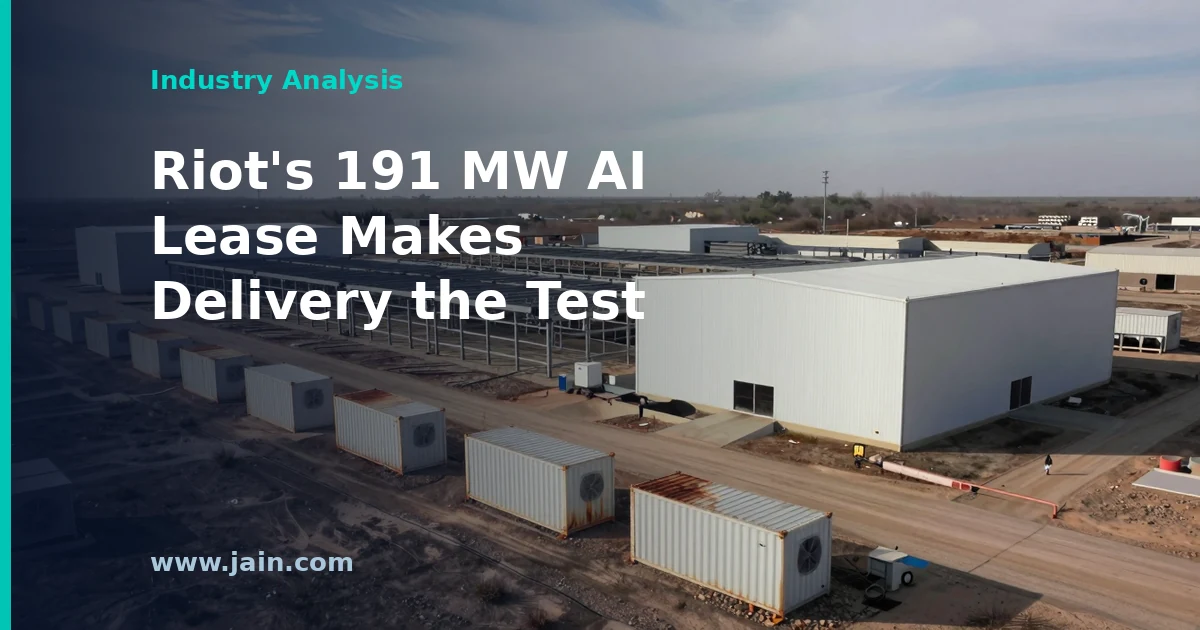
    Riot Has Delivered 25 MW. Its 191 MW Anthropic Lease Makes AI Execution the Test

    TL;DR · 30-second read

    The Short Version

    A company best known for mining bitcoin just signed a 20-year deal worth about $9.1 billion to house computers for an artificial intelligence lab, reportedly Anthropic.

    The catch: the new job is more than seven times the size of what it has finished for AI customers so far. The whole company brought in about $174 million last quarter.

    Mining sites have something AI companies want: access to huge amounts of electricity. Now the question is whether this one can build fast enough.

    Riot Platforms disclosed on August 10, 2026, that it has signed a 20-year data center lease for 191 megawatts (MW) of critical IT capacity, the power available to run computing equipment, at its Rockdale campus in central Texas. Riot expects about $9.1 billion in contract revenue over the initial term, which runs through June 2048, and about $16.1 billion if the tenant exercises two five-year extensions.

    CNBC reported that Riot struck a deal with Anthropic. Riot’s earnings release describes the tenant only as “one of the world’s leading frontier AI labs,” meaning a developer of the most advanced AI models.

    Executive Summary

    The lease is Riot’s second at Rockdale, following the Advanced Micro Devices (AMD) agreement announced on January 16, 2026. Riot’s earnings release says the two leases total 241 MW and about $9.8 billion of long-term contracted revenue. An 8-K filed the same day also says Riot has entered a non-binding letter of intent for a proposed lease at its Corsicana Facility.

    The deal matters because of the gap between what Riot has signed and what it has built. Riot reports delivering 25 MW to AMD on time and on budget, while the new lease is more than seven times that size. With a large contract now in hand, the questions move from whether a bitcoin miner can win an AI tenant to whether it can deliver at this scale, and how much protection the contract offers over two decades.

    From 25 MW to 191 MW: Why Execution Is Now the Test

    Riot’s delivery record is real but still small relative to its new obligation. The company says it completed AMD’s initial 25 MW on time and on budget. A further 10 MW is due in November 2026 and 15 MW in May 2027, which would bring AMD to 50 MW. The new 191 MW lease is more than seven times what Riot has delivered and nearly four times AMD’s full contracted capacity.

    The calendar sharpens the point. A 20-year initial term running through June 2048 implies a start around mid-2028, roughly 22 months after the announcement. That inference does not establish how the capacity will be phased. It does suggest that Riot may need to deliver far more capacity, in less time per megawatt, than it has so far.

    Tenants depend on that schedule to bring computing online, lenders and investors depend on it to start the revenue, and suppliers and contractors must be lined up to support it. Riot credits its in-house procurement, engineering and construction capabilities for the AMD record. The Rockdale lease will test whether that model holds at a much larger scale.

    What the $9.1 Billion Figure Does and Does Not Say

    Spread evenly, $9.1 billion over 20 years averages about $455 million a year, or about $2.4 million per MW annually. That is simple arithmetic rather than a payment schedule, and actual revenue may vary with phasing and contract terms. Even so, the scale is striking: Riot reported total second-quarter revenue of $174.2 million, up 14% from a year earlier, including $23.2 million from data centers, about 13% of the total.

    The larger $16.1 billion figure needs more care. Its additional $7.0 billion depends on two five-year extensions that are exercisable at the tenant’s election, so that portion is optional for the tenant rather than committed. Those ten years would average about $700 million annually, well above the initial-term average, though the reason for the difference is not explained in the company’s statement of the headline figures.

    Contract revenue is also not profit. The agreement is a “Data Center Lease and Services Agreement,” so the total may reflect more than rent, and returns will depend on the cost of building and operating the capacity.

    Tenant Credit Becomes Part of the Asset

    A long-term lease is worth only as much as the tenant’s ability to pay and the protections written into the contract. That is especially relevant here because a 20-year term is longer than today’s frontier AI labs have existed. Their spending is substantial, but a contract of this length requires lenders and investors to underwrite a young sector across decades. Credit support, termination rights and remedies for delays would all shape how much of the headline value is dependable.

    The contract book is also concentrated. By Riot’s figures, the new lease accounts for about 79% of contracted capacity (191 of 241 MW) and about 93% of contracted revenue ($9.1 billion of $9.8 billion). Having both AMD and a frontier lab broadens Riot’s customer list, but the financial outcome now rests heavily on one agreement.

    Power Wins the Meeting, but It Does Not Finish the Building

    Riot CEO Jason Les says the platform combines “multi-gigawatt-scale power capacity that is already fully approved and energized” with in-house development expertise and custom engineering. Approved, energized power is a meaningful advantage, and it helps explain why bitcoin miners have become candidates for AI development. They already operate large, power-intensive sites.

    A grid connection is not a finished data hall, however. Critical IT capacity counts only the power available to computing equipment, so a site must also supply cooling and other facility loads. AI facilities also generally demand higher reliability and more complex cooling than mining, which can tolerate interruptions more readily. Riot’s power position may reduce one major development risk, but it leaves construction and commissioning risk in place.

    The deal is one data point rather than proof that every miner can make this transition. Riot’s 10-Q now reports Data Centers as a segment alongside Bitcoin Mining and Engineering, but the Corsicana letter of intent is non-binding and should not be counted alongside signed leases. The measure of the pivot will be capacity commissioned and revenue recognized.

    Background

    Riot Platforms, based in Castle Rock, Colorado, describes itself as a digital infrastructure company specializing in large-scale data centers and bitcoin mining. It operates facilities in central Texas and Kentucky, with engineering and fabrication facilities in Denver and Houston.

    Bitcoin mining uses specialized computers and large amounts of electricity to validate transactions and earn bitcoin. Developers of advanced AI systems also need large amounts of power, which has made mining operators’ sites and grid access relevant to the AI data center market. Riot’s move into leasing began publicly with the AMD agreement in January 2026.

    Sources

    Source: Riot Platforms strikes deal with Anthropic as bitcoin miners shift focus to AI infrastructure – CNBC, on Riot’s deal and the wider shift by bitcoin miners toward AI infrastructure.

    Primary sources: Riot Platforms 10-Q filed 2026-08-10; Riot Platforms 8-K filed 2026-08-10; Exhibit 99.1 to 8-K filed 2026-08-10, Riot Platforms Reports Second Quarter 2026 Financial Results and Strategic Highlights; Exhibit 99.2 to 8-K filed 2026-08-10, Q2 2026 Earnings Deck.