
Google has unveiled an open-source liquid-to-air cooling sidecar designed for air-cooled data center environments, as reported by Data Center Dynamics on June 17, 2026. The design targets one of the most pressing constraints in the industry: modern AI accelerators increasingly require direct liquid cooling, while the vast majority of existing data center floor space was built to move heat with air alone.
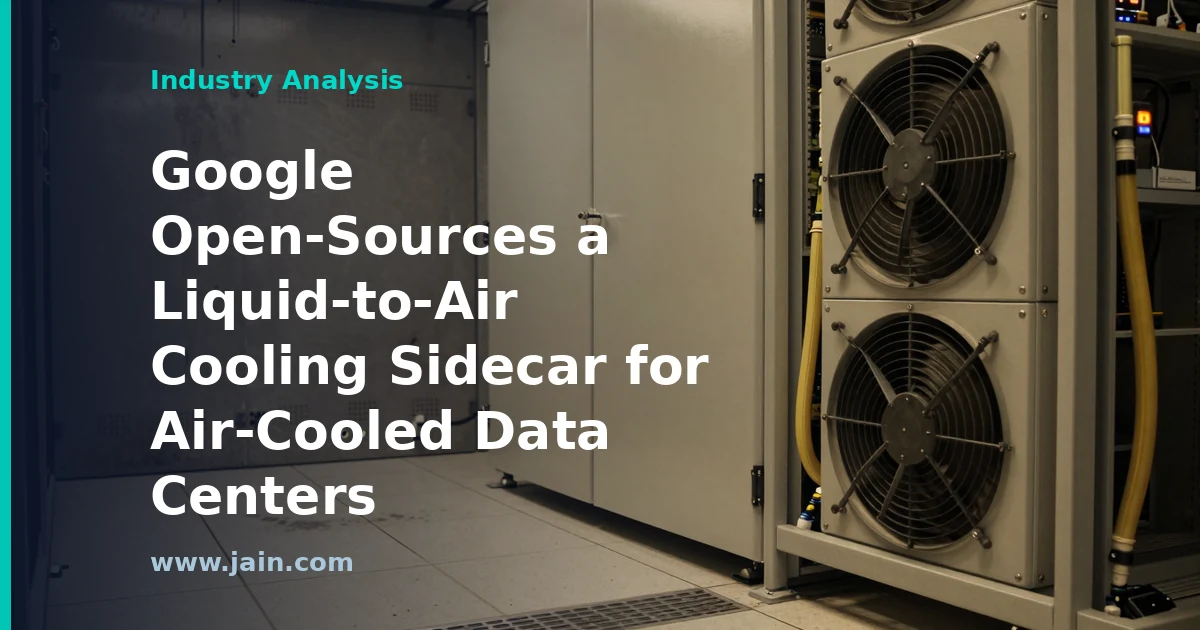
A sidecar of this type is a heat-exchanger cabinet that sits beside a rack of liquid-cooled servers, circulating coolant through the chips in a closed loop and then rejecting that heat into the room’s existing airflow — no facility water piping required. By publishing the design openly, Google is inviting vendors and operators to build and adapt it rather than keeping it proprietary.
Executive Summary
The announcement matters less for what the hardware is than for where it lets liquid cooling go. Direct-to-chip liquid cooling has become effectively mandatory for the densest AI training hardware, but deploying it normally requires facility-level infrastructure — coolant distribution units, piping loops, and water connections that most operating data centers simply do not have. A liquid-to-air sidecar sidesteps that requirement: the liquid loop stays local to the rack, and the building’s existing air-handling systems carry the heat away as they always have.
That makes this a retrofit play. Enterprises, colocation tenants, and smaller operators sitting on air-cooled capacity gain a path to host at least some liquid-cooled equipment without construction projects. It is also a continuation of Google’s recent posture of contributing cooling designs to the open hardware ecosystem rather than treating them as competitive secrets — a bet that standardizing the plumbing layer accelerates the whole market Google’s cloud and AI businesses depend on.
The report available at the time of writing is brief, and the announcement as covered leaves key engineering and availability details unstated — including the design’s cooling capacity, its publication venue and license, and whether it reflects hardware Google runs in production. Those specifics will determine whether this is a broadly useful reference design or a niche one.
The Retrofit Gap Is the Industry’s Quiet Bottleneck
Headlines about AI data centers focus on new gigawatt-scale campuses, but most of the world’s installed data center capacity is older, air-cooled space designed for racks drawing 5 to 15 kilowatts. Current AI server racks can draw many times that, and the chips inside them ship with cold plates that expect liquid, not airflow. Operators of existing facilities face an unattractive menu: leave AI workloads to someone else, undertake disruptive plumbing retrofits in live buildings, or find a bridge technology.
Liquid-to-air sidecars are that bridge. Because the liquid never leaves the immediate vicinity of the rack, the facility itself does not need water loops, external coolant distribution plants, or new mechanical rooms. The trade-off is physics: the room’s air systems still have to absorb every watt the sidecar rejects, so total rack density remains bounded by the building’s air-handling and power envelope. A sidecar extends the life of air-cooled space; it does not turn a legacy building into a frontier AI facility.
Why Give the Design Away?
Google has form here. The company has run liquid-cooled custom TPU accelerators internally since roughly 2018, and in 2025 it announced it would contribute a production coolant distribution unit design to the Open Compute Project, the industry body through which hyperscalers share hardware specifications. Open-sourcing a sidecar fits the same logic: cooling hardware is not where Google differentiates, but an immature, fragmented cooling supply chain slows everyone — including Google and the customers of its cloud business.
Open designs give equipment manufacturers a common reference to build against, which tends to lower prices, improve interoperability, and widen the vendor pool. For Google there is also a soft-power dividend: hyperscaler-authored designs shape industry standards, and the ecosystem that grows up around them tends to stay compatible with the author’s infrastructure choices. None of that makes the contribution less useful — but it is worth understanding open-source hardware as strategy, not charity.
Winners, Losers, and the Honest Limits
The clearest beneficiaries are operators of existing air-cooled facilities — enterprise server rooms, regional colocation providers, and edge sites — who gain an on-ramp to liquid-cooled hardware without capital construction. Cooling-equipment manufacturers get a design they can productize; some may welcome the demand signal, while vendors selling proprietary sidecar and rear-door heat exchanger products now face an open alternative that could compress margins.
The honest caveat is that the announcement, as reported, is a design release, not a product with published performance data. Until the specification’s capacity, tested configurations, and licensing terms are public and third parties have built against it, the practical impact is prospective. Open hardware contributions have a mixed track record: some become de facto standards, others languish without a manufacturing ecosystem. Which path this design takes depends on details the initial coverage does not yet supply.
Background
Google is one of the world’s largest data center operators and has cooled its custom TPU AI accelerators with liquid since roughly 2018 — years before liquid cooling became an industry-wide necessity. In 2025 it began contributing pieces of that cooling stack to the open hardware ecosystem, announcing a production coolant distribution unit design for the Open Compute Project, the body through which hyperscalers share server and infrastructure specifications.
The backdrop is a market-wide squeeze: AI hardware demand is rising far faster than new liquid-ready facilities can be built, leaving a large installed base of air-cooled data centers unable to host the densest equipment. Bridge technologies that bring liquid cooling into air-cooled buildings — sidecars and rear-door heat exchangers among them — have become one of the fastest-moving segments of data center engineering.
Source: Google unveils new open-source liquid-to-air cooling sidecar for air-cooled environments — Data Center Dynamics report, June 17, 2026, on Google’s open-source cooling hardware release.