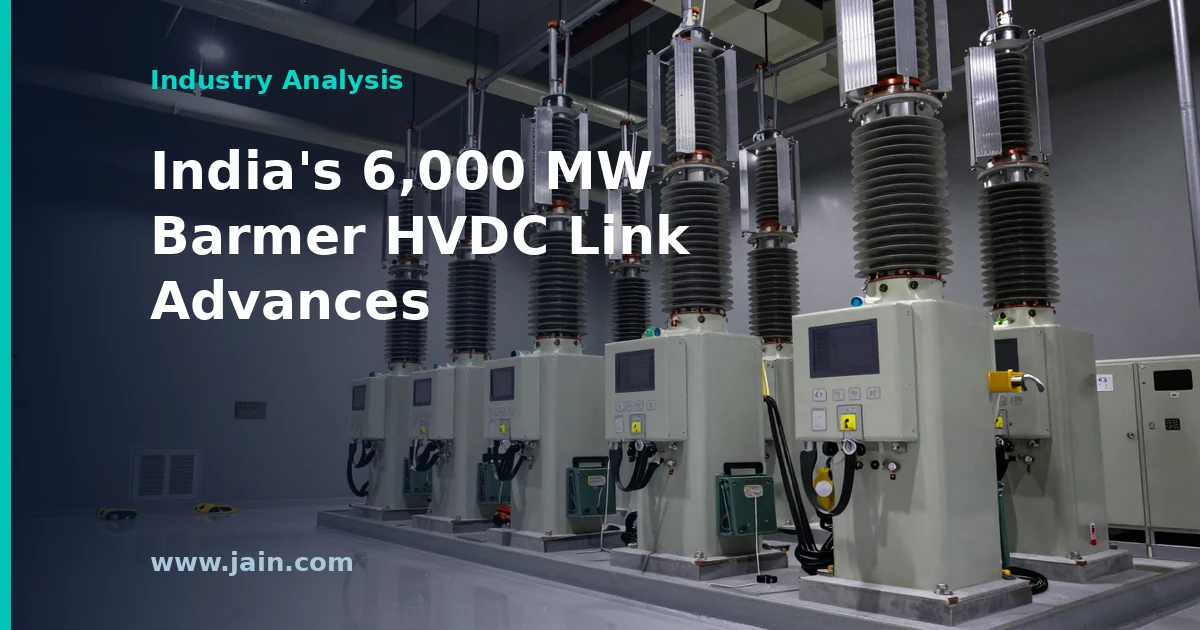
India’s state-controlled power-line company has won a project worth about 25,000 crore rupees, very roughly three billion US dollars, to build an electricity superhighway starting in Barmer, a desert district of Rajasthan crowded with solar and wind farms.
The line is designed to carry 6,000 megawatts, roughly the output of several large power stations. The Indian arm of the American company GE Vernova is reported to be the front-runner to supply the giant equipment at each end.
Why it matters: clean electricity is worthless if it cannot reach the cities, factories and data centers that need it.
Power Grid Corporation of India has secured the Barmer–South Kalamb high-voltage direct current (HVDC) transmission project, a 6,000 megawatt link valued at ₹25,000–₹26,000 crore (₹250–260 billion), Sahi Markets reported on September 7, 2026. The same report said GE Vernova T&D India emerged as the top bidder for the project’s terminal station equipment package, the converter stations that sit at either end of the line.
GE Vernova T&D India, the listed Indian subsidiary of GE Vernova, already carries an order backlog of ₹20,930 crore. Neither company has publicly confirmed the equipment award, its value or a construction schedule.
Executive Summary
The Barmer–South Kalamb award is one of the larger single transmission projects in India’s current build-out. At 6,000 megawatts, it is sized to move bulk renewable output from western Rajasthan, where land and sunshine are plentiful but local demand is modest, across long distances to consuming regions. HVDC is the technology of choice for that job because direct current loses less energy over long distances than conventional alternating current lines and lets grid operators control exactly how much power flows.
For the equipment supply chain, the significance is concentration. The terminal stations are the most technically demanding and valuable part of an HVDC system, and only a small number of manufacturers worldwide can deliver them. If GE Vernova T&D India’s reported position converts into a signed contract, it would add a substantial project to a backlog that is already more than four-fifths the size of the entire transmission scheme’s reported value.
For data center developers and other large power buyers, the story is a reminder that India’s clean-energy constraint is shifting from generation to delivery. Wind and solar capacity can be built in a few years; the transmission corridors that carry it to load centers take longer and depend on a thin supplier base.
Transmission Is Becoming the Scarce Asset
Renewable generation in India has clustered where resources are best, and Rajasthan’s Barmer region is a prime example. The problem is that the electricity is needed hundreds of kilometers away. Without enough transmission, solar and wind farms face curtailment, meaning they are ordered to cut output because the grid cannot absorb it. That makes long-distance corridors, rather than panels or turbines, the practical limit on how fast clean power reaches customers.
A 6,000 megawatt HVDC link is a direct response to that constraint. Unlike a conventional AC line, which spreads power across the network according to physics, an HVDC link behaves more like a pipeline with a valve: operators set the flow. That controllability is valuable for managing variable renewable output and for keeping regional grids stable as more intermittent supply is added.
A Narrow Supplier Base Holds Pricing Power
Converter stations, the equipment that turns alternating current into direct current and back again, are built by a small club of global manufacturers. That scarcity cuts two ways. Suppliers with local manufacturing and engineering capability, as GE Vernova T&D India has, are well placed to win work as India expands its HVDC pipeline. Buyers, meanwhile, face long lead times for transformers, valves and control systems, and limited competition on price.
A large existing backlog is both a strength and a question. The reported ₹20,930 crore order book signals demand visibility, but it also means new projects compete for the same factory slots, engineers and commissioning crews. Execution capacity, not order intake, is often what separates strong years from delayed ones in heavy electrical equipment.
What It Means for Data Center Power
India’s data center market is growing alongside rising demand for cloud and AI computing, and operators increasingly want renewable supply to meet customer sustainability targets. Most large campuses sit near major cities and connectivity hubs, not in the desert where renewable power is cheapest to generate. Corridors like Barmer–South Kalamb are what make long-distance renewable procurement, through open-access or power purchase arrangements, physically deliverable.
The project has not been tied to any specific data center or industrial customer, and it would be a stretch to read it as a data center announcement. The more measured takeaway is structural: large power buyers planning multi-year expansions in India should treat transmission timelines as a core site-selection and procurement risk, alongside land, water and fiber.
Background
India is building out large volumes of solar and wind capacity, much of it in resource-rich western states such as Rajasthan and Gujarat, far from major consumption centers. Moving that power requires new high-capacity transmission corridors, and HVDC links are increasingly used for the longest, highest-volume routes. Power Grid Corporation of India, the state-controlled central transmission utility, builds and operates much of this interstate network.
GE Vernova T&D India is the Indian-listed transmission and distribution subsidiary of GE Vernova, the energy equipment company spun off from General Electric. It manufactures and supplies grid equipment such as transformers, switchgear and HVDC systems, and it has benefited from utilities’ rising investment in grid expansion and modernization.
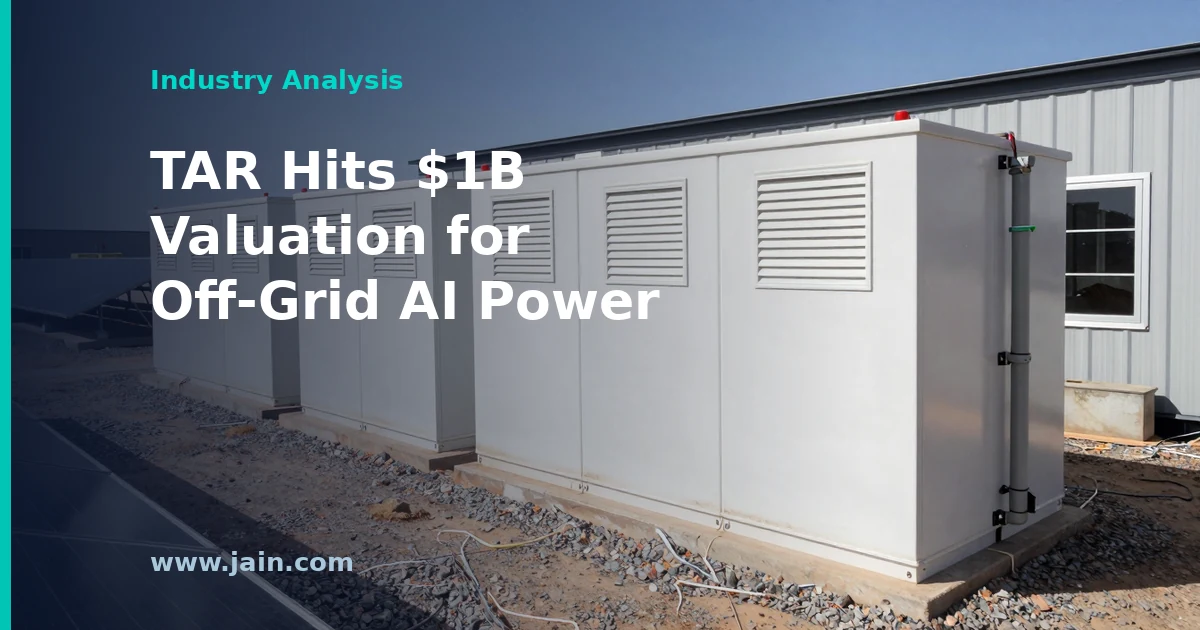
TAR, a Texas company started only this year, has raised $120 million from investors who now value it at $1 billion.
It builds private power plants for the giant computer warehouses behind artificial intelligence tools. The plants use renewable energy and huge batteries, and never plug into the public electricity grid.
Why it matters: these warehouses use so much electricity that many wait years to be connected. TAR says its approach lets them get power without competing with nearby homes and businesses for it.
Austin-based TAR has raised $120 million in Series A funding at a $1 billion post-money valuation, Pulse 2.0 reported on September 11, 2026. Spark Capital led the round. TAR was founded in 2026 by Pat Becker and Leonhard (Lenny) Soenke. It builds self-contained, modular power systems that combine renewable generation with battery storage and run independently of the electric grid, aimed at AI data centers at gigawatt scale.
The company says the money will expand its Austin headquarters and its San Francisco engineering office. It will also grow manufacturing and logistics operations in West Texas and speed up deployments already underway. Those deployments include a utility-scale project with one of the largest neoclouds, a dedicated project campus, and TAR Terminal One, a manufacturing and logistics center in West Texas.
Executive Summary
TAR’s raise is one of the clearest signs yet that investors see off-grid power for AI as a business category in its own right. It is no longer just a temporary fix for data centers waiting on a utility hookup. A company founded this year has reached unicorn status on its first institutional round by promising dedicated renewable-plus-battery generation that it designs, builds and operates itself.
The thesis rests on two claims. The first is that power, not chips, is now the binding constraint on AI computing. The second is that the fastest way to supply it is to own the whole project lifecycle and automate construction. TAR pairs energy veterans from Hut 8, AES and Vistra with robotics engineers from Zipline, GrayMatter Robotics and Lucid Motors, which suggests an attempt to treat power plant construction partly as a manufacturing problem.
What the company has not yet made public matters as much as the valuation. TAR has not disclosed installed megawatts, its customer’s name, contract terms or project timelines. The central engineering question for any off-grid system serving round-the-clock computing is how it maintains reliable supply, and TAR has not yet explained its approach.
Off-Grid Power Gets Its Own Venture Price Tag
For much of the data center boom, on-site generation has been framed as a bridge. It energizes a campus while the project waits in a utility’s interconnection queue, the line of projects awaiting approval to connect to the grid. A $1 billion post-money valuation for a company founded in 2026 suggests Spark Capital sees something more durable: a standalone category in which generation is built and run as a permanent, dedicated supply for computing.
The arithmetic is instructive. A $120 million raise at $1 billion post-money implies a pre-money valuation of roughly $880 million. TAR reached that figure without publicly disclosing completed megawatts, contracted revenue or a named customer. At that level, investors are paying for team, speed and position in a market where, as Spark’s Will Reed put it, “power is becoming the main bottleneck to scaling compute.” It is a bet on the size of the problem as much as on a track record.
The deal also points to a shift in where AI infrastructure capital goes. Energy assets have traditionally been funded by utilities, infrastructure funds and project lenders, who price them for steady, bond-like returns. A venture-style valuation for a power developer implies that some investors now treat the speed of energy delivery, and not only its cost, as a source of technology-like upside.
Owning the Whole Stack: Faster Delivery, Concentrated Risk
TAR’s strategy is vertical integration. It handles site selection, detailed engineering, procurement, logistics, civil construction, commissioning and ongoing operations itself, rather than coordinating a chain of outside contractors. The reasoning is that schedules tend to slip at the handoffs between firms. Co-founder Pat Becker said gigawatt-scale deployments (a gigawatt is a thousand megawatts, comparable to the output of a large power plant) “in tight time windows necessitate owning the full stack end-to-end.”
The company’s purpose-built deployment automation stack is meant to install generation faster, at larger scale and with less field labor than conventional construction. If it works, the limit on how fast power can be built shifts away from the supply of skilled field crews and toward factory and logistics throughput. TAR Terminal One in West Texas appears designed to supply that throughput.
The trade-off is concentration of risk. A contractor ecosystem spreads execution risk across many firms, while an integrated developer carries all of it. TAR must scale engineering, robotics, manufacturing, logistics and field operations at the same time. That is capital-intensive and operationally demanding. TAR has not yet disclosed completed projects that show its automation claims working at scale.
The Reliability Question for Renewables Plus Batteries
AI data centers run around the clock, and their customers expect very high uptime. A grid connection offers a backstop when on-site generation falls short, and an off-grid system has no such backstop. TAR describes its systems as combining renewable generation with battery storage and operating independently of the grid. The design therefore has to cover periods of weak sun or wind entirely on its own.
That problem can be solved in several ways: oversizing generation, adding longer-duration storage, or including firm backup generation. Each adds cost, equipment and land. How TAR balances these choices will largely decide whether its power competes on price and reliability with grid electricity or with gas-fired on-site plants, the other common off-grid option.
TAR’s community argument does resonate. Its systems do not draw on shared grid capacity, so the company says data center projects can add generation without competing with surrounding communities. That matters in siting debates, where the effect of very large facilities on local electricity supply and prices is a recurring concern.
Who Stands to Gain if the Model Works
Neoclouds are natural early customers. These are cloud providers that specialize in renting out GPU computing for AI, as opposed to the broad hyperscale clouds. They compete heavily on how quickly they can bring capacity online, which makes long grid timelines especially costly for them. TAR says it is already executing a utility-scale deployment with one of the largest neoclouds, a sign that its offer has found at least one buyer with urgent demand.
For utilities and grid operators, the effects are mixed. Off-grid campuses ease pressure on congested transmission lines, but they also mean large new electricity users that never become utility customers. Suppliers of batteries and generation equipment, along with West Texas manufacturing and logistics workforces, stand to benefit from any sustained buildout. TAR’s competition includes other on-site power developers and the traditional engineering and construction firms whose multi-contractor model it is explicitly positioning against.
Background
AI data centers use far more electricity than traditional facilities, and in many regions connecting a new large user to the grid means joining a long interconnection queue and waiting for new transmission and generation. That has pushed developers toward “behind-the-meter” power: generation built on or next to the site that serves the data center directly. Such projects have often been treated as temporary bridges until a grid connection arrives.
TAR, founded in 2026 in Austin, is pursuing the off-grid approach as a permanent model. It uses modular renewable generation and battery storage and manages projects end to end. Its lead investor, Spark Capital, is a venture capital firm. The company’s leadership draws on experience at energy and infrastructure companies including Hut 8, AES and Vistra, as well as robotics and hardware companies Zipline, GrayMatter Robotics and Lucid Motors.
Spain wants new data centers, the warehouse-sized buildings full of computers that run websites, apps and artificial intelligence, to help build the clean power they use.
Under a draft government rule, new sites would have to get at least 80 percent of their electricity from newly built wind, solar or similar sources, checked hour by hour. That includes nights, when solar panels produce nothing.
Sites that fall short would pay rising charges and could eventually lose their connection to the power grid. People familiar with the draft say it is not a ban, but it would make building harder.
The Spanish government has approved a draft decree, on a fast-tracked legislative path, that would require new data centers with 1MW (one megawatt) or more of capacity to source at least 80 percent of their electricity from new renewable generation, with compliance measured hourly rather than annually. Europa Press first reported the draft on August 26, 2026, and Data Center Dynamics relayed the details. The proposal is expected to go to public consultation before it takes effect.
The renewable supply must be additional: each new megawatt of data center capacity would be matched by equivalent renewable generation installed within the 18 months before the facility starts operating. Operators that fall short would face escalating surcharges on grid charges and network tariffs, and could ultimately lose grid access. The requirement would apply until Spain’s electricity mix reaches 90 percent renewables.
Executive Summary
Spain’s draft rule goes further than most corporate clean-energy commitments in three ways at once. It requires new generation rather than existing supply, it sets a high threshold of 80 percent, and it measures compliance hour by hour. It applies to new projects only, gives projects already under development a six-month grace period (three months for those awaiting a grid-access tender), and adds a requirement to meet the top tiers of a forthcoming European energy and water efficiency label for data centers.
The stakes are large because Spain has become one of Europe’s busiest data center markets. More than 10GW (gigawatts, thousands of megawatts) of data center projects are seeking grid connections in the country. A rule that ties every new megawatt to new renewable build, matched around the clock, turns energy procurement from a sustainability line item into a precondition for getting built.
The central consequence is less about how much clean power a project buys and more about when it arrives. Spain’s renewable strength is abundant daytime solar; an hourly test asks what supplies a data center at 3 a.m.
Hourly Matching Moves the Problem to the Night
Most corporate renewable claims today are settled annually. A company buys enough renewable energy over a year to equal its total consumption, and a surplus of midday solar can be counted against electricity drawn from gas or other sources at night. Spain’s draft closes that gap by measuring compliance hourly. Data centers draw close to the same power around the clock, so an 80 percent hourly test means clean supply has to be available in the evening and overnight hours as well, not just when the sun is high.
That is why the practical constraint shifts. The reported compliance routes include onsite deployments such as rooftop solar, but rooftop solar at a facility drawing a megawatt or more covers only a fraction of its load, and only in daylight. Meeting the threshold in dark hours points operators toward wind contracts, battery storage, or power purchase agreements (PPAs, long-term contracts to buy output from a specific generator) structured around a flat, 24-hour load profile. Those products are scarcer and typically priced higher than plain solar output. The people most affected are developers in Spain’s 10GW-plus connection queue, and the winners are likely to be sellers of firmed or shaped clean power rather than sellers of cheap daytime megawatt-hours.
The policy logic is straightforward: without additionality and time-matching, a fast-growing class of large, constant loads can absorb existing clean supply that other consumers would otherwise use, while leaving night-time demand to fossil plants. The open question is cost. An hourly 80 percent standard is materially harder and more expensive to meet than an annual one, and the draft as reported does not show how the government weighed that against the pace of investment it has been attracting.
An 18-Month Clock Couples Two Build Schedules
The additionality clause requires matching renewable generation to be installed within the 18 months before a data center reaches operational status. In effect, a data center’s opening date becomes dependent on a second infrastructure project: a wind farm, solar plant or storage installation that needs its own site, permits and grid connection. Delay on the generation side becomes delay on the data center side.
That favors operators who already develop renewable assets or who can partner early with utilities and independent power producers, and it disadvantages developers who planned to sign a supply contract late in construction. It also raises the importance of the transition terms: projects already under development get six months to comply, or three months if they are waiting on a grid-access tender. For projects whose timelines were set assuming existing supply, those windows are short relative to how long new generation typically takes to build.
The requirement is designed to expire once Spain’s electricity mix reaches 90 percent renewables. That sunset signals the rule is meant as a bridge while the grid decarbonizes, not a permanent cap, but it also means the burden falls hardest on projects built in the years before that threshold is reached.
Enforcement Runs Through the Grid Bill
The draft’s enforcement mechanism is notable. Rather than fines alone, shortfalls would trigger escalating surcharges on grid charges and network tariffs, with potential loss of grid access at the extreme. For a data center, grid access is the asset; putting it at risk makes compliance a matter of operational continuity, and lenders and customers signing long-term contracts will likely want to see the compliance plan before they commit.
Layered on top is an efficiency requirement: new facilities would be expected to meet the highest levels of the European data center energy and water efficiency labeling scheme that the European Commission is slated to enforce within a year. Combined, the measures raise the bar on both how a facility is powered and how efficiently it uses that power and water.
People familiar with the draft told Europa Press that it does not amount to a moratorium, and that is accurate on its face: nothing prohibits building. But the combination of additionality, hourly matching, short grace periods and grid-linked penalties could significantly curtail development, and it is reasonable to expect the 10GW queue to thin toward projects with credible, round-the-clock clean supply. This is one country’s draft rather than a European standard, and it is still subject to consultation, so its final shape matters as much as its headline number.
Background
Spain has been experiencing a data center boom, with operators drawn by its available land and strong renewable resources. More than 10GW of data center projects are currently seeking grid connections in the country, a queue that puts pressure on both grid capacity and the clean-power supply that other sectors are also counting on to decarbonize.
The draft decree draws on two ideas that have been gaining ground in clean-energy policy: additionality, which requires that a buyer’s demand be met by newly built generation rather than existing plants, and time-matching, which checks whether clean supply is available in the same hours the electricity is consumed. Many large technology buyers have pursued these goals voluntarily; Spain’s draft would make them a regulatory condition for new data centers of 1MW and above.
In 2025, the giant computer buildings that run cloud services and artificial intelligence used almost a quarter of all the electricity in Ireland. That is nearly as much as every home in the country put together.
Their electricity use grew five times faster than everyone else’s, even though Ireland stopped letting new ones plug into the grid around Dublin in 2021.
The lesson is that blocking new hookups did not stop buildings that were already connected from using more. Ireland now makes new sites bring their own power plants.
Data centers accounted for 23% of Ireland’s metered electricity consumption in 2025, according to Central Statistics Office (CSO) figures reported by Tom’s Hardware. Consumption rose to 7,663 gigawatt-hours (GWh) from 6,973 GWh in 2024, a 10% increase in one year, while electricity use across the rest of the economy grew about 2%. Homes, urban and rural combined, accounted for 28%.
The CSO’s newly compiled quarterly series shows data center use rising from 291 GWh in the first quarter of 2015 to 1,991 GWh in the fourth quarter of 2025, an increase of 584%. In 2015, data centers accounted for about 5% of national consumption.
Executive Summary
Ireland has roughly five million people and around 89 data centers, most of them clustered around Dublin and operated by hyperscalers (the largest cloud and platform companies, which build facilities for their own use) such as Microsoft, AWS, Google and Meta. Those facilities now draw nearly as much power as the country’s entire housing stock.
The figure matters because of what did not happen. In November 2021, Ireland’s energy regulator effectively froze new data center grid connections in the Greater Dublin Area. Consumption kept climbing through 2025 regardless. Grid operators elsewhere are weighing the same tool, and Ireland’s data shows its limits: a connection freeze controls which new projects join the grid, but it does not control how much power already-connected projects draw.
Ireland has since replaced the freeze with a rule requiring new large data centers to supply their own on-site generation and source most of their power from new renewable projects. That makes the country the clearest live test of what happens when AI-era demand outgrows a national grid.
Why a Connection Freeze Didn’t Freeze Consumption
The Commission for Regulation of Utilities (CRU) direction of November 2021 told grid operator EirGrid to stop processing standard connection applications for new data centers in the Greater Dublin Area. Developers had two options: build their own generation or move to less constrained regions. That is a control on queue entry, meaning which new sites get a grid connection at all. It is not a control on how much electricity existing sites consume.
The numbers show the gap between the two. Data center consumption rose by 690 GWh between 2024 and 2025. That is 10% growth, against 2% for everyone else, more than three years into the freeze. The most straightforward explanation is that facilities already connected, or already holding connection agreements, kept filling out their halls and drawing closer to the capacity they had secured before the freeze. A data center campus is rarely fully loaded on day one. Operators add server rooms and customers over years, and each step increases draw without any new application to EirGrid.
The quarterly data suggest this momentum has not faded. Fourth-quarter 2025 consumption of 1,991 GWh works out to roughly 7,960 GWh a year, which is above the 7,663 GWh total for 2025. Ireland therefore entered 2026 running at a higher rate than its annual average. For grid planners, the lesson is that a freeze delays the next wave of load but still leaves the grid to absorb growth that was effectively approved years earlier.
A Third of the Grid by 2026? The Arithmetic Says Not Yet
In 2024, the International Energy Agency projected that data centers could reach a third of Irish electricity consumption by 2026. The 2025 figures put that projection in context. If 23% corresponds to 7,663 GWh, national consumption was roughly 33,000 GWh. If data center use grows another 10% in 2026 and the rest of the economy grows 2%, the data center share rises to roughly 24%, not 33%. Reaching a third in 2026 would require a sharp acceleration beyond anything in the recent series.
That does not weaken the underlying trend. The share has more than quadrupled in a decade, from about 5% to 23%. But the trajectory looks like steady compounding rather than a sudden spike. The attribution to AI also needs care. Ireland’s early data center boom was built on cloud storage and social media, and generative AI is widely cited as the driver of recent growth. However, the CSO figures measure metered electricity for data centers as a category. They do not show how much of the increase came from AI training or inference compared with conventional cloud workloads.
The New Rule: Bring Your Own Power Plant
The freeze has been replaced by the CRU’s Large Energy Users (LEU) Connection Policy, introduced in late 2025. New data centers above 10 MVA (megavolt-amperes, a measure of electrical capacity; 10 MVA is a mid-sized facility) must provide 100% on-site, flexible generation to meet their demand. Within six years of operation, they must also source at least 80% of their annual electricity from new, unsubsidized renewable projects.
In practice, this moves the grid constraint inside the fence line. A developer in Ireland now also has to plan, finance and operate a power station that can cover the whole load, and then contract new wind or solar output on top of it. That raises capital costs and lengthens project timelines. It is likely to favor operators with large balance sheets, such as the hyperscalers, over smaller colocation providers that lease space to tenants. It also increases the scarcity value of capacity that was connected under the old regime, because no new Dublin site can replicate those terms.
What Other Grids Can Take From Ireland
Ireland is an extreme case because a small population is hosting infrastructure built for global cloud platforms. The same pressures are appearing elsewhere. Tom’s Hardware cites surveys projecting 26% growth in global data center electricity use this year, and reports that local opposition led to more than 75 US project cancellations in the first quarter of 2026.
For regulators considering a pause on new connections, Ireland’s data point is specific. A pause buys time to redesign connection rules, but consumption will keep rising for years as existing commitments fill up. The more durable lever appears to be the one Ireland reached next: tying new capacity to new generation, so that data center growth brings its own supply rather than drawing on the shared grid.
Background
Ireland became a European data center hub in the 2010s. Global cloud and social media companies built large campuses around Dublin, drawn by connectivity, a cool climate and an established base of technology firms. The Central Statistics Office has tracked the sector’s metered electricity use since 2015, when data centers accounted for about 5% of national demand.
As that share grew, concerns about grid adequacy led the Commission for Regulation of Utilities to issue its November 2021 direction, which effectively paused new Dublin-area connections. In late 2025, the regulator replaced the pause with the Large Energy Users Connection Policy, which requires new large facilities to bring their own flexible generation and contract new renewable supply.
Bitcoin mining operator Bitdeer will deploy 28 megawatts (MW) of mining capacity at a Soluna Holdings wind-powered site in Texas, according to a June 4, 2026 report by ForkLog. The arrangement pairs Bitdeer’s application-specific mining hardware with electricity generated at Soluna’s co-located Texas wind facility.
Executive Summary
The announcement is modest in scale — 28 MW is a fraction of a typical hyperscale data-center campus — but it is a clean illustration of a business model that has become a fixture of the U.S. power market: bitcoin miners acting as flexible offtakers for renewable generation that the grid cannot always absorb.
For Soluna, whose stated strategy is to co-locate compute loads with wind and solar assets in transmission-constrained regions, the deployment adds a paying tenant to existing infrastructure. For Bitdeer, it is incremental hashrate at a site whose marginal power cost should be low precisely because the underlying wind energy is often curtailed. Neither company disclosed contract length, pricing, or revenue-share terms in the source material.
Stranded Wind, Willing Buyer
West and South Texas produce more wind power than local transmission lines can always evacuate to demand centers. When the grid operator, ERCOT, cannot move the electrons, wind farms either curtail output or accept negative prices to keep turbines spinning. Bitcoin miners — which can start, stop, and modulate consumption in seconds — are among the few loads willing to sit next to that generation and buy the surplus. The Bitdeer–Soluna deployment is a textbook example of that pairing at 28 MW, roughly the draw of a mid-sized industrial park.
The economic logic is straightforward: mining revenue is set by the global bitcoin price and network difficulty, but the cost side is dominated by electricity. A site that can source curtailed wind at a deep discount to grid retail rates has a structural margin advantage, provided the operator can tolerate the intermittency.
What This Says About the Post-Halving Miner Playbook
Following bitcoin’s April 2024 halving, block rewards dropped to 3.125 BTC, compressing miner gross margins and forcing operators to hunt for the cheapest available power. Publicly traded miners have responded by signing behind-the-meter deals with independent power producers, buying distressed sites, and — as here — plugging into renewables developers that need a compute anchor tenant. Bitdeer, which is Nasdaq-listed and was spun out of Bitmain, has been methodically expanding its self-mining fleet alongside its hosting and cloud-hashrate businesses.
Soluna, for its part, is a small-cap public company whose thesis is that co-located data compute makes marginal renewable projects financeable. Every incremental megawatt under contract validates that thesis to its own investors, even if the absolute numbers remain small relative to utility-scale peers.
Winners, Losers, and the AI Overhang
The immediate winners are the two counterparties and, arguably, the wind farm’s original developer, which gains a more predictable revenue floor. Ratepayers in ERCOT are largely indifferent at this scale, though critics of behind-the-meter mining argue that adding flexible load anywhere on the grid changes wholesale price formation in ways that deserve scrutiny.
The looming variable is AI. Hyperscalers and neocloud operators are now competing with miners for the same combination of cheap power, fast interconnect, and permissive siting. AI training clusters generally pay more per megawatt-hour than mining and demand higher uptime, which could crowd miners off the best sites over time. A 28 MW mining build today is defensible; whether the same footprint gets renewed at 2029 pricing, when a GPU tenant might be willing to pay a premium for the same substation capacity, is an open question.
Background
Texas has become the center of gravity for U.S. bitcoin mining, driven by abundant wind and solar generation, a deregulated ERCOT market, and permissive local siting. Curtailment of West Texas wind — power that the grid physically cannot deliver to load centers — created an opening for flexible industrial consumers, and bitcoin miners, whose loads can ramp in seconds, filled it.
Soluna Holdings has built its strategy around this dynamic, developing modular compute sites next to renewable projects. Bitdeer, spun out of mining-hardware giant Bitmain and listed on Nasdaq in 2023, has grown by combining its own mining fleet with hosting and cloud-hashrate products, and by seeking low-cost power in the U.S., Norway, Bhutan, and elsewhere.
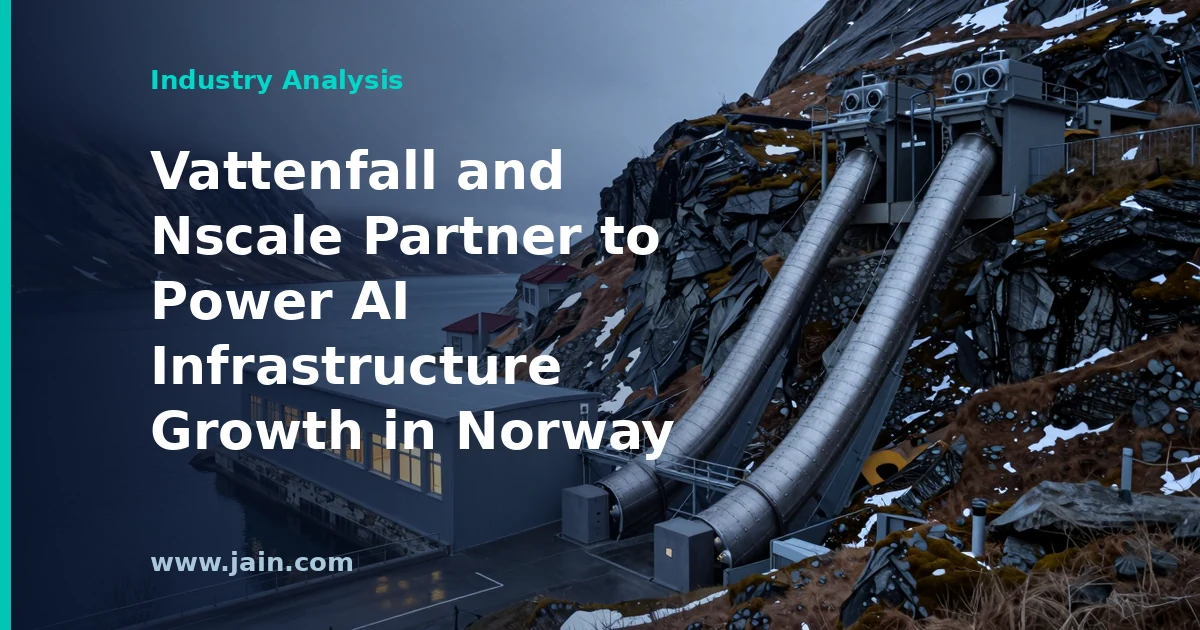
Vattenfall, the Swedish state-owned energy company and one of Europe’s largest power producers, announced on 27 May 2026 a partnership with Nscale, an AI infrastructure provider with operations in Norway, to support the growth of AI infrastructure in the country. The arrangement pairs Vattenfall’s position in the Nordic power market with Nscale’s GPU-based data center capacity.
The announcement, published through Vattenfall’s newsroom, frames the deal around enabling AI compute expansion in Norway with clean Nordic energy. Specific capacity figures, financial terms, and timelines were not detailed in the source material available to us.
Executive Summary
The partnership joins two sides of the equation that now defines AI infrastructure: electricity and compute. Vattenfall brings decades of experience generating and trading power in the Nordic region, where abundant hydropower keeps both electricity prices and carbon intensity among the lowest in Europe. Nscale brings the other half — data centers built to house GPUs (graphics processing units, the specialized chips that train and run AI models) — including an existing Norwegian footprint.
Why it matters: access to power has replaced access to chips as the binding constraint on AI buildout in much of the world. Grid connection queues in major markets stretch years, and hyperscalers increasingly sign deals directly with energy companies rather than waiting in line. A named partnership between a major European utility and a GPU infrastructure specialist is a signal of how the market is reorganizing — with power producers moving up the value chain toward compute, and compute providers moving upstream toward generation.
For Norway specifically, the deal reinforces the country’s bid to convert its renewable surplus into digital exports rather than only raw electricity — though it also lands amid an active Norwegian debate about which industries deserve scarce grid capacity.
Why AI Compute Keeps Moving North
The Nordics offer a combination few regions can match: hydropower-dominated grids with low, relatively stable wholesale prices; a cold climate that slashes cooling costs (cooling can be a significant share of a data center’s energy bill in warmer markets); political stability; and strong fiber connectivity to continental Europe. Norway in particular generates the overwhelming majority of its electricity from hydropower, which is both renewable and — unlike wind and solar — dispatchable, meaning it can run around the clock the way AI training clusters demand.
That is why Norway has attracted a steady stream of data center investment over the past decade, and why AI-focused operators like Nscale planted their flags there. Training large AI models is less latency-sensitive than serving consumer applications, so remote-but-cheap-and-green locations are a rational fit for training workloads even when end users are far away.
What a Utility Brings to the GPU Race
The scarce resource in AI infrastructure is no longer just GPUs — it is firm, sizable grid connections and the energy to feed them. Utilities control exactly that. A partnership with Vattenfall potentially gives an AI infrastructure operator earlier visibility into available capacity, structured long-term power purchase agreements (PPAs — contracts that lock in electricity supply and price for years), and credibility with grid operators and regulators. For Vattenfall, AI data centers represent something European utilities have lacked for years: large, creditworthy, growing demand in a region where industrial electricity consumption had been flat.
This mirrors a broader industry pattern of energy companies and compute companies converging — through PPAs, co-located campuses, and equity partnerships. The strategic logic is sound on both sides, but the value of any specific deal depends entirely on terms the parties disclose: how much power, at what price, for how long, and with what firmness. None of that is specified in the material available here.
A Thin Release, and the Questions Norway Is Already Asking
Based on the source available, this reads as a directional announcement rather than a detailed commercial agreement — no megawatts, sites, investment figures, or delivery dates are cited. That does not make it empty: named partnerships between a state-owned utility and an AI infrastructure firm typically precede concrete projects, and both parties accept reputational cost if nothing follows. But readers should distinguish between an announced intent to cooperate and a contracted buildout.
The deal also lands in a live Norwegian policy debate. Norway’s grid operators have faced more connection requests than the system can serve, and policymakers have discussed prioritizing which loads get capacity — weighing data centers against electrifying industry and transport. A fair reading is that partnerships like this one are partly designed to navigate that environment: aligning with an established utility is a way to demonstrate seriousness and secure standing in the queue. Whether Norwegian regulators and communities view AI data centers as valuable industry or as competition for their renewable advantage remains an open, legitimate question on all sides.
Background
Vattenfall, founded in 1909 and wholly owned by the Swedish state, is one of Europe’s largest electricity producers, with a generation fleet spanning Nordic hydropower, wind, and nuclear, and a stated strategy of enabling fossil-free energy across its markets. Nscale is a newer entrant that emerged in the mid-2020s wave of AI infrastructure specialists, building GPU data centers for AI training and inference and anchoring its early operations in Norway to take advantage of hydropower and a cool climate.
The partnership fits a broader industry realignment: as AI compute demand collided with constrained power grids across Europe and North America, energy companies and compute providers began pairing up through power purchase agreements, co-located campuses, and strategic alliances. The Nordics — with cheap renewable power and cold air — have been among the biggest beneficiaries of that shift, attracting hyperscalers and specialist operators alike over the past decade.
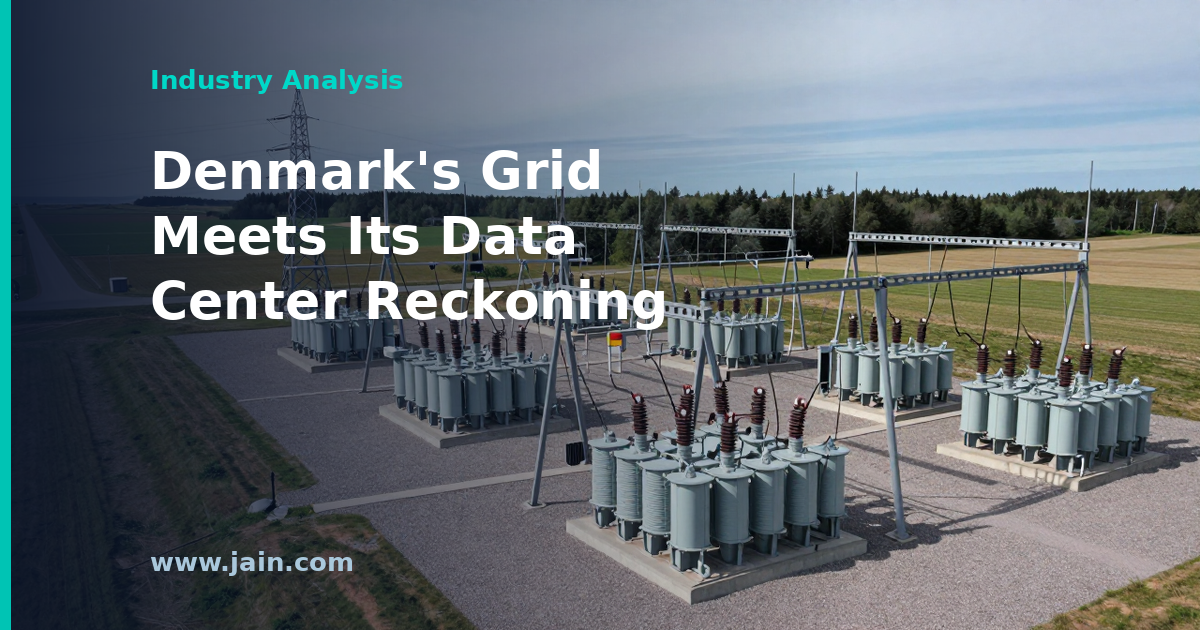
CNBC reports that Denmark is confronting a data center reckoning as its electricity grid struggles to keep pace with demand from new and planned compute campuses. The story frames Denmark — long marketed as a cool-climate, renewable-rich destination for hyperscale sites — as an early warning for the wider European market.
Executive Summary
Denmark built its data center pitch on wind power, fiber connectivity, and a stable regulatory climate. According to CNBC’s May 5, 2026 reporting, that pitch has now collided with a physical limit: the grid itself. Surging load from AI training clusters and cloud expansion is arriving faster than transmission and generation can be built to serve it.
The significance is less about one country and more about a pattern. When a small, wealthy, wind-heavy grid begins turning away or slow-walking data center load, it signals that Europe’s compute buildout is entering a capacity-constrained phase where power availability — not land, tax breaks, or fiber — decides who gets to build and when.
From Marketing Advantage to Physical Constraint
For roughly a decade, Nordic countries sold themselves as the natural home for hyperscale compute: cold air for free cooling, abundant wind and hydro, and grids with historically high renewable penetration. Denmark in particular attracted anchor tenants on that narrative. The CNBC framing suggests the narrative has aged faster than the infrastructure. Interconnection — the physical and contractual act of tying a new large load into the transmission system — is now a multi-year exercise in many European jurisdictions, and Denmark appears to be joining that queue-bound club.
The economics shift accordingly. When power is the binding constraint, the value of a permitted, energized site rises sharply relative to a greenfield parcel with only a land option. Developers holding older, already-connected sites gain leverage; newcomers face longer development cycles and more expensive grid upgrades passed through in connection fees.
The AI Load Curve Is Not the Cloud Load Curve
Traditional cloud regions grew in relatively predictable megawatt increments. AI training campuses do not. A single modern training hall can request tens to hundreds of megawatts at a single point of interconnection, with utilization profiles that are peakier and less flexible than a general-purpose cloud zone. Grids planned around gradual electrification of transport and heat were not sized for step-change industrial loads landing in single postcodes.
That mismatch is what turns a growth story into a reckoning. It is not that Denmark lacks renewable generation in aggregate; it is that moving power from where wind blows to where a proposed campus wants to plug in requires transmission that takes years to permit and build. In the interim, either the load waits, the grid operator constrains it, or fossil balancing quietly rises to keep the system stable.
Winners, Losers, and the New Site-Selection Playbook
Operators with existing energized capacity in Denmark and neighboring markets benefit from scarcity pricing on colocation and wholesale power capacity. Hyperscalers with the balance sheet to co-invest in transmission or to sign long-tenor renewable PPAs (power purchase agreements — long-term contracts to buy electricity from a specific generator) can still move forward, but on the utility’s timeline. Smaller enterprises and AI startups without that leverage are pushed toward secondary markets or toward renting capacity rather than building it.
Regulators and policymakers face their own trade-off. Restricting new data center load protects households and existing industry from grid stress and price spikes, but risks ceding a strategically important slice of the AI economy to jurisdictions willing to build faster. The Danish debate, as CNBC frames it, is a preview of choices Ireland, the Netherlands, and parts of Germany have already had to make explicitly.
What Substantiated, What Is Not
The reporting substantiates the direction — grid stress from data center demand in Denmark — more than any specific quantified ceiling. Readers should treat headline claims of “overwhelmed” grids as a description of pipeline pressure and interconnection backlog rather than active blackouts. The useful takeaway is directional: European compute siting is repricing around power, and Denmark is a visible early data point rather than a singular crisis.
Background
Denmark, along with Sweden, Norway, and Finland, spent the 2010s courting hyperscale data center investment on the strength of cool weather, renewable generation, and connectivity to mainland Europe. Anchor projects from major U.S. cloud providers helped establish the region as a credible alternative to the FLAP-D markets (Frankfurt, London, Amsterdam, Paris, Dublin).
By the mid-2020s, that same set of European markets began hitting grid constraints as electrification of transport, heating, and industry collided with a step-change in compute demand from AI. Ireland’s moratorium in the Dublin area and the Netherlands’ national siting restrictions were the first public signals; Denmark’s current situation extends that pattern into the Nordics themselves.