TL;DR · 30-second read
The Short Version
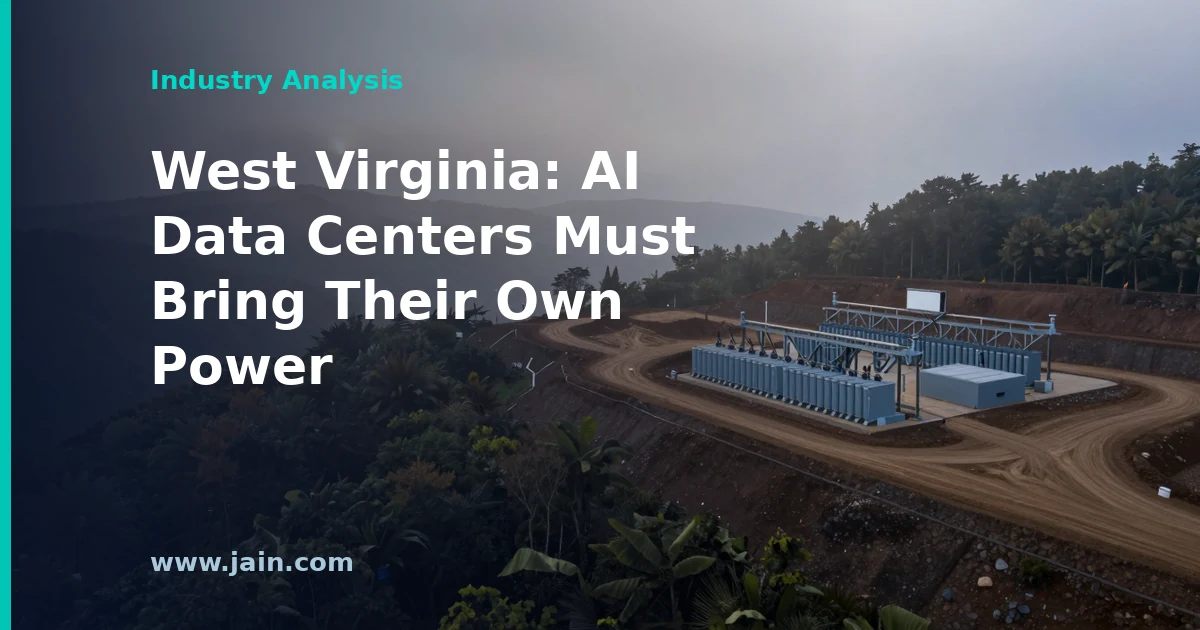
West Virginia wants the giant computer warehouses that power artificial intelligence, and it has none of them today.
Its new 20-year plan sets the terms. Companies must supply their own electricity instead of drawing on the power households use, and they must pay for any grid upgrades themselves. Half the money the projects bring in is set aside to cut, and eventually end, the state income tax.
The catch is that none of this has been tested yet. No company has signed on, and no one knows how much money will actually arrive.
On August 11, 2026, West Virginia Governor Patrick Morrisey, Senate President Randy Smith, House Speaker Roger Hanshaw and Department of Commerce leadership announced the West Virginia Responsible Data Center Development Plan, the Office of the Governor said. The framework relies on House Bill 2014, the Power Generation and Consumption Act, to set state-level oversight and development criteria for hyperscale data centers, the very large facilities built to run cloud and artificial-intelligence workloads.
The state says it starts with zero active hyperscale facilities. The plan is a 20-year strategy managed by a Data Economy Office. It requires developers to supply their own energy, and it dedicates 50 percent of project revenue to reducing the state personal income tax.
Executive Summary
West Virginia has published the rules it will use to attract AI-scale data centers. Before any hyperscale campus exists in the state, it has set four conditions. Developers must prove financial capacity, committed capital and clear power load projections to be certified. They must build, bring or procure their own energy and pay for their own grid and microgrid infrastructure. They must operate under a demand-response model that curtails grid use during peak stress. And project revenue is split by formula, with half going to income tax relief and none to the state general fund.
The central design choice is the energy requirement. Many jurisdictions compete for data centers on land, tax incentives and fiber. West Virginia is asking developers to arrive with a power solution already in hand. That changes who can realistically build in the state and what a site proposal has to contain. It also shifts the risk of new generation away from existing utility customers, at least on paper.
The release is strong on principles and light on mechanics. The revenue base, the enforcement of the ratepayer pledge, water targets and the advisory council’s standards are all still to come. The state’s projections of billions in investment and thousands of jobs have no figures behind them yet.
Bring Your Own Power Is the Real Entry Fee
The plan’s most consequential clause is the Ratepayer Protection Pledge. Developers must build, bring or procure their own energy resources and fully fund their own infrastructure and microgrid costs. A microgrid is a local power system that can run alongside the main grid or apart from it. The state says utility customers will not bear construction, operational or grid upgrade expenses. Certification also requires clear power load projections, meaning a forecast of how much electricity a facility will draw. As a result, a developer cannot secure a site first and look for power later. The energy plan is part of the application.
This is what makes site selection in West Virginia a power project. An AI campus proposal there needs the same pieces as a generation development: a fuel or supply source, generation or procurement contracts, and the capital to build them. It also has to coordinate capacity with the local utility and comply with the reliability frameworks of PJM (the regional grid operator for much of the Mid-Atlantic and Midwest), FERC (the federal energy regulator) and NERC (the body that sets grid reliability standards). On top of that, facilities must operate under demand response. During peak stress periods they either switch to on-site backup generation or cut their consumption.
The requirement is likely to favor well-capitalized developers and those with established generation partners. It is likely to filter out speculative land plays, which the release says it intends to reject. It also changes the conversation for AI tenants. Uptime at a West Virginia campus will depend partly on assets the developer owns and runs, not only on the utility. Demand response adds a further consideration: a facility must be able to curtail or self-supply during grid emergencies. Buyers will want to know how that interacts with their own service-level expectations.
A Revenue Formula Designed for Voters, Not Just Developers
The state has specified exactly where project revenue goes. Fifty percent is dedicated to reducing and ultimately eliminating the state personal income tax. Thirty percent goes to host counties for schools and government operations. Ten percent is spread across all other counties, and ten percent funds local water, wastewater and electrical upgrades. None enters the general revenue fund, and host county budgets cannot be negatively affected.
This structure answers a common local objection to data centers, which is that the host community carries the disruption while the benefits flow elsewhere. Tying half of the revenue to a statewide income tax cut also builds a constituency for the program beyond host counties. Whether the income tax goal is realistic depends on figures the state has not published. The plan does not say what counts as project revenue under the High Impact Data Center designation. It also gives no estimate of how much revenue a typical facility would generate. With zero hyperscale facilities today, the tax promise is a long-horizon aspiration rather than a budget line.
A Clean Slate, and an Unfinished Rulebook
The release says that before HB 2014, more than 50 West Virginia counties had no mechanism to approve, condition or deny large data center projects. That governance gap exists in many places that have seen sudden data center interest. Closing it at the state level before the first hyperscale project arrives is the plan’s clearest structural advantage. Developers get one certification path. Communities get a screening step that did not exist before.
Much of the detail is still to be written. A Data Center Advisory Council will recommend standards for setbacks, noise, site security and proximity to sensitive areas. On water, the state keeps existing oversight and says it is pioneering closed-loop systems, immersion cooling and reclaimed water. It aims to lead on Water Usage Effectiveness, a measure of water consumed per unit of computing energy. It has not set a numeric target or a requirement. Two claims in the release are also unquantified: that development will help modernize the grid and drive down residential rates over time, and that it will bring billions in investment and thousands of jobs. Both are reasonable goals, and neither is substantiated yet.
Background
West Virginia has long been an energy-producing state, and it sits inside the PJM grid region. That region’s reliability and capacity rules shape how any large new electricity user connects. The state enters the AI data center race without a single hyperscale campus. Until House Bill 2014, more than 50 of its counties had no formal mechanism to approve, condition or deny such projects.
The August 2026 plan builds on that law. It combines a Data Economy Office, a certification process for developers, a fixed revenue-sharing formula and a requirement that developers supply their own energy. Governor Morrisey described the approach as leading without repeating the mistakes of other states, which he did not name. Source: Governor Morrisey, Legislative Leaders Announce Unified Plan for Responsible Data Center Development in West Virginia, the West Virginia Office of the Governor’s announcement of the state’s 20-year data center framework under House Bill 2014.Sources