Tag: Ratepayer Protection Act

  • House’s 100 MW Rewrite Would Make Data Centers a Separate Class of AI-Era Power User

    House’s 100 MW Rewrite Would Make Data Centers a Separate Class of AI-Era Power User

    TL;DR · 30-second read

    The Short Version

    Who should pay when a giant computer warehouse needs new power plants and power lines: the company, or its neighbors through their monthly electric bills?

    A United States House committee is working on a bill that says the company should pay. Lawmakers just rewrote it to target data centers, the buildings that run AI and online services, rather than every huge electricity user.

    There is a catch. States would only have to consider the rule, not adopt it. Google and Microsoft have supported the bill, but singling out data centers could bring lawsuits.

    E&E News reported that the House Energy and Commerce Committee has narrowed the Ratepayer Protection Act, H.R. 9340, so that it applies specifically to data centers. Committee leaders released the change as a substitute amendment, meaning replacement bill text, ahead of a markup (the committee session where legislation is debated and amended) that began Monday, July 20, and was set to continue Tuesday, July 21.

    The bill, sponsored by Reps. Gabe Evans (R-Colo.) and Kathy Castor (D-Fla.), would require states to consider adopting a federal standard directing data centers to pay the full cost of new generation and transmission upgrades needed to serve them. The earlier language could have applied to projects with peak electricity demand of 100 megawatts or more.

    Executive Summary

    The rewrite changes who the Ratepayer Protection Act is about. A bill that could have reached large projects based on their electricity demand would now be aimed at one type of facility: the data center. That sharpens the political message, but it also opens a question the earlier version largely avoided: why should one kind of large power user be treated differently from another?

    The core cost principle remains in the committee’s description of the bill: data centers should pay the full cost of the new generation and transmission upgrades needed to serve them. The enforcement mechanism is softer than that principle sounds, because states would be required to consider the standard, not to adopt it.

    The result matters to developers, utilities, state regulators and electricity customers. Support from both parties gives the bill momentum, yet the calendar, Democratic calls for stronger measures, an uncertain Senate path and possible legal challenges all stand between the committee’s text and any change in what customers pay.

    From a Size Test to a Single Industry

    The most consequential edit is a change in how the bill identifies its target. A 100-megawatt test turns on how much power a project demands at its peak; a megawatt is a million watts, and peak demand is the most a facility draws at one time. A data center test turns on what the facility is. Under the narrowed text, a large electricity user outside the data center category would appear to fall beyond the federal standard, even if it places a similar demand on the grid. That is the sense in which the rewrite would make data centers a separate class of power user.

    This goes to the heart of the industry’s position. Data center and technology companies have maintained that they should be treated similarly to other large power users, and the new language moves away from that principle. Their argument has an intuitive engineering logic: a transmission upgrade costs what it costs, regardless of what the customer does with the electricity. The case for the narrower approach is more political and more immediate. Data centers are the facilities generating nationwide concern, and committee leaders chose to address them directly.

    Each position leaves something to prove. Supporters of the narrower text need a principled reason for applying a cost rule to one class of large user and not another, particularly since the change could become fodder for lawsuits. The industry, for its part, needs to show that equal treatment would protect other customers at least as well, rather than simply diluting attention on the sector driving the current debate. Developers, utilities and other large users all have a stake in where that line lands.

    A Federal Standard That States Only Have to Consider

    The phrase “pay the full cost” is strong, but the operative verb is “consider.” As described, H.R. 9340 would require states to weigh adopting the federal standard, not necessarily to put it into effect. That leaves the practical decision at the state level, so protection for ratepayers, and costs for developers, could differ from one state to the next.

    For site selection teams and utility planners, that points to a patchwork risk. Passage of the bill would not by itself settle what a project pays. Teams would still need to follow how each relevant state responds, and a state’s decision could affect the economics of a project that requires new generation or grid upgrades.

    The hardest technical question sits inside the words “needed to serve them.” New power plants and transmission lines often serve many customers over many years, so deciding which portion of a shared upgrade belongs to one data center is an allocation exercise as much as a billing one. A standard’s value to ratepayers will depend heavily on how that line is drawn.

    Bipartisan Support, With Different Definitions of Enough

    Lawmakers from both parties appeared ready to back the legislation on Monday, but they did not describe it in the same way. Chair Brett Guthrie (R-Ky.) framed it as a way to pursue “the race to AI dominance” while helping ensure communities do not pay the associated electricity costs. Ranking member Frank Pallone (D-N.J.), who has endorsed a national moratorium on data center construction, called the bills “a good start” but said they “don’t go far enough,” adding that “we may need a moratorium” if Congress does not put sufficient guardrails in place.

    Reps. Doris Matsui (D-Calif.) and Paul Tonko (D-N.Y.) also advocated stronger legislation, and Democrats said they would push other bills on data center pollution and water concerns. Those are the issues this bill does not settle, and their separate treatment suggests that the cost standard may be only one front in a broader debate. The critics’ claim that the bill falls short has support in its consider-only design, though how much it would shift costs in practice remains untested.

    Timing is the other constraint. Guthrie had hoped for a floor vote before the August recess, which now looks like a long shot with the House set to leave at the end of the week. In the Senate, Sen. Jon Husted (R-Ohio) introduced a companion bill, S. 5028, and said he would keep working with the Energy and Natural Resources Committee. Its chair, Sen. Mike Lee (R-Utah), said last month of data center legislation, “I don’t currently have that identified as a priority.” Committee momentum is real, but it is not yet a path to enactment.

    Background

    Data centers are facilities filled with computing equipment that power AI and other online services. Their electricity needs have become a national political issue, with lawmakers debating how to support AI development while protecting other customers from higher bills. The House Energy and Commerce Committee, which is handling H.R. 9340, has pushed hard for the bill in recent weeks.

    US electricity oversight is divided between levels of government. States generally oversee retail electricity rates, while the Federal Energy Regulatory Commission oversees interstate transmission and wholesale power markets. That division helps explain why a federal standard that states must consider differs from a nationwide rule that directly sets what a data center pays.

    Sources

    Source: House committee narrows data center energy bill, E&E News by POLITICO’s report on the substitute amendment narrowing the Ratepayer Protection Act to data centers.

  • $19.2B North Carolina Withdrawal Shows County Zoning Is a Gate on AI Capacity

    $19.2B North Carolina Withdrawal Shows County Zoning Is a Gate on AI Capacity

    TL;DR · 30-second read

    The Short Version

    A company called Energy Storage Solutions has dropped its plan for a $19.2 billion building full of computers for artificial intelligence in a rural North Carolina county.

    At first it would have used about 300 megawatts of electricity, roughly what a couple of hundred thousand homes use, and possibly three times that later.

    Local officials had already refused it a permit. Now they are considering a two-year ban on any new projects like it. The takeaway: a county vote can stop part of the artificial intelligence boom before a single computer is installed.

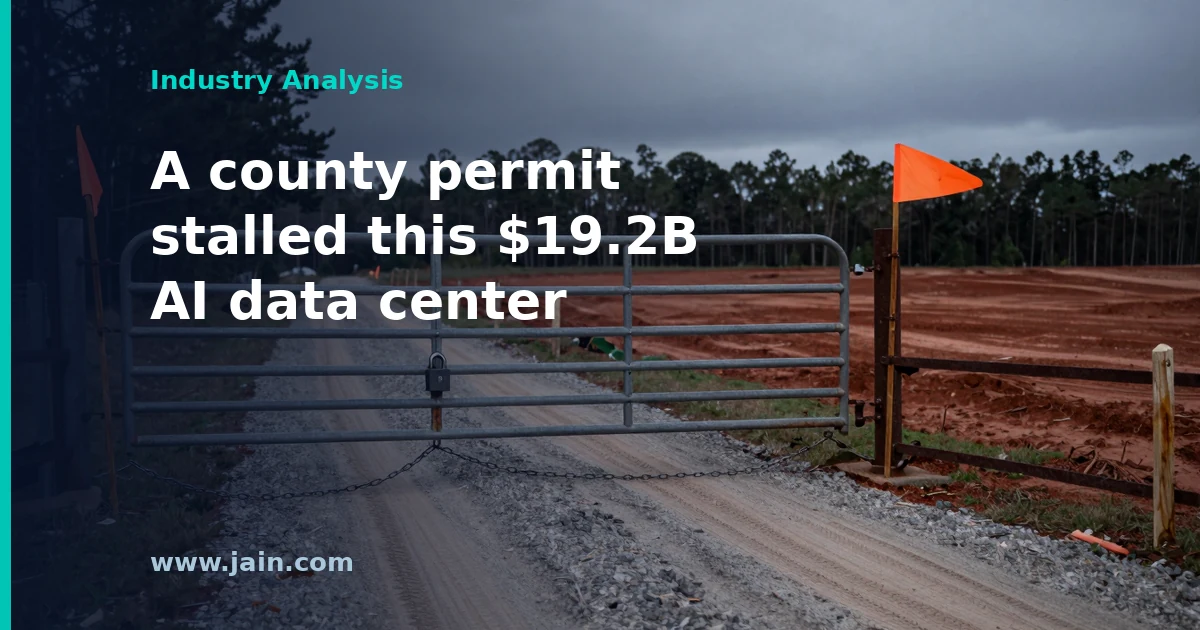
    A proposed $19.2 billion AI data center in Edgecombe County, North Carolina, has been withdrawn by its developer, Energy Storage Solutions, Data Center Dynamics reported on July 15, 2026. County Manager Eric Evans told the board of commissioners at its July 6 meeting that the company had pulled the project earlier in the month. The multi-phase campus was planned for the Kingsboro development area near Tarboro, about 70 miles east of Raleigh.

    The county denied the project a special-use permit late last year, when it was described as an eight-phase, 300MW campus on 52 acres. Other accounts put the eventual build-out at 300 acres and 900MW. At the same July 6 meeting, commissioners discussed a 24-month moratorium on new data center developments. A public hearing is scheduled for August.

    Executive Summary

    The Edgecombe withdrawal takes one of North Carolina’s largest announced AI data center proposals off the table, at least for now. The obstacle on the public record was not chips, turbines or transformers. It was a county special-use permit, the discretionary approval a local board can grant or refuse. Commissioners refused it, the developer appealed, and the project has now been withdrawn while that appeal was reported to be ongoing.

    The episode matters beyond one county because two policy layers are tightening at once. Locally, Edgecombe is weighing a two-year pause on all new data center projects. At the state level, the House has passed the Ratepayer Protection Act, which would make data center developers pay upfront for the grid expansion, transmission upgrades and new generation their facilities require. Together they change both whether a campus can be built and who pays to power it.

    For developers, utilities and the cloud and AI companies that lease capacity, the practical point is that a site’s local approval status now belongs in capacity forecasts alongside land and megawatts.

    The Gate on This 300MW Campus Was a County Vote

    Most public discussion of AI infrastructure constraints centres on chips, power supply and electrical equipment. In Edgecombe County, the documented obstacle came earlier than any of those. Late last year, the board of commissioners denied a special-use permit for an eight-phase, 300MW data center campus on 52 acres. A special-use permit is discretionary. Even where land is zoned for industrial use, a county board can attach conditions or say no. Energy Storage Solutions appealed and said it would proceed. By early July, the county manager was telling commissioners the project had been withdrawn.

    The moratorium under discussion would turn one project’s rejection into a countywide freeze. For 24 months, no developer could bring a new data center through the county’s approval process. Campuses like this one are planned in phases across several years, so a two-year stop at the approval stage delays the first phase, and every phase behind it, by at least that long. That delay holds whether or not power, financing and tenants are ready.

    Several groups absorb that risk. Developers and landowners assemble parcels on the expectation of approval. Utilities plan transmission and generation around announced loads. Tenants, usually cloud and AI companies, need capacity delivered on a specific date. For all of them, entitlement status, meaning whether a site actually holds the local approvals needed to build, is as material as the megawatt figure in the announcement. A single county vote removed a planned 300MW from the pipeline here, and possibly 900MW.

    A $19.2 Billion Figure Without a Fixed Size

    The $19.2 billion headline is the project’s most quoted number and its least anchored one. The permit application the county reviewed described 300MW on 52 acres. Other reports described a 300-acre campus reaching 900MW. Divided across 900MW, the figure works out to about $21 million per megawatt. Divided across 300MW, it is about $64 million per megawatt. A threefold gap makes it impossible to benchmark the proposal against other campuses or to tell whether the figure includes the servers and AI chips inside the buildings, which often cost more than the buildings themselves.

    Headline figures for multi-phase campuses tend to describe a full build-out rather than a first phase. That makes them useful as a measure of ambition and weak as a measure of what is financed or contracted. For readers tracking AI capacity announcements, the useful distinction is between the capacity a regulator has actually reviewed, here 300MW, and the capacity that appears in the eventual vision, here up to 900MW.

    North Carolina Moves the Grid Bill Toward Developers

    The state-level change could matter more than any single county’s decision. The Ratepayer Protection Act, passed by the North Carolina House and awaiting Senate approval, would require data center developers to cover the upfront costs of grid expansion, transmission upgrades and new power generation for their facilities. The practical effect is to shift those costs away from a utility’s general customer base and onto the project. That raises the capital a developer needs before a site produces revenue, and it makes locations near existing grid capacity relatively more valuable.

    The bill also includes a coal plant moratorium. Public utilities could not retire coal-fired plants until regulators approve new large-scale nuclear facilities. That provision would keep existing generation on the system while new supply is planned. Its cost and environmental trade-offs will be argued on their merits in the Senate.

    Taken together, the local and state layers raise the bar for projects that lack committed customers and deep financing. Developers with signed tenants and capital to fund grid upgrades are better placed under these rules than those seeking approvals first and backers later. Counties and ratepayers gain more leverage over terms. The open question for the industry is how many other North Carolina counties adopt similar tools. The state has seen resident opposition to data center proposals in several places.

    Background

    North Carolina has become a hotspot for data center development, with some local residents opposing new projects in several parts of the state. Edgecombe County, whose seat is Tarboro, about 70 miles east of Raleigh, became one focal point when Energy Storage Solutions proposed a multi-phase AI data center campus in the Kingsboro development area.

    The county board of commissioners denied the project a special-use permit late last year. The developer appealed and said it would proceed, before withdrawing the project in early July 2026. State lawmakers are meanwhile debating the Ratepayer Protection Act, which would make data center developers pay upfront for the grid infrastructure and generation their facilities require.

    Sources

    Source: North Carolina AI data center proposal withdrawn as county officials mull moratorium, Data Center Dynamics’ report on the withdrawal of Energy Storage Solutions’ $19.2 billion Edgecombe County project and the county’s proposed 24-month moratorium.