Tag: PUE

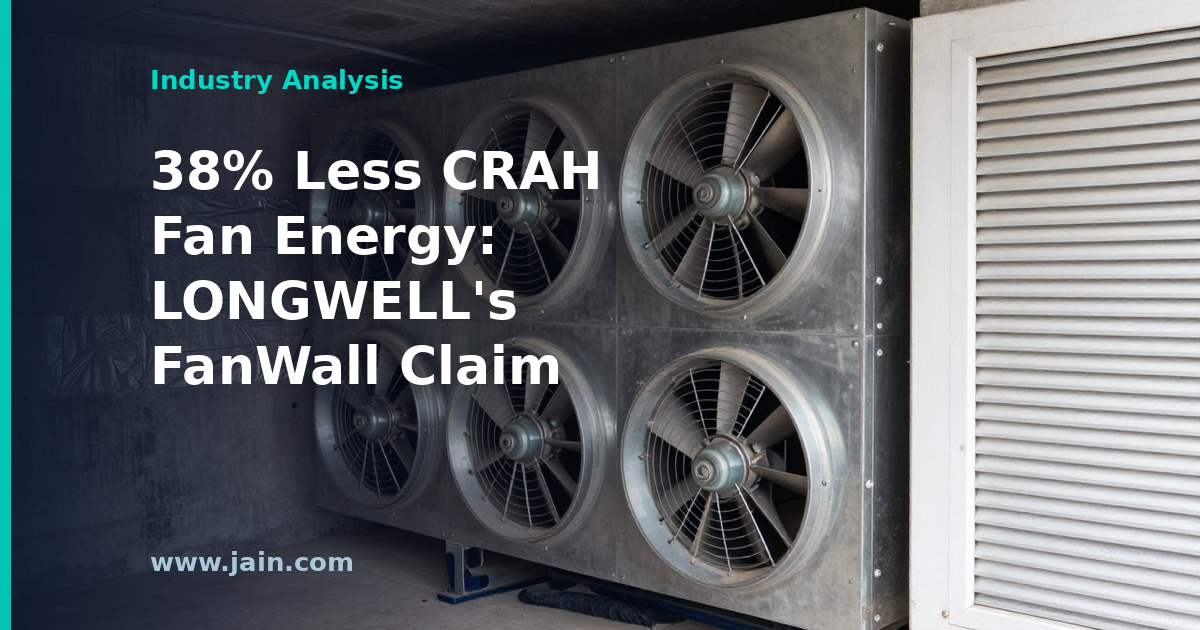
  • LONGWELL’s FanWall Claim: 38% Less CRAH Fan Energy

    LONGWELL’s FanWall Claim: 38% Less CRAH Fan Energy

    Ningbo Longwell Electric Technology Co., Ltd. (LONGWELL), a Chinese fan and motor manufacturer founded in 1990, announced on 31 August 2026 an AI-era data center cooling line built around its LWBE3G EC plug-fan platform. Deployed as a FanWall array — a bank of smaller fans replacing one large fan — the company reports a 38% reduction in CRAH fan energy consumption, a 6.5 dB(A) noise reduction, and no field failures on the project cited.

    The work was done with what LONGWELL describes as one of the world’s top three precision-cooling OEMs, which it does not name. LONGWELL says it delivered 12 engineering samples in 35 days, passed DV/PV testing 100% on the first attempt, and went from specification validation to mass production in 90 days. The first customer order was 1,500 units; 2025 deliveries exceeded 80,000 units under a 2025–2027 framework agreement with a stated annual minimum of 60,000 units.

    Executive Summary

    The headline number is a 38% cut in the electricity drawn by the fans inside CRAH units — the computer-room air handlers that push cold air through a data hall. LONGWELL also reports that the CRAH system’s contribution to the facility energy-efficiency metric improved from a 1.42 baseline to 1.28 on the project in question. Fan power is one of the largest non-IT loads in an air-cooled hall, so a double-digit percentage cut there is economically meaningful even though it changes nothing about the servers themselves.

    The second, arguably more consequential claim is about speed. LONGWELL states that the incumbent European supplier on the same program had scheduled 14 months of development plus six months of production ramp, while LONGWELL completed spec-validation-to-mass-production in 90 days. If that comparison holds up, it says something about how quickly the precision-cooling supply chain can be re-sourced when AI buildouts compress every schedule — and about competitive pressure on established European fan vendors.

    The context is thermal density. LONGWELL cites rack loads moving from 15–20 kW to 60–100 kW in two years, with next-generation platforms exceeding 100 kW. That trajectory is usually cited as the argument for liquid cooling. This announcement makes the opposite-facing point: the air side of the plant still exists, still consumes power, and still has efficiency headroom that operators can capture without re-plumbing a building.

    Fan Power Is the Quiet Line Item in Data Center Energy

    In an air-cooled data hall, electricity splits between the IT equipment and everything that supports it: chillers, pumps, power conversion losses, and air movement. The air-movement share is easy to overlook because no single fan looks expensive, but CRAH fans run continuously, at every hour of every day, for the life of the facility. That duty cycle is what turns a percentage into money. A 38% reduction on a load that never switches off compounds differently from a 38% reduction on something that runs during business hours.

    The physics behind FanWall designs is not exotic and is worth stating plainly for non-specialists: fan power rises steeply with speed, so several smaller fans each running slower can move the same air volume for less power than one large fan running hard. EC — electronically commutated — motors, which use electronic control rather than mechanical brushes, make that easier by allowing precise, continuous speed modulation instead of on-off cycling. The array also degrades gracefully; LONGWELL cites automatic N+1 failover, meaning the array carries a spare fan’s worth of capacity so a single failure does not force a shutdown.

    None of that is unique to LONGWELL. FanWall architectures and EC motors are established practice across precision cooling, which is precisely why the interesting question in this release is not whether the approach works but what specifically LONGWELL’s platform was replacing, and at what operating point. The release’s own footnote says the comparative energy data refer to the equipment displaced on that project.

    Ninety Days Versus Twenty Months: The Real Competitive Story

    Component qualification is normally the slowest, least glamorous part of building cooling equipment. An OEM cannot simply swap a fan; it must re-run design verification and production validation testing, requalify acoustics and vibration, and re-certify the assembled unit. That is why the incumbent’s quoted 14-month development plus six-month ramp is not obviously unreasonable — it is roughly the industry’s normal cadence. LONGWELL’s claim is that it collapsed the same sequence to 90 days, with 12 engineering samples inside 35 days and a first-pass DV/PV result.

    For buyers, first-pass DV/PV is the detail worth noticing. Test cycles fail routinely, and each failure costs weeks. A supplier that passes on the first attempt is signalling that its engineering samples already matched the specification, which is a manufacturing-maturity claim as much as a design one. For the precision-cooling OEMs racing to fill AI-driven order books, a supplier who can compress twenty months into three is solving a scheduling problem, not just a component-cost problem.

    The competitive read is straightforward and should be stated without overreach: European fan suppliers have long held strong positions in HVAC and data center air movement on the strength of engineering depth and long qualification relationships. Speed of response is now being priced alongside that. The release does not claim the incumbent’s product was technically inferior — only that its timeline was longer on this program — and it explicitly disclaims any affiliation or endorsement.

    What the 38% Establishes, and What It Does Not

    LONGWELL is unusually candid in its own disclaimer: the performance data correspond to a specific project and a specific operating point, and final selection must be confirmed against operating point, voltage and control scheme, mounting arrangement, and project validation. That caveat is doing real work. Fan performance is highly sensitive to the pressure the fan works against, and a figure measured in one CRAH cabinet at one airflow does not transfer automatically to another.

    The 1.42-to-1.28 figure deserves particular care. Those numbers are in the numerical range of PUE — power usage effectiveness, the ratio of total facility power to IT power, where 1.0 is theoretically perfect — but the release describes this as the CRAH system’s contribution to the efficiency metric on this project, not a whole-facility PUE for a named site. Read as a subsystem-level improvement it is a coherent result; read as a facility PUE it would be a much larger claim than the release supports. The distinction matters for anyone modelling savings.

    The commercial figures are the most independently checkable part of the announcement, in the sense that they describe behaviour rather than test conditions. A first order of 1,500 units expanding to more than 80,000 units delivered in 2025, under a 2025–2027 framework with a 60,000-unit annual minimum, is a customer voting with volume. It is not third-party verification of 38%, but repeat purchasing at that scale is a stronger signal than a datasheet.

    Air Cooling Does Not Disappear Because Liquid Arrives

    The prevailing narrative says racks above roughly 60–100 kW must go to liquid cooling, and for the densest AI training clusters that is broadly where the industry is heading. But the transition is neither instant nor total. Direct-to-chip liquid cooling typically removes most, not all, of a rack’s heat; the remainder still leaves via air. Storage, networking, and general-purpose compute remain air-cooled. Retrofit halls with existing CRAH fleets will keep running for years on depreciation schedules that do not care about GPU roadmaps. Condensers and cooling towers — LONGWELL’s LWAE3G axial fan line targets these — are needed in liquid-cooled plants too.

    That is the strongest version of this announcement’s editorial premise: air-side efficiency has remaining headroom precisely because it is being treated as legacy. Capital and attention are flowing toward liquid, which leaves ordinary optimisation of the air path comparatively under-exploited. Operators who cannot re-plumb a building this year can still change fans.

    The counter-risk for a supplier in this position is that it is selling into a segment whose long-run share of new-build capacity may shrink even as its absolute installed base stays large. LONGWELL’s stated data center fan capacity of more than 120,000 units annually against a 60,000-unit contractual minimum suggests it has built for growth beyond this one customer; whether that growth comes from new AI halls, retrofits of existing ones, or the condenser and cooling-tower side of liquid-cooled plants is not something the release addresses.

    Background

    Precision cooling — the equipment class covering CRAC and CRAH units that hold data halls at controlled temperature and humidity — has historically been dominated by a small group of global OEMs, which in turn buy fans and motors from a specialist supply chain long anchored by European manufacturers. Fans are qualified rather than simply purchased: each one must pass verification testing inside the OEM’s cabinet, so incumbency has been durable and switching slow.

    The AI compute buildout has strained that arrangement. As per-rack heat loads climbed from the 15–20 kW typical of general-purpose servers toward 60–100 kW and beyond for accelerated computing, OEMs have needed higher-performance air movement on schedules far shorter than the industry’s traditional multi-year qualification cadence. LONGWELL, a Ningbo-area manufacturer founded in 1990 and long active in HVAC-R and industrial fans, is one of several Asian suppliers positioning against that compressed timeline — an announcement that is as much about procurement velocity as about thermodynamics.

    Source: La technologie FanWall de LONGWELL EC permet de réduire de 38 % la consommation énergétique des ventilateurs CRAH des centres de données IA de nouvelle génération — PR Newswire release, dated 31 August 2026 from Ningbo, China, detailing LONGWELL’s LWBE3G EC plug-fan platform, its reported CRAH fan energy and acoustic results, and the volumes shipped under a 2025–2027 framework agreement.
  • MHI Reports Field-Verified Efficiency Gains From AI Cooling Optimization

    MHI Reports Field-Verified Efficiency Gains From AI Cooling Optimization

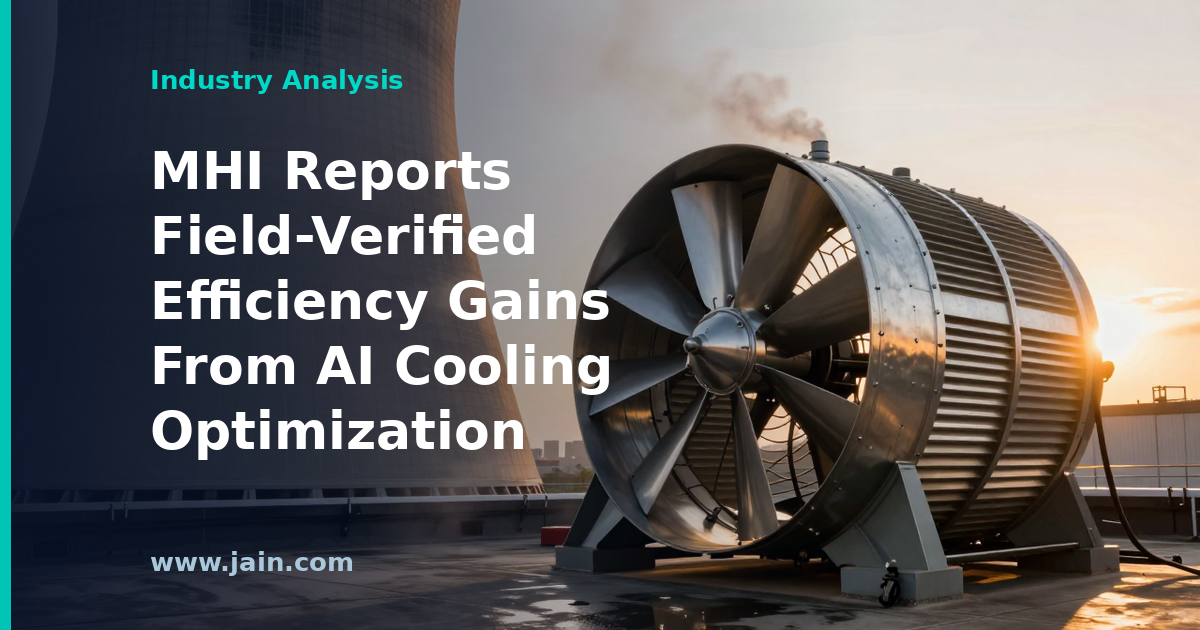
    Mitsubishi Heavy Industries (MHI) announced on July 9, 2026 that it has demonstrated energy-efficiency improvements through cooling optimization in an operational data center. Rather than a lab simulation or a controlled test bed, the demonstration ran in a live facility — the setting where cooling systems must respond to real, fluctuating IT loads.

    Executive Summary

    MHI, the Japanese heavy-industry group whose portfolio spans power generation, HVAC and thermal systems, says it has shown measurable energy-efficiency improvements by optimizing cooling in a data center that was actively serving production workloads. The approach centers on smarter control of cooling equipment — adjusting how chillers, air handlers and airflow respond to actual conditions rather than running at conservative fixed settings.

    The announcement matters for a simple reason: cooling is one of the largest non-IT consumers of electricity in a data center, and it is one of the few places where efficiency gains can be captured without touching the servers themselves. With AI workloads pushing rack power densities sharply higher, operators are looking hard at control-layer optimization as a way to cut operating costs and free up power capacity. A field demonstration in a live facility — as opposed to vendor modeling — is the kind of evidence buyers increasingly demand, though the syndicated version of this release does not carry the underlying figures, which readers should verify against MHI’s full publication.

    Why a Live-Facility Demonstration Matters

    Cooling-optimization claims are easy to make in simulation and hard to prove in production. A real data center has messy thermal behavior: IT load rises and falls with customer demand, outside temperatures swing by season and hour, and no operator will tolerate a control experiment that risks overheating servers. Demonstrating gains in an operational facility means the system had to deliver savings while respecting those constraints — which is why field verification is the credibility bar for this product category.

    That said, a single-site demonstration is evidence, not proof of general applicability. Results depend heavily on the baseline: a facility with poorly tuned cooling will show dramatic improvement from almost any optimization, while a well-run site will show far less. The commercial question is not whether MHI improved one building, but how transferable the method is across climates, cooling architectures and load profiles — something only multi-site data can answer.

    Cooling Is the Biggest Efficiency Lever Left

    In most data centers, cooling is the largest energy consumer after the IT equipment itself, which is why the industry’s standard efficiency metric — PUE, or power usage effectiveness, the ratio of total facility power to IT power — is largely a measure of cooling overhead. Servers get more efficient with every silicon generation, but the facility side improves only when operators invest in it. Control-layer optimization is attractive because it can often be applied to existing equipment: the chillers stay, the software running them gets smarter.

    The economics have sharpened as AI infrastructure scales. Grid connections are constrained in many markets, so every kilowatt not spent on cooling is a kilowatt available for revenue-generating compute. For operators facing multi-year waits for new power capacity, efficiency gains at the cooling layer function as found capacity — frequently at a fraction of the cost of new construction.

    MHI Enters a Crowding Field

    MHI is not alone here. AI-assisted cooling control has been pursued by hyperscalers internally and by facility-equipment and building-management vendors for several years, and the space now includes established cooling manufacturers, controls specialists and software startups. MHI’s differentiation, if it holds, comes from owning the equipment side: a company that builds chillers and thermal systems can integrate control optimization more deeply than a software-only vendor, and can stand behind the combined result.

    For MHI, the strategic logic is also defensive. As liquid cooling, heat reuse and AI-driven operations reshape data center thermal design, equipment makers that offer only hardware risk being commoditized while the value migrates to the control and services layer. A demonstrated optimization capability positions MHI to sell outcomes — efficiency, capacity headroom — rather than just machines. Whether that translates into a commercial product with published pricing and guarantees is the next thing to watch.

    Background

    Mitsubishi Heavy Industries is a diversified Japanese engineering group whose thermal-systems businesses build chillers, HVAC and industrial cooling equipment — the physical machinery that data center cooling optimization software ultimately controls. Like other established equipment makers, MHI has been extending from hardware into the control and services layer as data center operators demand measurable efficiency outcomes rather than standalone machines.

    The push comes amid a broader industry squeeze: AI-driven demand has data center construction booming while grid power in major markets is scarce, making energy efficiency both a cost issue and a capacity issue. Cooling, as the largest non-IT energy consumer in most facilities, has become the primary battleground, with hyperscalers, controls vendors and equipment manufacturers all pursuing AI-assisted optimization of the thermal plant.

    Source: MHI Demonstrates Energy Efficiency Improvements through Cooling Optimization in Operational Data Center — Mitsubishi Heavy Industries announcement, July 9, 2026, via Google News.

  • China Switches On the First Commercial Underwater Data Center

    China Switches On the First Commercial Underwater Data Center

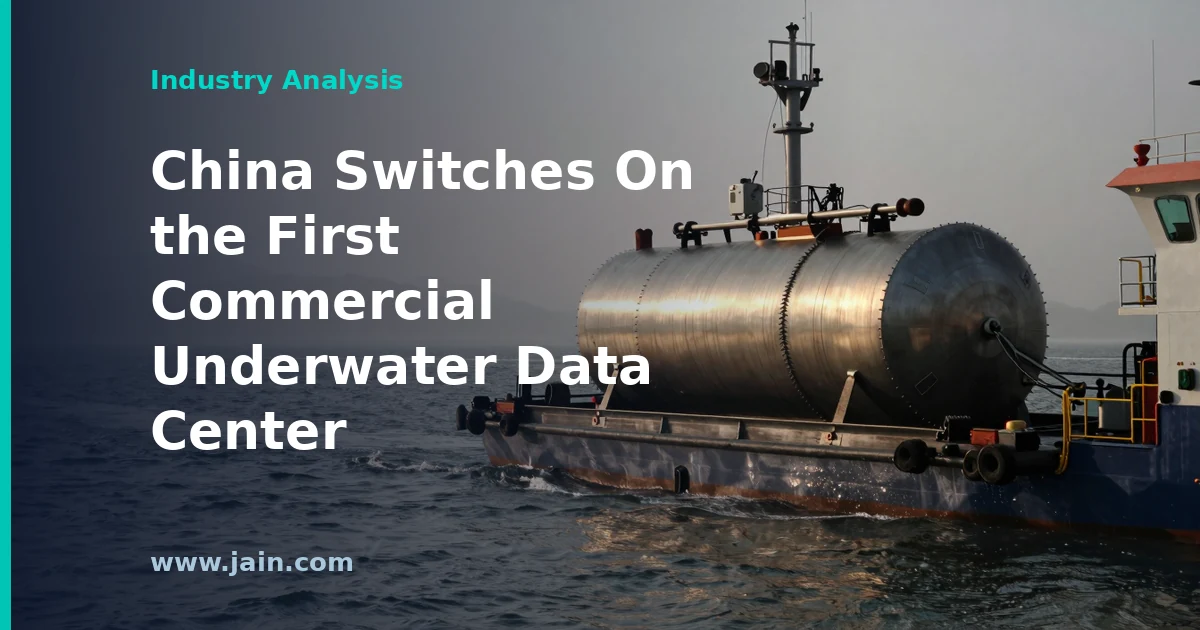
    China has brought online what is being described as the world’s first commercial underwater data center, according to a report published July 4, 2026 by the Spanish outlet OkDiario. The facility submerges sealed server modules in the ocean and uses the surrounding seawater as its cooling medium, an approach the report says sharply reduces the energy the facility consumes.

    The report frames the launch as a template other coastal regions could adopt, naming Cartagena, Spain as the kind of Mediterranean port city where the model might be replicated. It does not disclose the operator, the facility’s capacity, or its precise location.

    Executive Summary

    The announcement matters because it moves underwater data centers from experiment to product. Submerging servers has been tested before — most famously by Microsoft — but a commercial deployment means paying customers are expected to run real workloads on seabed infrastructure, and that changes the questions from “does it work?” to “does it pencil out?”

    The core appeal is cooling. Keeping servers from overheating is one of the largest energy costs in any data center, and the deep ocean offers a vast, stable heat sink at no mechanical-chilling cost. If seawater cooling delivers the efficiency the concept promises at commercial scale, it would arrive at a moment when AI-driven demand has made power and cooling the industry’s tightest constraints.

    That said, the source report is brief and light on specifics. It attributes no capacity figures, energy metrics, customer names, or operator details. The launch is a genuine milestone in cooling infrastructure if the commercial framing holds — but the evidence available in this report is a claim of a first, not a documented performance record.

    Why Put Servers on the Seabed?

    Data centers spend an enormous share of their electricity not on computing but on removing the heat that computing generates. The industry measures this with PUE — power usage effectiveness, the ratio of total facility power to the power that actually reaches IT equipment. Conventional air-cooled facilities need chillers, fans, and often large volumes of water to hold safe temperatures, and in hot climates that overhead climbs steeply.

    The ocean solves the problem passively. Below the surface, water temperature is low and remarkably stable year-round, and water conducts heat far better than air. A sealed capsule on the seabed can reject heat directly into an effectively unlimited sink, eliminating most mechanical cooling. Subsea deployment also removes evaporative water consumption — a growing point of friction between data centers and the communities that host them — and seabed real estate near dense coastal cities is not competing with housing or industry the way urban land is.

    From Microsoft’s Experiment to Chinese Commercialization

    The concept is not new; the commercial claim is. Microsoft’s Project Natick sank a sealed server vessel off Scotland’s Orkney Islands from 2018 to 2020 and reported that the submerged servers failed at a fraction of the rate of an equivalent land-based control group — likely because the nitrogen-filled, human-free capsule eliminated oxygen corrosion, humidity swings, and accidental knocks. Microsoft judged the experiment a technical success but never turned it into a product. China, meanwhile, has been running underwater data center pilots off its own coast for several years, so a progression from pilot to commercial service there is consistent with the trajectory — even though this report does not name the company involved.

    If the commercial characterization is accurate, China would be first to market with a technology a US hyperscaler proved and shelved. That is a familiar pattern in infrastructure: the economics that don’t fit one company’s portfolio can fit another market’s constraints, particularly where coastal land, grid capacity, and water for cooling are all scarce at once.

    The Hard Economics of Subsea Capacity

    The obstacles are as real as the appeal. A submerged module cannot be serviced by a technician; a failed component stays failed until the entire vessel is raised, which pushes operators toward redundant hardware and infrequent, expensive retrieval cycles. Marine engineering, corrosion-resistant housings, subsea power and fiber connections, and specialized deployment vessels all add capital cost that the cooling savings must repay. Insurance, uptime guarantees, and repair logistics for seabed assets are largely uncharted territory for enterprise customers used to walking their auditors through a facility.

    Environmental questions also need honest accounting. Rejecting heat into the ocean is thermodynamically unavoidable here, and while small-scale trials such as Natick reported minimal localized warming, the effect of dense clusters of commercial modules on marine ecosystems is site-specific and largely unstudied. Coastal permitting regimes — fisheries, shipping lanes, protected habitats — will shape where this model can actually go, and the report offers no detail on how the Chinese deployment cleared those hurdles.

    Could Cartagena Be Next?

    The report’s suggestion that coastal cities like Cartagena could follow is speculation, not an announced project, and it is worth being clear about that distinction. Still, the logic of the shortlist is sound: Mediterranean port cities combine dense populations that want low-latency services, constrained urban land and grids, warm climates that make conventional cooling expensive, and immediate deep water. Those are precisely the conditions under which subsea capacity is most competitive against land-based builds.

    For European adoption, the gating factors would be EU environmental review, marine-spatial-planning approvals, and — not least — the geopolitics of importing a Chinese-proven infrastructure model into European digital sovereignty debates. Any operator pursuing it would more likely license the concept or develop it independently than deploy Chinese-operated modules in EU waters.

    Background

    Underwater data centers trace to Microsoft’s Project Natick, which began with a proof-of-concept in 2015 and culminated in a sealed vessel of several hundred servers operating off Scotland from 2018 to 2020. The retrieved servers had failed at a small fraction of the rate of an identical land-based group, validating the reliability case — but Microsoft ended the program without a commercial product. China picked up the thread with coastal pilot deployments in the years that followed, pursuing subsea capacity as an answer to scarce coastal land, strained grids, and the water consumption of conventional cooling.

    The timing is not incidental. By 2026, explosive AI demand had made electricity and cooling the data center industry’s defining bottlenecks worldwide, pushing operators toward liquid cooling, novel sites, and any design that cuts overhead energy. A commercial subsea launch is China staking a claim to one of those frontiers first.

    Source: China just switched on the first underwater data center, cooling servers with the ocean to slash energy use, and coastal cities like Cartagena could be next — OkDiario report, July 4, 2026, on China’s launch of the first commercial seawater-cooled underwater data center.

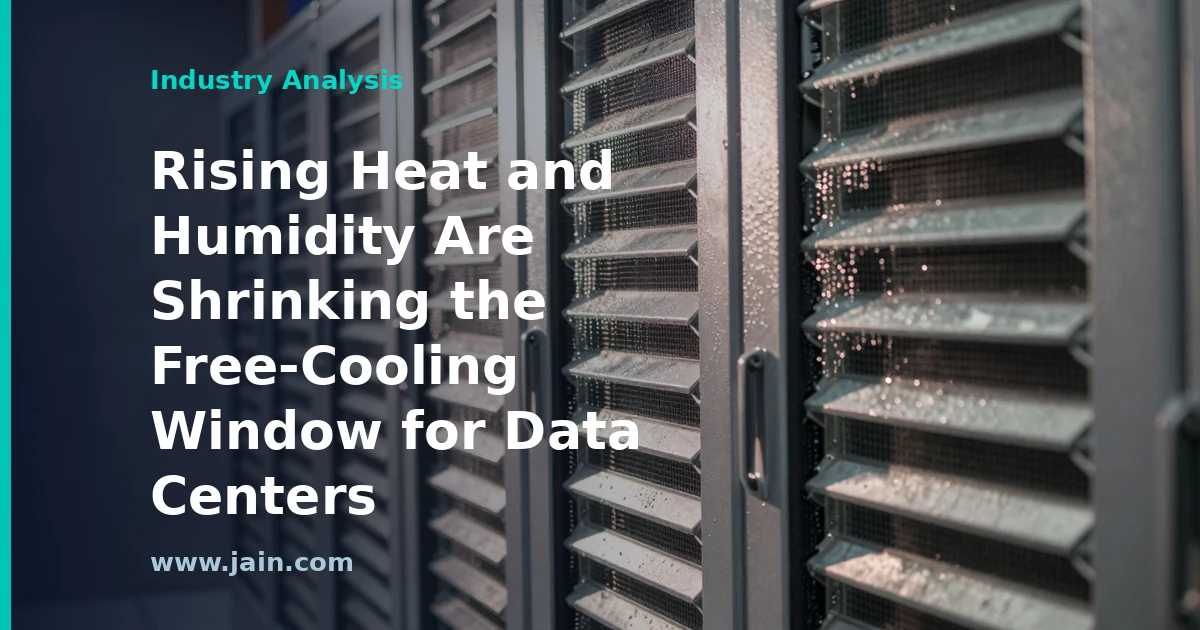
  • Rising Heat and Humidity Are Shrinking the Free-Cooling Window for Data Centers

    Rising Heat and Humidity Are Shrinking the Free-Cooling Window for Data Centers

    Research highlighted by Phys.org on June 26, 2026 warns that rising global temperatures and humidity are undermining one of the data center industry’s most important energy-efficiency strategies: free cooling, the practice of using cool outside air or water to remove server heat instead of running energy-hungry mechanical chillers. As more hours of the year become too hot or too humid for outside air to do the job, facilities worldwide face growing cooling energy demand.

    The finding lands at a sensitive moment. Data center construction is accelerating to serve AI workloads, and cooling is typically the largest energy consumer in a facility after the IT equipment itself — so any climate-driven loss of free-cooling hours compounds an already steep power challenge.

    Executive Summary

    The core claim is straightforward: free cooling only works when the outside environment is cooler and drier than the conditions servers require, and climate change is steadily reducing the number of hours per year when that is true. Heat is only half the story — humidity matters just as much, because evaporative cooling systems, which cool air by evaporating water, lose effectiveness as the air becomes more saturated. Regions that were designed around thousands of free-cooling hours a year are watching that budget shrink.

    Why it matters: efficiency assumptions made at design time are baked into a data center for decades. A facility engineered in a climate that no longer exists will either consume more energy than its models promised, lean harder on water, or require retrofit investment. For an industry under scrutiny over electricity and water consumption, the research reframes climate not as a sustainability talking point but as an engineering input — one that belongs in site selection, cooling-system choice, and capacity planning from day one.

    Free Cooling Was the Industry’s Efficiency Workhorse

    For the past fifteen years, the biggest gains in data center efficiency — reflected in falling PUE, the ratio of total facility power to IT power — came largely from using the outdoors as a heat sink. Air-side economizers pull in filtered outside air; water-side economizers and evaporative systems use cooling towers to shed heat with modest energy input. Hyperscale operators famously sited facilities in cool climates precisely to maximize these hours.

    The research reported by Phys.org attacks the durability of that playbook. If the number of hours cool and dry enough for economization declines, chillers run more, and the efficiency gap between a well-sited facility and a poorly sited one narrows in the wrong direction. The gains of the last decade were real, but they were partly a loan from a stable climate — and the terms of that loan are changing.

    Humidity Is the Underappreciated Variable

    Public discussion of data center cooling fixates on temperature, but wet-bulb temperature — a combined measure of heat and humidity that sets the floor for evaporative cooling — is the more binding constraint. When wet-bulb temperatures rise, evaporative systems must work harder and consume more water for less cooling effect, and in extreme conditions they cannot reach the setpoints servers need at all. That pushes operators back toward mechanical refrigeration exactly when grid demand for air conditioning also peaks.

    This has a second-order consequence: the trade-off between energy and water gets sharper. Evaporative cooling saves electricity but consumes water; dry coolers and chillers save water but consume electricity. Rising humidity degrades the attractiveness of the water-based option in many regions, forcing a choice between two increasingly expensive resources — often in communities already contesting data center water use.

    Winners: Liquid Cooling, Cool Geographies, and Honest Modeling

    If outside air can carry less of the load, the premium shifts to technologies that tolerate warmer heat rejection. Direct-to-chip liquid cooling and immersion cooling move heat in water or fluid rather than air, allowing higher operating temperatures and, in many designs, year-round heat rejection without compressors even in warm climates. The AI build-out was already pushing the industry toward liquid cooling for density reasons; climate trends add an efficiency rationale.

    Geography gains value too. Sites in cool, dry, or high-latitude regions — the Nordics, parts of Canada, high-altitude locations — become relatively more attractive, though they bring their own constraints in connectivity, latency, and power availability. And engineering firms that model cooling against forward-looking climate projections rather than historical weather files gain a real advantage: a 25-year asset should be designed for the climate of 2040, not 2010.

    Risks: Stranded Efficiency and Rising Operating Costs

    The losers in this shift are facilities whose economics depend on free-cooling assumptions that no longer hold — particularly older air-cooled sites in regions warming fastest. Their operating costs drift upward without any change in workload, and their sustainability reporting deteriorates through no operational fault. For colocation providers, whose customers increasingly scrutinize PUE and water metrics in procurement, that drift is a competitive problem, not just an engineering one.

    There is also a grid-level risk. The hours when data centers lose free cooling are the same hot hours when regional grids are most stressed. Climate-driven cooling demand is therefore correlated demand — it arrives when power is scarcest and most carbon-intensive, which is precisely the scenario utilities and regulators planning for data center growth need to model.

    Background

    Data center cooling has evolved through distinct eras. Early facilities ran cold and relied almost entirely on mechanical chillers. From roughly 2010 onward, hyperscale operators drove a revolution in economization — siting in cool climates, using outside air and evaporative systems, and widening acceptable server temperature ranges — which pushed the best facilities’ PUE from around 2.0 toward 1.1. That efficiency story became central to the industry’s answer to critics of its energy footprint.

    The current AI build-out is testing every part of that model: rack power densities have jumped severalfold, cooling loads are climbing, and communities are scrutinizing both electricity and water consumption. Research showing that climate change is eroding free cooling adds a structural pressure on top of a cyclical boom — and helps explain the industry’s accelerating shift toward liquid cooling and climate-aware site selection.

    Source: Rising heat and humidity challenge energy-efficient data center cooling worldwide — Phys.org report, June 26, 2026, on research into climate-driven erosion of data center free-cooling potential.

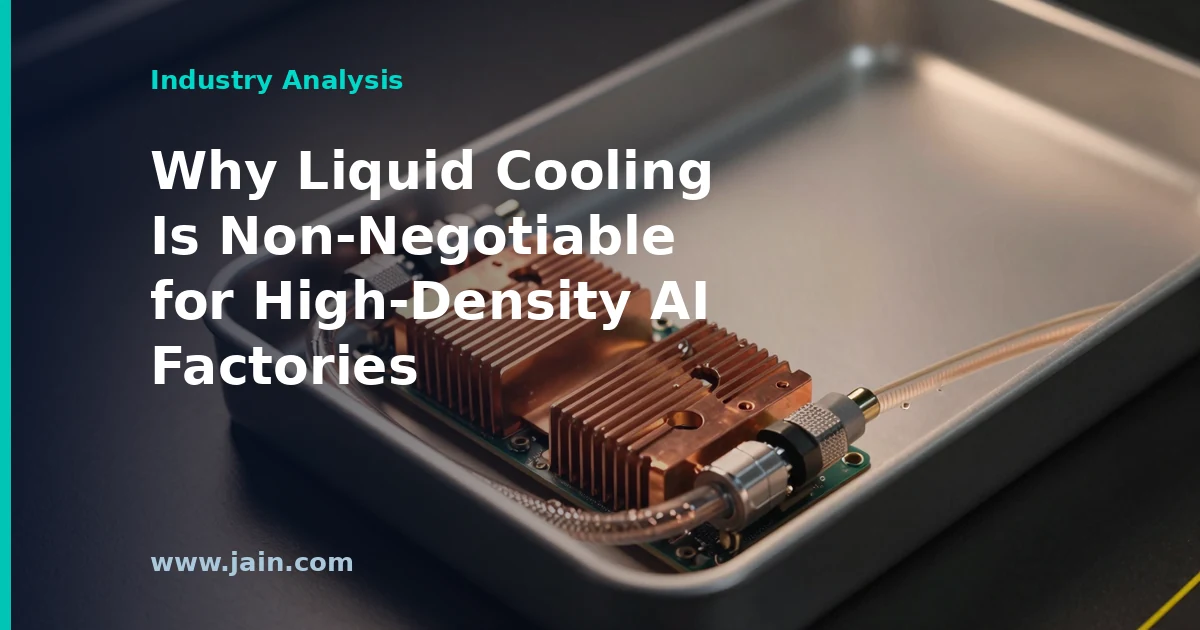
  • Why Liquid Cooling Is Non-Negotiable for High-Density AI Factories

    Why Liquid Cooling Is Non-Negotiable for High-Density AI Factories

    Data Center Dynamics published an analysis on 25 June 2026 contrasting the cooling demands of AI factories — facilities purpose-built for dense GPU training and inference clusters — with those of conventional cloud data centers, arguing that liquid cooling is now essential for high-density AI workloads rather than an optional upgrade.

    The piece lands amid an industry-wide retooling: operators worldwide are redesigning halls, mechanical plants, and supply chains around direct-to-chip and other liquid cooling approaches as accelerated computing outgrows the air-cooled designs that served the cloud era.

    Executive Summary

    The core claim is straightforward: the data center designs that carried the cloud computing era are hitting a physical ceiling. Conventional cloud halls were engineered around air cooling — moving chilled air through racks drawing power in the single-digit-to-low-double-digit kilowatt range. AI training clusters concentrate far more power in each rack, because modern GPU systems pack accelerators tightly together to keep them on fast, short interconnects. At those densities, air simply cannot carry heat away fast enough, and liquid — which is far denser and holds vastly more heat per unit volume than air — becomes the only practical medium.

    Why it matters: cooling is no longer a back-of-house mechanical detail but a gating factor for who can host AI workloads at all. Operators with liquid-ready facilities can court the highest-value tenants; operators with legacy air-cooled halls face expensive retrofits or a narrowing addressable market. For enterprises buying AI capacity, a provider’s cooling architecture is now a proxy for whether it can actually deliver current-generation GPU infrastructure.

    The analysis frames this as a structural divide — ‘AI factory’ versus ‘cloud hall’ — rather than a spectrum, which is a useful lens even if real-world facilities often blend both.

    The Physics Sets the Deadline, Not the Marketing

    Air cooling works by blowing large volumes of conditioned air through servers, and it has a well-understood practical ceiling: as rack power climbs, the airflow, fan energy, and temperature gradients required become unmanageable. Liquid cooling — most commonly direct-to-chip cold plates, where coolant flows across a metal plate bonded to the processor, or immersion, where hardware is submerged in a dielectric (electrically non-conductive) fluid — removes heat at the source with far greater efficiency. This is not a vendor preference; it is thermodynamics. Water-based coolants can absorb on the order of thousands of times more heat per unit volume than air, which is why every leading accelerated-computing platform roadmap now assumes liquid at the high end.

    The important nuance is that the ceiling is not a single number. Well-engineered air systems with hot-aisle containment can stretch surprisingly far, and many inference and enterprise workloads will remain comfortably air-coolable for years. The ‘non-negotiable’ framing applies specifically to dense training clusters, where chips must sit physically close together for interconnect performance. Density is a networking decision as much as a thermal one — and that is precisely why it cannot be relaxed just to make cooling easier.

    Economics: Liquid Costs More Up Front and Less to Run

    Liquid cooling shifts spending from operations to capital. Cold plates, coolant distribution units, manifolds, leak detection, and plumbing add up-front cost and engineering complexity that air systems avoid. In exchange, operators typically get lower fan energy, better power usage effectiveness (PUE — the ratio of total facility power to IT power, where closer to 1.0 is better), and the ability to run warmer coolant loops that reduce or eliminate energy-hungry chillers. Heat captured in liquid at useful temperatures is also far easier to reuse — for district heating or industrial processes — than diffuse warm air.

    The strategic consequence is that cooling architecture now shapes site selection and facility economics together. A liquid-cooled AI factory can put more revenue-generating compute on the same power envelope, which matters enormously when grid connections — not land or capital — are the scarcest input in the industry. That said, buyers should treat sweeping efficiency claims with care: realized PUE depends on climate, design discipline, and utilization, and figures quoted for flagship builds do not automatically transfer to retrofits.

    Winners, Losers, and the Retrofit Question

    The clearest winners are operators and builders that committed early to liquid-ready designs — reinforced floors for heavier racks, space for coolant distribution, higher-capacity power delivery — along with the supply chain behind them: cold-plate and CDU manufacturers, fluid suppliers, and mechanical contractors with liquid experience. Chipmakers benefit too, since liquid cooling removes a constraint on how much power their next generations can draw.

    The harder story is the installed base. Thousands of existing air-cooled halls cannot be casually converted: adding liquid means new piping, floor loading analysis, leak-management protocols, and often a rethink of the entire mechanical plant. Some facilities will be retrofitted profitably, some will serve the still-large market for air-coolable workloads, and some will be stranded relative to AI demand. For colocation providers, the honest question customers should ask is not ‘do you support liquid cooling?’ but ‘how many megawatts of it can you deliver, at what density, and by when?’

    Operational Risk: New Skills, New Failure Modes

    Bringing liquid into the white space introduces failure modes the air-cooled era rarely faced: leaks near live electronics, coolant chemistry maintenance, and the coordination of facility water loops with IT equipment loops. None of these are exotic — mainframes were water-cooled decades ago, and modern systems are engineered with negative-pressure loops and leak detection — but they demand skills that many data center operations teams are still building. Expect certification programs, standardized quick-disconnect fittings, and reference designs to matter as much as raw technology in determining who executes this transition smoothly. The industry’s real constraint may be trained people, not parts.

    Background

    Data center cooling has followed computing density for decades: water-cooled mainframes gave way to air-cooled commodity servers in the client-server and cloud eras, when racks drawing modest power made air the cheap, simple choice. The generative AI boom reversed the trend — modern accelerator systems concentrate unprecedented power in single racks, and leading GPU platform roadmaps now assume liquid cooling at the high end, pulling the entire industry’s mechanical design along with them.

    Data Center Dynamics, the publication behind this analysis, is a long-established trade outlet covering data center design and operations. Its framing of ‘AI factories’ versus conventional cloud facilities echoes terminology popularized by the accelerated-computing industry to describe purpose-built AI infrastructure — a sign of how thoroughly that vocabulary has permeated the sector.

    Source: AI factory cooling vs cloud data centers: Why liquid cooling is essential for high-density AI workloads — a Data Center Dynamics analysis, published 25 June 2026, on why liquid cooling has become a baseline requirement for dense AI infrastructure.

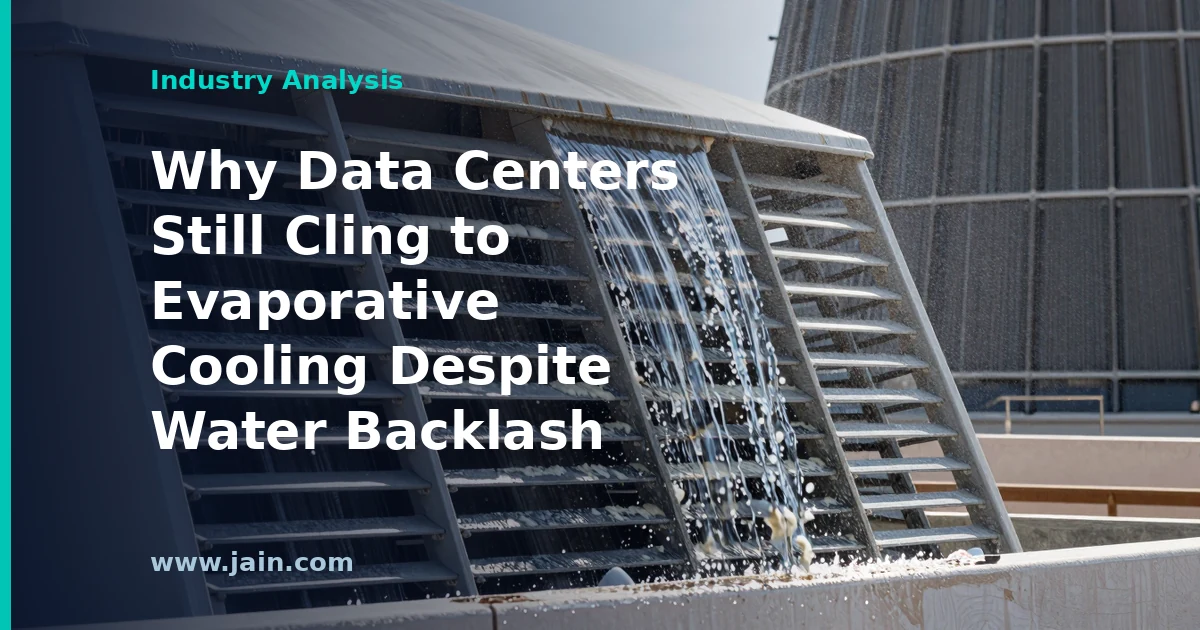
  • Why Data Centers Still Cling to Evaporative Cooling Despite Water Backlash

    Why Data Centers Still Cling to Evaporative Cooling Despite Water Backlash

    Data Center Knowledge published a report on June 18, 2026 examining why the data center industry continues to rely on evaporative cooling — a heat-rejection method that consumes large volumes of water — even as public and regulatory backlash over water use intensifies. The piece frames the industry’s position as hesitation rather than refusal: operators broadly acknowledge the water problem but have been slow to abandon a technology that remains cheaper and more energy-efficient than the alternatives.

    Executive Summary

    The report’s core subject is a tension the industry has lived with for years and that the AI build-out has sharpened: evaporative cooling rejects heat by evaporating water, which makes it highly energy-efficient but water-hungry, while the main alternatives — dry (air-cooled) systems and refrigerant-based chillers — save water at the cost of higher electricity consumption, larger equipment footprints, or both. In markets where power is the scarcest commodity a data center can buy, trading water savings for a bigger electrical load is not a simple upgrade; it is a genuine engineering and economic trade-off.

    That trade-off is why the headline speaks of hesitation. Operators face mounting pressure from drought-affected communities, local governments, and sustainability commitments to cut water use, and technologies such as closed-loop liquid cooling and hybrid systems are maturing. But retrofitting existing facilities is expensive, and for new builds the calculus depends heavily on local climate, water price, and power availability — variables that differ from one metro to the next. The result is an industry moving unevenly rather than uniformly, which is precisely the dynamic worth understanding for anyone siting capacity or evaluating operators’ sustainability claims.

    The Water-for-Energy Trade at the Heart of Cooling

    Every data center must move heat from chips to the outside world, and the physics offers no free option. Evaporative systems — cooling towers and their variants — exploit the fact that evaporating water absorbs enormous amounts of heat, which lets a facility reject heat with comparatively little electricity. Dry coolers and air-cooled chillers avoid consuming water but must push heat into the air mechanically, which takes more fan and compressor power, especially on hot days when the temperature difference working in the operator’s favor shrinks. In plain terms: saving water usually means burning more electricity, and in an era when grid connections are the binding constraint on data center growth, extra megawatts spent on cooling are megawatts not available for revenue-generating compute.

    This is the economic logic the Data Center Knowledge piece points at with its framing of industry hesitation. An operator that switches a large campus from evaporative to dry cooling is not just paying for new equipment; it is accepting a permanently higher power draw — degrading power usage effectiveness, the industry’s standard efficiency metric — and potentially reducing the sellable IT capacity of a power-constrained site. Where water is cheap and power is scarce, the incumbent technology keeps winning on spreadsheets even as it loses in public opinion.

    Why the Backlash Is Getting Harder to Price at Zero

    For most of the industry’s history, water was effectively an afterthought in site selection — abundant, inexpensive, and invisible to the public. That has changed. Data center water consumption has become a recurring flashpoint in drought-prone regions, a subject of local permitting fights, and a standard line of questioning for journalists and community groups evaluating new projects. Operators now routinely publish water usage effectiveness figures and, in some cases, commit to becoming “water positive” — replenishing more water than they consume.

    The practical consequence is that water carries a growing shadow price beyond the utility bill: longer permitting timelines, conditions attached to approvals, reputational exposure, and in the worst case the loss of a site altogether. The report’s premise — that the industry hesitates rather than transitions — suggests that many operators still judge those risks manageable relative to the hard costs of switching. Whether that judgment holds depends largely on how regulators and communities act next, which varies enormously by jurisdiction.

    The Alternatives Are Real, but Not Drop-In

    The transition options are well understood in engineering terms. Dry cooling eliminates onsite water evaporation at the cost of energy and space. Hybrid systems run dry most of the year and evaporate water only during peak heat, cutting consumption substantially without the full energy penalty. Direct-to-chip liquid cooling and immersion cooling — increasingly common in AI deployments because high-density chips demand them — move heat in closed loops that consume little or no water onsite, though the heat still has to be rejected somewhere, and that final stage can itself be wet or dry. None of these is a simple swap for an operating facility: cooling infrastructure is capital-intensive, deeply integrated with a building’s design, and typically replaced on decade-plus cycles.

    That replacement cycle is the quiet variable in the whole debate. The realistic path for the industry is less about retrofitting the installed base and more about what gets designed into the enormous wave of new construction now underway. If new AI-era facilities standardize on low-water designs where climate and economics allow, the fleet’s water profile shifts over years, not quarters. If they default to evaporative cooling because power constraints dominate, the backlash the report describes is likely to intensify.

    Winners, Losers, and the Siting Chessboard

    The cooling transition redistributes advantage. Cooler, water-rich regions gain appeal because they make both wet and dry cooling cheaper; hot, arid markets that boomed on cheap land and power face the sharpest version of the water-versus-energy dilemma. Vendors of hybrid and liquid cooling systems benefit from every tightening of water rules. Utilities and municipalities gain leverage, since water service is becoming a negotiated element of large deals rather than a formality. And operators that invested early in low-water designs acquire a permitting and public-relations asset that is difficult for laggards to replicate quickly. Buyers of colocation and cloud capacity should read cooling architecture as a proxy for siting risk: a facility’s water dependence is now part of its long-term cost and continuity profile.

    Background

    Cooling is one of the two great resource demands of data centers, alongside electricity: every watt a server consumes becomes heat that must be removed. For decades, evaporative cooling towers have been a workhorse of large-scale heat rejection across many industries because evaporating water is thermodynamically cheap. Data centers adopted the approach widely as the industry scaled through the cloud era, and it helped drive the sector’s headline efficiency gains. The AI construction boom that accelerated through the mid-2020s raised the stakes on both sides of the equation — far denser computing produces far more heat, while the communities hosting these facilities have grown increasingly vocal about local water and power impacts. Trade publication Data Center Knowledge, which published the report discussed here, has tracked this cooling debate as one of the defining infrastructure questions of the AI build-out.

    Source: Evaporative Cooling in Data Centers: Why the Industry Hesitates to Move On — Data Center Knowledge report, June 18, 2026, on the economics slowing the industry’s shift away from water-intensive cooling.

  • Copper Cold Plates and the 90% Cooling-Energy Claim: What Is Actually Shown

    Copper Cold Plates and the 90% Cooling-Energy Claim: What Is Actually Shown

    A report published May 19, 2026 by New Atlas describes a copper cold-plate cooling design that, its developers say, could slash data-center cooling energy use by as much as 90%. Cold plates are metal blocks that sit directly on hot chips and carry heat away in circulating liquid, and they are already the workhorse of liquid cooling for AI servers.

    The syndicated listing carries the headline claim but few technical specifics, so the central question for operators is what baseline the 90% figure is measured against and how far the design is from production racks.

    Executive Summary

    The announcement lands in the middle of the data-center industry’s most pressing operational problem: heat. As AI accelerators push individual chips past the point where moving air can cool them, operators are converting to direct liquid cooling, in which coolant is piped to a copper plate mounted on each processor. Cooling can consume a substantial share of a facility’s total power, so a design that meaningfully cuts that overhead would translate directly into more of a site’s grid connection being available for compute — the scarcest resource in the industry right now.

    That is why a 90% reduction claim deserves attention, and also why it deserves scrutiny. Laboratory cooling advances routinely post dramatic percentage improvements against narrow baselines — often legacy air cooling rather than the modern liquid systems they would actually compete with. The report as syndicated does not settle which comparison is being made, what workloads were tested, or what the path to manufacturing looks like.

    Our read: the direction of the work is squarely aligned with where the industry is going, but the headline number should be treated as a research claim pending the details — test conditions, baseline, and durability data — that determine whether it survives contact with a production rack.

    Why Cooling Energy Is the Prize

    Every watt a data center spends on cooling is a watt it cannot sell as compute. The industry measures this with PUE (power usage effectiveness), the ratio of total facility power to IT power; cooling is typically the largest contributor to the overhead above 1.0. With utilities quoting multi-year waits for large new grid connections, reducing cooling energy is one of the few ways an operator can add sellable capacity inside an existing power envelope.

    AI has sharpened the problem. Modern accelerators dissipate far more heat per chip than the servers most air-cooled facilities were designed around, and rack densities have climbed to the point where liquid cooling is no longer optional for leading-edge deployments. Any credible improvement in how efficiently heat moves from silicon to the outside world therefore has a direct, monetizable value — which is exactly why cooling claims also attract inflated framing.

    What a Cold Plate Does, and Where 90% Could Come From

    A cold plate is conceptually simple: a copper block with internal channels, clamped to a chip, with liquid flowing through it. Copper is used because it conducts heat exceptionally well. The engineering is in the internal geometry — how the channels are shaped determines how much heat the plate extracts per unit of coolant flow, and how much pumping energy is needed to push liquid through it.

    Large system-level energy savings in cooling generally come from one of a few places: extracting heat more effectively so pumps and fans work less; running coolant at warmer temperatures so facilities need little or no energy-hungry mechanical chilling; or exploiting phase change, where evaporating liquid absorbs far more heat than warming it does. The report does not specify which mechanisms this design relies on, and the answer matters — a plate that enables warm-water operation saves energy at the facility level, while one that merely improves plate-level performance saves much less in practice.

    The Baseline Question

    The most important unstated detail is what the 90% figure is measured against. Compared with a legacy air-cooled facility using mechanical chillers, a well-executed modern liquid-cooling system can already cut cooling energy dramatically — so a new design showing 90% savings against air cooling would be roughly matching the state of the art, not leapfrogging it. A 90% saving against current cold-plate systems would be a genuinely major result, but a far more demanding claim requiring correspondingly strong evidence.

    This is not a criticism unique to this announcement; it is the standard failure mode of cooling-technology communication. Percentage claims are only as meaningful as their denominators, and syndicated coverage frequently drops the denominator. Buyers evaluating any such technology should ask for the comparison system, the coolant supply temperature, the heat load tested, and the pumping power included in the accounting.

    From Lab Bench to Production Rack

    Even a validated design faces a long road to deployment. Cold plates must be manufactured at volume and consistent quality, qualified against leaks over multi-year lifetimes, integrated with server vendors’ thermal designs, and supported by the manifolds, coolant-distribution units, and facility water loops that make up a complete cooling chain. Hyperscale operators typically require extended reliability testing before new thermal hardware touches revenue-generating silicon.

    The realistic near-term significance of research like this is therefore directional: it signals continued headroom in cold-plate engineering at exactly the moment the market is standardizing on the technology. Incumbent cooling suppliers, server OEMs, and chipmakers all have active cold-plate programs, so novel designs tend to reach the market through licensing or acquisition rather than as standalone products. For operators, the practical takeaway is that cooling efficiency is still improving quickly enough to factor into facility designs with multi-decade lifetimes.

    Background

    Data-center cooling has moved through distinct eras: raised-floor air cooling with room-scale chillers, then contained hot/cold aisles and free-air economization, and now direct liquid cooling as AI chips exceed what air can handle. Cold plates — liquid-cooled copper blocks on each processor — have shifted in just a few years from a niche high-performance-computing technique to the default for new AI capacity, alongside alternatives such as immersion cooling, which submerges entire servers in dielectric fluid.

    Because cooling is the largest controllable overhead in facility power, and because grid capacity has become the binding constraint on data-center growth, cooling-efficiency research now attracts intense industry and investor attention — along with a steady stream of dramatic percentage claims that reward careful reading of their baselines.

    Source: Cooling copper plates could slash data center energy use by 90% — New Atlas, a May 19, 2026 report on a copper cold-plate design claimed to sharply reduce data-center cooling energy.