Tag: public-private partnership

  • CISA’s $2.45M ANCHOR-CI Gives AI Data Centers a Door, Not a Guaranteed Seat

    CISA’s $2.45M ANCHOR-CI Gives AI Data Centers a Door, Not a Guaranteed Seat

    TL;DR · 30-second read

    The Short Version

    The United States’ main cyber-defense agency has set up a new network of private meeting groups. In them, power companies, water utilities, telecom firms and other operators of essential services can trade warnings about hackers and physical threats with government officials.

    It costs about $2.45 million a year and has up to eight federal staff. That is a small team for the whole country.

    Why it matters: the giant computer warehouses that run artificial intelligence do not fit neatly into any existing group. They will have to organize themselves to get a voice.

    The U.S. Cybersecurity and Infrastructure Security Agency (CISA) has formed the Alliance of National Councils for Homeland Operational Resilience–Critical Infrastructure (ANCHOR-CI), Industrial Cyber reported on July 2, 2026. ANCHOR-CI is an advisory framework chartered by the Department of Homeland Security (DHS) that brings government and critical infrastructure owners and operators together to share sensitive threat information and develop security and resilience recommendations.

    The framework allows four kinds of councils: sector, cross-sector, industry and regional. It is exempt from the Federal Advisory Committee Act, so all eligible meetings are closed to the public. It will run for an initial two years at an estimated annual operating cost of $2.45 million, funded by CISA, covering up to eight full-time federal employees. DHS set out the council’s composition in a Federal Register notice.

    Executive Summary

    ANCHOR-CI restores a confidential, structured channel between the federal government and the companies that run the country’s power grids, networks, water systems and other essential services. Councils will review the threat environment, discuss vulnerabilities and send recommendations to DHS through CISA. DHS Secretary Markwayne Mullin called the framework “a game changer in how the public and private sectors collaborate and share information.”

    The structure matters more than the rhetoric. Sector councils follow federally designated sectors. A new category of industry councils, along with explicit room for “emerging industries and technologies not aligned with a specific critical infrastructure sector,” creates a possible route for operators that fall between sectors. AI data centers are the most prominent example. That route is permissive rather than guaranteed, and a lean federal budget means much of the organizing is likely to fall to industry itself.

    For power and data-center operators, ANCHOR-CI creates no new rules. It creates access: a closed room where threat intelligence and operational concerns can be shared candidly, and where the recommendations DHS receives get shaped.

    A Closed-Door Forum Returns

    The most consequential line in the announcement is the exemption from the Federal Advisory Committee Act. That 1972 law generally requires federal advisory bodies to meet in public and publish their records. Because ANCHOR-CI is exempt, its councils can meet privately, and every eligible meeting will. For operators, that is the point. A utility is unlikely to describe a weakness in its substation controls in a room that ends up in the public record. The same goes for a data-center operator describing an intrusion attempt on its building-management systems.

    The framework also fills a gap. In early 2025, DHS ended the Critical Infrastructure Partnership Advisory Council (CIPAC), the earlier exempt forum through which industry-led sector coordinating councils met government counterparts. ANCHOR-CI is described as building on that previous structure while widening who can take part. The practical test is how quickly the new rooms fill. Only councils with an approved charter and a balanced membership list may hold meetings, so the forum exists on paper before it exists in practice.

    Closed meetings carry a cost that deserves a fair hearing. The councils’ output is advice and recommendations delivered to DHS through CISA, and the public will not see the deliberations behind them. The trade-off is not new, since the prior forum worked the same way. It does, however, put weight on how CISA reports what it does with the advice it receives.

    Why AI Data Centers Get a Door, Not a Seat

    Sector councils are organized around federally designated sectors. Data centers have no designated sector of their own. These warehouse-scale buildings house the servers that train and run AI models. Their computing equipment falls under information technology and their fiber links under communications, and their fast-rising electricity demand makes them a major customer of the energy sector. This applies to a hyperscaler, one of the few cloud giants that build their own campuses. It also applies to a colocation provider, a landlord that rents space, power and cooling to many tenants. For both, security concerns can end up split across several tables.

    ANCHOR-CI adds two mechanisms that could change this. First, Critical Infrastructure Industry Councils may be created for industries that “manage or control critical systems and assets but do not fit neatly within existing sector structures.” Second, membership can extend to entities from emerging industries and technologies not aligned with a specific sector. Cross-sector councils, meanwhile, are designed for exactly the interdependencies where a large AI campus and the grid that feeds it share risk.

    The operative word is “may.” An industry council is permitted, not promised. Membership outside the defined categories is at the discretion of the council or the CISA director. No council can meet until its charter is approved and its membership balanced. Nothing in the announcement names data centers or AI computing as a priority. The framework opens a door for them. Getting a seat will depend on whether operators and their trade associations put forward a credible, balanced council.

    $2.45 Million and Eight Staff: Industry Carries the Load

    CISA estimates ANCHOR-CI’s annual operating cost at $2.45 million. That covers administrative expenses, contract support and up to eight full-time federal employees, and excludes extras such as invitational travel. A full-time Designated Federal Officer must approve agendas, attend every meeting and ensure minutes are produced. That is a lean federal footprint for a framework that allows four council types spanning every designated sector plus regional and cross-sector bodies.

    The likely consequence is that much of the work of convening councils, drafting recommendations and sustaining momentum will fall to members. Non-federal participants are unpaid, may be required to sign non-disclosure agreements, and serve for two-year charter terms. For a utility or data-center operator, joining means committing senior security and operations staff time without compensation. Large firms can absorb that cost more easily than rural cooperatives or small regional operators, which are the participants the regional councils are meant to bring in.

    What Changes for Power and Data-Center Operators

    For utilities, grid operators and data-center owners, ANCHOR-CI changes the venue rather than the rules. It adds no security requirement and no reporting mandate. What it changes is access: a confidential channel for sharing threat information with government, hearing what agencies are seeing, and shaping the recommendations DHS receives.

    Regional coordinating councils may matter most where AI buildout and grid strain meet locally. Many new data-center campuses are being built wherever power can be secured, including in rural areas. The framework explicitly aims to give rural infrastructure entities a voice in national resilience planning. Operators should watch whether a regional council actually forms in a data-center corridor during the initial two-year term.

    Background

    CISA is the federal agency responsible for coordinating the security and resilience of U.S. critical infrastructure: the systems whose disruption would harm national security, the economy or public safety. That infrastructure is divided into federally designated sectors, sixteen under long-standing federal policy, including energy, communications, information technology and water. For years, industry-led Sector Coordinating Councils and their government counterparts, Government Coordinating Councils, met through the Critical Infrastructure Partnership Advisory Council, a closed forum that DHS ended in early 2025.

    Data centers have become central to that landscape without fitting neatly into it. The rapid buildout of AI computing has turned them into some of the largest new electricity customers on the grid and core dependencies for nearly every other sector. Yet they have no designated sector of their own. ANCHOR-CI’s industry and cross-sector councils are the framework’s answer to infrastructure that sits between the lines.

    Sources

    Source: CISA launches ANCHOR-CI to strengthen critical infrastructure security and resilience, improve cyber coordination, Industrial Cyber’s report on the new DHS-chartered advisory council framework for critical infrastructure operators.

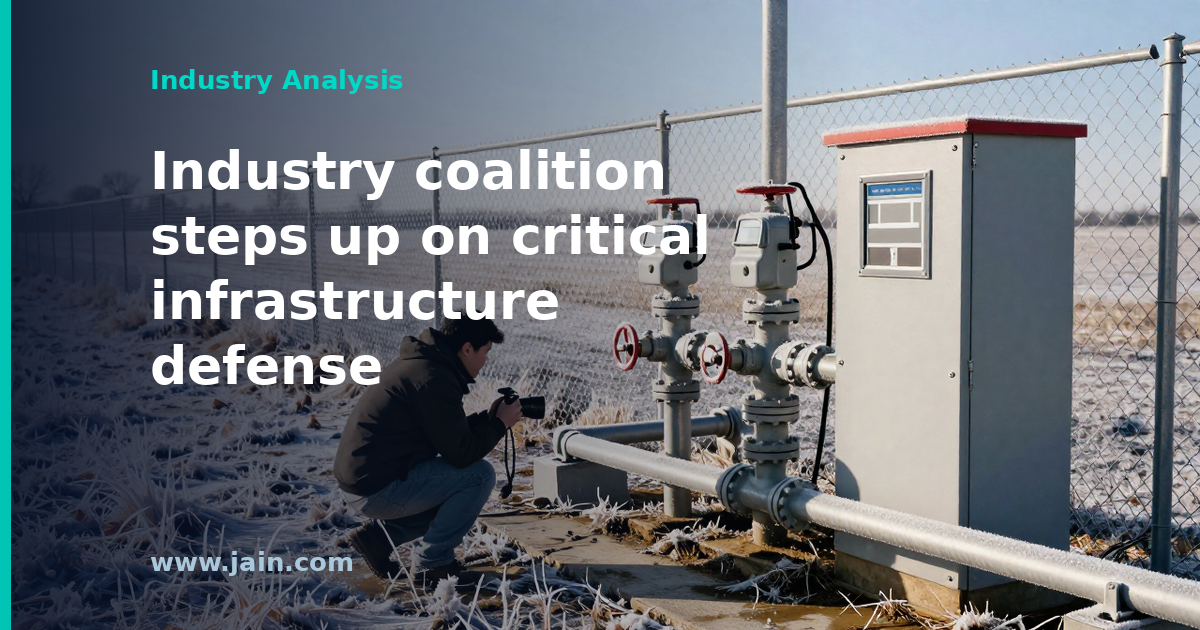
  • Industry Coalition Aims to Lead US Critical Infrastructure Cyber Defense

    Industry Coalition Aims to Lead US Critical Infrastructure Cyber Defense

    A newly formed cybersecurity industry coalition has said it intends to take a leading role in protecting United States critical infrastructure — the power grids, pipelines, water systems, telecommunications networks and data centers that other services depend on. The formation was reported on 11 May 2026 by Cybersecurity Dive.

    The coverage available to us is headline-level: it establishes that the coalition exists and states its ambition, but the membership roster, funding model, governance structure and operating timeline are not detailed in the material we can verify. This article analyzes the structural question the announcement raises — what an industry-led body can and cannot do for national cyber defense — and sets out the specifics that remain open.

    Executive Summary

    The announcement is best understood as a positioning move in a shifting division of labor. For roughly a decade, US critical infrastructure cyber defense has been organized around a federal hub — the Cybersecurity and Infrastructure Security Agency (CISA) — surrounded by sector-specific industry groups. Through 2025 and into 2026, CISA absorbed widely reported workforce reductions and proposed budget cuts, while the statutory liability protections that encouraged companies to share threat data with the government lapsed in late 2025 and became the subject of ongoing legislative debate. A vacuum, real or anticipated, invites someone to fill it.

    Why it matters for infrastructure operators: cyber defense at national scale is fundamentally a coordination problem, not a product problem. Attacks on one utility or carrier are previews of attacks on the next, and the value of any defensive body lies almost entirely in how fast and how completely warning travels between competitors. Whoever convenes that exchange sets the terms — what gets shared, with whom, under what legal cover, and at what price.

    What is not yet established: the coalition’s claim to leadership is, at this stage, a stated intention rather than a demonstrated capability. Nothing in the available reporting confirms who has joined, what the group will fund, or how it will relate to the federal agencies and existing sector bodies already occupying this space. Those are the tests worth applying, and they are answerable within months.

    Why Industry Is Volunteering for a Job It Once Resisted

    For most of the past decade, the private sector’s posture toward critical infrastructure cybersecurity policy was defensive: resist mandates, negotiate reporting rules, worry aloud about liability. A coalition announcing that it intends to lead is a notable inversion. The plainest explanation is not altruism but exposure. Roughly the great majority of US critical infrastructure is privately owned and operated, which means the operators absorb the losses — outage costs, ransom payments, regulatory penalties, insurance repricing — regardless of who holds the coordinating role in Washington.

    If federal coordinating capacity contracts, the risk does not disperse; it lands on balance sheets. Under those conditions, funding a shared defensive apparatus becomes a rational cost, in the same way that competing airlines jointly fund safety data programs because a crash at one carrier damages all of them. The economics here are the economics of a public good that private parties have decided to buy for themselves.

    The counter-reading deserves equal weight. Industry coalitions are also lobbying vehicles, and a group that positions itself as the operational leader of critical infrastructure defense acquires substantial influence over the regulation of its own members — including which standards become de facto requirements and which incidents are deemed reportable. Neither reading is disprovable from a formation announcement. Both should be held open until the governance documents appear.

    What a Coalition Can Do — and What Only Governments Can

    A well-run private body can do a great deal. It can pool threat intelligence faster than any agency clears it; it can run joint exercises, publish detection signatures, fund shared tooling for smaller utilities that cannot afford their own security teams, and set procurement standards that vendors must meet to sell into the sector. These are genuine capabilities, and where they already exist — in the sector-based Information Sharing and Analysis Centers, or ISACs, and in cross-vendor groups like the Cyber Threat Alliance — they have measurable value.

    What no coalition can do is exercise state power. It cannot compel a reluctant operator to patch, cannot seize infrastructure used by an adversary, cannot see foreign signals intelligence, cannot indict anyone, and cannot grant legal immunity to a company that hands over customer-adjacent telemetry. That last point is not a technicality. The 2015 information-sharing framework worked largely because it told general counsels that sharing indicators would not create antitrust or privacy liability. With that protection lapsed and its restoration unresolved, a private coalition asking members to share aggressively is asking them to accept legal risk that only Congress can remove.

    The realistic model, then, is complementary rather than substitutive. Industry can carry operational tempo — the fast, technical, day-to-day work of spotting and blocking. Government retains the coercive and intelligence functions. The failure mode to watch for is a coalition that markets itself as a replacement for federal capacity, because that framing tends to reduce political pressure to fund the functions industry structurally cannot perform.

    Winners, Losers, and Who Pays for Coordination

    If the coalition matures, the clearest beneficiaries are large operators with mature security programs. They already generate high-quality telemetry, they can absorb membership costs, and they gain influence over standards they were going to meet anyway. Hyperscale cloud providers and major data center and network operators sit in a particularly strong position: they see enormous volumes of attack traffic, which makes them the most valuable contributors and therefore the most powerful voices at the table.

    The parties at risk of being left out are the ones the country most needs covered — small municipal water systems, rural electric cooperatives, regional hospitals, mid-sized carriers. These organizations often run legacy operational technology, employ few or no dedicated security staff, and cannot pay meaningful dues. Any coalition serious about critical infrastructure rather than large enterprise defense has to answer how those operators are subsidized. A pricing model that tracks ability to pay is a strong signal of seriousness; a flat corporate membership fee is a signal that the group’s practical scope is narrower than its name.

    There is also a vendor question worth watching without prejudging it. Security suppliers have a legitimate operational role in any such body — they hold much of the visibility — and also a commercial interest in defining the standards their products satisfy. Governance that separates threat-sharing operations from standards-setting, with disclosed member lists and recusal rules, is the ordinary remedy. Its presence or absence will be visible in the founding documents.

    The Evidence Test to Apply Over the Next Two Quarters

    Announcements of this kind are cheap; sustained coordination is expensive. Four observable markers separate the two. First, a published member list with named operators from more than one sector — a coalition drawn from a single industry is a trade association with a broader title. Second, a funded budget and paid technical staff, rather than a volunteer steering committee. Third, a concrete first deliverable with a date: a joint exercise, a shared detection feed, a subsidized tooling program for small utilities.

    Fourth, and most diagnostic, an explicit statement of how the group relates to CISA, to the sector coordinating councils, and to the existing ISACs. Critical infrastructure defense is not an empty field; it is a crowded one with a decade of institutional plumbing. A new body that names its interfaces is doing engineering. A new body that does not is, for now, doing communications.

    None of this is a reason for skepticism about the underlying need. The threat picture that plausibly motivated the coalition — persistent adversary pre-positioning inside operational technology networks, ransomware against hospitals and municipalities, the exposure of long software supply chains — is well documented and does not depend on this announcement being substantive. The question is narrower and fairer: whether this particular vehicle is built to carry that weight.

    Background

    US critical infrastructure cyber defense has been organized since the mid-2010s around a public-private model: a federal coordinating hub, formalized as CISA in 2018, working alongside sector coordinating councils and the Information Sharing and Analysis Centers that circulate threat data within industries. The Cybersecurity Information Sharing Act of 2015 supplied the legal foundation, giving companies liability protection for passing indicators of compromise to the government and to each other. In 2021, CISA added the Joint Cyber Defense Collaborative to bring major technology and security firms into planning alongside federal agencies.

    That arrangement has come under strain. CISA sustained widely reported staffing reductions and proposed budget cuts through 2025 and into 2026, while the 2015 law’s information-sharing protections lapsed in late 2025 with restoration still contested in Congress. At the same time, publicly documented threats to operational technology networks — the industrial control systems that run grids, pipelines and water treatment — have grown more persistent. Roughly the great majority of the affected assets are privately held, meaning the operators carry the financial consequences regardless of how federal capacity evolves. That combination is the setting into which this coalition has announced itself.

    Source: New cybersecurity industry coalition aims to lead US critical infrastructure protection — Cybersecurity Dive, 11 May 2026, reporting the formation of an industry group intending to take a leading role in US critical infrastructure cyber defense.