
TL;DR · 30-second read
The Short Version
Two companies behind the cables inside the giant computer buildings that run artificial intelligence have signed a ten-year deal. Molex, a maker of connectors, will supply its customers with glass-fiber cable made by Prysmian, one of the world’s biggest cable makers.
Prysmian says it will spend $1.43 billion to more than double how much fiber it makes in the United States, adding about 600 American jobs. The money reaches all the way back to the first step: making the glass rods that fiber strands are pulled from.
Artificial intelligence runs on light moving through these hair-thin threads, and big buyers now want supply promised a decade ahead.
Molex and Prysmian have entered a 10-year supply agreement to expand fiber connectivity for AI data centers, Lightwave reported on July 21, 2026. Under the arrangement, hyperscalers (the largest cloud and internet operators) and data center builders can secure Prysmian fiber cable supply through Molex.
Alongside the agreement, Prysmian will invest $1.43 billion to extend fiber cable production at U.S. plants, including the glass preform stage, which it says will more than double its domestic fiber capacity. The company expects to create 1,000 jobs worldwide, 600 of them at U.S. manufacturing sites.
Executive Summary
The deal pairs a connectivity specialist with one of the world’s largest cable manufacturers for a decade. Molex CEO Joe Nelligan called it “a strategic expansion in the U.S., bringing increased capacity to support the growing demand for data center solutions.” Prysmian CEO Massimo Battaini said the agreement and capacity investments “strengthen our leadership in data centers.”
What makes the announcement more than a distribution tie-up is where the money goes. Prysmian’s investment reaches upstream to preform, the glass that every strand of fiber is drawn from. That is the step that determines whether new cable capacity is real or merely a reshuffling of existing output, and it is why a ten-year term makes sense for both sides.
For data center buyers, the agreement adds another source of fiber connectivity in a market where Corning has already signed a string of large partnerships. For Prysmian, it marks a push from grid, long-haul and submarine cable into the fiber that runs inside data centers, a segment it forecasts will add $11 billion of value through 2035.
Why AI Fiber Capacity Starts at the Glass Preform
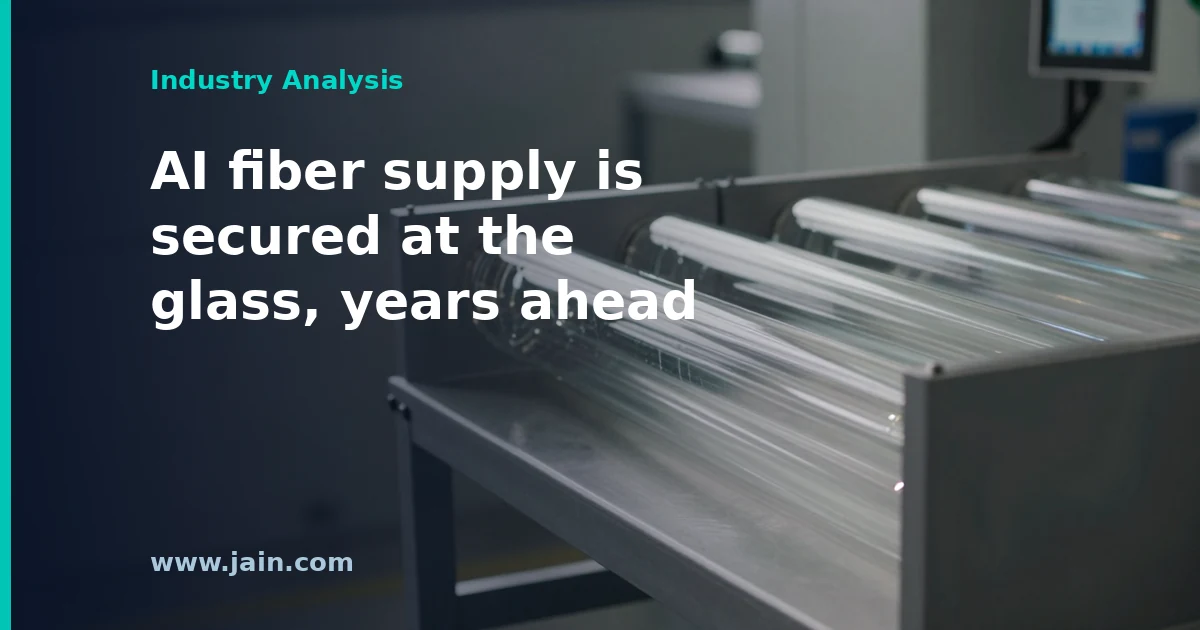
Optical fiber begins as a preform: a thick rod of ultra-pure glass that is heated and drawn into strands thinner than a human hair, which are then bundled and jacketed into cable. The sequence matters. A manufacturer can add cabling lines, but unless it buys glass from someone else, the amount of fiber it can ship is capped by how much preform it can make. So the most telling detail in this announcement is not the $1.43 billion figure itself but where it is spent: extending U.S. production “including the glass preform stage,” with the stated result of more than doubling Prysmian’s domestic fiber capacity.
Doubling fiber output without more preform would simply move the constraint one step upstream. Glass-making capacity is a long-lived asset, and a commitment of this size is easier to underwrite against a long contract than against spot orders. The ten-year term lines up with that logic, and with Prysmian’s own planning horizon, which runs to 2035.
The people affected are those who buy connectivity for AI clusters, where large numbers of processors and switches are linked by fiber. Customers who source through Molex gain access to supply backed by new glass capacity rather than a reallocation of existing cable. The broader lesson for buyers is practical: a fiber or connectivity supply promise is only as firm as the preform behind it, and where a supplier’s glass comes from is now a fair question in any procurement discussion.
Molex Turns Itself Into a Route to Fiber Supply
Molex is best known for connectors, not glass. The agreement repositions it as a channel through which hyperscalers can lock in fiber cable, with both companies stressing “supply chain optionality and resilience through diversified sourcing” and improved lead-time reliability. The company describes the deal as one pillar of a broader global strategy to scale fiber cable supply, which suggests Molex intends to add further sources rather than rely on one.
The more interesting fit is with Molex’s work on co-packaged optics (CPO), which places optical connections directly beside a processor or switch chip instead of in pluggable modules at the edge of the equipment. That shortens the electrical path, which matters as AI systems push more data between chips. Molex recently completed its acquisition of Teramount, a fiber-to-chip connectivity provider, and has expanded its CPO interconnect toolkit. A vendor that controls both the connection at the chip and a long-term supply of the cable leading to it can offer customers a more complete package than either piece alone.
Corning Has Already Drawn the Map
Molex and Prysmian are following a pattern rather than inventing one. Corning has secured multi-billion-dollar partnerships across nearly every layer of the AI connectivity chain: a service provider (Lumen), cloud and data center operators (Amazon and Meta), GPU maker NVIDIA, chip designer Broadcom and connector maker US Conec. The common thread is fiber producers tying their manufacturing to the companies that design, buy and install AI infrastructure, years in advance.
For buyers, a second vertically linked supply chain is useful in its own right: it provides an alternative, and with it some negotiating leverage, when demand is outrunning manufacturing. For Prysmian, the agreement extends a business built on power grid cable, long-haul digital links and submarine telecom into the “inside” data center market, which it expects to grow with modernization cycles for performance and energy efficiency, AI-driven architecture changes and higher fiber density.
What the Numbers Do and Do Not Establish
Several figures in the announcement are firm commitments: a ten-year agreement, a $1.43 billion investment, a doubling-plus of U.S. fiber capacity, and 1,000 expected jobs, 600 of them in the U.S. Others are forecasts. Prysmian values the data center segment at $11 billion on an incremental basis through 2035 compared with 2025, including $1 billion of yearly revenue from 2031. That is a projection of market opportunity, not contracted business.
The capacity claim is also relative. “More than double” is measured against a current baseline that has not been quantified publicly, so the absolute amount of new fiber, and how much of it is earmarked for Molex customers, cannot yet be calculated. That does not weaken the direction of the deal; it limits how precisely anyone can size it.
Background
Prysmian is one of the world’s largest cable makers, operating 112 manufacturing facilities in 50 countries, including more than 20 plants in North America. Its U.S. footprint includes optical fiber plants in Claremont and Lexington and a submarine cable facility under development in Somerset, Massachusetts. Historically its data center business has centered on energy and long-distance digital connections, such as grid cables and long-haul fiber, rather than cabling inside the building.
Molex is a connectivity manufacturer led by CEO Joe Nelligan. It has been building out co-packaged optics interconnect products and recently completed its acquisition of fiber-to-chip specialist Teramount. Demand for fiber inside data centers is being driven by modernization cycles aimed at performance and energy efficiency, AI-driven changes in system architecture and rising fiber density, the same forces behind Corning’s recent partnerships with cloud providers, chipmakers and connector firms. Source: Molex and Prysmian enter fiber AI data center supply pact, Lightwave’s report on the companies’ 10-year fiber supply agreement and Prysmian’s $1.43 billion U.S. capacity expansion.Sources