
TL;DR · 30-second read
The Short Version
A company called PowerPlay AI wants to build a very large artificial intelligence computing center outside Abilene, Texas. It plans to make its own electricity on site from natural gas instead of waiting to plug into the public power grid.
The target is 400 megawatts by 2028. That is roughly the electricity a mid-sized American city uses.
Why it matters: new projects can wait many years for a grid connection. Building your own power skips that line. The partner, the money and the customers have not been named yet.
PowerPlay AI announced on July 20, 2026, in a release distributed via PR Newswire, an initial 400-megawatt “behind-the-meter” AI data center development in the greater Abilene area of West Texas. Behind-the-meter means the campus would be powered by generation on or next to the site rather than drawing its main supply from the public grid. The project is a joint venture with a Nasdaq-listed “neocloud,” a specialist cloud provider that rents out AI computing capacity. The partner is not named.
According to the release, the joint venture has completed site feasibility work, infrastructure assessment and land acquisition. It is now progressing natural gas service agreements and moving toward selecting a preferred independent power producer after a request-for-proposal process. The target is to deliver the first 400 megawatts of behind-the-meter power in 2028.
Executive Summary
The announcement is a power-first data center plan. PowerPlay AI describes itself as a company that turns raw land into “power-secured, shovel-ready sites” for hyperscalers (the largest cloud companies) and data center operators. Here it is pairing that model with a publicly traded neocloud. The site is unincorporated, which the company says frees it from zoning restrictions. It is served by installed natural gas and adjacent fiber, and it sits near several gigawatt-scale AI campuses that are operating, under construction or proposed.
It matters because of the rationale PowerPlay gives. Luke Velterop of PowerPlay AI said interconnection queues, the waiting lists to connect new large loads and generators to the grid, “now stretch into the 2030s.” A 2028 target from on-site gas generation is a direct bid to beat that timeline. The plan also echoes federal policy that, in the company’s words, calls on industry to “build, bring or buy” its own energy.
The release discloses a scale, a location, a fuel and a date. It does not disclose the partner, the financing, a customer or a signed power contract. It describes an early but real development rather than a campus under construction.
Why Behind-the-Meter Is the Whole Strategy
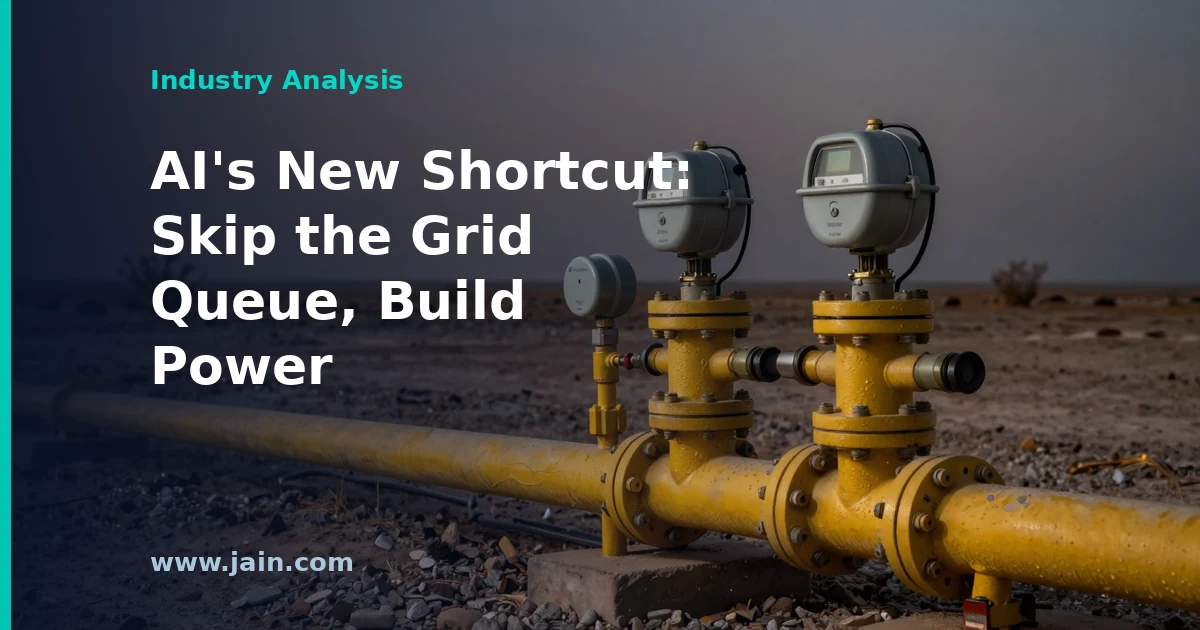
The conventional route for a large data center is to request a grid connection and wait. The utility and the grid operator must study whether the transmission system can carry the new load, and upgrades can take years. PowerPlay’s own framing puts that wait into the 2030s. Its answer is to change the order of operations. First it secures a site with a gas pipeline already in the ground; the release includes a photo captioned as a March 2026 pipeline installation. Then it contracts an independent power producer, a company that builds and runs power plants and sells the output, to generate electricity at the campus. On that sequence, the project targets 400 megawatts in 2028, years ahead of the queue timeline the company cites.
That is the mechanism behind the headline. The binding constraint on this project is no longer a place in line with the utility. It is a gas supply agreement, a generation contract and the equipment to build a plant. Those are commercial negotiations a developer can push forward, rather than an administrative queue it cannot. The groups affected are neoclouds that need capacity quickly to serve customers renting AI chips, and landowners with pipeline access, who now hold a scarce asset. Utilities and grid operators also lose some of their role as the gatekeeper for where large AI loads can appear.
This is one project, and it does not prove that the grid is being abandoned. It does show clearly what a developer now treats as the scarce input. PowerPlay has spent its effort so far on land, gas and a power producer, not on tenants.
The Queue Doesn’t Disappear, It Moves
Bypassing the grid swaps one set of risks for another. The release says the joint venture is “progressing” gas service agreements and “moving toward” choosing a power producer. Neither the fuel contract nor the generation partner is final. Gas-fired generation equipment has its own procurement lead times. A plant of this size also needs air permits before it can run. The 2028 date depends on all of these steps landing on schedule.
Reliability is the other trade-off. A grid-connected campus can fall back on the wider system when a generator trips. An islanded campus has to build in spare generating capacity and redundancy to reach the uptime that AI customers expect. That usually means the plant must be larger than the computing load, or the usable computing capacity will be smaller than the headline power figure. The release gives 400 megawatts of power. It does not say how much of that becomes rentable computing capacity. Fuel cost is a third exposure: an on-site gas plant ties the campus’s operating costs to natural gas prices in a way that a blended grid tariff partly smooths out.
A Land-and-Power Developer Meets a Neocloud
The joint venture divides the work in a sensible way. PowerPlay’s stated business is assembling land and securing power. The neocloud partner, which the release credits with “world-class AI infrastructure expertise,” presumably supplies the computing side and the customer relationships. Neoclouds compete with the largest cloud providers mainly on how quickly they can bring GPU capacity online. A partner that brings its own power addresses the problem that most often delays them.
The release also says the project is positioned for “engagement with leading AI infrastructure operators and hyperscalers.” That suggests the campus is still looking for end users rather than delivering for a signed tenant. That is normal at this stage, but it is the difference between a power-secured site and a financed data center. Readers weighing the announcement should treat the 400 megawatts as a development target backed by land and gas access, not as contracted capacity.
Why Abilene, and Why Now
Location is a central part of the pitch. The company says the site is near several gigawatt-scale AI campuses, which gives it an existing ecosystem of contractors, fiber routes and workers experienced in large builds. An unincorporated site avoids municipal zoning review, one fewer approval on the critical path. Being part of a cluster cuts both ways, though. Nearby projects compete for the same construction labor, generation equipment and pipeline capacity. The first advantage PowerPlay cites, speed, depends on securing those inputs ahead of its neighbors.
Background
PowerPlay AI, legally PowerPlay AI Pty Ltd according to the release’s disclaimer, describes itself as a developer that transforms raw land into power-secured, shovel-ready sites for enterprises, hyperscalers and data center operators, “taking AI infrastructure from ground to gigawatt.” Its announcement was issued from New York.
The Abilene area of West Texas has become one of the country’s most closely watched AI data center corridors. It is home to the Crusoe-developed campus associated with OpenAI and Oracle’s Stargate project, along with other large campuses built or proposed nearby. Texas combines abundant natural gas, available land and its own grid operator, ERCOT. Developers are pairing these more and more with on-site generation as demand for AI computing runs ahead of what the grid can connect quickly. Source: PowerPlay AI Announces 400 MW Behind-the-Meter AI Data Center Development in Greater Abilene with Nasdaq-Listed Neocloud Joint Venture Partner (PR Newswire, July 20, 2026) — PowerPlay AI’s announcement of a gas-powered, behind-the-meter AI campus joint venture near Abilene, Texas, targeting 400 MW in 2028.Sources