TL;DR · 30-second read
The Short Version
- The artificial intelligence company CoreWeave is building a $6 billion computing campus in Lancaster County, Pennsylvania — farm country about halfway between Philadelphia and Harrisburg.
- What buyers are really chasing is not the dirt but the electricity. Land that already has a big power hookup has sold for more than $8 million an acre in some markets.
- Farmland nearby drew more than 50 purchase offers in a single year. Some owners are selling; others have legally locked their land to farming only.
- Why care? These campuses use enough electricity to run a small city, and states are now arguing over who pays for the wires.
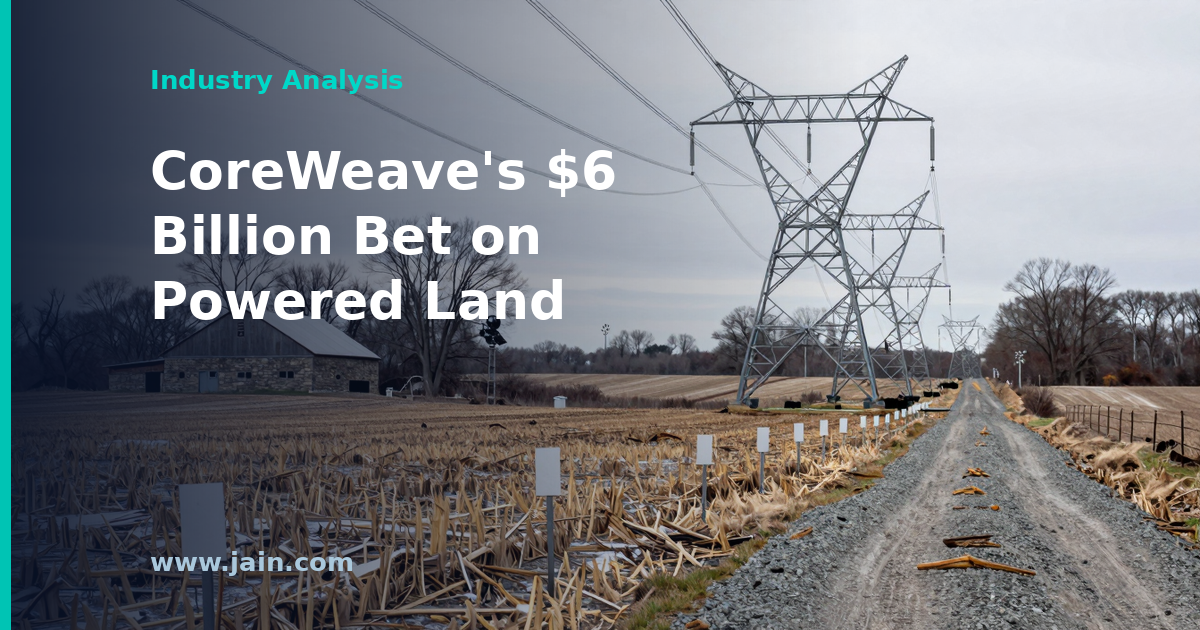
StartupHub.ai reported, drawing on CNBC’s segment Inside The Real Estate Rush Behind AI, that CoreWeave is building a $6 billion data center campus in Lancaster County, Pennsylvania, less than 20 miles from Mount Joy farmland that attracted more than 50 purchase offers in a single year. Lancaster’s draw, according to that account, is a reliable electrical grid, state incentives and a Mid-Atlantic position within reach of several major metropolitan areas.
The project lands in the middle of a national scramble for what the industry calls powered land — sites that already have, or can plausibly obtain, large-scale grid connections. Investors spent nearly $6 billion on U.S. land earmarked for future data centers in the first half of 2026, up 79% year over year and roughly 27% of all spending on development sites. The United States already hosts more than 4,700 data centers.
Executive Summary
For CoreWeave, the significance of Lancaster is not the headline number but the change in posture it implies. The company grew by renting: it filled other operators’ buildings with graphics processing units — the specialized chips that train and run artificial intelligence models — and sold that capacity by the hour. A campus of its own, at $6 billion of committed capital, moves it a long way toward being the landlord rather than the tenant.
That shift concentrates a set of risks the company previously paid someone else to carry. Whoever owns the site owns the interconnection queue — the waiting list utilities maintain for connecting large new loads to the grid — along with the substation costs, the zoning fight, the water permit and the timing risk if energization slips. It also captures the margin that a third-party operator would otherwise take, and gains control over how quickly the next building goes up.
The wider market context is unforgiving on both counts. Amazon, Alphabet, Microsoft and Meta spent over $167 billion combined in the second quarter of 2026, up 79% year over year, which sets the pace CoreWeave has to match to stay relevant. At the same time, Pennsylvania Governor Josh Shapiro has said that of more than 100 data center proposals in the state, only five hold permits to operate — a reminder that announced capital and delivered capacity are separated by a queue that is currently very long.
From Renting Racks to Owning the Substation
The economics of a specialist artificial intelligence cloud have always been awkward. Chips depreciate on a schedule measured in a handful of years; buildings and electrical infrastructure amortize over decades. A company that leases space pays a spread to the landlord and inherits the landlord’s delivery schedule, which in a market this tight is the binding constraint on growth. Owning the campus removes the spread and, more importantly, removes the queue-jumping problem: you are no longer waiting for someone else to decide which tenant gets the next 50 megawatts.
The trade is that development risk stops being a line item in someone else’s business. Site work, transformer procurement, interconnection studies and permitting all move onto the builder’s balance sheet, and none of them are hourly-billable until the first customer racks go live. The release notes that near-term power shortages already add a year simply to assess distribution to a site — a delay that costs nothing to a tenant and a great deal to an owner carrying $6 billion of committed spend.
Scale gives some perspective on the commitment. The campus’s stated cost is roughly equal to what every investor in the United States combined spent buying data center land in the first half of 2026 — different categories of spending, since one figure is construction and the other is raw acreage, but a useful marker of how much a single project now weighs against an entire national land market.
Powered Land Is the Asset; Dirt Is the Wrapper
The premium in this market attaches to electricity, not acreage. Sites with large power access have exceeded $8 million per acre in Northern Virginia and the Northeast, and the industry needs an estimated 40,000 acres of such land to meet growth through 2030. That is the whole thesis in one sentence: land is abundant, grid capacity is not, and the price gap between the two is where developers are making their money.
It is also where the risk sits. Speculators frequently buy before they know whether permits or power will arrive, and the release is blunt about the consequence — if power does not materialize, the land stays illiquid. Boise Valley values have reached 15 times pre-pandemic levels on the strength of Micron’s two fabrication plants and a large Meta campus 10 to 15 miles away, and brokers there expect much of the remaining farmland to convert to industrial use within five to seven years. Those expectations are underwritten by an assumption about utility delivery, not by signed interconnection agreements.
The speculative posture is visible in how developers are building. Idaho developer Mike Adler, who controls 1,000 acres and $1 billion of real estate and is expanding from 1.9 million to 4.6 million square feet, says 62% of his current Boise Valley projects are spec builds — constructed before any tenant signs a lease. That is a rational bet when demand outruns supply. It is also the classic structure through which a slowdown in one sector transmits into a regional property market.
The Rules Are Being Written While the Concrete Cures
Two governors have moved in the same direction from different angles. Shapiro signed an August executive order intended to block cost pass-throughs to residents and limit water use, alongside his observation that only five of more than 100 Pennsylvania proposals hold operating permits. In Texas, Governor Greg Abbott has directed regulators to require data centers to fully fund their own electric infrastructure. Both are answers to the same political question: when a single campus draws load comparable to a city, who pays for the wires?
The direction of travel matters for anyone underwriting these projects. U.S. electricity consumption is projected to rise nearly 2% annually through 2030 — more than twice the rate of the prior decade — and the incremental demand is concentrated in exactly the large-load interconnections regulators are now scrutinizing. A rule that shifts substation and transmission costs onto the developer does not stop projects; it raises the effective cost per megawatt and rewards operators with the balance sheet to absorb it. That favors the largest builders and squeezes thinly capitalized speculators holding options on unpowered ground.
What the Boom Looks Like at Ground Level
Around Mount Joy, the conflict is a zoning question with a long horizon. Bobby Thompson and Michelle Kennedy, who have farmed there for decades, placed an easement on their land — a permanent legal restriction limiting it to farming — while neighbors have applied to rezone for an industrial park. Both are legitimate uses of private property rights, and the outcome will be settled parcel by parcel rather than by any single decision.
The downstream economics are real and already measurable. Air Filter Superstore, which supplies the kind of filtration these facilities consume in volume, grew from under $10 million in annual revenue before 2020 to more than triple that, expanding from 7,000 square feet to over 30,000 after investing about $1 million. Multiply that across electrical contractors, mechanical suppliers and site trades and you have the local case for approval. Micron’s plan to invest $250 billion in the United States through 2035 suggests the industrial demand behind those suppliers is not a one-year phenomenon.
The caution is that supplier expansion, spec construction and land repricing are all leveraged to the same assumption — that hyperscaler capital expenditure keeps compounding. A 79% year-over-year increase from the four largest spenders is a powerful signal, but it is a growth rate, not a floor. Communities weighing tax base against farmland, and vendors sizing warehouses against forecast orders, are implicitly taking a view on how long that rate holds.
Background
CoreWeave began as a cryptocurrency mining operation before repurposing its expertise in dense, power-hungry computing into a cloud business built on graphics processing units. It listed publicly in 2025 and scaled principally as a tenant, installing its hardware in facilities owned by third-party data center operators — an asset-light approach that let it grow quickly without carrying construction risk.
The market it operates in has been reshaped by the electricity constraint. As artificial intelligence workloads pushed rack power densities far beyond traditional cloud computing, the scarce input stopped being land or even chips and became grid interconnection. U.S. electricity consumption is projected to rise nearly 2% annually through 2030, more than twice the previous decade’s rate, and that demand is concentrating in a handful of regions with available capacity — pulling multibillion-dollar industrial projects into farm counties in Pennsylvania, Idaho and elsewhere, and prompting state governments to rewrite the rules on who pays for the grid upgrades they require. Source: CoreWeave $6 billion Lancaster data center — StartupHub.ai’s account of the Lancaster campus and the national competition for powered land, drawing on CNBC’s segment Inside The Real Estate Rush Behind AI.Sources